Executive context: why this matters to hedge funds
Disney's ESPN business sits at the fault line of a multi-year unwind: the U.S. pay TV bundle continues to shrink, while live sports remains the last must-have appointment category with pricing power. The investment debate is not whether sports is valuable; it is whether ESPN can migrate its monetization model from high-margin affiliate fees and bundled distribution to a direct-to-consumer model without destroying economics in the transition.
In 2025, Disney moved from strategic intent to product in market with a standalone ESPN DTC service branded simply as ESPN, offering an Unlimited plan priced at $29.99 per month and a Select plan at $11.99 per month, with multiple Disney bundling options. The launch arrived alongside rights and distribution moves that are directly relevant to adoption and willingness-to-pay, including positioning the product as an all-in gateway to ESPN's linear networks via streaming and a headline partnership with the NFL involving ESPN acquiring NFL media assets in exchange for a 10 percent equity stake in ESPN (subject to approvals).
For public markets, ESPN DTC is not just another streamer. It is a potential reset of Disney's risk profile across earnings durability, margin structure, capital allocation, and competitive dynamics. Hedge funds need fast, decision-grade signal: who actually subscribes, at what price, and what they cancel to fund it. That is exactly what the Ditto report provides.
This case study uses a single Ditto market research study as the core example: "Disney / ESPN DTC: who will subscribe, what will they cancel, and what bundle wins?"
Original Ditto research study: https://app.askditto.io/organization/studies/shared/fA1p1S9SGtnKsEMBeKmcV5qLfLtH0p3oYJByav6tHvc
Key point for analysts: the report was generated in about 30 minutes using synthetic personas (not human respondents), and the researcher can ask follow-up questions directly to any persona in the panel to go deeper on edge cases, segmentation, and scenario testing.
Background: the ESPN DTC deal in business terms
What Disney launched, and why the Street cares
Disney announced that its new direct-to-consumer ESPN offering would be singularly branded ESPN and would provide, for the first time, direct access to ESPN's linear networks outside the traditional cable bundle. The disclosed structure was intentionally simple: an Unlimited tier at $29.99 per month and a Select tier at $11.99 per month, plus Disney+ and Hulu bundling options, including a promotional offer at launch.
From Disney's perspective, this is a defensive-offensive hybrid: defensively, it preserves ESPN relevance as households cord-cut, capturing sports fans who never subscribed to traditional television. Offensively, it builds a direct relationship, data layer, and app engagement flywheel that creates a more valuable advertising and commerce platform over time.
From an equity standpoint, the killer question is whether ESPN DTC is incremental or cannibalistic. If ESPN DTC drives net-new subscription dollars, Disney's long-term TAM and valuation expand. If ESPN DTC mostly displaces existing spend, headline subscriber numbers can look good while profit contribution disappoints.
The NFL partnership: a content anchor move with direct DTC implications
A crucial part of the ESPN DTC narrative is content sufficiency. Sports is not monolithic; consumers subscribe for specific leagues, specific teams, and often specific moments. Disney's partnership with the NFL is a direct response to the need for anchor content to make DTC sticky.
In August 2025, ESPN announced it would acquire NFL Network and other NFL media assets in exchange for a 10 percent equity stake in ESPN, subject to approvals. The ESPN press release explicitly frames the deal as strengthening NFL content distribution and integrating assets into ESPN DTC. Analysts have noted the NFL stake could be worth $2 to $3 billion and that the deal would bolster ESPN's streaming service.
Where banks have landed (and why Morgan Stanley's question mattered)
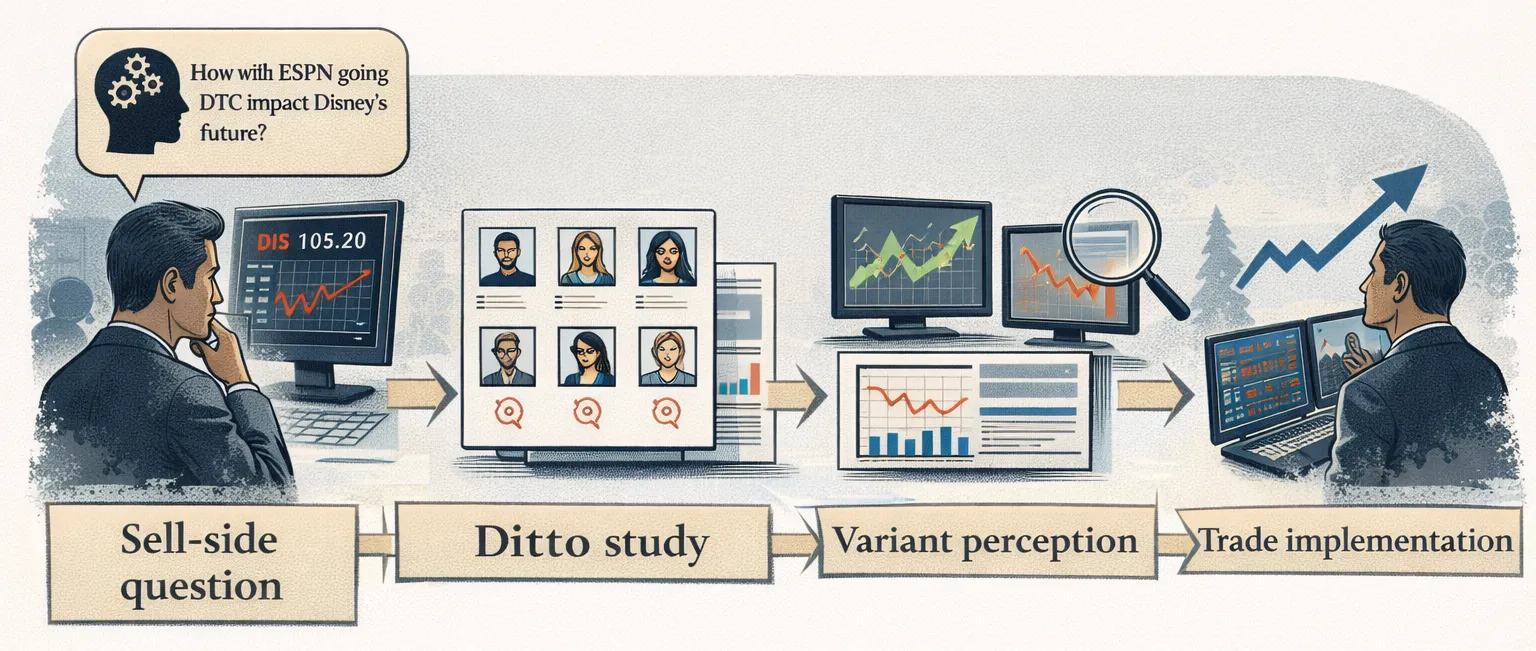
Sell-side reaction has not been uniform, but the contours are consistent. The bull case frames ESPN DTC as upside optionality, while execution scrutiny focuses on cannibalization risk and price sensitivity. The most investable articulation of the uncertainty came from Morgan Stanley's Ben Swinburne, who asked whether adoption, engagement, and package preferences meaningfully change the long-term outlook now that the product is in market.
Ditto compresses the time between that question and actionable consumer signal from weeks to minutes.
Why Ditto is relevant for hedge fund market research
Ditto provides synthetic market research using population-true synthetic personas that mirror real populations by combining official statistics with behavior, culture, media, and price context. It also claims personas are influenced by current information environments and monitored against global news sources.
- Speed: concept, message, and pricing tests in minutes.
- Breadth: instant access to many segments and countries.
- Auditability: generalization checks, test-retest stability, and wording sensitivity.
- Iteration: direct follow-ups with the same panel for scenario testing.
The Ditto study used as the core example
Study objective (paraphrased)
The objective was to pressure-test whether ESPN's DTC launch changes the long-term economic outlook for ESPN and Disney, and if so, through what consumer mechanisms.
- Who is likely to subscribe to ESPN DTC and under what conditions.
- How price-sensitive demand is across plausible price points.
- Whether ESPN DTC spend is incremental or substituted from other subscriptions and bundles.
- Which services are most at risk of cancellation or downgrade.
- What barriers could constrain adoption and retention.
Study overview
- Panel: 64 U.S. adult synthetic personas from Ditto's "100 Americans" panel.
- Output volume: 192 total responses across three core questions.
- Respondents: synthetic personas (digital twins), not human subjects.
- Deliverable: decision-oriented brief with quantitative summary plus qualitative rationales.
Participants: who the panel represented
The study used a broad cross-section of U.S. adults and noted an over-index toward rural and price-sensitive households, which is appropriate for testing ESPN DTC's ceiling and floor in the mass market. In a hedge fund workflow, the unit of analysis is not the average consumer. It is the distribution: die-hard sports households, seasonal sports households, highlights-first households, rural households with bandwidth constraints, and bundle optimizers who rotate subscriptions.

Results: what the Ditto report found
Baseline behavior: ESPN DTC competes with good enough substitutes
Sports consumption already happens through low-cost or free modes. Highlights and clips are near-universal, many watch occasional live games via broadcast or antenna, and a substantial share uses league or ESPN apps. Fewer than half keep a live TV bundle year-round; many treat it as seasonal. ESPN DTC is entering a crowded stack where substitutes already exist, increasing elasticity and retention risk outside peak sports windows.
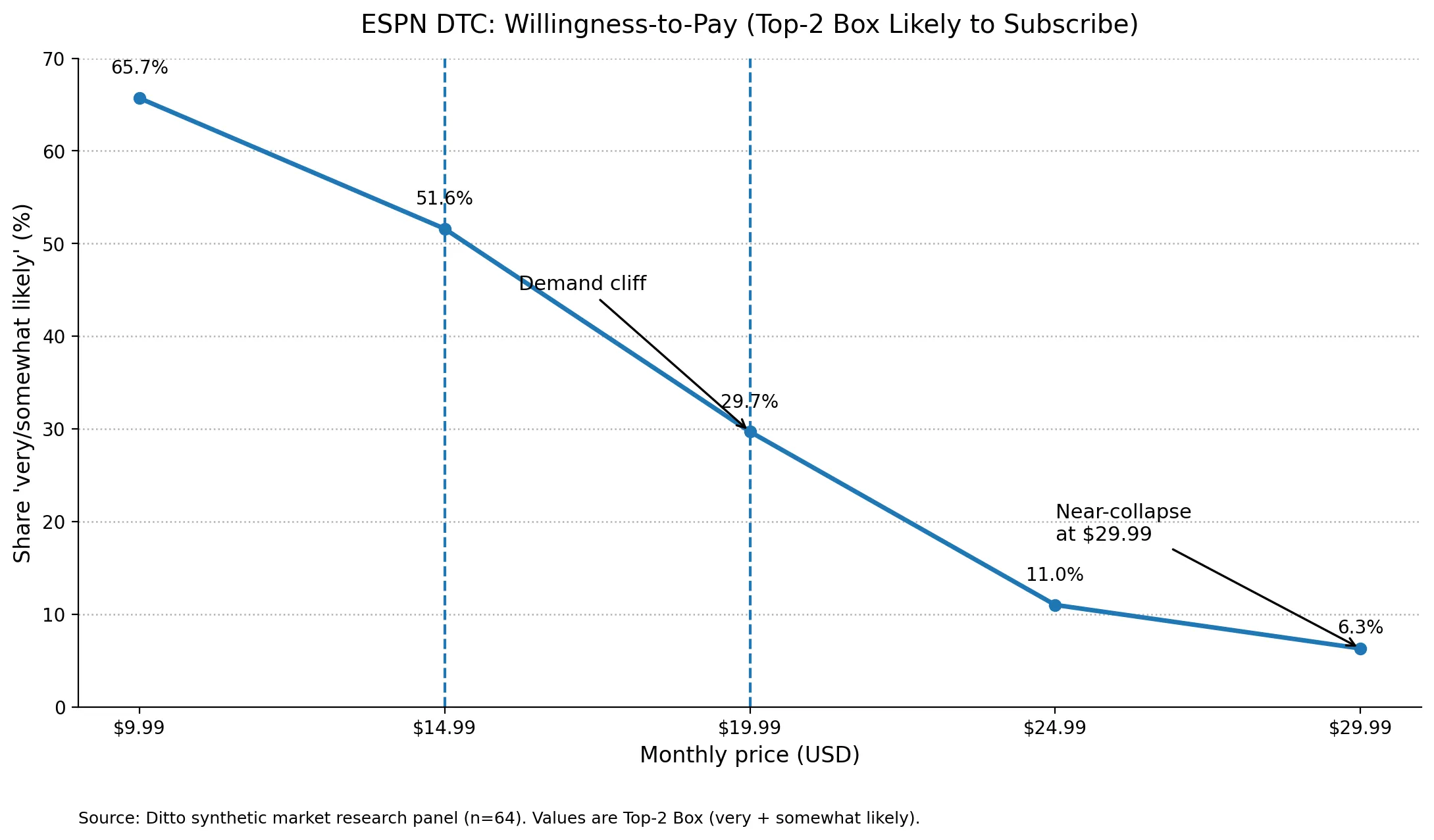
Willingness-to-pay: demand cliff between about $15 and $20
The WTP curve converts narrative into a distribution.
| Price point (USD) | Top-2 box likelihood |
|---|---|
| $9.99 | ~65.7% |
| $14.99 | ~51.6% |
| $19.99 | ~29.7% |
| $24.99 | ~11.0% |
| $29.99 | ~6.3% |
The study also flags a persistent never-subscriber slice in the mid-single digits to around 10 percent. Hedge fund implication: a $29.99 price point likely produces a much smaller addressable base than sports is must-have intuition implies, unless offset by bundling, discounting, or a meaningful perceived value step-up.
Incrementality vs substitution: one-in, one-out dominates
When asked what they would cancel if they subscribed to ESPN DTC, respondents consistently described substitution behaviors: cancel ESPN+ if it becomes redundant, pause or cancel Netflix or Hulu to free budget, and downgrade or rotate live TV bundles after playoffs. The correct model is a mix-shift framework, not simple price times subscribers.
Key friction points: rights clarity and reliability are gating variables
The biggest barriers are structural: blackouts and local rights ambiguity, streaming reliability and bandwidth, and bundle confusion. ESPN DTC's ceiling is less about marketing and more about rights resolution and product experience. That creates an investable watchlist of catalysts such as RSN partnerships, league equity deals, and product changes that reduce friction.
Ditto's decision-grade recommendations
- Lead with a lower-priced event or mobile pass around $9.99.
- Keep a standard tier near $14.99 to capture the large conditional segment.
- Maintain a premium all-inclusive tier for die-hard fans.
- Reduce friction via blackout transparency, low-bandwidth options, and explicit cancel-anytime mechanics.
Summary insights for hedge fund research analysts
- ESPN DTC is likely a seasonal product for many households unless price comes down or value increases.
- The WTP curve shows a hard demand cliff above about $15 to $20, with adoption collapsing at $24.99 and especially at $29.99.
- ESPN DTC dollars are often funded by cancellations of other services or bundles, implying mix shift across the media complex.
Three hedge fund trade frameworks (illustrative, not investment advice)
Important: the following are research-style frameworks only and are not investment advice.
Strategy 1: The $30 illusion
Core Ditto insight: at $29.99 per month, only about 6 percent of the panel is very or somewhat likely to subscribe, versus about 52 percent at $14.99 and about 66 percent at $9.99. If investor expectations assume broad adoption at $29.99, the Ditto WTP curve suggests adoption and retention could be overestimated unless promotions are aggressive.
- Downside hedges into ESPN DTC KPI disclosures.
- Volatility structures around earnings or investor days where pricing or churn is discussed.
Strategy 2: Short the rotational bundle
Core Ditto insight: many households treat live TV bundles as month-to-month products and describe downgrading or canceling when they subscribe to ESPN DTC. ESPN DTC competes directly with vMVPDs and skinny live TV bundles.
- Short a basket of vMVPD-exposed equities into peak sports activation periods.
- Pair trade long Disney and short a vMVPD basket to isolate bundle displacement effects.
Strategy 3: The rights and blackout unlock
Core Ditto insight: rights clarity and reliability are gating variables that keep many consumers from fully converting to DTC. Rights resolution or RSN partnerships could unlock adoption among the large conditional segment.
- Long Disney into rights resolution catalysts.
- Paired short in MVPD or cable distributors to express accelerated cord-cutting risk.
What this case study demonstrates about Ditto for hedge funds
This case study shows how Ditto compresses the research cycle: start from a real sell-side question, generate a decision-grade consumer signal in minutes using synthetic personas, quantify elasticity, identify funding sources, and isolate gating variables. Then translate findings into trade frameworks with explicit catalysts and iterate with direct persona follow-ups until the thesis is tight enough to size.
Ditto reduces the time between a market question and a differentiated view from weeks to minutes, and makes the research interactive.

About the author
Phillip Gales
Phillip is a serial tech entrepreneur that specializes in applying AI and machine learning solutions to antiquated and heavy industries. He has been a senior leader or founder at a number of succesful startups.
Phillip holds an MBA from Harvard Business School, an MEng from the University of Cambridge, and is a Y-Combinator alum