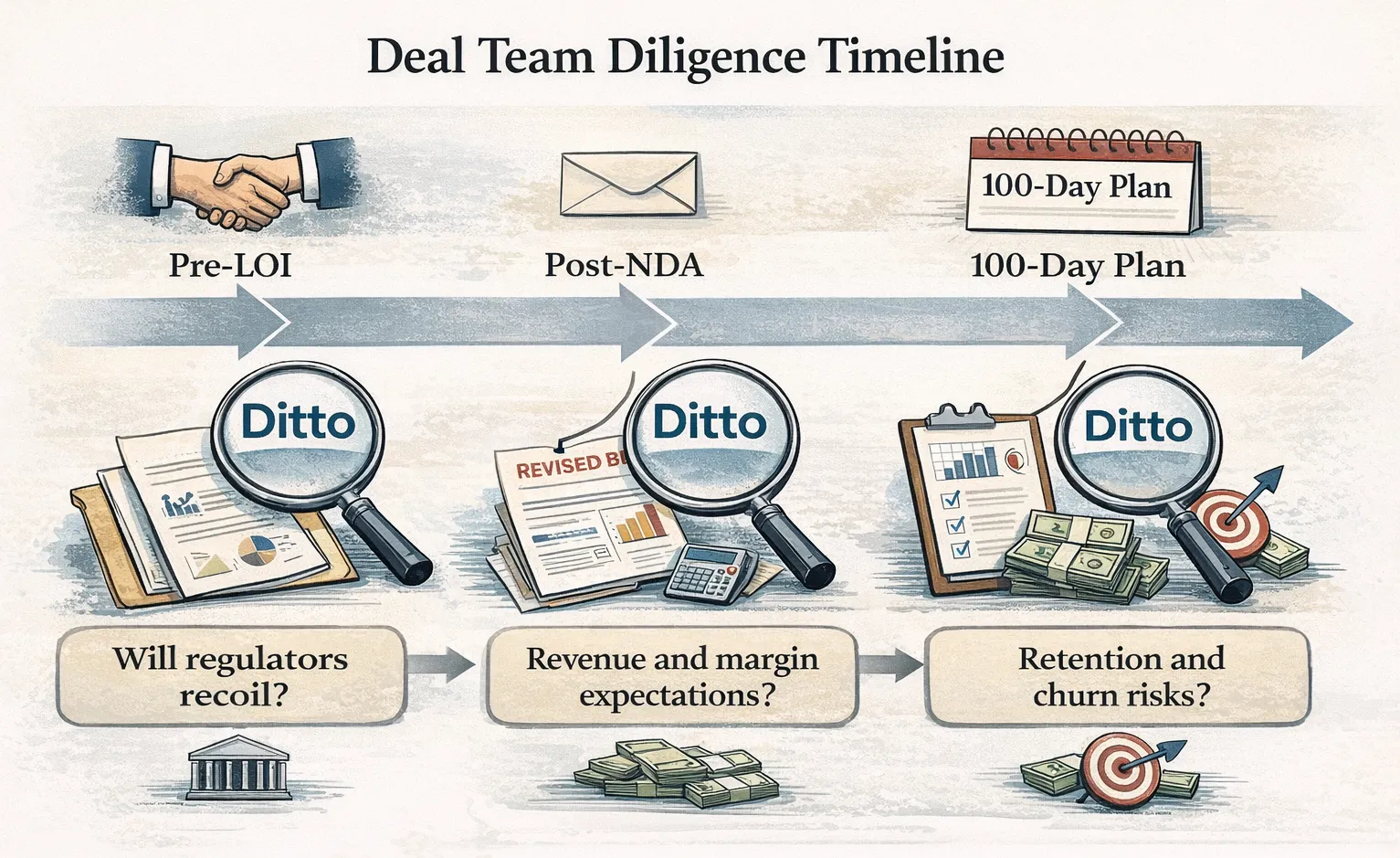
Rapid voice of customer underwriting for deal teams
In competitive M&A processes, the constraint is rarely analytical capability. It is time, information asymmetry, and access to the right external truth sources. Traditional diligence is designed to reduce asymmetry and help buyers decide whether to proceed and at what price. The problem is that the diligence clock starts immediately, and in the middle market often runs about 30 to 45 days, frequently in an auction format with tight first-round deadlines.
That timeline collides directly with primary research. Recruiting qualified respondents typically requires two to four weeks, and some of the most valuable audiences for commercial diligence are expensive or practically impossible to recruit quickly.
Ditto removes that bottleneck by turning primary-market questioning into software: a dedicated, owned intelligence environment populated with population-true synthetic personas, accessible directly by the deal team, with most runs returning results in minutes.
This case study shows how a private equity deal team, investment bank, or consulting firm can use Ditto to accelerate commercial diligence using a Loblaw Companies banner study, with signal concentrated on No Frills.
Original Ditto research study: https://app.askditto.io/organization/studies/shared/BAfT-Qk35T65RYibtq953y6q_HAze42Wvryf1onido0
How M&A diligence works (and where commercial diligence breaks)
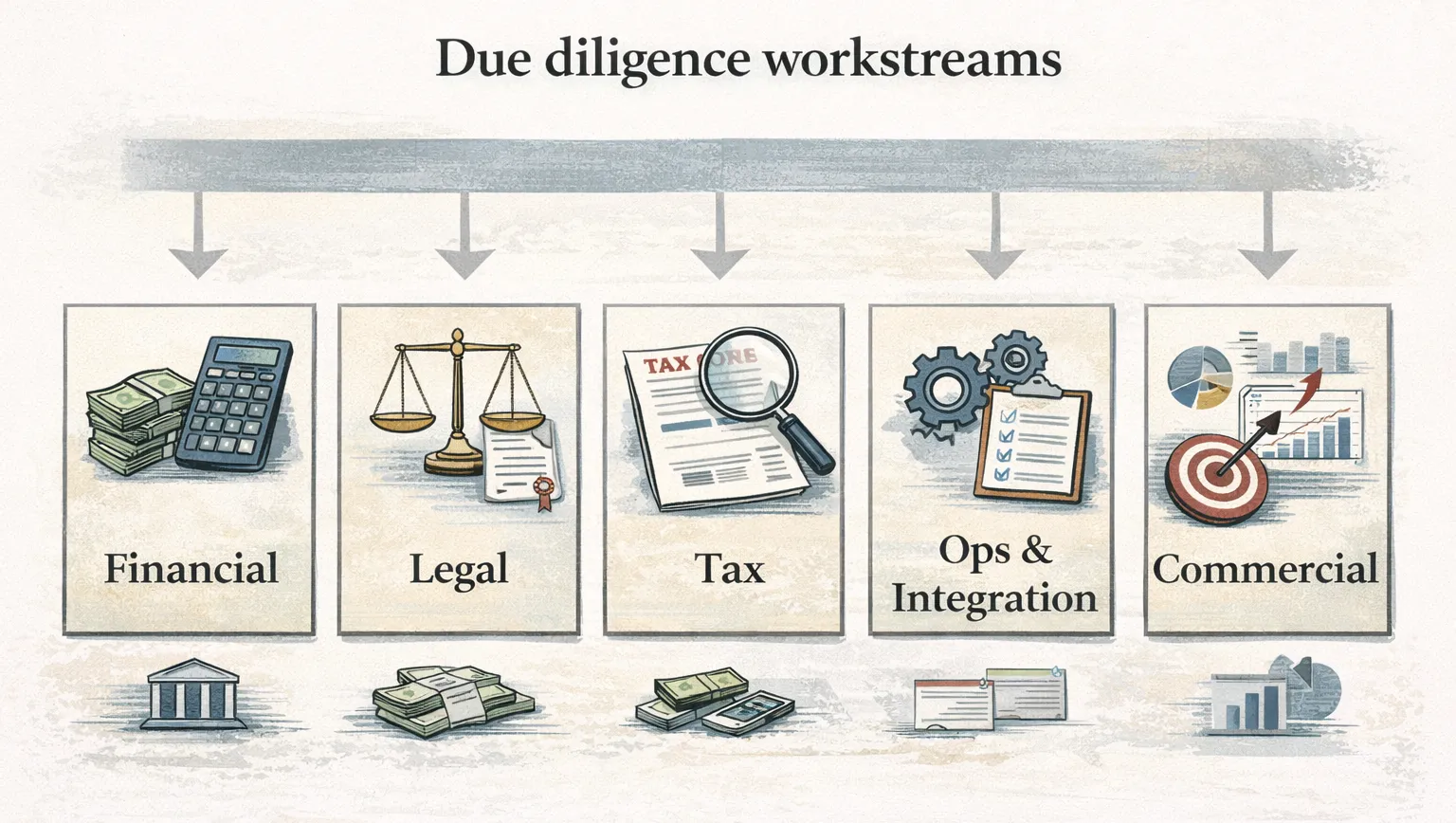
M&A diligence typically spans four major buckets: financial diligence, business and commercial diligence, legal and tax diligence, and integration and operational diligence.
In a formal auction, the operating cadence is consistent: NDA, CIM distribution, first-round bids, management meetings, data room work, LOIs, confirmatory diligence, and signing or closing.
Commercial due diligence (CDD) is often the gating item because it underwrites the only question that truly matters to valuation: the sustainable cash flow trajectory under an ownership plan. CDD focuses on market structure, customer behavior, revenue quality, and competitive positioning.
- The diligence window is short, often 30 to 45 days.
- Primary customer work is slow, with recruiting delays before analysis.
- Customer access is constrained; competitors' customers are hardest to reach.
- Voice-of-customer evidence often arrives late, pushing teams toward management claims and backward-looking KPIs.
Ditto's value in diligence is simple: replace weeks-to-first-answer with minutes-to-first-answer so teams can reshape bids, valuation, and diligence plans while there is still time to act.
What Ditto delivers for diligence
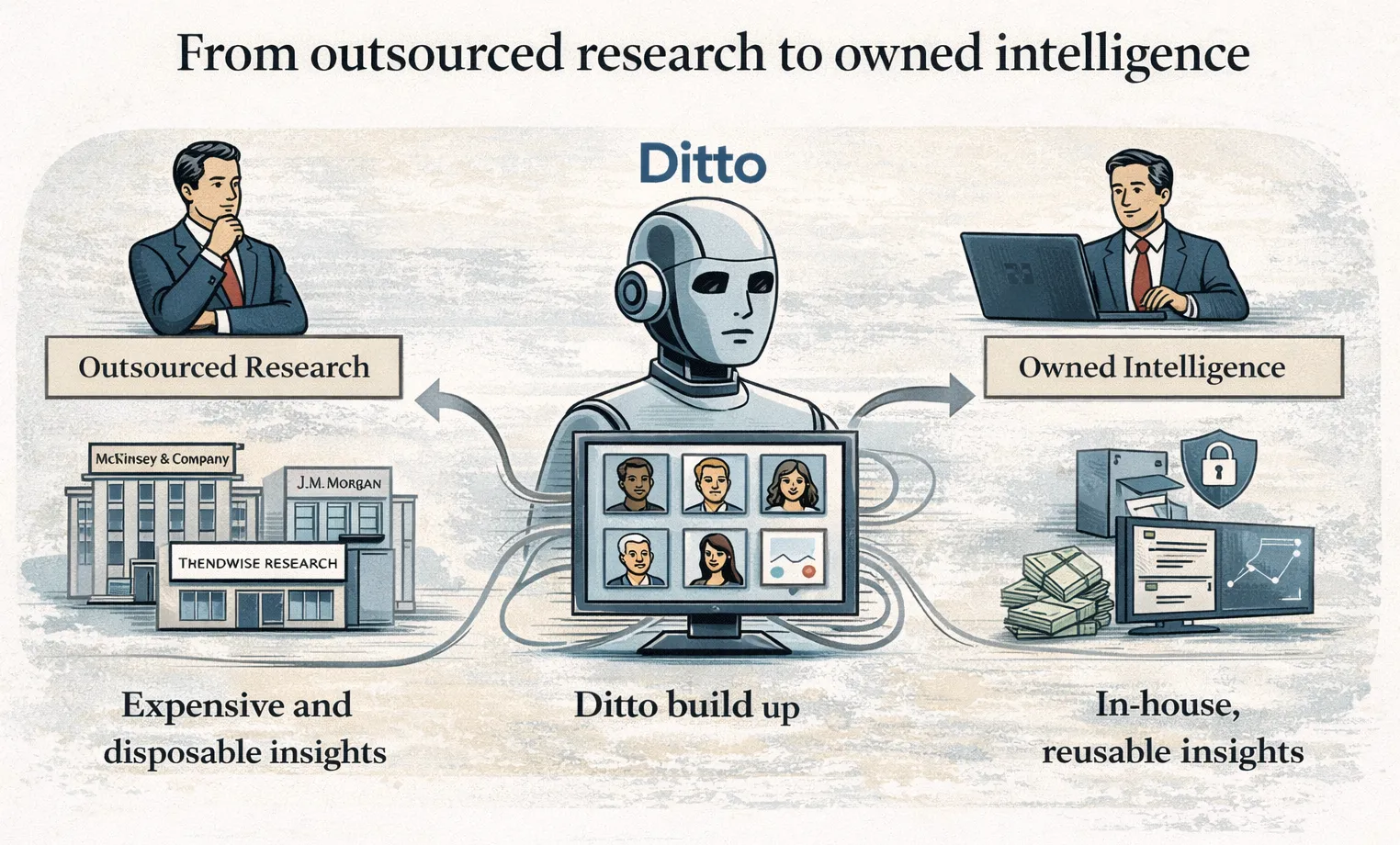
Owned intelligence versus episodic research
Ditto programs a dedicated environment of population-true synthetic personas calibrated to the target business context. This matters because diligence is not one-off. The same category thesis and heuristics get reused across targets.
Direct system access for deal teams
Rather than writing a research brief, waiting for translation, and receiving a static deck, Ditto provides direct system access to ask questions in plain English and run scenarios across segments and regions.
- Generate an outside-in customer view before first-round bids.
- Use findings to write sharper management questions.
- Iterate as new red flags emerge from the data room.
Speed with methodological guardrails
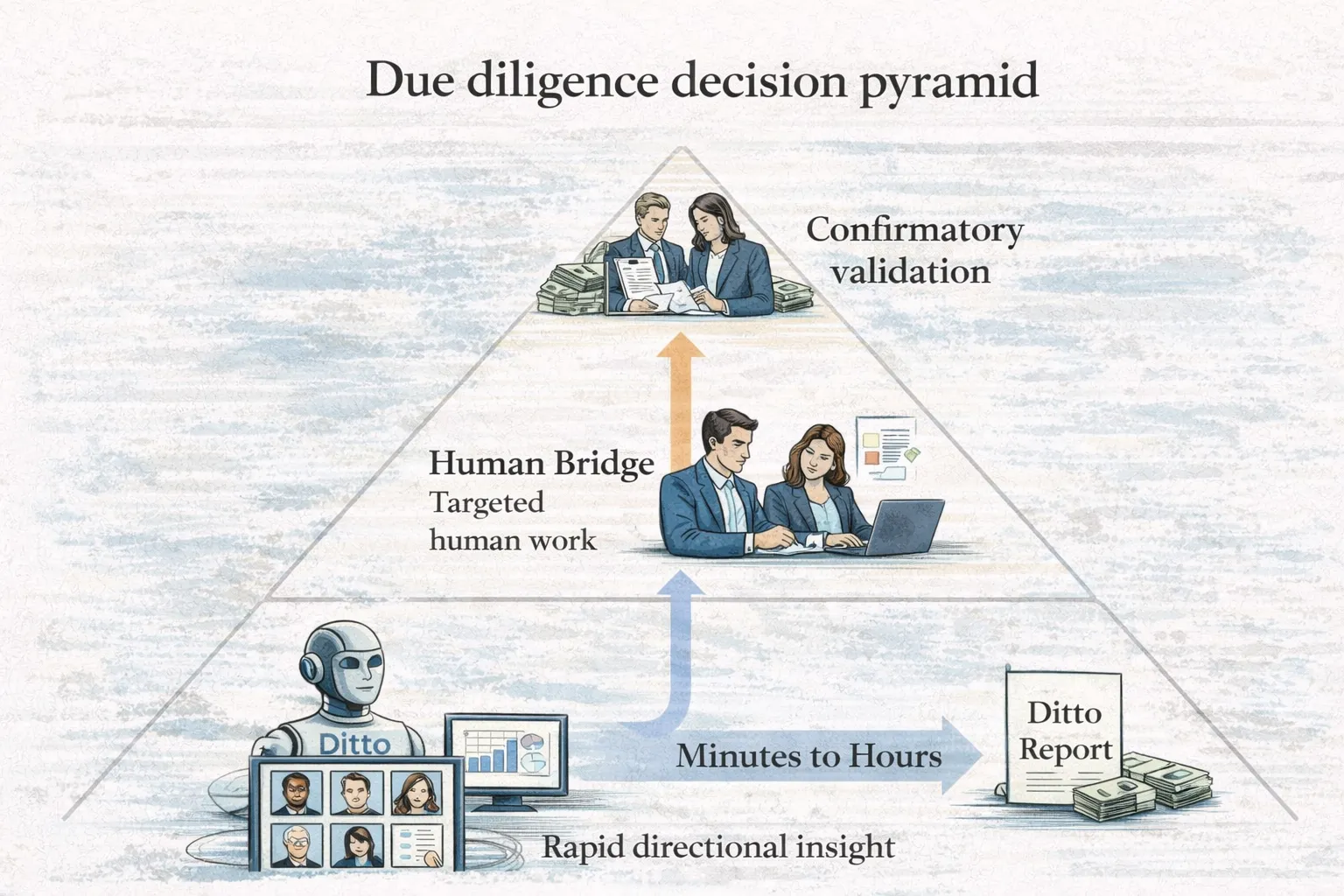
Ditto states most tests return results in minutes, with reliability checks such as test-retest stability and wording sensitivity. For higher-stakes decisions, Ditto offers an optional Human Bridge validation step.
All twins are synthetic. It is a model of people, not a list of people, which matters for confidentiality and early-stage diligence.
Why Loblaw / No Frills is a useful diligence proxy
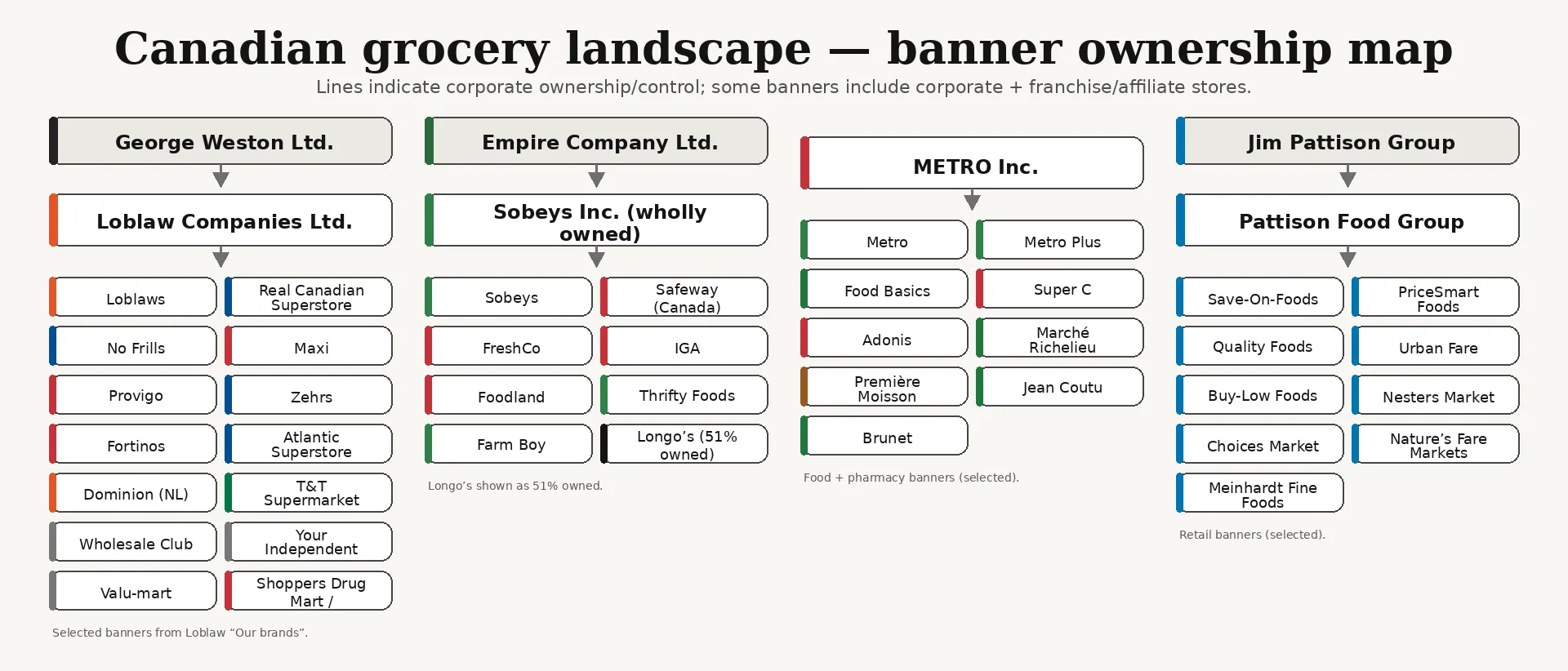
Loblaw is Canada's largest food and pharmacy retailer, operating banners that include Shoppers Drug Mart, No Frills, and Maxi. In 2025 reporting, Loblaw highlighted discount banners attracting cost-conscious shoppers in a volatile macro environment.
- Loyalty-driven economics: the PC Optimum program shapes behavior through targeted rewards and promotions, which can defend share while compressing margin.
- Regulatory and reputational sensitivity: Loblaw faced scrutiny around grocery inflation and property controls, risks that can become financially material through traffic and pricing power.
The Ditto study used in this case study
Study title: "Customer use of Loblaws companies" (shared Ditto report, updated Nov 20, 2025).
Original study link: https://app.askditto.io/organization/studies/shared/BAfT-Qk35T65RYibtq953y6q_HAze42Wvryf1onido0
Core research question (paraphrased)
The study set out to understand how consumer use and perceptions of Loblaw Group brands evolved, with focus on:
- Which grocers consumers use most.
- Familiarity and use of No Frills.
- Impression shift over the last 12 months.
- Reactions to No Frills ads.
Study design and participants
- Research group: 20 Canada-based consumers (ages 17 to 63) across Ontario, Quebec, British Columbia, and other regions.
- Output volume: 80 total responses.
- Participants are synthetic personas with consistent backstories (age, location, occupation, income band).
Examples in the report include a 57-year-old in Alberta with a budget-conscious profile, a 22-year-old banking analytics professional in Mississauga, and a 17-year-old bilingual First Nations student in suburban Quebec. These participants are synthetic personas, not recruited respondents.
This report was generated in about 16 minutes, consistent with Ditto's operating model of same-day iteration.
Key results for deal teams
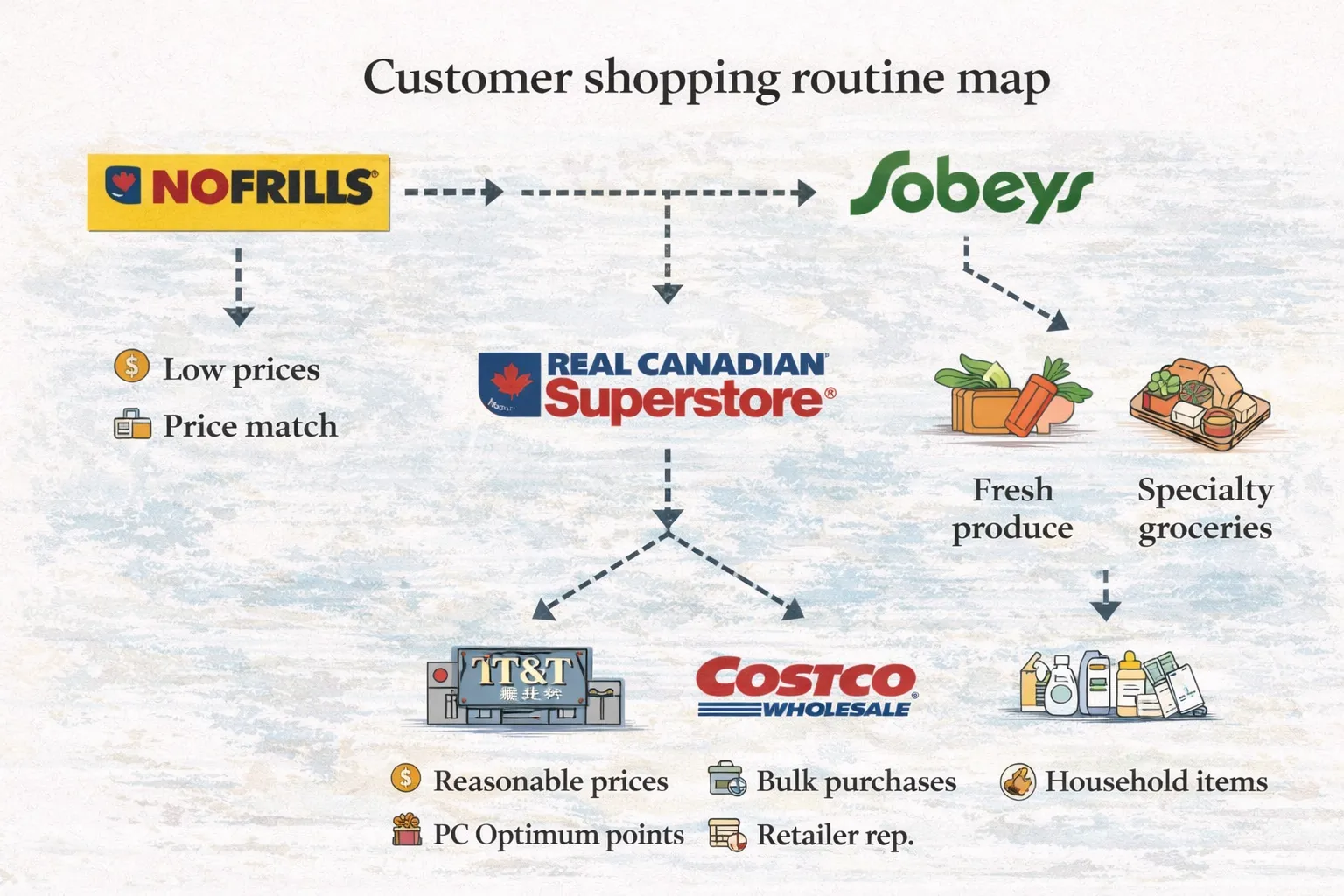
Consumers run pragmatic, multi-store routines
Shoppers behave as portfolio managers. Discount chains are used for low-cost staples, Costco for bulk, and farmers' markets or ethnic shops for freshness and cultural needs. Tie-breakers include proximity, pickup convenience, hours, and checkout speed.
Diligence implication: share gains are not binary. They are driven by trip missions. A banner can win staples while losing fresh, or win proximity trips while losing stock-up baskets.
No Frills is tactical, not a full weekly shop
Awareness is near-universal, but usage is tactical: No Name staples, flyer loss-leaders, and points. Constraints include limited selection, variable produce, and stockouts, compounded by shrinkflation headlines.
Diligence implication: if a sell-side narrative assumes consumers consolidate a full shop into the banner, that is a bet against observed behavior. A more realistic strategy is to expand share-of-wallet by improving fresh and availability while defending value.
Impression drift is negative on trust and consistency
Net sentiment drifted slightly negative over 12 months, with deterioration tied more to trust and consistency than absolute price. A minority reports stability or improvement where relative price outperformed local alternatives.
Diligence implication: this is not purely a pricing problem. It is a credibility problem, which requires different levers than blunt price cuts.
Ads are noticed but feel gimmicky without proof
No Frills ads were noticed and on-brand, but widely viewed as gimmicky unless backed by proof on price, quality, and availability.
Diligence implication: marketing is a multiplier, not a driver, when operational trust is impaired.
The report converts insight into a 0 to 180 day plan
The report proposes quick wins, core initiatives, KPIs, and risks with mitigations, closely aligned with a CDD and 100-day plan workstream.
Quick wins
- Price-lock essentials with unit and weight transparency.
- Improve produce standards and on-shelf availability.
- Staff express lanes to relieve self-checkout bottlenecks.
- Add proof-point tags that back value claims.
Core initiatives
- Fresh and Available program (produce standards, flyer guard-stock, OSA).
- PC Optimum Simple Value tied to a transparent essentials basket.
- Pickup excellence (substitution quality and communications).
- Truth in value communications anchored in proof points.
KPIs recommended include basket price index versus local peers, on-shelf availability, produce quality signals, substitution experience, loyalty adoption, and proof-to-purchase conversion. Risks and mitigations include margin pressure from price locks, execution variance, transparency backfiring, IT delivery risk, and banner cannibalization.
Scope note: Shoppers Drug Mart and Joe Fresh did not surface materially in this sample and warrant dedicated follow-up.
How this changes diligence in practice
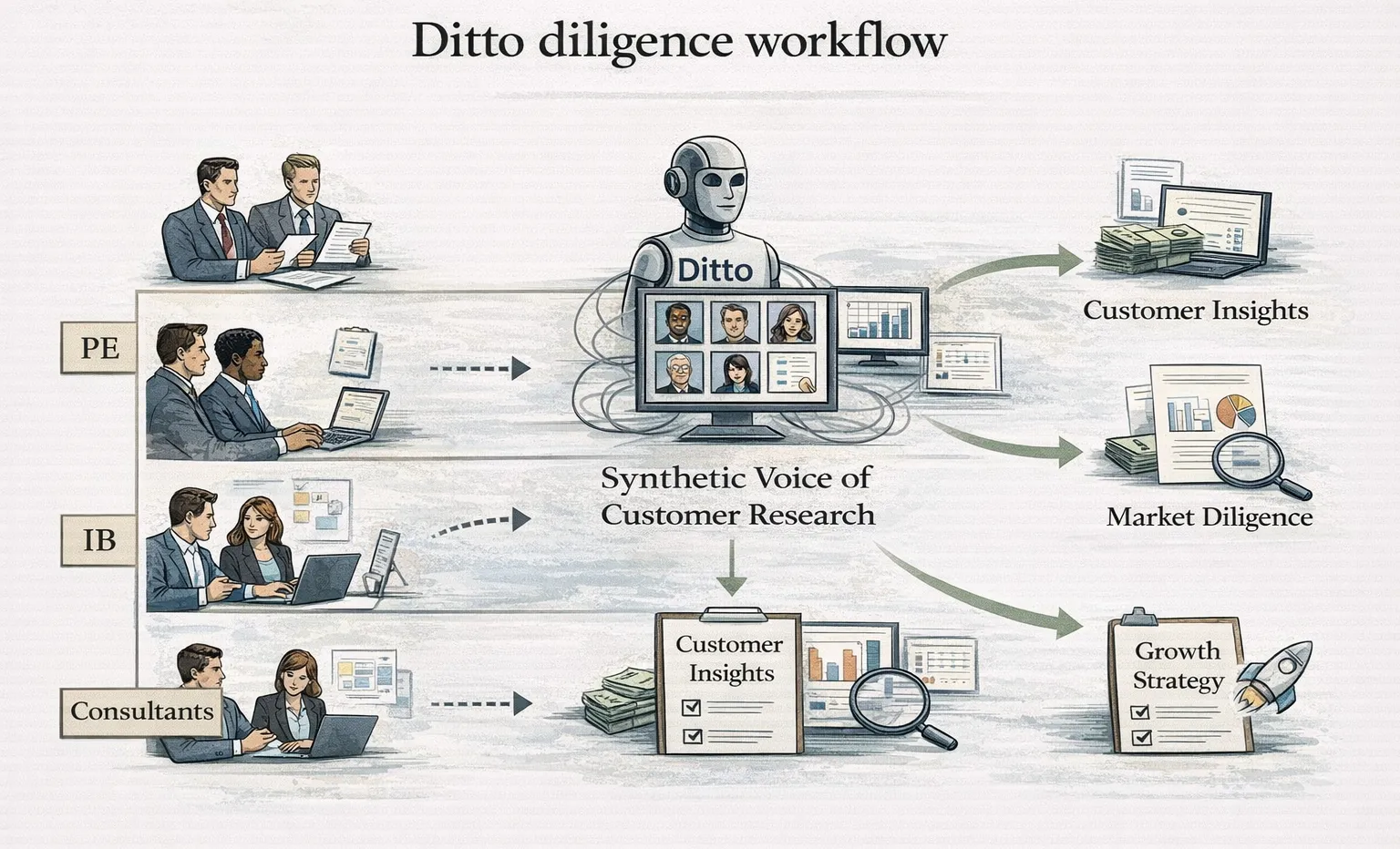
A) Pre-LOI screening
Before an NDA, teams can only do surface diligence beyond public filings. Ditto adds an outside-in customer lens early enough to matter.
- Build a rapid customer mission map.
- Identify top thesis killers to validate in management meetings.
- Stress-test the sell-side growth story against consumer reality.
- Generate a first-pass risk register on trust, price image, and availability.
Applied to Loblaw / No Frills, a pre-LOI team would arrive with sharper hypotheses: growth is more likely to come from winning fresh and availability missions than from full-shop conversion; trust and consistency are binding constraints; ads must be gated on operational proof points.
B) Post-NDA confirmatory diligence
Once the data room opens, diligence becomes triage. Ditto enables rapid hypothesis testing and scenario interrogation tied to new information.
- Condition tests on CIM details and constraints.
- Run counterfactuals on pricing, loyalty, and rollout cadence.
- Ask follow-ups to the same panel to resolve ambiguity fast.
Example confirmatory questions: Would price-locking an essentials basket change trip frequency or just compress margin? Would improved produce standards convert any segment into a primary shop? Which segments respond to proof-point communications versus remain trust-impaired?
Three high-impact diligence strategies unlocked by this study
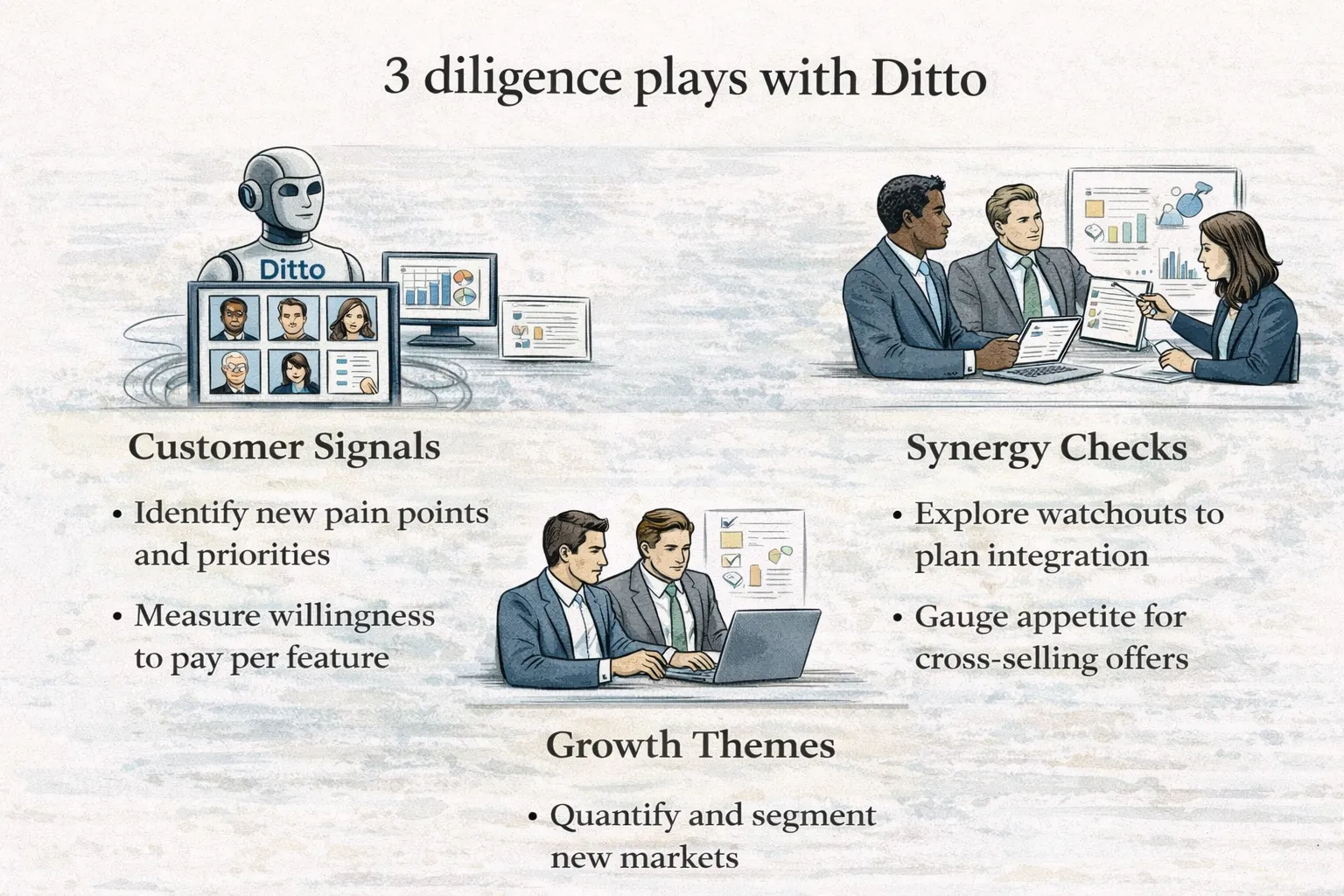
The mission-based revenue bridge
Shoppers operate mission-based routines. Underwrite growth by the missions a banner can realistically win in 12 to 24 months, not by broad share gains.
- Upside: increased trip frequency and larger staple baskets.
- Downside: continued tactical-stop behavior and trust drag.
The trust and availability turnaround
Convert trust into an operating KPI: basket price index, on-shelf availability, produce quality signals, substitution accuracy, and checkout throughput. Tie the 0 to 180 day plan to these metrics.
Marketing as a multiplier
Do not underwrite a marketing-led growth plan if operations are not fixed. Sequence operational improvements first, then use proof points to amplify conversion.
How Ditto speeds diligence end to end
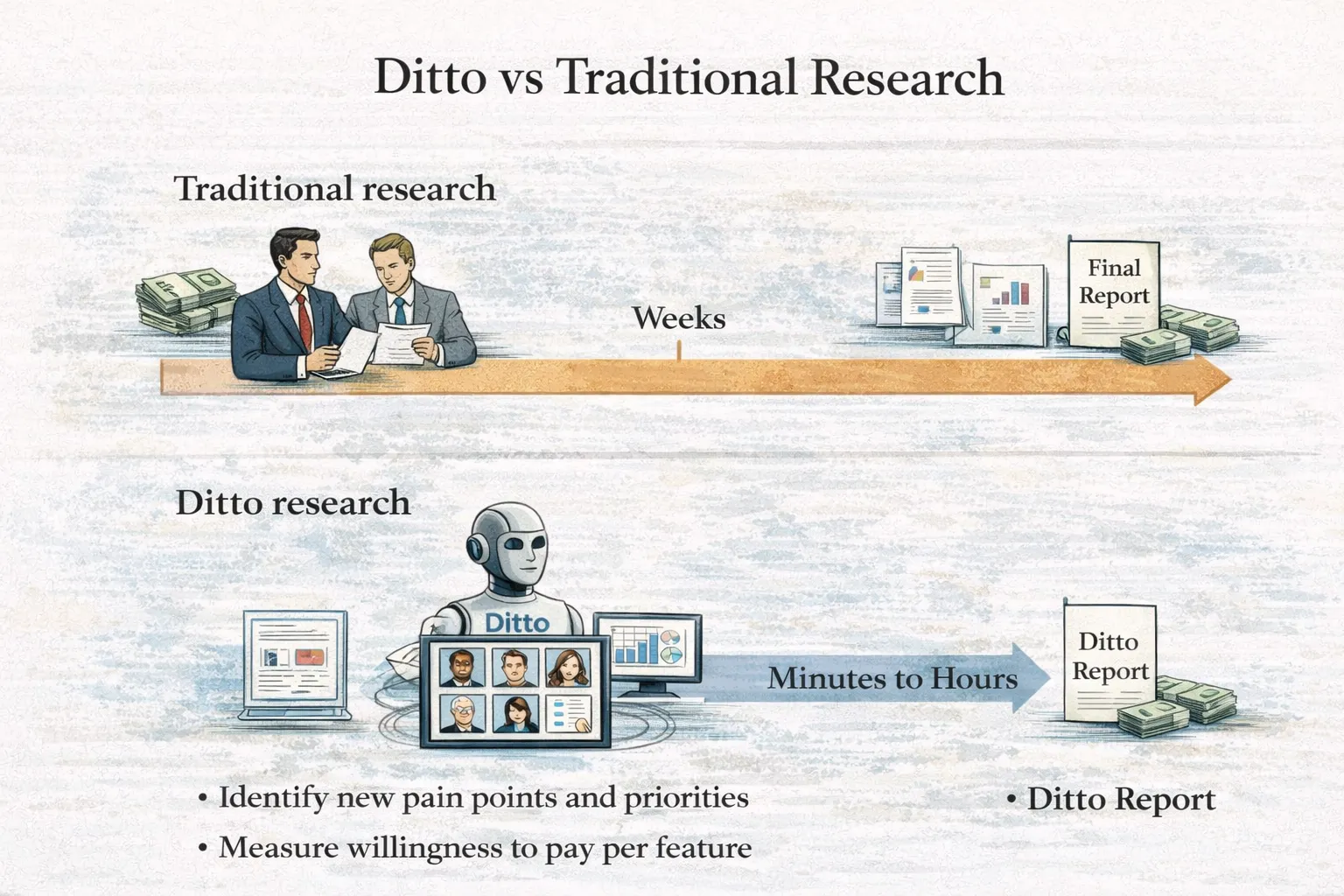
Traditional research bottlenecks are not controversial: recruiting takes weeks, some audiences are hard to reach, and iteration is expensive. A Ditto-enabled diligence workflow compresses the cycle.
- Phase 1 (48 to 72 hours pre-bid): build a synthetic panel, run a mission map, produce top findings and diligence questions.
- Phase 2 (first two weeks post-NDA): condition on CIM details, run scenario tests, and isolate drivers.
- Phase 3 (confirmatory diligence): pressure-test management assertions and decide where Human Bridge validation is required.
- Phase 4 (IC memo and 100-day plan): convert findings into KPI-linked action plan.
Example follow-up questions for the same panel
Because participants are synthetic personas, you can interrogate the why and the counterfactuals immediately.
- If No Frills published a monthly value and freshness scorecard, would trust change?
- Rank levers: produce guarantee, express lanes, flyer in-stock, price-lock essentials.
- Would simplified PC Optimum points feel like real value or manipulation?
- What would cause a full weekly shop shift to No Frills?
- Which competitor do you trust on fresh and why?
Closing: what this case study proves (and what it does not)
This Loblaw / No Frills study shows why Ditto is structurally suited to M&A diligence: it produces a decision-ready CDD-style insight pack in minutes, transforms diligence into an iterative hypothesis loop, and is privacy by design. It does not claim to replace every part of diligence. High-performing teams use Ditto to reach directional truth fast, then deploy human validation where it changes valuation, deal terms, or integration plans.

About the author
Phillip Gales
Phillip is a serial tech entrepreneur that specializes in applying AI and machine learning solutions to antiquated and heavy industries. He has been a senior leader or founder at a number of succesful startups.
Phillip holds an MBA from Harvard Business School, an MEng from the University of Cambridge, and is a Y-Combinator alum