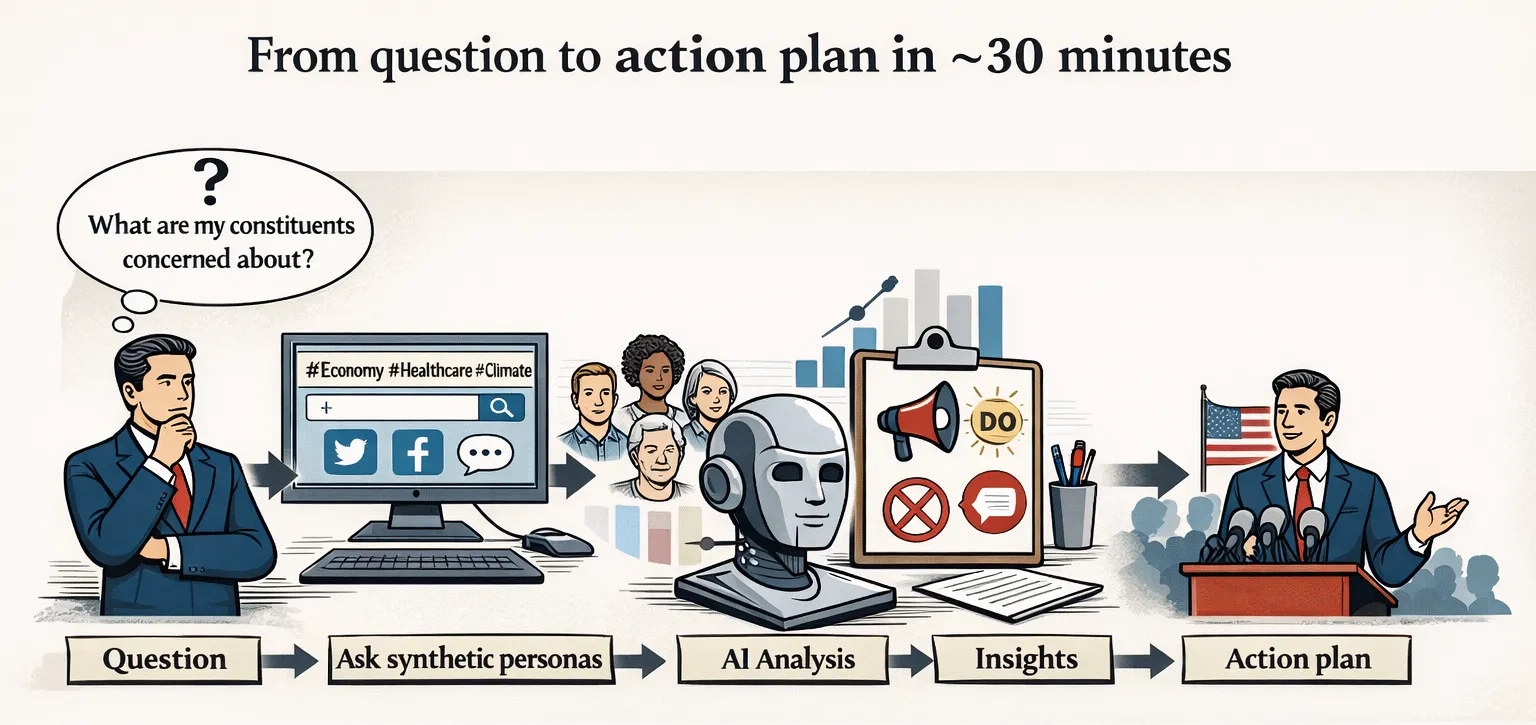
Executive context
Public-sector leaders face a familiar constraint: constituents experience government through a handful of high-frequency moments, but the institution's ability to hear those experiences in real time is structurally slow. Traditional polling and focus groups can be high quality, but they often lag the news cycle, legislative calendar, and operational reality.
Ditto enables teams to run research in minutes using population-grounded synthetic persona panels, built on official statistics and contextual layers rather than ad-hoc roleplay. This case study analyzes a Ditto-generated study on what Michigan residents want from the Michigan Secretary of State across four issues: digital driver's licenses, election modernization versus election protection, voter and license-plate data privacy, and dark money disclosure concerns.
The report was generated in about 24 minutes. All participants are synthetic personas, and analysts can ask deeper follow-up questions immediately after seeing initial results.
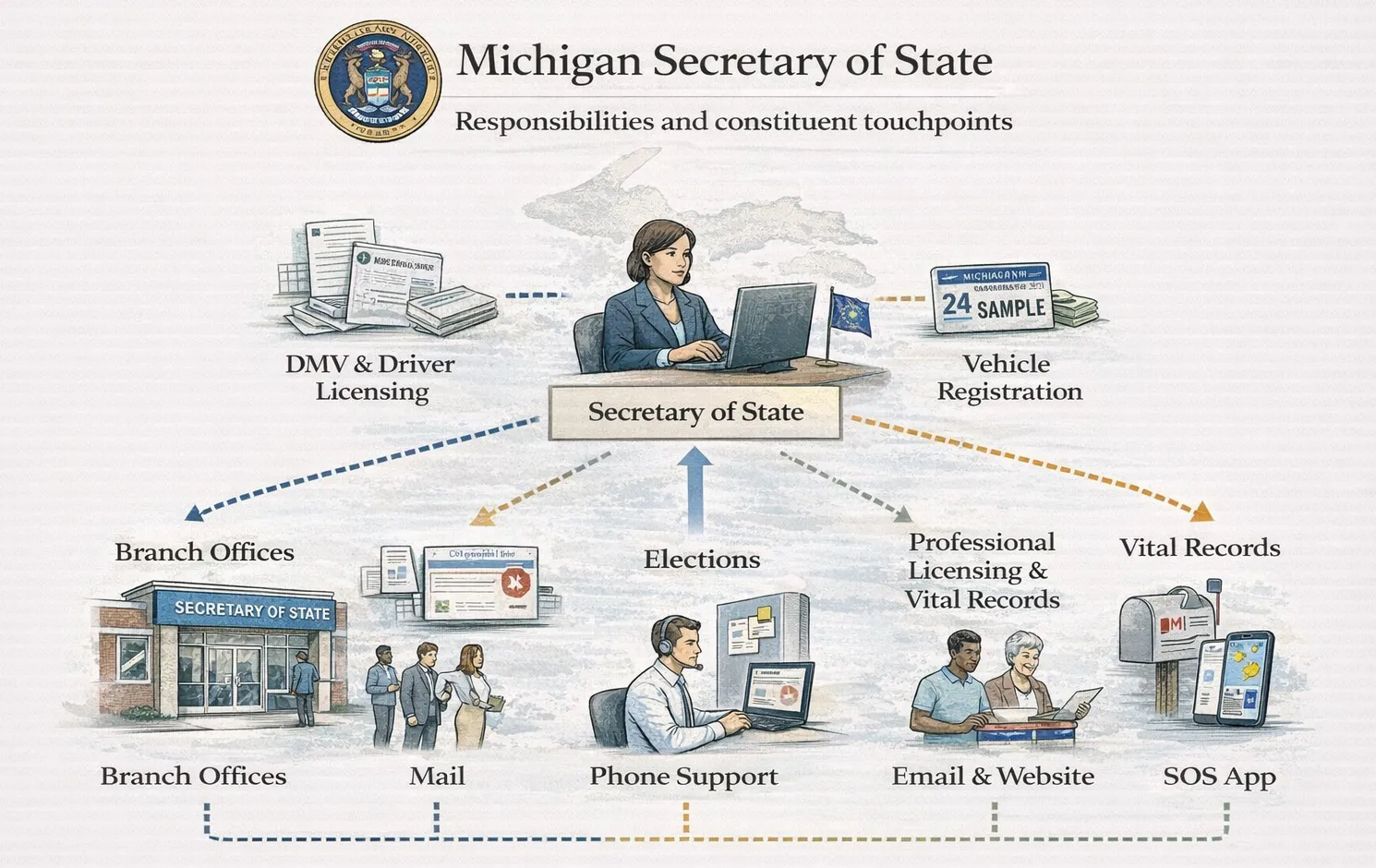
Background: why Secretary of State priorities are high stakes
The Michigan Secretary of State blends two high-salience domains: elections and motor vehicle administration. That dual mandate creates two distinct trust tests: operational trust (wait times, appointments, call center performance) and democratic trust (election administration, integrity safeguards, data security posture).
The four topics in the Ditto study sit at the intersection of service and trust, and they routinely create reputational and operational risk for the office.
Digital driver's licenses and mobile IDs
Michigan has considered mobile driver's licenses and digital IDs. Any program has adoption, trust, and operational risk: older households may see coercion, law enforcement interactions can shift perceptions toward surveillance, and offline verification or device failure can create chaos without guardrails.
Election modernization versus election integrity
Election integrity is table stakes. Leaders still need to understand what actually moves trust, especially as narratives shift with national headlines and localized incidents.
Voter data privacy and license-plate data
Privacy is no longer abstract. Constituents increasingly expect enforceable controls, transparency, and limits on data sharing as a condition of trust.
Dark money and disclosure
Disclosure debates in Michigan reflect broader trust concerns. Constituents do not need to be experts to feel when the system is opaque.
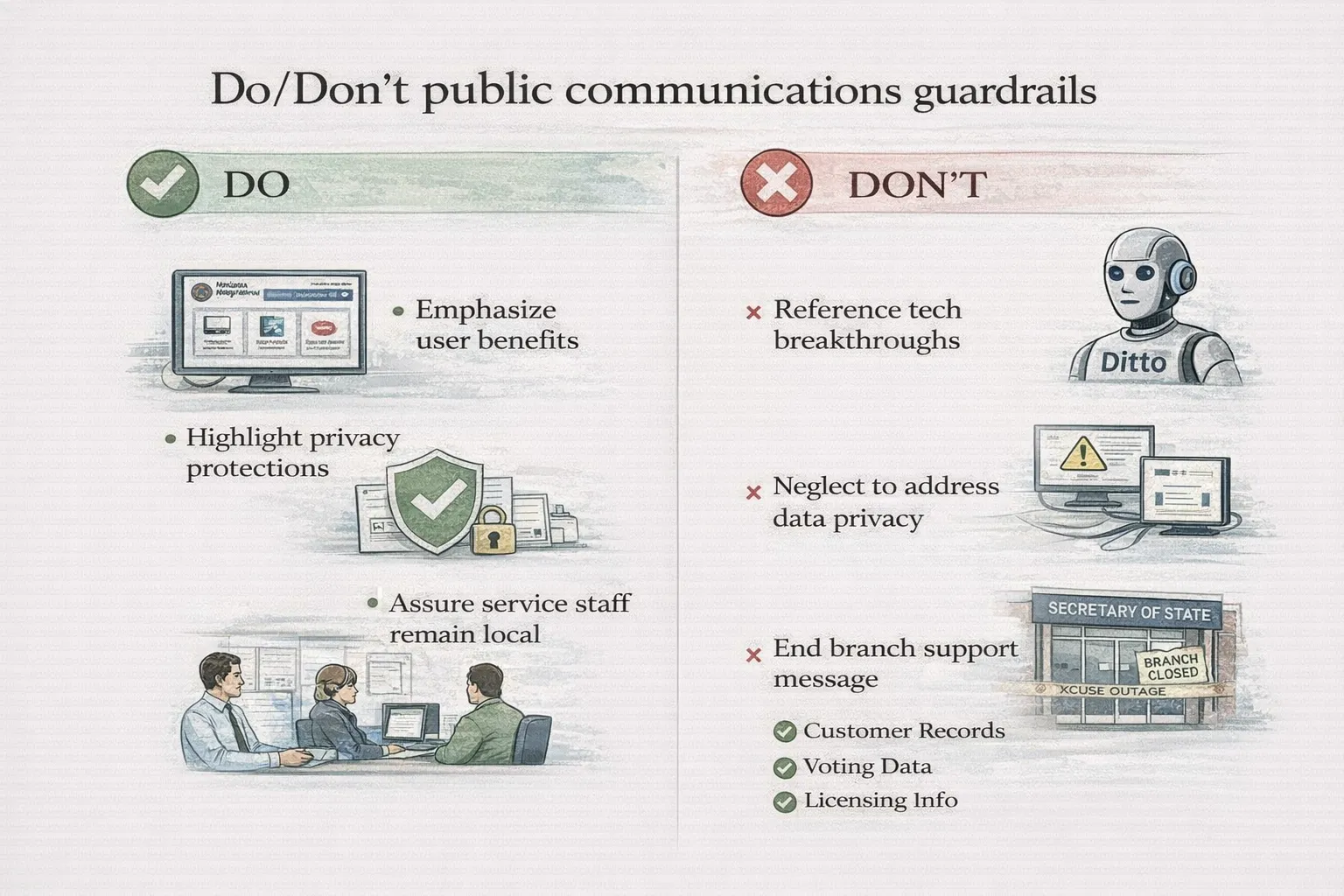
Ditto versus traditional constituent research
Ditto is synthetic research using population-grounded persona panels designed to simulate real populations quickly and repeatably. It returns concept and message tests in minutes, enables direct dialogue in plain English, and is privacy by design.
- Speed: fast iteration without recruitment delays.
- Direct dialogue: run scenarios across segments and regions without a research middleman.
- Privacy by design: synthetic personas protect constituent data.
- Optional human validation: Human Bridge for high-stakes confirmation.
Study objectives (paraphrased)
- Digital ID acceptance conditions and non-negotiable safeguards.
- Service modernization versus election integrity prioritization.
- Credibility thresholds for data privacy promises.
- Dark money concern and disclosure trust impact.
Study overview
- Sample: 10 Michigan voters represented as synthetic personas, ages 32 to 73.
- Questions: 4 prompts.
- Total responses: 40.
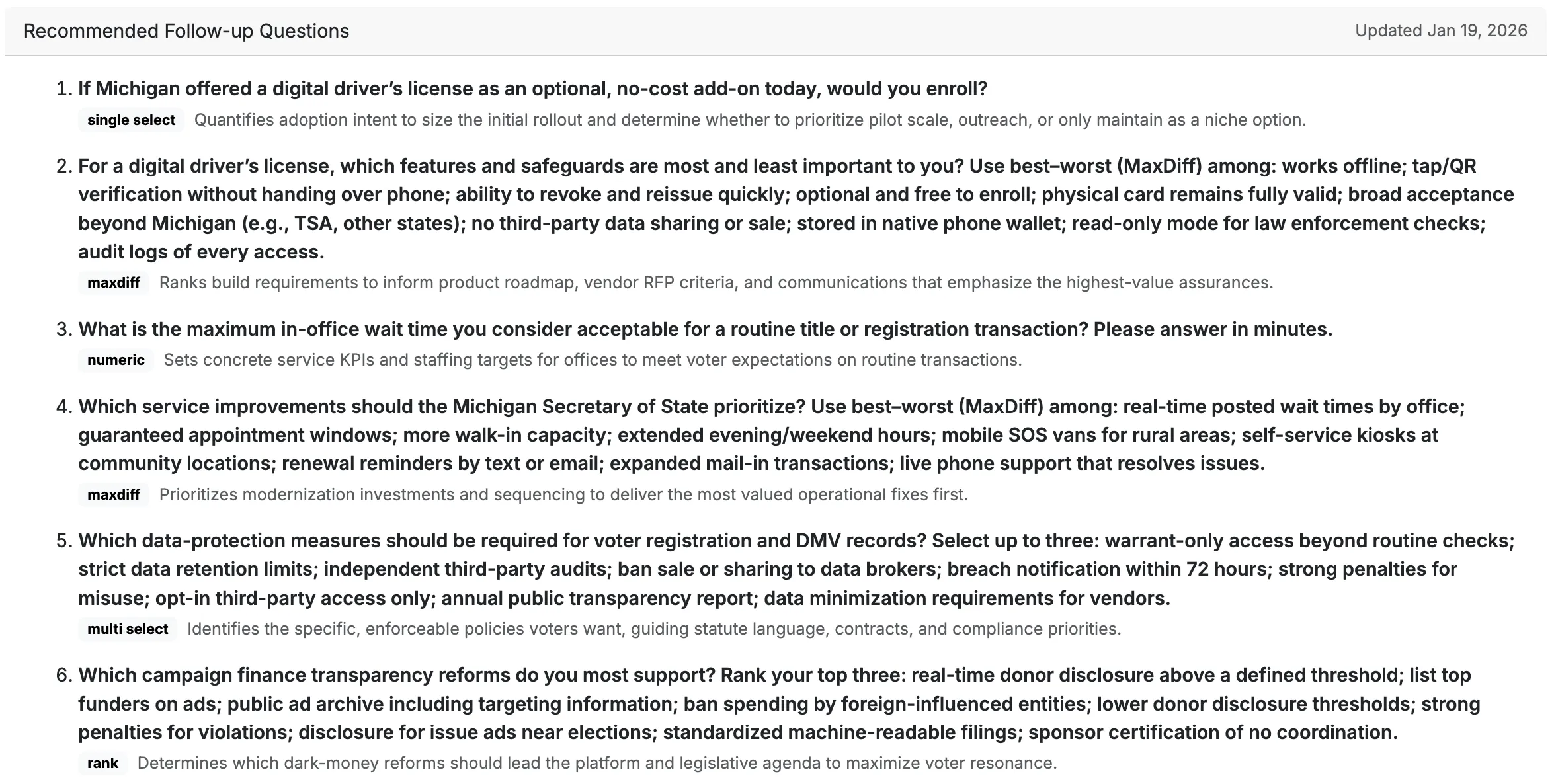
- Outputs: executive overview, insights, recommendations, segmentation, risks, KPIs, and follow-up questions.
Original study link: https://app.askditto.io/organization/studies/shared/lQxvQhmypLakKsZDWGk6Hvt4EyFvFTStzuqk5oNl3cE
Who the participants were
The study includes synthetic personas across rural and metro contexts, with a mix of occupations and life stages. These are synthetic personas, not real constituents, enabling rapid and repeatable scenario testing grounded in population modeling.
Key results and insights
Digital driver's licenses require specific guardrails
The dominant pattern is conditional acceptance: residents are open to a digital license as an optional backup, but want the physical card preserved as the reliable baseline. Trust requirements include optional and free access, wallet-native storage, offline verification, selective disclosure, no phone handover, fast revoke and reissue, data minimization, and cross-jurisdiction acceptance clarity.
Service reliability competes with election integrity messaging
Election integrity is a baseline expectation, while service reliability is felt weekly. The study suggests a combined operating model: paper-backed integrity plus boringly reliable services with measurable SLAs.
Privacy trust requires enforceable mechanisms
Privacy promises are discounted without mechanisms such as warrant-only access, no data broker sales, short retention with purge schedules, audit logs, transparency reports, and penalties for misuse.
Dark money concern is high
Constituents penalize anonymous spending and reward visible disclosure. Reforms that resonate include listing top funders on ads, near-real-time disclosure timelines, and enforcement that feels meaningful.
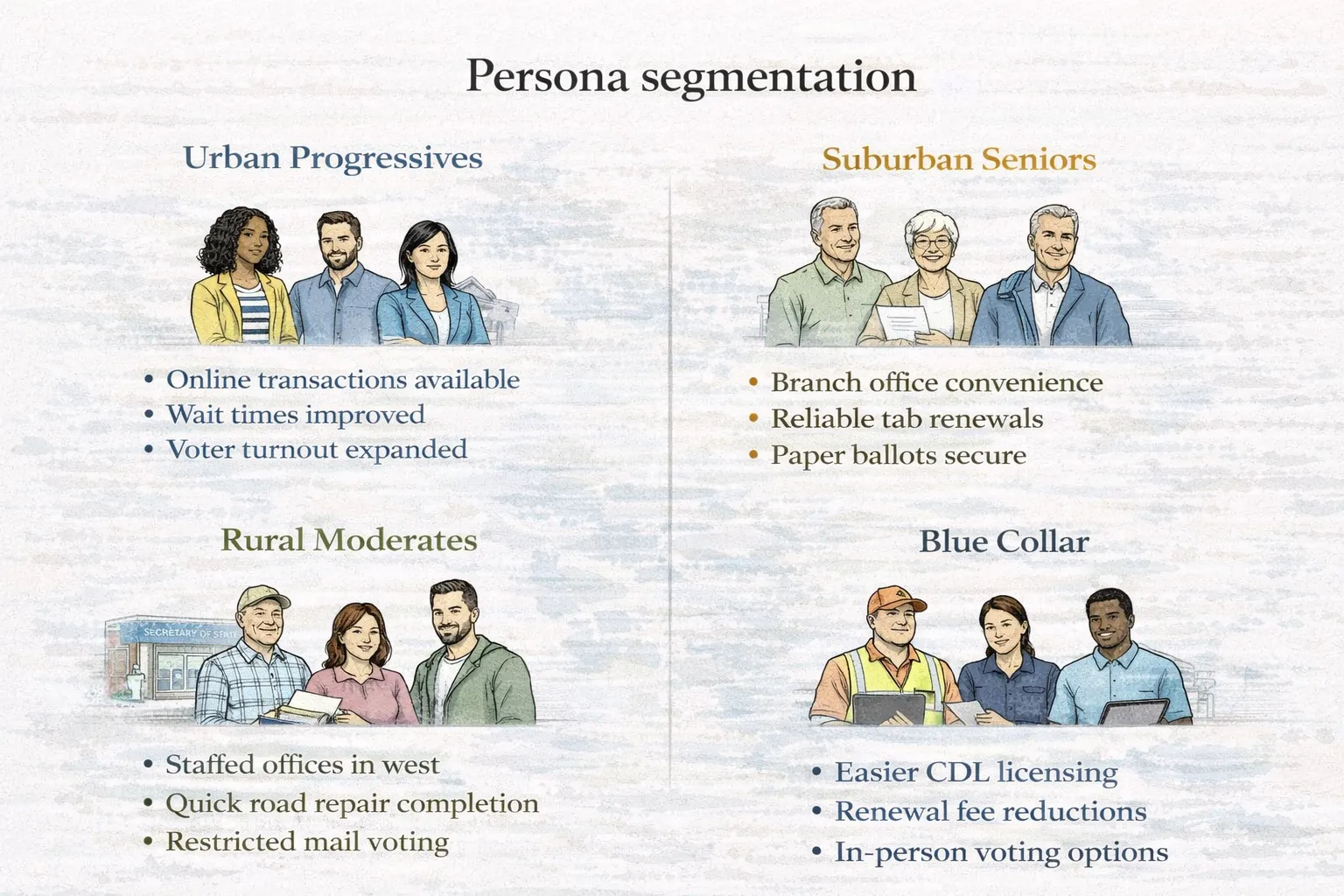
Segment-level trust thresholds
- Rural and vehicle-dependent roles require offline reliability and predictability.
- Older adults and low-tech households need paper fallbacks, human support, and low fees.
- Public-safety professionals require statutory limits, auditability, and short retention.
- Tech-literate professionals still demand wallet-native UX, selective disclosure, and transparency metrics.
Recommendations in the report
Quick wins (2 to 4 weeks)
- Keep the physical ID and position digital ID as a free backup.
- Publish a Data Use and Access pledge with specific mechanisms.
- Publish service transparency targets and appointment SLAs.
- Release plain-language multilingual materials (EN, ES, KR).
Initiatives (30 to 90 days and beyond)
- Service reliability blitz with wait-time and appointment targets.
- Privacy and vendor governance reform with audit logs and retention limits.
- Digital ID backup-first pilot with wallet integration and offline verification.
- Election integrity operations with audits and after-action reporting.
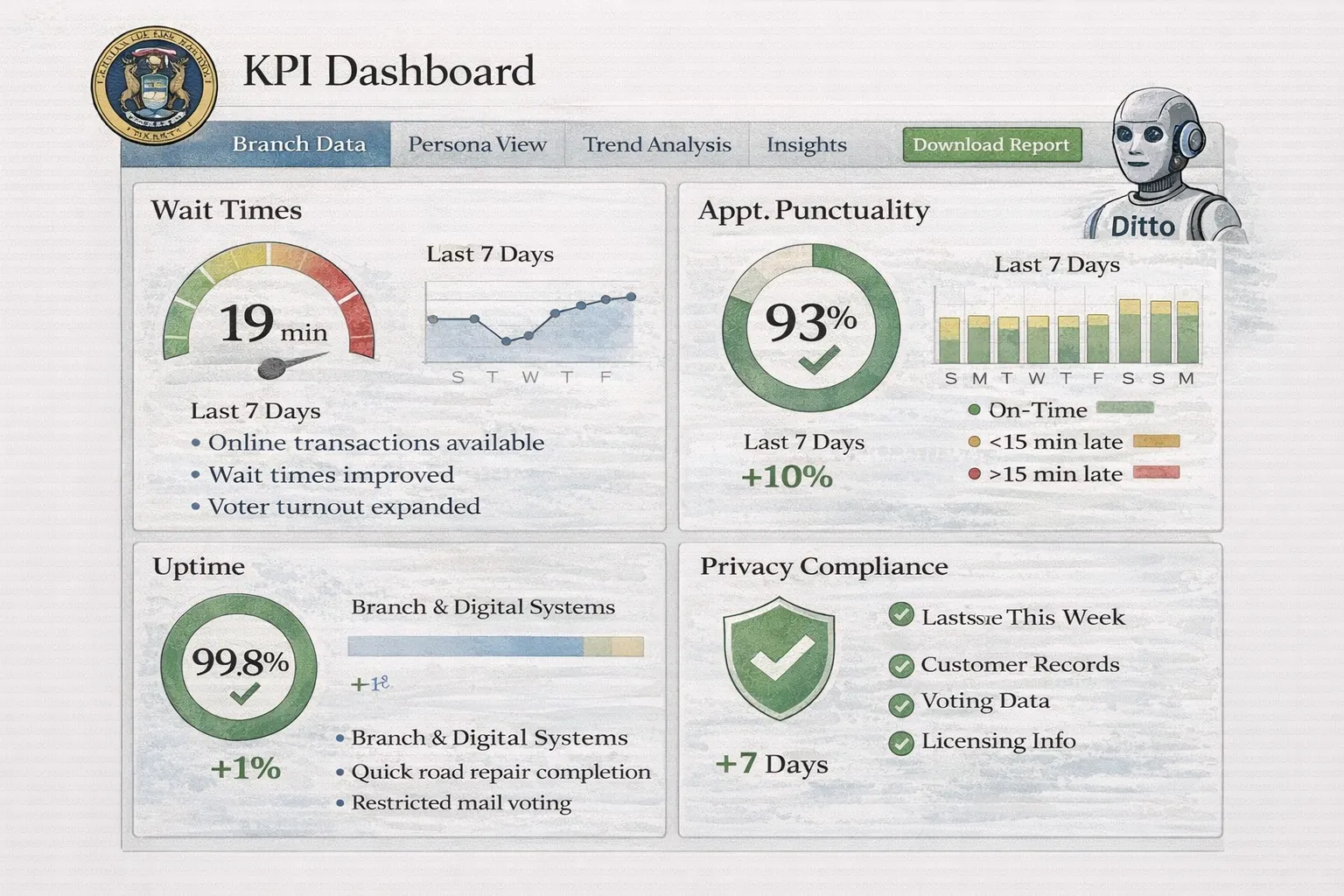
KPIs include wait times, appointment punctuality, online uptime, privacy compliance, and transparency reporting.
Why this case study proves Ditto's value
The study demonstrates speed to insight, segment-level depth, and the ability to iterate in minutes. It is privacy-safe by design and suitable for sensitive topics where real-world testing may be risky.
Closing
For public-sector leaders, public trust is a capacity constraint. This Ditto case study shows that trust constraints can be surfaced early and at speed, enabling modernization that feels like service, not surveillance.

About the author
Phillip Gales
Phillip is a serial tech entrepreneur that specializes in applying AI and machine learning solutions to antiquated and heavy industries. He has been a senior leader or founder at a number of succesful startups.
Phillip holds an MBA from Harvard Business School, an MEng from the University of Cambridge, and is a Y-Combinator alum