
Here's something that's been nagging at me. The content marketing industry generates roughly $600 billion annually, and the vast majority of it is, to put it charitably, noise. Recycled insights dressed up in fresh graphics. Listicles that could apply to any company in any industry. Thought leadership that neither leads nor thinks.
The problem isn't effort. It's that most content marketing has been severed from the one thing that would make it genuinely valuable: original research.
And I think I know why. Real research is expensive, slow, and logistically nightmarish. A single focus group study can cost $15,000 and take six weeks. A proper Voice of Customer programme runs to $200,000 a year. So companies do the rational thing. They skip the research and wing it.
The result? An ocean of content that's fundamentally interchangeable. Swap the logo and the brand name, and most B2B blog posts could belong to any of a thousand companies. It's a peculiar way to run a differentiation strategy.
The Economics of Bad Content
Let me be specific about the numbers, because they're genuinely striking.
A traditional research-backed blog article costs $2,000 to $10,000 when you factor in agency research fees, freelance writing, design, and editorial review. At that price, most teams can produce two to four articles per month. And because the research is expensive, they tend to recycle findings across multiple pieces – diluting the very uniqueness that justified the investment.
Meanwhile, Google's algorithms increasingly reward original primary research. The sites that rank aren't the ones rephrasing everyone else's data. They're the ones generating their own. And with the rise of AI-powered search (what's now called Generative Engine Optimisation, or GEO), this premium on original, structured, citable content is only intensifying.
So we have a situation where the market rewards original research, but the economics of producing it are prohibitive. That's the sort of contradiction that usually signals an opportunity.
What a Content Marketing Engine Actually Is
The term gets thrown around rather loosely, so let me be precise. A content marketing engine is a systematic, repeatable process that transforms customer research into multiple content formats at a pace that traditional methods can't match. It's not a content calendar. It's not a workflow diagram pinned to someone's wall. It's an operating system for turning customer insight into business-relevant content, continuously.
The key word is "continuously." Most companies treat content as a campaign – seasonal bursts of activity followed by quiet stretches of repurposing. A proper content marketing engine produces fresh, research-backed material on a regular cadence. Monthly at minimum. Weekly if you're ambitious.
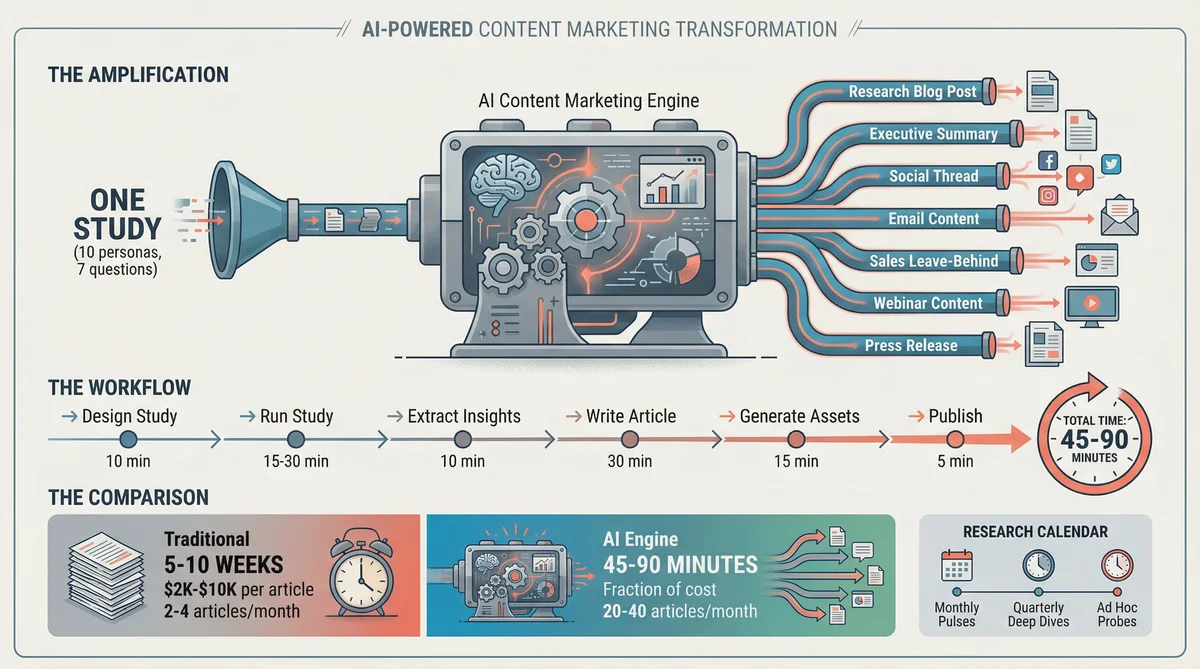
For product marketing teams in particular, this matters enormously. Every study you run generates language, pain points, competitive intelligence, and quotable insights that feed directly into blog articles, battlecards, social posts, email campaigns, sales enablement materials, and webinar content. The study is the atom. Everything else is molecular.
Best Practices That Actually Matter
Before diving into the mechanics, it's worth establishing what separates effective content marketing from the merely prolific. Having spent rather too long studying this, I'd distil it to six principles:
Customer centricity above all. Every content decision should flow from deep customer understanding, not product features. The companies that get this right write in their customers' language about their customers' problems. The ones that don't write corporate monologues that nobody asked for.
Original research is your moat. In a world where anyone can generate a competent 1,500-word blog post using AI, the differentiator is unique data. Primary research that nobody else has. Customer quotes that nobody else can cite. If your content could be written by someone who's never spoken to your customers, it's not content marketing. It's copywriting.
Value over features. Content anchored in customer outcomes outperforms feature-focused material by a wide margin. Nobody wakes up thinking about your product's capabilities. They wake up thinking about their own problems. Meet them there.
Testing loops and rapid learning. The best content teams don't just publish and pray. They test headlines, validate messaging, and iterate based on engagement data. The speed of the feedback loop matters more than the brilliance of any single piece.
Tiered content prevents fatigue. Not every insight warrants a 2,000-word treatise. Some findings deserve a social post. Others merit a full research report. The art is in the triage.
Measure revenue-adjacent signals. Blog views are nice. Demo requests generated from those blog views are better. Track engagement, trial signups, pipeline influence, and the actual utilisation of your content by the sales team. A 60/40 split between leading indicators and lagging ones keeps you honest without sacrificing long-term thinking.
The Ditto and Claude Code Solution
Right, here's where it gets genuinely interesting.
Ditto is a synthetic research platform. It creates AI-powered personas – complete with demographic profiles, media diets, professional backgrounds, and coherent opinions – that behave like actual market research participants. You ask them questions. They respond with the nuance and specificity you'd expect from real people, but available instantly, at a fraction of the cost, and without the logistical overhead of recruitment.
Claude Code is an AI agent that can orchestrate complex, multi-step workflows autonomously. It can design research studies, execute them via Ditto's API, extract insights from the results, write articles, generate metadata, publish to a CMS, create social content, and send personalised emails – all in a single automated sequence.
Together, they form the backbone of a content marketing engine that's genuinely different from anything I've seen in the market.
Here's the production workflow:
Step 1: Design the study (10 minutes). Claude Code creates a 10-persona, 7-question Ditto study tailored to your content thesis. Want to write about how consumers perceive sustainable packaging? The study validates whether that's actually a topic your audience cares about, and generates the raw material for the article simultaneously.
Step 2: Run the study (15–30 minutes). Ditto recruits personas matching your target demographic, asks the questions, and collects rich, detailed responses. Each persona provides thoughtful, substantive answers that reflect genuine consumer perspectives.
Step 3: Extract insights (10 minutes). Claude Code analyses the responses, identifies themes, pulls quotable moments, and structures the findings into a coherent narrative framework.
Step 4: Write the article (30 minutes). Using the research data as its foundation, Claude Code produces a 1,000 to 2,500-word article that's SEO-optimised, structured for both human readers and AI citation, and populated with unique primary data that no competitor can replicate.
Step 5: Generate supporting assets (15 minutes). From that same study, Claude Code produces an infographic, social media threads, email content segments, and a public share link to the original research.
Step 6: Publish and distribute (5 minutes). The article goes live on your CMS with full metadata – SEO descriptions, AI-optimised summaries, key takeaways, quotable insights, and FAQ schema. Social posts go out. Outreach emails land in prospect inboxes.
Total elapsed time: 45 to 90 minutes. Traditional equivalent: 5 to 10 weeks.
Seven Formats From One Study
This is the part that makes finance people slightly emotional. From a single Ditto study, Claude Code can generate:
Research blog post (1,000–2,500 words) – the cornerstone content piece, built on original data
Executive summary – a one-page distillation for time-pressed readers and C-suite stakeholders
Social media thread – three to five posts with quotable insights and data visualisations
Email content – personalised outreach incorporating study findings relevant to the recipient
Sales leave-behind – customer-facing version of findings that sales teams can share with prospects
Webinar or presentation content – slide-ready insights with supporting data
Press release – newsworthy findings formatted for media distribution
Traditional content teams producing these seven formats from scratch would need a researcher, a writer, a designer, a social media manager, and several weeks of coordination. The content marketing engine produces them from a single study in under two hours.
The SEO and GEO Advantage
Here's something that doesn't get enough attention. Google's ranking algorithms have always rewarded original content, but the emergence of GEO – Generative Engine Optimisation – has raised the stakes considerably.
AI assistants are increasingly becoming purchase decision gatekeepers. When someone asks ChatGPT or Claude or Perplexity to recommend a solution, those systems prioritise structured, credible, citation-worthy content. Articles built on original research with clearly stated claims, key takeaways, and quotable insights are precisely what these systems favour.
Every article produced by the content marketing engine includes:
Structured metadata that AI systems can parse and cite
A factual summary optimised specifically for AI retrieval
Key takeaways as discrete, citable data points
Quotable insights drawn from actual research participants
Schema markup for enhanced search visibility
This isn't theoretical. Companies that publish structured, research-backed content are seeing measurably better performance in both traditional search and AI-powered discovery. It's the difference between being found and being invisible.
The Always-On Research Programme
The real power of this approach isn't any single article. It's the cadence.
A properly configured content marketing engine runs on a research calendar:
Monthly pulse checks – three questions, six personas. Quick reads on shifting customer priorities. Each produces at least one blog post and a social thread.
Quarterly deep dives – seven questions, ten personas. Comprehensive exploration of a major theme. Generates a cornerstone article, multiple derivative pieces, and sales enablement content.
Ad hoc targeted probes – five questions, eight personas. Responsive research triggered by competitive moves, market shifts, or emerging trends. Timely content that captures search interest while topics are hot.
Pre-launch studies – concept testing before committing resources. Validates content themes the same way you'd validate a product feature.
A traditional Voice of Customer programme running at this frequency would cost upward of $200,000 annually and require dedicated research staff. With Ditto and Claude Code, it takes roughly two hours per month and costs a fraction of that figure.
Measuring What Matters
The temptation with any content programme is to fixate on vanity metrics. Page views are gratifying but meaningless unless they connect to business outcomes.
The metrics framework I'd recommend for a content marketing engine:
Content-to-lead conversion rate – what percentage of readers take a meaningful action? This is the metric that keeps you honest.
Pipeline influence – which deals had content touchpoints? Multi-touch attribution is imperfect, but directionally useful.
Study share engagement – unique to research-led content. When you publish a public share link to your Ditto study, you can track how many prospects actually explore the underlying research. This is a profoundly strong buying signal.
Sales team utilisation – are your sales colleagues actually using the content? If they aren't, either the content isn't good enough or you haven't made it accessible enough. Both are fixable.
Search ranking trajectory – not position alone, but movement. Are you climbing for your target terms? Original research tends to compound over time as other sites cite your data.
Maintain that 60/40 split between leading and lagging indicators, and resist the urge to optimise for clicks at the expense of quality. A thousand readers who never return are worth less than a hundred who bookmark your site.
The Uncomfortable Truth About Content Marketing in 2026
I'll end with an observation that might be slightly uncomfortable.
McKinsey reports that 89% of decision-makers consider AI-driven personalisation critical over the next three years, and that companies applying generative AI to marketing see up to 15% improvement in personalisation performance. The direction of travel is unmistakable. Content marketing is becoming an AI-native discipline.
This doesn't mean human judgment is obsolete. Quite the opposite. The companies that will win are those that combine AI-powered research velocity with genuine editorial intelligence – teams that can design insightful studies, recognise the interesting signal in the noise, and craft narratives that resonate with actual humans.
The content marketing engine isn't about replacing the product marketer. It's about giving them superpowers. Instead of spending three weeks producing one article based on recycled survey data, they spend 90 minutes producing seven pieces of content built on original research that nobody else has.
If your content could be written by someone who's never spoken to your customers, it's time to rethink your approach. The engine is ready. The question is whether you are.