
There is a peculiar optimism that overtakes product marketing teams when they're building a go-to-market strategy. They gather in a room – or, these days, a Zoom that nobody has remembered to record – and produce a document that reads like a battle plan. Target segments, selected. Motion type, chosen. Channels, mapped. Launch date, circled in red. Everyone leaves feeling clever and purposeful.
Then it hits the market, and the market declines to cooperate.
The channel strategy assumed buyers discover products through LinkedIn. They don't – they ask a colleague over coffee. The sales-led motion assumed buyers want a demo. They don't – they want a free trial they can poke at on a Sunday evening. The pricing assumed enterprise buyers would pay for premium features. They won't – they consider those features table stakes and are irritated you'd charge extra.
The go-to-market strategy was perfectly logical. It was also perfectly wrong. Not because the team lacked intelligence, but because the strategy was built on assumptions about buyer behaviour that nobody had validated.
This is the GTM problem in a nutshell: the most consequential decisions – where to focus, how to sell, what to charge, and how to reach people – are routinely made on the basis of executive intuition and competitive mimicry rather than evidence from the people you're trying to reach.
What Go-to-Market Actually Means (and What It Doesn't)
Let's be precise, because "go-to-market" has become one of those phrases that means whatever the speaker needs it to mean. A GTM strategy is a comprehensive plan covering how a product will be positioned, priced, promoted, and distributed to a specific market. Gartner breaks it into three phases: analyse (define the market and map the customer journey), design (select target segments and craft a differentially better value proposition), and deliver (optimise sales, marketing, pricing, and distribution).
The critical word is "comprehensive." A GTM strategy is not a launch plan, though it includes one. It's not a channel strategy, though it specifies channels. It's not a pricing decision, though pricing is a component. It's the architecture that connects all of these pieces into a coherent motion.
And here's the insight that most GTM planning misses: GTM is not just for launches. Every pricing change, every feature rollout, every market pivot, every expansion into a new segment needs a GTM motion. The companies that treat GTM as a one-time event for major launches are making major decisions about minor releases without any strategic framework at all.
The Five GTM Decisions That Matter
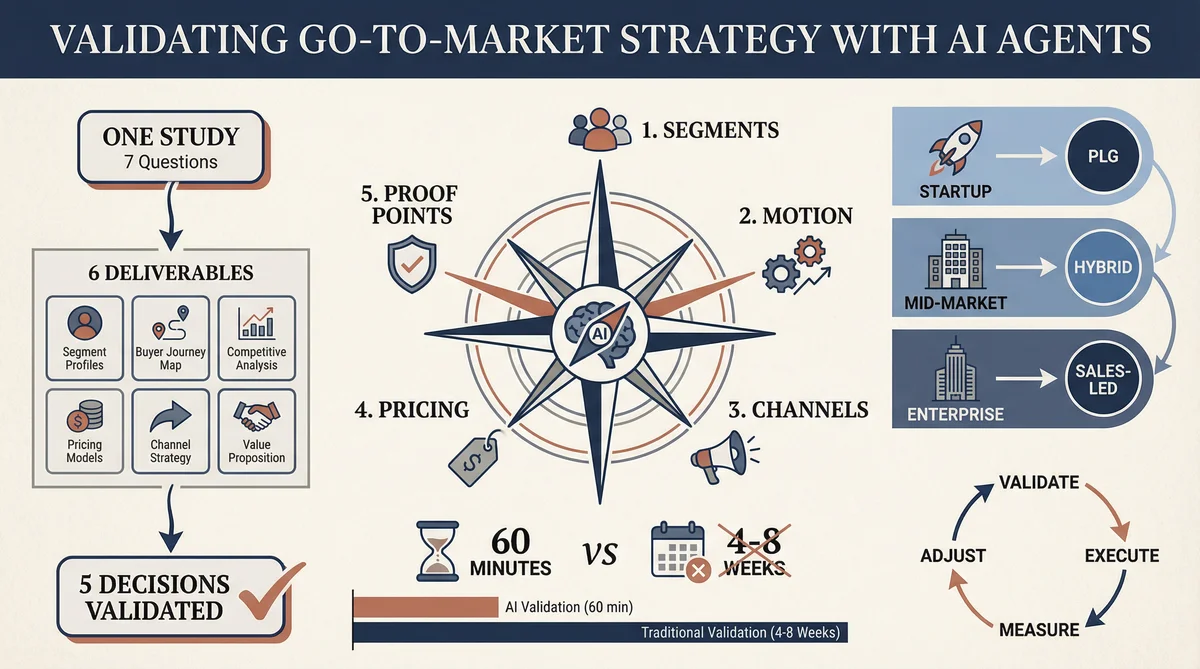
Strip away the frameworks and consultancy jargon, and GTM comes down to five decisions. Get these right and the rest follows. Get any one wrong and the entire motion is compromised.
Which segments to target – and, equally important, which to ignore. Most GTM failures come from trying to serve everyone. The discipline is in choosing one to two beachhead segments with clear exclusion criteria.
Which motion to use – product-led growth (the product drives acquisition through free trials and freemium), sales-led (a sales team drives revenue through relationships and demos), or hybrid. McKinsey's research on product-led sales documents the shift: most successful modern SaaS companies now use a hybrid where product usage data informs sales outreach timing.
Which channels to prioritise – owned (website, email), earned (analyst coverage, podcasts, word of mouth), or paid (search, social advertising). The trap is defaulting to what you've always done rather than what your buyers actually respond to.
What pricing and packaging to offer – not just the number, but the structure. Trials, pilots, freemium, bundled packages. The offer design determines who can say yes without committee approval and who requires a procurement process.
What proof points to lead with – case studies, analyst endorsements, free audits, product data. Different segments need different evidence to feel confident buying. The enterprise buyer needs a security whitepaper. The startup founder needs to see a similar company succeed.
Each of these decisions is currently made based on a cocktail of competitive analysis ("Competitor X does it this way"), historical precedent ("We've always used a sales-led motion"), and executive preference ("I think we should try PLG"). What's conspicuously absent from this cocktail is the perspective of the people you're trying to reach.
Validating GTM Decisions Before They Become Expensive Mistakes
Here's where it gets interesting, and where the economics change rather dramatically.
Ditto is a synthetic research platform with over 300,000 AI-powered personas, each with a demographic profile, professional background, media diet, and coherent set of opinions. Claude Code is an AI agent that orchestrates the entire workflow: designing the study, recruiting personas, asking questions, interpreting responses, and generating structured deliverables.
A single GTM validation study – 10 personas, 7 questions – takes approximately 25 minutes. Claude Code then transforms the responses into a set of deliverables that directly inform those five GTM decisions. Total time from zero to validated strategy inputs: roughly one hour.
The traditional approach to GTM validation – if companies bother with it at all – involves customer interviews, analyst conversations, and sales team debriefs spread across four to eight weeks. Most companies skip validation entirely, preferring the faster route of guessing confidently.
The Seven Questions That Validate a GTM Strategy
These seven questions are engineered to produce actionable data for every major GTM decision. Each question targets a specific component of the strategy, and several do double duty.
Q1: "When you last evaluated a new [product category] solution, how did you discover it? What channels, sources, or recommendations led you there?"
This is the channel strategy question. When eight out of ten personas say they discovered their current solution through a colleague's recommendation rather than a Google search, your paid search budget needs rethinking. The gap between where companies think buyers discover products and where they actually discover them is consistently one of the most valuable findings in GTM research.
Q2: "Who else in your organisation would be involved in a purchase decision for [product type]? What are their concerns versus yours?"
Buying committee mapping. In B2B, the person you're talking to is rarely the only decision-maker. This question reveals the invisible stakeholders – the IT security reviewer who has veto power, the finance director who controls budget approval, the end user whose resistance can kill adoption. Each stakeholder has different concerns, and your GTM must address all of them.
Q3: "What would make you choose to try a free trial versus request a demo versus talk to a salesperson? What signals tell you which path to take?"
This is the motion selection question, and it produces genuinely surprising results. Many companies default to sales-led because it feels "safer" for complex products. But when personas tell you they'd strongly prefer to self-serve and only want to talk to sales after they've already formed an opinion, you've just discovered that your sales-led motion is creating friction rather than removing it.
Q4: "If a company reached out to you unsolicited with a free [research/audit/analysis] of your business, how would you react? What would make you open that email versus delete it?"
Outreach strategy. This question separates the approaches that generate engagement from those that generate annoyance. The specificity matters: personas don't just tell you whether they'd open the email – they tell you what the subject line would need to say, what the offer would need to contain, and what would trigger immediate deletion.
Q5: "What's your biggest frustration with how [product category] vendors typically sell to you?"
Sales experience gaps. This is the question that reveals what your competitors are doing wrong in their GTM execution – and where you can differentiate not through product superiority but through a better buying experience. When seven personas say "I hate that I can't see pricing without talking to sales," you've found a GTM advantage that costs nothing to implement.
Q6: "If you could get [core value] in [timeframe] at [price point], would that feel like a good deal, fair, or overpriced? What would tip you?"
Pricing validation in the context of value perception. This isn't just "would you pay X" – it frames the price against a specific value delivery, revealing how buyers anchor their willingness to pay. The responses inform not just the price point but how to frame pricing in sales conversations.
Q7: "What would you need to see or experience to feel confident recommending [product type] to your boss or team? What proof matters most?"
Proof point strategy. Different buyer segments need different evidence. Some need case studies from their industry. Others need a free trial. Others need analyst endorsements. When you know which proof points matter most to your target segment, you can prioritise content creation accordingly – rather than producing a library of assets that nobody asked for.
What the Study Actually Produces
Claude Code transforms the raw persona responses into six GTM-specific deliverables:
Channel preference matrix – how buyers in your target segment actually discover, evaluate, and select products in your category. Ranked by frequency, with the specific channels named. This replaces the assumption-based channel strategy with evidence.
Buying committee map – the stakeholders involved in purchase decisions, their roles, their concerns, and their relative influence. For B2B products, this is the most operationally valuable deliverable. It tells your sales team who else to engage and what each stakeholder needs to hear.
Motion recommendation – product-led, sales-led, or hybrid, based on buyer preferences rather than company tradition. Includes the specific triggers buyers identified for choosing each path ("I'd try a free trial if it didn't require a credit card" versus "I'd want a demo if the product is complex enough to need guidance").
Outreach messaging strategy – what gets opened versus what gets deleted, derived from Q4 responses. Includes subject line patterns, offer types, and the specific triggers that move buyers from "interesting" to "I'll take a meeting."
Pricing perception analysis – where value thresholds sit for your target segment, how buyers frame the value-price relationship, and where your pricing might be creating unnecessary friction.
Proof point priority list – the evidence your buyers actually need, ranked by importance. When the study reveals that buyers in your segment care more about a same-industry case study than an analyst endorsement, you know where to invest your content budget.
Multi-Segment GTM: Why One Strategy Doesn't Fit All
Here's where the approach becomes properly powerful.
Most companies develop one GTM strategy and apply it across all segments. The startup buyer gets the same sales process as the enterprise buyer. The technical evaluator gets the same proof points as the economic buyer. This works roughly as well as you'd expect, which is to say it doesn't.
With Ditto, you can run the same seven GTM questions against three or four different persona groups – each representing a distinct segment – and compare the responses systematically. Claude Code orchestrates the parallel studies and produces a comparative analysis.
Imagine running the study against three groups:
Group A: Startup decision-makers (aged 25–40, employed, description: professionals at companies under 50 employees)
Group B: Mid-market managers (aged 30–50, bachelor's degree, description: managers at companies with 50–500 employees)
Group C: Enterprise evaluators (aged 35–55, master's degree, description: senior professionals at companies with 500+ employees)
The findings routinely reveal that each segment needs a fundamentally different GTM motion:
Startups discover products through Twitter and peer recommendations, want a free trial with no credit card, make purchase decisions in days, and need to see a company similar to theirs succeeding.
Mid-market discovers through Google search and industry publications, wants a guided demo after initial self-exploration, involves two to three stakeholders, and needs a same-industry case study with ROI data.
Enterprise discovers through analyst reports and vendor shortlists, requires a structured procurement process, involves five to seven stakeholders, and needs security compliance documentation before anything else.
A single GTM strategy cannot serve all three. The startup motion is product-led. The mid-market motion is hybrid. The enterprise motion is sales-led. The channel mix is different. The proof points are different. The sales cycle is different. Treating them identically wastes budget on channels that don't reach the segment and proof points that don't convince them.
The marginal cost of running two additional studies is approximately 50 minutes of compute time. The cost of a misaligned GTM strategy applied to a segment worth millions in pipeline is rather higher.
The GTM Feedback Loop
A GTM strategy is not a document. It's a hypothesis. And hypotheses should be tested, measured, and updated.
The traditional GTM lifecycle looks like this: research (maybe), plan, execute, measure (eventually), update (reluctantly). The feedback loop takes quarters. By the time the market data suggests the channel strategy isn't working, you've spent a full quarter's budget on it.
With Ditto and Claude Code, the feedback loop tightens to weeks:
Pre-launch: Run the full 7-question GTM validation study. Build the strategy on evidence rather than assumption.
Month 1: Execute the GTM strategy. Collect real-world performance data: which channels are generating pipeline, which aren't; which proof points are being requested; how the sales process is actually unfolding.
Month 2: Run a targeted follow-up study (5 questions, 8 personas) testing the specific elements that underperformed. Did the channel strategy miss? Is the outreach messaging landing? Are buyers confused by the pricing?
Month 3: Adjust. Rerun the validation study with updated assumptions. Compare with the pre-launch baseline. Measure the drift between what buyers said they'd do and what the market data shows they actually did.
Quarterly: Full GTM refresh. Fresh personas, same seven questions. Track how buyer channel preferences, committee structures, and proof point requirements are evolving. Update the strategy accordingly.
This turns GTM from a static plan into an adaptive system. The strategy improves with every cycle because each iteration incorporates both synthetic research (what the market says it wants) and real-world data (what actually happened). The gap between the two is where the most valuable learning lives.
The Motion Decision: PLG, Sales-Led, or Hybrid
The motion decision – how you actually sell – deserves special attention because it's the GTM choice with the highest stakes and the least validation.
Most companies choose their motion based on what feels natural to the founding team. Technical founders default to PLG because they personally prefer to try products without talking to salespeople. Sales-experienced founders default to sales-led because they know how to build pipeline. Neither approach is wrong, but neither is validated against what buyers actually prefer.
Question 3 in the study design targets this directly: "What would make you choose to try a free trial versus request a demo versus talk to a salesperson?" The responses consistently reveal that buyer motion preferences are more nuanced than the binary PLG-versus-sales debate suggests:
Many buyers want to self-serve first and only engage sales after they've formed an initial opinion. This is the product-led sales (PLS) hybrid that McKinsey documents in their research on PLG evolution.
The trigger for engaging sales is often not product complexity but purchase complexity: "I'd try the free trial myself, but I'd need sales to help me get budget approval."
Some segments actively avoid free trials because they don't have time to evaluate: "Just show me the demo. I'll know in 15 minutes if it's worth pursuing."
The word "salesperson" carries negative connotations for certain segments. When the same concept is reframed as "product specialist" or "solution consultant," receptivity increases. Language matters in motion design.
These insights are impossible to generate from internal planning sessions. They require asking buyers. The study makes this possible in 25 minutes rather than 25 interviews.
Measuring Whether Your GTM Strategy Is Working
A validated GTM strategy should improve measurable outcomes. Here's what to track:
Pipeline velocity. The formula is (win rate × average contract value × number of qualified opportunities) ÷ sales cycle length. A well-targeted GTM increases the numerator (better leads, higher win rates) and decreases the denominator (shorter cycles). If pipeline velocity doesn't improve after GTM revision, either the strategy needs further iteration or the execution is misaligned.
Channel efficiency. Track cost per qualified lead by channel. If the GTM study identified peer recommendations as the primary discovery channel but your budget is concentrated on paid search, reallocating should produce measurable improvement in cost per lead.
Proof point utilisation. Which proof points are being requested by prospects and used by the sales team? If the GTM study identified same-industry case studies as the top proof requirement but your sales team is leading with analyst reports, there's a misalignment to correct.
Buying committee coverage. Are deals stalling at specific stakeholders? If the GTM study identified IT security as a key buying committee member and your deals consistently stall at security review, the strategy needs a dedicated security proof point or a faster compliance response.
Motion conversion rates. If you shifted from pure sales-led to a PLG component based on study findings, track trial-to-paid conversion separately from sales-led conversion. The study told you buyers prefer self-serve first – measure whether that preference translates into actual behaviour.
GTM Strategy Was Never the Problem. GTM Assumptions Were.
Product marketing teams are extraordinarily good at building go-to-market strategies. They're experienced, thoughtful, and strategically literate. The frameworks they use – Gartner's analyse-design-deliver, McKinsey's PLG evolution model, segment-motion-channel matrices – are genuinely useful.
The problem has never been the quality of the thinking. It's been the quality of the inputs. A beautifully constructed GTM strategy built on incorrect assumptions about buyer channel preferences, committee structures, and motion preferences will produce beautiful results in the slide deck and disappointing results in the pipeline.
What Ditto and Claude Code make possible is a shift from assumption-based GTM to evidence-based GTM. Run the seven questions against your target segment. Discover how they actually discover, evaluate, and buy products in your category. Build the strategy on what they told you rather than what you assumed.
The traditional GTM validation process – when companies bother with it – takes four to eight weeks and costs enough to make most teams skip it. The Ditto and Claude Code approach takes roughly the time it takes to have lunch. I appreciate that this sounds like a pitch, and perhaps it is, but the maths is genuinely that simple: seven questions, ten personas, twenty-five minutes, six deliverables that directly inform the five decisions that determine whether your product reaches its market or misses it.
For multi-segment products, run the study against three or four buyer groups and produce segment-specific GTM plans in an afternoon. For ongoing optimisation, run quarterly refreshes that track how buyer behaviour is evolving. For pre-launch validation, test the strategy before committing the budget.
The best GTM strategies, as the saying goes, are "just positioning, executed." The corollary is that the best GTM validation is just Voice of Customer, applied to the five decisions that matter most. You already know the questions. Now you have a way to get the answers before the market teaches you the hard way.