
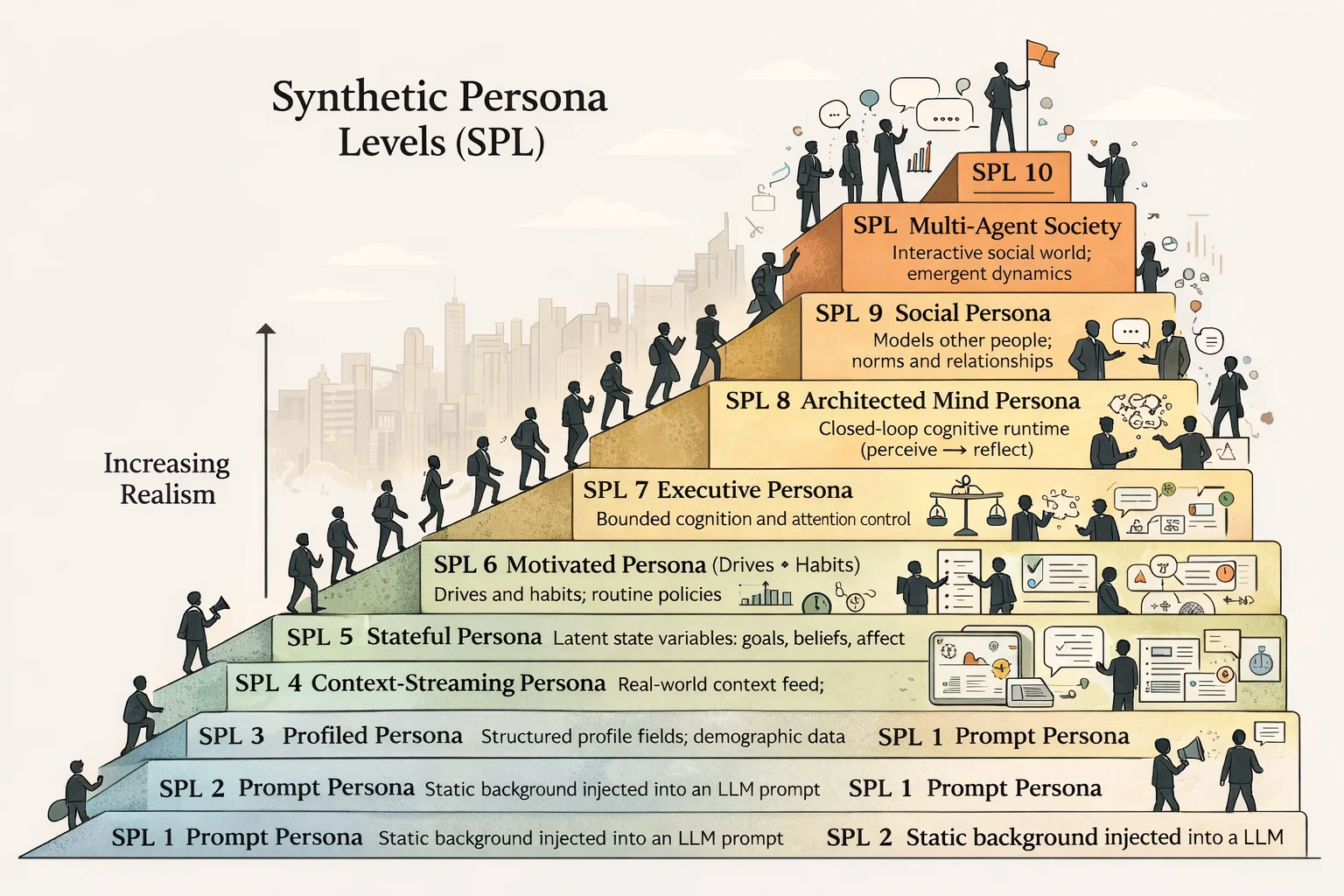
Synthetic Persona Levels (SPL): A Standard Nomenclature for Synthetic People
A practical classification system for synthetic personas, from prompt-only profiles to interactive multi-agent societies.
Introduction
As the field of synthetic market research grows, the term “synthetic persona” has become unclear and poorly defined.
Some vendors use it to describe a single prompt with demographic flavour text. Others mean agents with persistent memory, beliefs, mood, and long-run consistency. Still others refer to panels of agents that evolve over time, consume information streams, and influence each other socially. Without an agreed standard, buyers cannot reliably compare systems, and practitioners cannot specify what level of realism and scientific traceability they require.
The Synthetic Persona Levels (SPL) framework is a discrete, capability-based ladder that makes synthetic personas legible. Each level introduces a clearly testable step-change in cognitive or behavioural fidelity: memory, temporal context, latent state, motivations, bounded cognition, reflection, social cognition, and finally interactive societies. We don't want to force a single implementation, but we do want standardise the functional claims a system can responsibly make.
The Synthetic Persona Levels (SPL) framework is a discrete, capability-based ladder that makes synthetic personas legible
For Ditto, SPL functions as a technical and commercial shorthand. When we say a persona is SPL 8, it means it runs a closed-loop cognitive runtime (perceive → appraise → update state → decide → act → reflect), with structured memory types and consolidation. When we say SPL 10, it means the personas are not merely “social-aware”; they interact continuously in a simulated social world and produce emergent dynamics such as diffusion, norm formation, and polarisation.
Quick lookup table
SPL | Level name | Definition (what it adds) | Capabilities |
|---|---|---|---|
SPL 1 | Prompt Persona | Basic background injected as an LLM prompt | Plausible single-turn responses |
SPL 2 | Profiled Persona | Structured persona history and background | Stable demographics/attributes and basic segmentation |
SPL 3 | Retrieval Persona (Episodic Memory) | Memories, history, remembers prior conversations | Remembers prior interactions and experiences when cued |
SPL 4 | Context-Streaming Persona | External “world feed” e.g. news, social media, prices, etc | A meaningful “today”; time-sensitive reactions and drift |
SPL 5 | Stateful Persona (Latent Variables) | Dynamic internal state (goals, beliefs, affect, constraints) | Realistic within-person variance and longitudinal coherence |
SPL 6 | Motivated Persona (Drives + Habits) | Driver, deficits and planning | Routine behaviour, friction, impulse vs deliberation |
SPL 7 | Executive Persona (Bounded Cognition) | Attention limits, salience scoring, inhibition, switching costs | Satisficing, context effects, fatigue effects, realism under load |
SPL 8 | Architected Mind Persona (Closed-Loop Runtime) | Perceive → Appraise → Update → Decide → Act → Reflect, with consolidation | Auditable mediators and stable evolution over time |
SPL 9 | Social Persona (Theory of Mind) | Models other people, relationships, norms, and social inference. | Social desirability, household negotiation, trust dynamics |
SPL 10 | Multi-Agent Society (Interactive Social World) | Personas interact continuously, producing emergent social dynamics | Diffusion, norm formation, polarisation, cascades, subcultures |
Detailed Definitions of the Synthetic Persona Levels (SPL) ladder
SPL 1 — Prompt Persona
Definition: A Prompt Persona is a static block of descriptive text (e.g., demographics, a short biography, a few preferences) inserted into an LLM prompt. The persona has no persistent internal state and no memory beyond what fits in the immediate context window.
What it delivers: SPL 1 is useful for generating plausible “voice of customer” outputs quickly. It can produce coherent single-turn answers, and it can be styled to approximate a segment’s tone or vocabulary. It's cheap and easy to create, and you can probably do it yourself with ChatGPT. However, it's inaccurate, simplistic, and behaves like a one-off improvisation each time it is run.
Typical failure modes: The same persona will contradict itself across sessions, drift in preferences, and show unrealistic stability to framing. From a research perspective, SPL 1 is closer to copy ideation than a reliable synthetic respondent.
SPL 2 — Profiled Persona
Definition: A Profiled Persona stores structured attributes (age, region, household composition, income band, category usage, lifestyle, etc.) and reliably re-injects them into each interaction. The persona still does not maintain an event history in a meaningful way, but its “facts about the person” remain stable.
What it delivers: SPL 2 supports basic segmentation and repeatable attribute-conditioned responses. It reduces contradictions around stable personal details and enables consistent surface-level differentiation across a set of personas.
Where it breaks down: Without memory and internal dynamics, SPL 2 cannot credibly model learning, persuasion over time, or the effect of lived experience on attitudes. It is best understood as a structured, repeatable prompt template.
SPL 3 — Retrieval Persona (Episodic Memory)
Definition: SPL 3 introduces memory as a first-class system component. Interactions and events are stored (e.g., as an event log and/or embeddings in a retrieval index), and relevant prior episodes are retrieved and injected into the LLM context when the persona is asked about related topics.
What it delivers: The persona can reference earlier conversations, recall prior product experiences, and maintain continuity across longer studies (e.g., multi-session interviews or diaries). Importantly, it can anchor explanations in prior “episodes” rather than inventing a new life story each time.
Research implications: SPL 3 enables longitudinal qualitative work, but it must be handled carefully to avoid “perfect recall.” Human memory is cue-based, partial, and biased by what is salient. A robust SPL 3 implementation therefore includes relevance thresholds, recency effects, and controlled retrieval breadth.
SPL 4 — Context-Streaming Persona (Current Affairs / Environment Feed)
Definition: SPL 4 adds a dynamic external context stream: news, cultural discourse, pricing environment, category signals, weather, and other “world state” inputs that change over time. The persona now has a meaningful “today,” and its opinions can shift in response to the information environment.
What it delivers: This level is critical when evaluating messaging, concepts, or positioning that is sensitive to macro sentiment. A persona that cannot react to inflation narratives, trust shocks, social discourse, or category-level disruptions is missing the context that shapes real consumer interpretation.
Operational note: Context streams must be handled as structured observations with source credibility and relevance tagging, not as an unfiltered dump of headlines. Otherwise, the persona becomes either noisy (reacting to everything) or brittle (over-fitting to a single input).
SPL 5 — Stateful Persona (Latent State Variables)
Definition: SPL 5 introduces persistent internal state beyond demographics and memory. This includes affect (mood/emotion/arousal), goals, constraints, and probabilistic beliefs with confidence. State evolves over time in response to perceived events and internal dynamics.
What it delivers: SPL 5 produces realistic within-person variance: the same agent can respond differently on different days for plausible reasons (fatigue, stress load, goal pressure, social context). It also makes survey-like behaviours more realistic: attention, patience, and elaboration can vary systematically.
Why this matters: In human research, “noise” often reflects latent variables the researcher did not measure. SPL 5 makes those variables explicit. This allows a research team to interpret outputs not only as text, but as a function of state mediators.
SPL 6 — Motivated Persona (Drives + Habits)
Definition: SPL 6 adds an explicit motivational system: drive setpoints and deficits (e.g., safety, belonging, autonomy, competence, comfort, novelty), plus procedural behaviour and habits. Habits provide default policies that compete with deliberative reasoning.
What it delivers: This is where personas stop behaving like perpetual optimisers. Many consumer actions are habitual and context-triggered, and preference statements are often post-hoc rationalisations of routine behaviour. SPL 6 can reproduce switching friction, impulse purchases, and routine consumption patterns.
Mechanistic clarity: Drives influence what becomes salient, which plans are considered, and which memories are strongly encoded. Habits determine what the persona does when attention is low or time is constrained. Together, they produce realistic “messiness” without reducing the model to randomness.
SPL 7 — Executive Persona (Attention + Executive Control)
Definition: SPL 7 implements bounded cognition and executive control: salience scoring, working-memory limits, planning depth modulation, inhibition, and task-switching costs. This is the cognitive machinery that explains satisficing, fatigue effects, and context sensitivity.
What it delivers: Under cognitive load or low energy, SPL 7 personas become more habitual, less exploratory, and more likely to settle for “good enough.” Under calm focus, they plan more deeply and articulate more nuance. This produces realistic survey effort profiles and response-quality variation.
Research realism: SPL 7 is where question-order effects and framing effects become robust rather than incidental. Because attention is scarce, what is foregrounded shapes what is processed and remembered, which in turn changes subsequent outputs.
SPL 8 — Architected Mind Persona (Closed-Loop Mind Loop + Reflection)
Definition: SPL 8 implements a closed-loop cognitive runtime: Perceive → Appraise → Update State → Decide → Act → Reflect. It formalises memory types (episodic, semantic, procedural, autobiographical, social), and it includes reflection and consolidation cycles that compress experiences into stable knowledge and narrative.
What it delivers: This level produces longitudinal coherence with interpretability. Outputs are not only plausible; they are explainable through logged mediators: what the persona perceived, what it attended to, which beliefs updated, what goal was activated, and what was stored in memory after the event.
Why it is a step-change: SPL 8 is the point where a persona behaves like a system rather than a conversation. It can run continuously, evolve realistically, and support controlled manipulations where the researcher can isolate causal pathways across cognition, affect, and memory.
SPL 9 — Social Persona (Theory of Mind + Relationship Dynamics)
Definition: SPL 9 adds social cognition as a structured layer. Personas build models of other people: inferred traits, relationship histories, norms, predicted beliefs (“they think I’m…”), and social constraints. Social perception and impression management become active components of behaviour.
What it delivers: SPL 9 can reproduce social desirability effects, household negotiation, trust dynamics, reputational concerns, and norm sensitivity. It also enables realistic interpersonal explanations: “I wouldn’t buy that because my friends would judge it,” or “I’d ask my partner first.”
Practical value: Many product decisions are social decisions, even when the purchase is individual. SPL 9 is essential for word-of-mouth modelling, influencer resonance, group identity messaging, and the social context of adoption and churn.
SPL 10 — Multi-Agent Society (Interactive Human-Like Social World)
Definition: SPL 10 is a living social environment in which personas interact continuously as if they are actual humans embedded in networks. They talk, observe, imitate, argue, negotiate, coordinate, and influence one another over time. Outcomes emerge endogenously from agent-to-agent interactions rather than being produced solely by external prompts.
What it delivers: SPL 10 produces emergent macro patterns: diffusion curves, cascades, norm formation, reputational dynamics, polarisation, subculture formation, and “what people are talking about” effects. This enables research that tests not only individual preference but also the social mechanisms that determine whether a product, message, or narrative spreads.
Core components: SPL 10 typically includes network structure (households, communities, weak ties, hubs), multiple interaction channels (private chat, group chat, public posts), and influence mechanisms (homophily, conformity pressure, prestige bias, reactance/backlash). It also tracks relationship memory and reputation, so interactions accumulate meaning over time and create realistic social histories.
Audit-style checks: A robust SPL 10 system shows different adoption outcomes when a stimulus is seeded through high-centrality nodes versus random nodes; it shows clustering and echo-chamber effects under divisive stimuli; and it shows community-specific norms about acceptable language and behaviour rather than uniform reactions across the entire population.
Summary
The SPL framework is intended to provide a practical ladder for describing what a “synthetic persona” actually is.
This scale allows you to compare between different vendors and providers to see what you're getting. $40 per month for an SPL1 - great! But does your manager need something more like an SPL5 or 6 to be confident in your insights and recommendations.
SPL 1-2 personas are great for simple checks, and you can often even create them yourself! But it's SPL 5+ where the personas become human-like, where research groups become auditable, and where responses are valid. Ditto currently provides access to SPL 5-8 personas, depending upon our clients' needs.
SPL 9 and 10 are currently hypothetical, but they're a huge leap in cognitive capability and the depth of modelling that can occur. In essence they turn the personas into "living humans in the matrix" - so they actually interact, talk to each other, argue, and problem-solve.
We hope this simple scale allows you to clearly assess what type of persona you're using and how much you can trust the results!