When Horizon Capital acquired Juniper Education in 2019, they bought into a market in flux. The UK school management information system (MIS) sector was dominated by SIMS, a legacy player with 85% market share. Fast forward to 2026, and SIMS has cratered to 32% while cloud-native challengers like Arbor (44%) and Bromcom (16%) have surged. Juniper sits at roughly 8% market share, with a unique freemium model and deep penetration into Multi-Academy Trusts (MATs).
But what do schools actually want? What would make them switch? And is Juniper positioned to capture the next wave of growth? We ran a comprehensive synthetic research study with 12 UK adults to find out. The findings have significant implications for Horizon Capital's investment thesis and any future exit.
The Study: 7 Questions, 12 Participants, One Goal
We surveyed 12 UK adults across Birmingham, Leeds, Bristol, Cardiff, Swansea, Liverpool, and London. The questions covered administrative pain points, brand perceptions, switching barriers, decision-making processes, pricing model reactions, MAT-specific needs, and future requirements.
The objective was clear: understand customer stickiness, competitive positioning, and growth potential from a private equity due diligence lens.
The Four Horsemen of School Admin Pain
One phrase emerged repeatedly across all 12 participants. Schools are plagued by what one respondent called 'the four horsemen of school admin':
Duplicate entry across systems that don't talk to each other
Systems that refuse to integrate (MIS, finance, HR, safeguarding all siloed)
Shifting compliance rules from DfE, Ofsted, and GDPR
Zero protected time for administrative tasks
'If I'm sat in a school office with a cold coffee and a dying printer, these are the bits that would chew my day and my patience: attendance codes are a maze, safeguarding adds pressure, and the DfE census is spreadsheets on top of spreadsheets with the fear of sending something off that will boomerang back.' — Mariel Santos, Bristol
The pain is real and persistent. Teachers spend 10+ hours per week on non-teaching tasks. Office staff are constantly interrupted mid-task, restarting everything three times while worrying about missing a safeguarding detail. Census deadlines trigger genuine anxiety. September is 'basically Tetris with feelings.'
Brand Perceptions: Where Juniper Stands
We asked specifically about the four major MIS providers: SIMS, Arbor, Bromcom, and Juniper. The responses were illuminating.
SIMS was described as 'old but solid' with deep data but terrible UX. Schools stick with it because of inertia, not love. One respondent noted it 'feels like a free printer that drinks gold ink.'
Arbor is winning the migration battle. The parent app is 'cleaner', payments and trip consents are 'less faff', and messages are clearer. Migration week can be chaotic, but day-to-day it 'feels lighter than SIMS.'
Bromcom is seen as powerful for timetables and analytics but 'busy and bitty on screen, like too many panes shouting at you.' Support is hit-or-miss.
Juniper (including ScholarPack and Pupil Asset brands) is known for 'simple register flow for primaries.' However, 'reporting feels shallow once SLT wants fancy cuts, and the parent bits feel basic compared to Arbor.'
'My big-picture take: permissions hell, duplicate entry, and brittle reporting are the common griefs. The one that wins is the one that sends one clear message to parents and lets the office run attendance and dinner money without five spreadsheets.' — Mariel Santos, Bristol
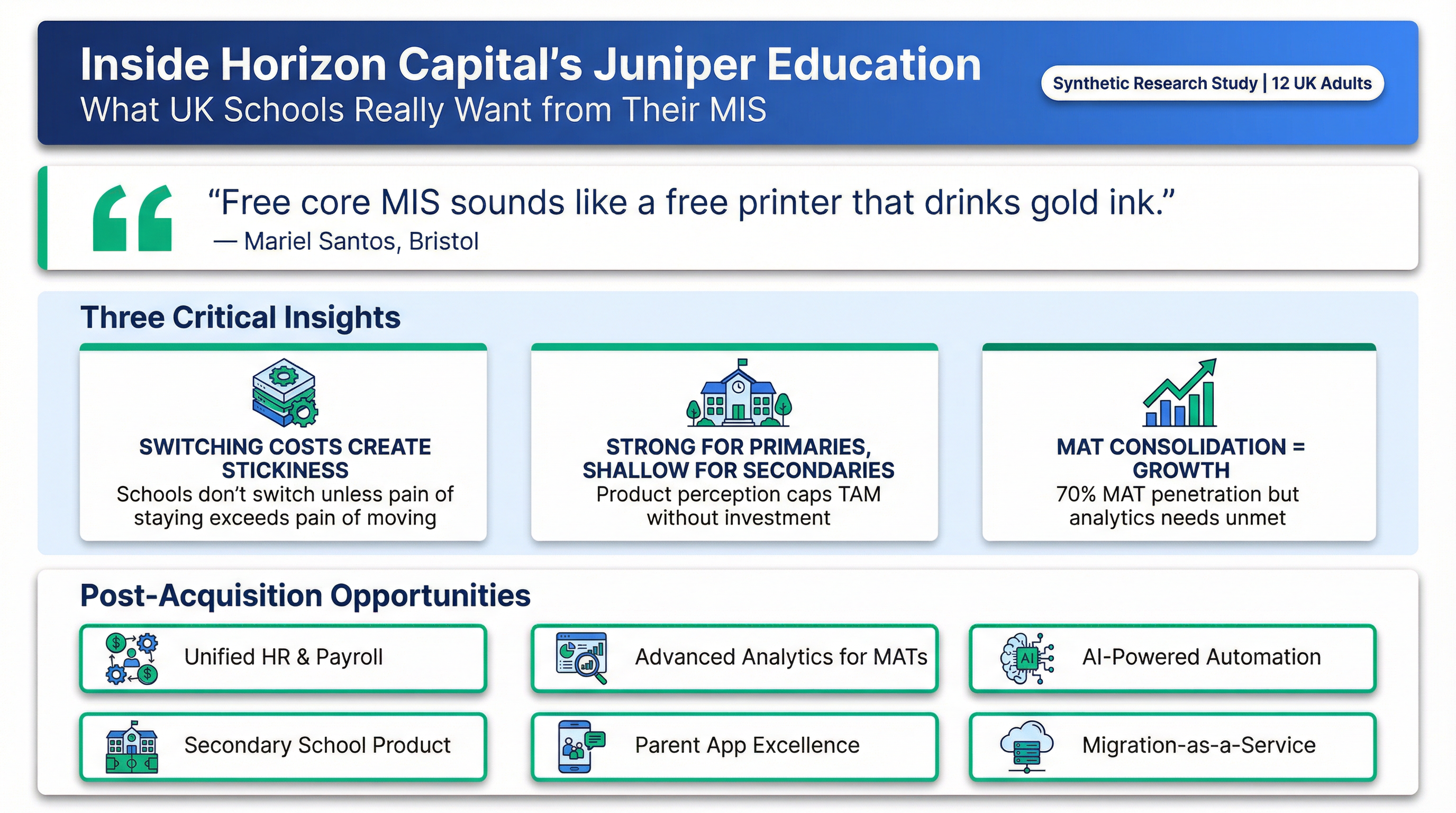
This is a critical finding for Horizon Capital. Juniper is perceived as 'good for primaries, shallow for secondaries.' This caps the total addressable market unless product gaps close.
Switching Barriers: The Moat is Real
Here's the good news for investors: switching costs are extremely high. Schools don't switch unless 'the pain of staying beats the pain of moving.' The barriers include:
Data migration risk — historic trends, attachments, medical plans, safeguarding notes could be lost
Contract lock-in — awkward notice periods, exit fees, unclear data ownership
Staff retraining — muscle memory, shortcuts, change fatigue
Integration breaks — finance, HR, safeguarding, catering dependencies
September fear — nobody wants a wobble during the busiest week
'Schools don't switch unless the pain of staying beats the pain of moving. If go-live stumbles, the office gets the blame while providers swap tickets. Morale cost is real.' — Sarah Cartwright, Birmingham
What would make switching easier? Fixed-scope migration with data audits, parallel runs with rollback options, role-based training with cover, and transparent pricing with fair exit terms. Schools want references from 'three schools like us — same phase, size, deprivation mix — willing to show their numbers and say where it hurt.'
The Freemium Model: Attractive But Risky
Juniper's unique value proposition is a free core MIS with paid add-ons for HR, payroll, analytics, and premium support. We tested this model directly with our participants.
The reaction was mixed. Freemium is attractive to cash-strapped governors and for pilots. But there's deep suspicion.
'"Free core MIS" sounds like a free printer that drinks gold ink. Attractive to governors on a tight budget, but my office-brain hears hidden gaps and upsells at the worst possible moment. If support sits behind a paywall or parent comms is not included, it is a non-starter for me.' — Mariel Santos, Bristol
The critical insight: the base package MUST include registers, attendance tools, parent comms, payments, safeguarding logging, census tools, SSO, and normal support. If schools need to pay extra for a human at 8:45am when registers break, trust evaporates.
Participants suggested a middle path: free core plus a single 'Essentials bundle' priced per pupil that includes parent comms, payments, census tools, and standard support. Expected annual pricing ranged from £5-12k for primaries to £20-40k for secondaries.
The MAT Opportunity: Juniper's Sweet Spot
Multi-Academy Trusts are growing rapidly in the UK, and Juniper claims 70% MAT penetration. Our research confirms this is a massive opportunity, but also reveals unmet needs.
MATs need what individual schools don't:
Data consistency — same codes, same definitions, same cut-off dates across all schools
Central vs local balance — policies and templates that harmonise without suffocating
Safeguarding oversight — trust-level pattern detection with strict role-based access
Staffing at scale — FTE tracking, agency spend, and staff working across multiple sites
Trust-wide dashboards — live KPIs for CEO, CFO, and Director of Education
'MATs are herding five different schools' habits into one tidy story while the clock and Ofsted both glare. The hard bit is standardise without suffocating — kill duplicate entry, but don't flatten what makes a school actually work.' — Marek Zielinski, Birmingham
A single MIS across the trust is seen as 'high' importance — but only if it allows local workflows and has a sane migration plan.
Investment Thesis Implications for Horizon Capital
Positives
High switching costs = sticky customers once acquired (churn should be low)
Real, persistent pain points = market need is validated, not invented
MAT structural tailwind = academisation continues to drive consolidation
Freemium land-and-expand = viable if executed carefully
Services cross-sell = HR, payroll, governance, CPD are high-margin add-ons
Risks
Arbor momentum — winning the migration wars, perceived as more modern
'Shallow for secondaries' perception — product gaps limit TAM expansion
Freemium trust issues — if essentials are paywalled, adoption stalls
Support quality — 'September morning hotline' is make-or-break
Data migration execution — one botched go-live damages reputation across MAT
Post-Acquisition Opportunities
If Horizon Capital is considering doubling down or positioning for exit, the research points to several value creation levers:
1. Unified HR and Payroll
Every participant mentioned the pain of disconnected HR, payroll, cover, and budget systems. Integrating or acquiring a robust HR/payroll solution and baking it into Juniper would eliminate a major pain point and create significant cross-sell opportunity. One participant said: 'If HR, payroll, cover, timesheets, agency spend, and training compliance were tied back to budget in one place, I'd pay more and never look back.'
2. Advanced Analytics for MATs
Trust leaders need live dashboards, not end-of-term PDFs. Early-warning heatmaps for attendance, exclusions, staffing stability, and budget drift. The research shows MAT CFOs and CEOs will pay premium for 'Trust command centre' capabilities — but only if they can drill down from a red flag to the pupils behind it and the next step.
3. AI-Powered Automation (Boringly Brilliant)
Schools don't want flashy AI. They want 'boringly brilliant automation' that kills duplicate entry. Specific opportunities include:
Attendance triage — auto-chase texts, translate, log replies, prioritise high-risk pupils
Compliance autopilot — census validator that pre-cleans data all term
Data quality copilot — flags odd patterns, suggests fixes, tracks changes
Cover optimiser — suggests cover options with cost impact at 7am
'AI I'd accept: summarise behaviour notes into plain English, predict risk of persistent absence, suggest interventions, auto-translate sensibly. AI I'd bin: creepy surveillance, generic waffle, black-box grades. Explain your outputs or get out.' — Mariel Santos, Bristol
4. Secondary School Product Investment
The 'shallow for secondaries' perception is a clear product gap. Investing in deeper assessment analytics, exam management, and curriculum tools could unlock a significant portion of the market currently going to Arbor and Bromcom.
5. Parent App Excellence
Parent communication is a major differentiator. Schools want 'one app, two-way, sane translations, read receipts, segmenting by cohort, and automated nudges that actually reduce dinner money debt.' If Juniper can match or exceed Arbor's parent experience, it removes a key switching driver.
6. Migration-as-a-Service
The biggest barrier to switching is migration fear. A white-glove migration service with 'fixed-scope pricing, two dry runs, full attachments, historic years, and a named person on site for go-live' could be a significant competitive advantage and premium revenue stream.
Due Diligence Questions for Investors
Based on this research, we'd recommend any potential acquirer or Horizon Capital themselves investigate:
What percentage of revenue comes from add-on services vs free MIS users?
What is churn rate by segment (standalone primary vs MAT)?
How does Juniper's secondary school penetration compare to Arbor?
What is NPS/CSAT at September go-live vs 3 months post?
What percentage of MAT customers buy analytics vs just core MIS?
How many schools have switched FROM Juniper, and to whom?
The Bottom Line
Juniper Education sits in a defensible position with high switching costs and strong MAT penetration. But the market is moving. Arbor is winning mindshare with a more modern product and better parent experience. SIMS is declining but still entrenched. Bromcom is strong in secondaries.
For Horizon Capital, the path to value creation is clear: close the product gaps in secondaries, nail the parent app, build AI-powered automation that saves real hours, and consider M&A in HR/payroll. The freemium model is working for land-grab, but execution on upsell and support quality will determine whether those customers stick.
The UK school MIS market is worth £200M annually and consolidating rapidly. Juniper has the pieces to win — but only if it listens to what schools are actually asking for: fewer clicks, calmer mornings, and systems that finally talk to each other.
View the full study with all 12 participant responses: Juniper Education PE Due Diligence Study