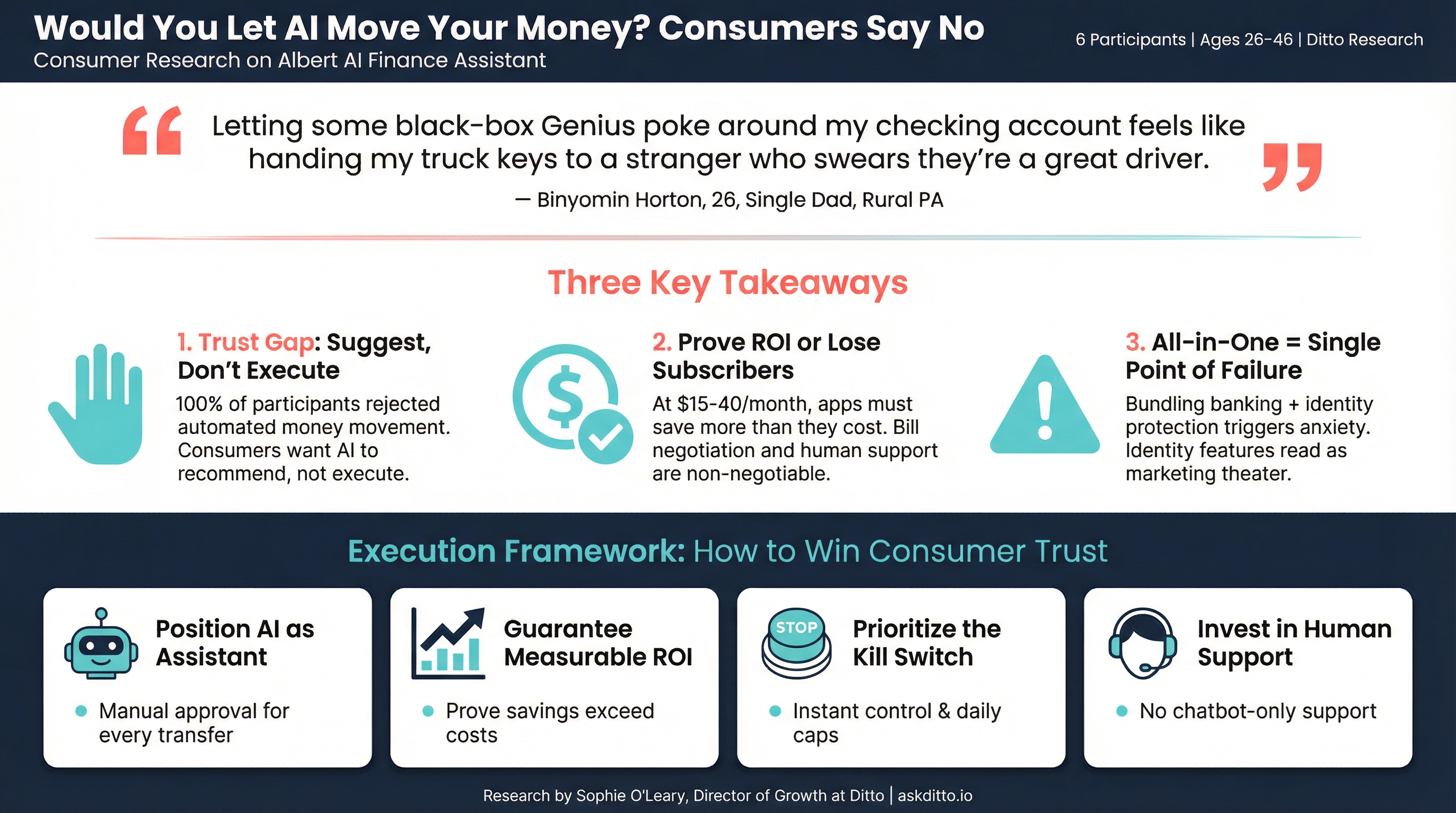
Here's a question that's been nagging at me: would you let an AI move your money? Not just track it, not just categorise it, but actually move it? Albert's betting you will. Their 'Genius' feature promises to automatically create budgets and shift your cash around for you. But when I asked six American consumers how they feel about AI making financial decisions on their behalf, the response was almost uniformly cautious. And their reasons reveal a fundamental tension in fintech's automation push.
I ran a study with six US consumers across different ages (26-46), locations, and financial situations, from a rural Pennsylvania single dad to a San Francisco healthcare administrator. The goal was simple: understand what people really think about AI-powered finance apps that promise to do the thinking for them.
The Participants
This was a deliberately diverse group. Nathan, a 46-year-old maintenance technician in Connecticut who tracks every dollar in a notebook. Binyomin, a 26-year-old single dad in rural Pennsylvania with irregular income. Destene, a 27-year-old librarian in South Carolina juggling daycare and a mortgage. Valerie, a 40-year-old sales manager in Chattanooga. Molly, a 34-year-old MRI technologist in Colorado. And Eric, a 40-year-old healthcare administrator in San Francisco, a bilingual immigrant particularly sensitive to anything that might trigger a bank flag.
What unites them? They all manage money carefully, and they all have strong opinions about who, or what, should be allowed to touch it.
AI Moving Your Money: The Unanimous 'No'
I asked how comfortable they'd be with an AI assistant that automatically creates budgets and moves money for them. The response was striking: every single participant said they were not comfortable with automated money movement.
"Letting some black-box 'Genius' poke around my checking account feels like handing my truck keys to a stranger who swears they're a great driver. Maybe they are, maybe they slam it into a ditch right before the propane bill hits."
That's Binyomin, the single dad in Pennsylvania. His metaphor captures what I heard across the board: the problem isn't that AI can't be helpful, it's that the downside of getting it wrong is catastrophic. One participant, Eric, specifically mentioned being a non-citizen and worrying about anything that might "trigger a weird bank flag."
What would make them consider it? The requirements were extensive:
Manual approval for every transfer, no exceptions
Per-transaction and daily caps they control
Protected accounts AI can't touch (rent, mortgage, childcare)
A big red 'kill switch' to stop everything instantly
Full audit logs and clear fee structures
Read-only mode by default, write access only with explicit approval
Key insight: Consumers want AI to suggest, not execute. The gap between 'helpful recommendations' and 'automatic actions' is where trust falls apart.
$15-40/Month: What Would Make It Worth Paying?
Albert charges $14.99-$39.99 per month. With free alternatives like Mint available, what would make a paid finance app worth it? The answer was consistent: it has to pay for itself in clear, measurable savings.
"Forty bucks a month for a money app? That has to earn its keep. If I'm paying, it better do more than show me a colorful pie chart I could make in a spreadsheet during nap time."
That's Destene, juggling daycare and a mortgage in South Carolina. The requirements for justifying a subscription were specific:
Bill negotiation that actually lowers internet or insurance costs
Overdraft prevention that works with real-time alerts
Subscription cancellation that catches zombie charges
Rock-solid bank sync that doesn't break or duplicate transactions
Human support, not chatbots, when something goes wrong
Privacy with no data selling, clear policies, easy deletion
The consensus? At the low end ($15), it needs to save at least that much monthly. At the high end ($40), it needs to include "concierge-level execution" that handles tasks they'd otherwise avoid, like negotiating with service providers.
Key insight: Free alternatives have trained consumers to expect basic features at no cost. Paid apps must deliver tangible ROI, not just prettier dashboards.
The All-in-One Promise: Appealing But Risky
I asked about the appeal of an app that handles savings, spending, AND identity protection all in one place. The response? Tempting in theory, terrifying in practice.
"Bundling money moves, spend tracking, and identity stuff into one stack screams single point of failure. Most 'identity protection' add-ons feel like a marketing halo anyway, not real security."
That's Valerie, the Chattanooga sales manager. The fear of consolidation ran deep: one breach, one outage, one price hike, and everything breaks at once. Several participants specifically called out identity protection features as "theater" that adds perceived value without actual security improvement.
The conditions for considering an all-in-one app were demanding:
Modular permissions: read-only by default, transfers require explicit approval
Transparent data policy with no selling, SOC 2 certification, easy export
Works with small credit unions and doesn't choke on rural internet
Clear pricing with no intro rate games or hidden fees
Real human support, not chatbots, with fast response times
Key insight: Consolidation appeals to time-strapped consumers, but the trust threshold for a single app holding both bank access AND identity data is extremely high.
What This Means for AI Finance Apps
If you're building or marketing an AI-powered finance app, this research suggests some clear directions:
Position AI as an assistant, not an autopilot. 'I approve every move' is the only trust-building message.
Guarantee ROI or refund. If the app can't prove it saves more than it costs, consumers won't pay.
Unbundle identity protection. It reads as marketing fluff unless proven otherwise.
Invest in human support. Chatbots are dealbreakers when money is involved.
Support irregular income and small institutions. Many consumers have lumpy pay and local credit unions.
Prioritise the kill switch. The ability to stop everything instantly is non-negotiable.
The Bottom Line
Albert's value proposition, an AI that handles your finances automatically, runs headlong into a fundamental consumer truth: people don't trust automation with their money. They'll accept suggestions. They'll appreciate nudges. But the moment an algorithm wants to move their cash without explicit per-transaction approval, trust evaporates.
The verdict from these six consumers? They'd consider Albert if it operates in "watch-only mode" with human-in-the-loop approval for any actual transfers. And at $15-40/month, it needs to prove, not promise, that it saves more than it costs. The bar isn't impossible. But it's much higher than a slick onboarding flow and some AI marketing can clear.
What the Research Revealed
We asked real consumers to share their thoughts. Here's what they told us:
How comfortable are you with AI making financial decisions on your behalf?
Eric Vazquez, 40, Healthcare Administrator, San Francisco, CA, USA:
Short answer: I'm not comfortable letting an AI move my money. Budget insights are fine, but automatic transfers without my explicit OK make my stomach drop. I'm risk sensitive because I'm not a citizen yet, so anything that could trigger a weird bank flag is a hard no for me.
Binyomin Horton, 26, Full-Time Family Caregiver, Rural, PA, USA:
Short answer - not comfortable. Letting some black-box 'Genius' poke around my checking account feels like handing my truck keys to a stranger who swears they're a great driver. My income's lumpy, child support lands on its own rhythm, and one dumb algorithm 'optimizing' something and I'm juggling overdraft nonsense.
Molly Kubek, 34, MRI Technologist, Longmont city, CO, USA:
Short answer: not comfortable. I run a zero-based budget with fixed rules and autopay I control. If I ever tested it, moves would require my approval via 2FA with a per-transaction cap and a daily cap. No access to primary checking. Sandbox subaccount only.
Destene Gokey, 27, Librarian, Columbia city, SC, USA:
Gut check? Not very comfortable. I'm fine with an app tallying receipts and nudging me, but letting an AI actually move my money around feels like handing my grocery list to a stranger and hoping they don't swap diapers for scented candles.
Nathan Ochoa, 46, Maintenance Technician, Danbury city, CT, USA:
No. Not comfortable. I don't like that. I want control. I press send. Rent first. Siempre. No risk. One bad move. Bank fee. Landlord mad. Maybe alerts ok. Remind me, fine. Move money, no.
Valerie Guerra, 40, Sales Manager, Chattanooga city, TN, USA:
Short answer: cautiously, with tight guardrails. I'm happy automating the boring, predictable stuff I already decided on, but I'm not handing strategy to a black box. I need caps, a clear audit trail, fee transparency, and a big red kill switch.
What would make a subscription-based finance app worth paying for?
Nathan Ochoa, 46, Maintenance Technician, Danbury city, CT, USA:
$14.99-$39.99? Muy caro. Mint es gratis. I pay only if it saves real cash. Every month. No story. Spanish human support. Low-balance alert. Overdraft buffer. If it does 3 of these good, maybe $10-$15. $40? No way.
Destene Gokey, 27, Librarian, Columbia city, SC, USA:
Forty bucks a month for a money app? That has to earn its keep. Daycare and the mortgage already eat first. Clear ROI I can point to: bill negotiation that actually lowers my internet or insurance, real overdraft-fee reimbursements.
Eric Vazquez, 40, Healthcare Administrator, San Francisco, CA, USA:
At $15-$40 a month, it has to put more money back in my pocket than it takes, and save me real time. For our family, I'd only pay if it nailed guaranteed savings or I get a credit, overdraft prevention that works, shared bilingual household features.
Binyomin Horton, 26, Full-Time Family Caregiver, Rural, PA, USA:
Paying 15 to 40 bucks a month just to look at prettier pie charts? Hard no. If I'm forking over real money, it better straight-up put more cash back in my pocket than it costs, every single month.
Molly Kubek, 34, MRI Technologist, Longmont city, CO, USA:
At $15-40 a month, it has to pay for itself in saved time or hard dollars. Free is fine if you tolerate ads, broken bank sync, and junky category rules. I will only pay if the app is rock solid and gives me zero drama.
Valerie Guerra, 40, Sales Manager, Chattanooga city, TN, USA:
If it's just a prettier Mint, hard pass. At $14.99-$39.99 a month, a money app has to do real work, not just make dashboards. My personal threshold: $15-$20 worth it if it saves me ~3 hours a month or $50+ consistently.
How appealing is an all-in-one app for savings, spending, and identity protection?
Nathan Ochoa, 46, Maintenance Technician, Danbury city, CT, USA:
Short answer: medium. I like simple. One app, menos lio. But I do not trust easy. Todo junto feels risky in my gut. Good: one view. Less time. Auto save. Bad: one break, todo se cae. Need: flat price. Month to month. Easy cancel.
Binyomin Horton, 26, Full-Time Family Caregiver, Rural, PA, USA:
Short answer: not very appealing. Stuffing my savings, spending, and identity into one basket feels like letting a stranger hold my wallet, house key, and Social Security card at the same time. One glitch and I'm eating overdraft fees while some help desk reads from a script.
Destene Gokey, 27, Librarian, Columbia city, SC, USA:
Gut reaction: tempting, but no. On paper it sounds like fewer logins, fewer pings, more calm. In real life, it screams all-my-eggs-in-one-basket and I can already feel my neck tense up. Single breach, single outage, single price hike, and I'm cooked.
Valerie Guerra, 40, Sales Manager, Chattanooga city, TN, USA:
Short answer: appealing in theory, risky in practice. I love fewer logins and a cleaner home screen, but bundling money moves, spend tracking, and identity stuff into one stack screams single point of failure.
Molly Kubek, 34, MRI Technologist, Longmont city, CO, USA:
Short answer: low appeal unless it beats my current stack on control, security, and cost. Single point of failure for money movement plus PII, vendor lock-in, and black-box rules misclassifying categories or sweeping cash at the wrong time.
Eric Vazquez, 40, Healthcare Administrator, San Francisco, CA, USA:
Short answer: only mildly appealing. These all-in-one money apps promise a lot, but they become a single point of failure and a new monthly bill. I also lose sleep about one app holding both bank logins and identity data, especially as a non-citizen.
Want to understand how your target customers really feel about your product? Ditto lets you run studies like this in hours, not weeks.