
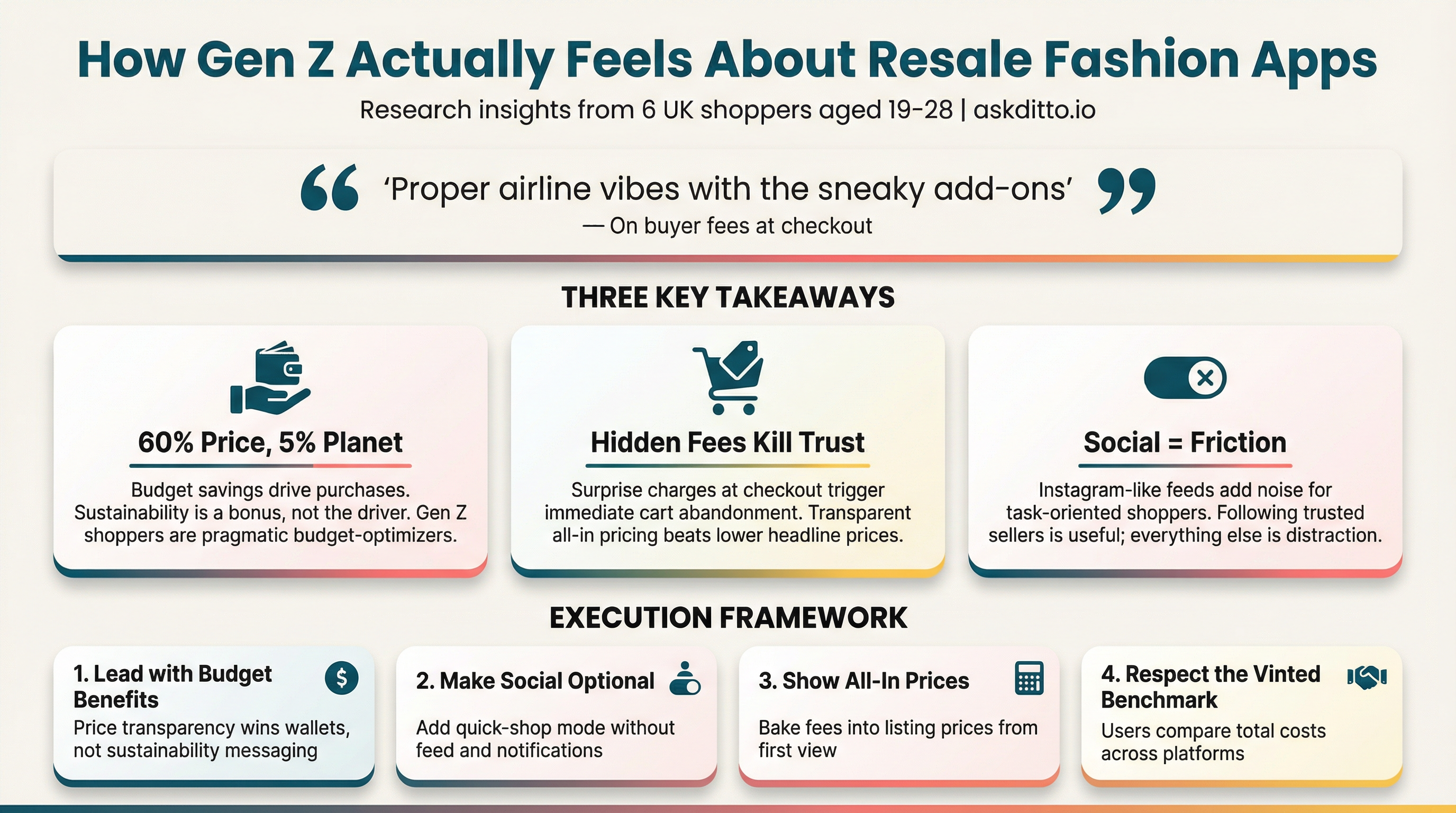
Six Gen Z shoppers. Three questions about how they buy clothes. One brutal verdict: buyer fees at checkout feel like getting 'mugged off.' Not because they cannot afford them. Because surprise charges at the last click kill trust faster than you can say 'Y2K Primark dress.'
I ran a Ditto study to understand how young UK consumers (the actual target market, not marketing personas) feel about resale fashion apps like Depop. The findings challenge some comfortable assumptions about Gen Z and sustainability.
The Participants
Our panel included six UK shoppers aged 19-28, based in Leeds, Birmingham, and Manchester. Students, admin assistants, and a graduate researcher. All use secondhand platforms regularly. All manage tight budgets. And all have strong opinions about where their clothing money goes.
What Actually Drives Resale Shopping
When we asked what draws them to resale platforms over buying new, the answer was unanimous and unromantic: price first, everything else second.
Honest answer: it's mostly price. Then quality and fit. The eco bit is nice but it's not what gets me to hit buy.
Lauren, a 19-year-old design student from Leeds, broke it down: '60% price, 25% quality/fit, 10% finding something a bit different, 5% sustainability.' That ratio appeared almost identically across all six participants.
Every response followed the same pattern:
Budget is the driver - 'Old Levi's, wool coats, proper trainers for less'
Sustainability is a 'nice bonus' not the main event
Quality matters - 'Older bits last and have pockets'
Unique finds are occasional treats, not the core use case
Callum from Birmingham was refreshingly direct: 'Sustainability: nice bonus, not the driver. I'm not pretending I'm a saint.'
Key insight: Gen Z resale shopping is primarily rational budget optimization. Sustainability messaging may attract attention, but price transparency wins wallets.
The Social Layer Problem
Depop's Instagram-style interface (following sellers, liking items, building profiles) is supposed to make shopping more engaging. Our participants had other ideas.
Short answer: mostly noise for me.
The feedback was consistent: following a few reliable sellers in your size is genuinely useful. Everything else? 'Like Instagram glued onto a shop - bit cringe when I just want a hoodie in my size for a fair price.'
The pattern across responses:
Useful: Following trusted sellers, using likes as bookmarks
Noise: The feed, notifications, 'drop at 7pm babes' culture
Result: 'Mute what I can and go straight to search, filters and price caps'
Lucy, a Manchester grad student, captured the tension perfectly: 'It turns shopping into vibes and clout, which makes my brain go fizzy. I just want a navy jumper without the performance.'
The comparison with Vinted was telling. Multiple participants said they use Vinted more because it is 'dead transactional and calm' - the opposite of Depop's social design.
Key insight: Social features add friction for task-oriented shoppers. A 'plain shop mode' toggle might serve users better than forcing engagement.
The Fee Structure Fury
We asked about Depop's approach of charging buyers a fee at checkout rather than taking commission from sellers. The reaction was visceral.
Proper airline vibes with the sneaky add-ons.
Callum's comparison hit hard: seeing a fee pop up at checkout feels like budget airlines adding baggage fees after you have committed to the flight. 'That one ticked me off the most' was a common refrain.
The behaviour impact was clear:
'If it's 50p I'll sigh and pay. If it's £2-3 I usually back out.'
'I've had a £12 pair of jeans become £16 with fees and postage - closed the app.'
'If the totals are close, I go Vinted because it feels clearer and usually ends up cheaper.'
'I check both, add postage, and pick the lowest total.'
When asked who should bear the cost, the answer was universal: bake it into the listing price. Marek from Birmingham explained the logic: 'I do not care who pays in theory. I care about the number that leaves my account and how clean the comparison is across apps.'
Key insight: Hidden fees do not just annoy users - they actively push them to competitors. Transparent all-in pricing beats lower headline prices with surprise add-ons.
What This Means for Resale Platforms
If you are building or running a resale fashion platform, this research suggests some counterintuitive priorities:
Lead with budget benefits, not sustainability. The environmental angle is marketing polish, not purchase motivation.
Make social features optional. A quick-shop mode without feed, followers, and notifications would serve your most active users.
Show all-in prices from the first view. Surprise fees at checkout create competitors, not customers.
Respect the Vinted benchmark. Your users are comparing total costs across platforms. Being slightly cooler does not overcome being slightly more expensive.
Quality beats uniqueness. Messaging about 'finds' and 'one-of-a-kind' matters less than 'lasts longer than fast fashion.'
The Bottom Line
Gen Z resale shoppers are pragmatic, price-sensitive, and allergic to hidden costs. They will tolerate social features they do not use. They will not tolerate feeling tricked at checkout.
The platforms that win will be the ones that respect the real motivation: saving money on better clothes. Everything else - the sustainability story, the social engagement, the curated aesthetic - is dressing on top.
Want to test how your platform's pricing or features land with real target users? Ditto lets you run studies like this in hours, not weeks. Book a demo at askditto.io.
What the Research Revealed
We asked real Gen Z shoppers to share their thoughts. Here's what they told us:
What draws you to resale platforms like Depop versus buying new?
Callum Reeves, 22, Admin, Birmingham:
Price and hassle, mostly. I'll use Depop if I can grab a specific thing cheaper, but for stuff I wear loads I buy new because returns are easy and I know the fit.
Lucy Ainsworth, 21, Graduate Student, Manchester:
Honestly? It's price first, every time. I've got Monzo pots glaring at me and I'm not paying £35 for a flimsy new top when I can get something better for a tenner on Vinted.
Natalia Nowak, 22, Vocational Student, Birmingham:
Honestly it's price first, then quality/fit; unique is just a bonus. I use Vinted more than Depop because the postage and 'curated closet' markups do my head in.
Lauren Atkinson, 19, Design Student, Leeds:
Honest answer: it's mostly price. Then quality and fit. The eco bit is nice but it's not what gets me to hit buy.
Marek Kowalski, 28, CAD Technician, Birmingham:
Short answer: price first, then time and hassle, then a bit of sustainability. Unique pieces are last on my list.
Jamie Cartwright, 28, Admin/Parent, Birmingham:
Honestly, it's price first. Everything else is a nice extra. I'm not hunting statements. I want stuff that fits, lasts, and doesn't rinse my bills pot.
Does Depop's social interface make shopping better or worse?
Lauren Atkinson, 19, Design Student, Leeds:
Bit of both, honestly. Following a couple sellers in my size is actually useful, and liking stuff helps me park it till payday. But the home feed feels like clutter and the pushy offer DMs do my head in.
Callum Reeves, 22, Admin, Birmingham:
Mostly worse, to be honest. It feels like Instagram glued onto a shop - bit cringe when I just want a hoodie in my size for a fair price.
Jamie Cartwright, 28, Admin/Parent, Birmingham:
Short answer: mostly noise for me. I'm there to find a size L jacket, not to swim through selfies and cutesy captions.
Lucy Ainsworth, 21, Graduate Student, Manchester:
Short answer: worse for me. It turns shopping into vibes and clout, which makes my brain go fizzy. I use Vinted more because it's dead transactional and calm.
Natalia Nowak, 22, Vocational Student, Birmingham:
Honestly, the social bits are mostly noise for me. I'm there to find a size 8 jacket under £25, see the total with postage, and check measurements, not chase likes.
Marek Kowalski, 28, CAD Technician, Birmingham:
Short answer: worse for me. I treat shopping like a task, not entertainment. The social feed adds friction when I just want to find a size, check condition, see postage, and pay.
How do you feel about Depop's buyer fee at checkout?
Lauren Atkinson, 19, Design Student, Leeds:
Honestly, I don't like it. Seeing a fee pop up at checkout makes me feel a bit mugged off, like when a cafe adds service you didn't ask for. I want the total shown up front so my Monzo pots don't get thrown.
Callum Reeves, 22, Admin, Birmingham:
Yeah, it puts me off. Looks cheap, then you get slapped with a fee at checkout. Proper airline vibes with the sneaky add-ons and I hate that.
Natalia Nowak, 22, Vocational Student, Birmingham:
As a buyer, I hate it. It feels like drip pricing, like the sneaky baggage stuff on budget airlines, and it triggers my little 'wait, what did I just agree to' panic.
Jamie Cartwright, 28, Admin/Parent, Birmingham:
Like a sneaky little 'gotcha' at the till. I see a price, I do the maths, then a fee pops up and nudges it over my budget. Instant mood killer.
Marek Kowalski, 28, CAD Technician, Birmingham:
Short answer: I don't like it. As a buyer, a fee dumped on me at checkout feels like a platform tax. I budget tight, bills are going up, so a surprise line item at the last click just irritates me and I close the tab.
Lucy Ainsworth, 21, Graduate Student, Manchester:
Gut reaction: buyer fees at checkout make me grumpy. It feels like getting to the till and someone quietly adds a fiver - kills the vibe and my Monzo pot starts shouting.