
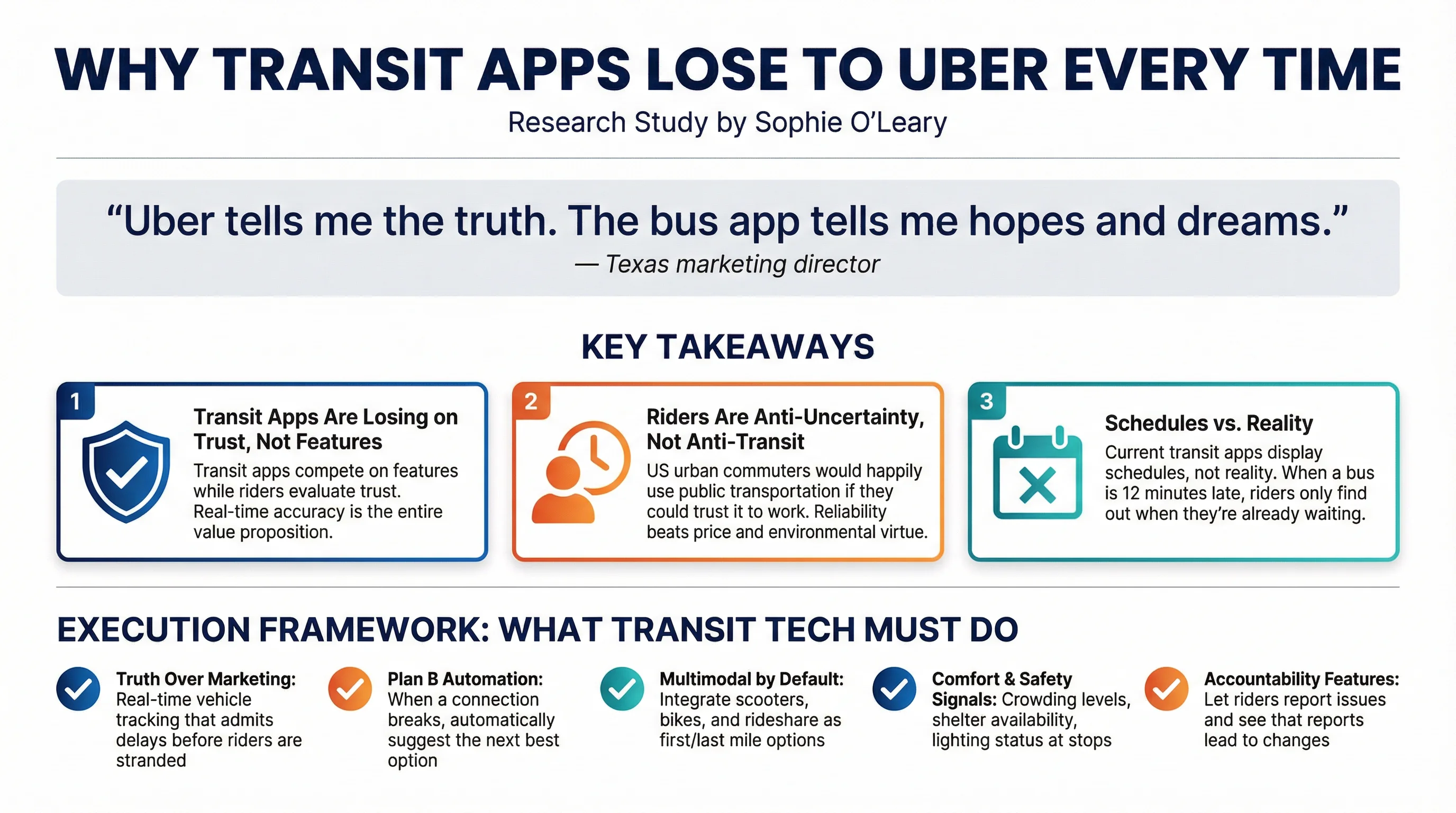
"Reliability and total door-to-door time beat price and green points most days." That is Yolanda, a 43-year-old project manager in Chandler, Arizona, explaining what would actually make her choose public transit over Uber.
I ran a study with 6 US urban commuters to understand why transit apps struggle to compete with rideshare. The findings were clear: transit technology is losing on trust, not features.
The Participants
Our panel included 6 US commuters aged 30-56, from Arizona, California, Texas, Florida, and rural areas. We had a project manager, a postal worker, a marketing director, a barber shop owner, a warehouse supervisor, and someone between jobs. All live in areas with some form of public transit and all have made recent choices between transit and rideshare.
The Reliability Gap
When we asked what would make participants choose a city transit app over Uber or Lyft, the answer was unanimous: reliability.
Not price. Not environmental virtue. Reliability.
A Chandler project manager put it bluntly: "If the app can't prove the bus is actually coming, I am not standing on a sun-baked curb to feel virtuous."
The core problem: current transit apps display schedules, not reality. When a bus is running 12 minutes late, riders only find out when they are already waiting.
A Florida postal worker explained: "The schedules in our transit apps are aspirational fiction. Show me the actual vehicle, not the plan."
Key insight: Transit apps are competing on features while riders are evaluating trust. Real-time accuracy is not a nice-to-have, it is the entire value proposition.
What Riders Actually Want
When we asked participants to describe their ideal transit app experience, several themes emerged:
Real-time that is actually real - Sub-minute countdowns tied to the vehicle, not a static timetable. If it slips, tell me early.
Door-to-door time with backups - Honest walk segments, weather considerations, and a one-tap Plan B if a connection is missed.
Crowding and safety signals - Bus occupancy, well-lit stop indicators, and late-night microtransit options.
Integrated pay with fare capping - Apple Pay, daily and weekly caps, no overpaying.
First- and last-mile baked in - Scooters, e-bikes, and shuttle connections in the same app.
A San Antonio barber shop owner summarised: "Right now, the app is an obstacle, not a shortcut. Fix that and I might actually use it."
The Rural Reality Check
One theme emerged that transit apps rarely address: for many Americans, public transit simply does not exist.
A warehouse supervisor from rural California explained: "There is no bus here. One route goes to the hospital twice a day. That is it."
Another participant mentioned: "I was stuck at Walmart for four hours because the bus schedule changed and nobody told me."
Key insight: Transit apps cannot solve infrastructure problems. For many users, the issue is not the app, it is the absence of service.
Why Rideshare Keeps Winning
When we asked what makes participants choose Uber or Lyft over transit, the answers were practical:
Predictable arrival time - They know exactly when the driver arrives and when they will reach their destination.
Weather immunity - No standing in rain, heat, or cold waiting for a vehicle that may not come.
Direct routing - Door to door, no transfers, no walking.
Accountability - If something goes wrong, there is a record and a refund process.
A Texas marketing director put it simply: "Uber tells me the truth. The bus app tells me hopes and dreams."
What This Means for Transit Tech
Based on this research, transit apps that want to compete with rideshare should focus on:
Truth over marketing - Real-time vehicle tracking that admits delays before riders are stranded.
Plan B automation - When a connection breaks, automatically suggest the next best option.
Multimodal by default - Integrate scooters, bikes, and rideshare as first/last mile options within the transit experience.
Comfort and safety signals - Crowding levels, shelter availability, lighting status at stops.
Accountability features - Let riders report issues and see that reports lead to changes.
Conclusion
US urban commuters are not anti-transit. They are anti-uncertainty. The riders we spoke to would happily use public transportation if they could trust it to work.
The current generation of transit apps fails because it prioritises schedules over reality. The apps that win will be the ones that tell riders the truth, even when the truth is uncomfortable.
As one participant said: "I am not asking for magic. I am asking for honesty."
Want to understand how your customers really feel about your product? Ditto lets you run studies like this in hours, not weeks. Book a demo at askditto.io.
Selected Participant Responses
What would make you choose a city transit app over Uber/Lyft?
Yolanda Andreasen, 43, Chandler AZ: "I'll pick transit if it saves me time without lying. Reliability and total door-to-door time beat price and green points most days. If the app can't prove the bus is actually coming, I am not standing on a sun-baked curb to feel virtuous."
Jorge Calico, 30, San Antonio TX: "Right now, the app is an obstacle, not a shortcut. Real-time that doesn't lie, fewer mystery delays, and a backup plan when connections break."
What frustrates you most about public transit in your area?
Clarence Woodward, 56, Orlando FL: "The schedules in our transit apps are aspirational fiction. Show me the actual vehicle, not the plan. I need to know if I'm going to make my shift."
Maria Gonzalez, 48, Rural CA: "There is no bus here. One route goes to the hospital twice a day. That is it. The app is useless because the service is useless."