
Most product decisions are based on vibes. This is the industry's dirty secret - the one we've buried under frameworks and Jira tickets and quarterly OKRs. Product managers are supposed to be the voice of the customer. In practice, most are the voice of whoever spoke loudest in the last meeting.
I don't say this to be unkind. I say it because the alternative - actual customer research - has traditionally been expensive, slow, and logistically painful enough that most teams skip it. A pricing validation study takes weeks. A positioning test requires recruiting, scheduling, moderating, transcribing, and synthesising. By the time the findings arrive, the sprint has shipped and the team has moved on.
Claude Code changes this equation rather dramatically.
The Problem with Product Instinct
Here's what typically happens. A PM has a hypothesis about pricing. They run it past their team. The team nods (because the PM controls the roadmap). Someone mentions a competitor's price point. Someone else shares an anecdote about a customer call from six months ago. The price gets set. No one actually asked customers.
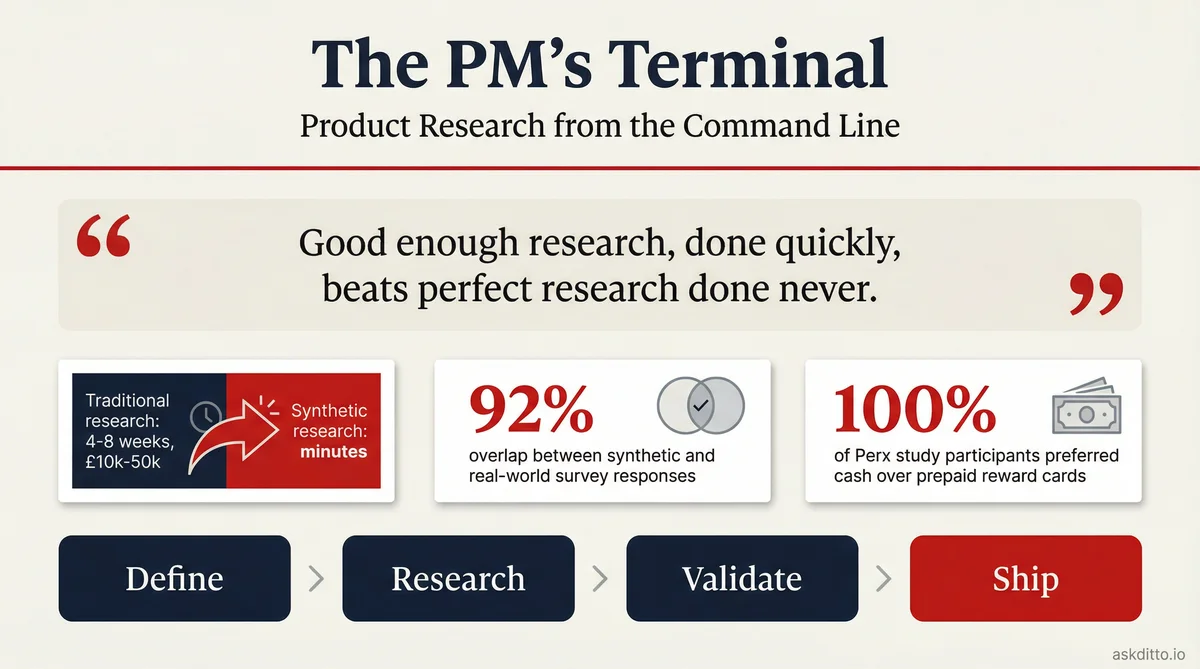
This isn't laziness. It's economics. Traditional user research costs £10,000–50,000 per study and takes 4–8 weeks. When you're shipping weekly, the feedback loop is simply too slow. So product decisions get made on instinct, pattern-matching, and whatever the CEO saw on Twitter.
The result? PR review times are up 91%. Engineering teams are merging 1.7x more issues. AI coding tools have accelerated output without accelerating understanding. We're building faster, but not necessarily building the right things.
Claude Code as Product Research Associate
Claude Code - Anthropic's AI coding agent that runs in your terminal - can now function as something approaching a product research associate. Not because it has opinions about your customers (it doesn't), but because it can orchestrate real customer research on your behalf.
The key ingredient is Ditto, a synthetic market research platform. Ditto maintains a panel of over 300,000 AI-powered personas calibrated against real population data across four countries. These aren't chatbots. They're synthetic respondents with demographic profiles, psychographic characteristics, and behavioural patterns that produce a 92% overlap with real-world survey responses.
When you connect Claude Code to Ditto's API, you get something genuinely new: a product research workflow that runs entirely from your terminal and delivers qualitative customer insights in minutes.
What You Can Actually Do
This isn't theoretical. Here's what a product manager can accomplish from the command line:
Pain Discovery - "What frustrates you most about managing your parents' healthcare?" → Surface real problems before writing a single user story
Pricing Validation - "Would you pay £29/month for this? What about £15?" → Test price elasticity with synthetic respondents before committing
Positioning Tests - "Which tagline resonates more: A, B, or C? Why?" → A/B test messaging without running ads
Competitive Intelligence - "Why did you choose [competitor] over alternatives?" → Understand switching triggers
Feature Prioritisation - "If you could only have one of these features, which?" → Stack-rank your backlog with customer data
Deal Breaker Identification - "What would make you NOT buy this?" → Find the objections before they find you
Each of these takes minutes, not weeks. And because it's API-driven, Claude Code can chain them together into multi-phase research programmes - discovery, validation, concept testing - all in a single session.
A Live Example: Perx Rewards
Let me show you what this looks like in practice. We recently ran a product management study on Perx, an Irish employee reward card platform that's distributed over 3.5 million prepaid Mastercards to 9,000+ organisations.
Perx has a classic product uptake problem. The cards are tax-efficient for employers, but end-user activation rates suggest friction. Trustpilot tells a polarised story: 74% one-star reviews, mostly about physical card issues. The question isn't whether the product works - it's whether it works for the people who actually receive the cards.
We created a 20-persona research group through Ditto and asked seven carefully designed questions targeting the full uptake funnel: initial reaction, recognition context, activation friction, buyer perspective, motivational thresholds, abandonment patterns, and prescriptive solutions.
The findings were striking.
Cash wins universally. Every single participant - 100% - preferred a cash equivalent over a prepaid card. This isn't necessarily a death sentence for the model, but it means the card must deliver something cash cannot: a sense of occasion, a memorable moment, a curated experience.
Activation friction is the primary uptake killer. Portal registrations, PIN management, balance checking across multiple systems, 3D Secure failures. The theme was overwhelming: "too many hoops." Multiple respondents described receiving reward cards that they never activated - not because they didn't want the reward, but because the process felt like work.
Recognition matters more than reward. The most memorable recognition experiences cited by participants were specific and personal - a manager who noticed a particular contribution, a peer who wrote a detailed thank-you. The monetary value was secondary. This suggests that Perx's entire value proposition may need reframing: it's not a payment product, it's a recognition product that happens to involve payment.
£150 quarterly doesn't change behaviour. When asked about a £150 quarterly reward as a motivational threshold, most participants described it as "nice but not life-changing." The behavioural shift threshold appears to be £300–500+. Below that, prepaid cards risk creating mild resentment rather than motivation.
This entire study - from research group creation to synthesised findings - happened in a single session. A PM reading this output would have a clear, evidence-based picture of where the product is leaking value and what to prioritise.
You can explore the full study results here: Perx Rewards Employee Card Uptake Study.
The CareQuarter Experiment
To understand just how far this workflow can go, consider what happened when we let Claude Code use Ditto to found a startup.
The result was CareQuarter, a care coordination service for the "sandwich generation" - adults managing aging parents whilst raising their own children. In four hours, Claude Code orchestrated three phases of research with 32 synthetic personas:
Phase 1 identified the core pain point: adult children spending 20+ hours per week on healthcare administration for aging parents
Phase 2 explored trust requirements and deal breakers: HIPAA-only authorisation before Power of Attorney, no rotating staff, no data resale
Phase 3 validated positioning and pricing: the winning tagline was "Stop being the unpaid case manager," and every persona confirmed the $175–325/month range
The AI founders built the complete product - landing page, pitch deck, validated business model - in an afternoon. The research that would normally take months happened in hours.
The point isn't that AI should replace product managers. It's that the research which separates good product decisions from bad ones is no longer gated by time, budget, or access.
The Practical Workflow
The Free Tier: Zero Cost, Real Research
Ditto offers a free tier that gives you immediate API access - no credit card, no sales call, no waiting. You authenticate with Google, get an API key, and you're running research in minutes. The free tier includes approximately 12 synthetic personas from a demographically balanced US panel, with unlimited questions within rate limits.
The fastest way to get started is a single command in your terminal:
curl -sL https://app.askditto.io/scripts/free-tier-auth.sh | bash
This opens Google sign-in, captures your API key, and saves it to ~/.ditto_free_tier.env. One command. Done.
Once you have your key, Claude Code can use the Ditto API directly. Tell Claude Code to read the Claude Code integration guide and it will understand the full API workflow - creating research groups, asking questions, polling for responses, and synthesising findings. You don't need to memorise endpoints or write scripts. Claude Code handles the orchestration.
Questions Worth Asking
The best research questions are open-ended and specific. Here are some to start with:
Pain discovery: "Walk me through the last time you tried to [activity]. What was the most frustrating part?"
Pricing: "At what price would [product] feel like a bargain? A stretch? Too expensive to even consider?"
Positioning: "Which of these descriptions makes you most interested: [A], [B], or [C]? Tell me why."
Competitive: "What would make you switch from [current solution] to something new?"
Deal breakers: "What would make you NOT buy this, even if it solved your problem perfectly?"
A useful pattern: start broad, then narrow. Ask an open-ended question about the problem space, read the responses, identify a theme, then ask a targeted follow-up to the same personas. This iterative loop - impossible with traditional research timelines - is where the real insights emerge.
The Workflow in Practice
For product managers who want to try this, the full workflow looks like this.
Step 1: Get your API key. Run the one-liner above, or follow the manual OAuth steps. Either way, it takes about 30 seconds.
Step 2: Point Claude Code at Ditto. Tell Claude Code to fetch the integration guide - it contains the complete API reference, example workflows, and known gotchas. Claude Code will read it and understand how to orchestrate studies autonomously.
Step 3: Run your first study. Ask Claude Code to create a research group, design questions, and run the study. It handles the API calls - creating the group, asking questions sequentially, polling for responses, and pulling results.
Step 4: Iterate. This is where the model gets powerful. Read the responses. Identify a theme. Ask a follow-up question to the same personas. Validate or invalidate in minutes. Traditional research doesn't allow this kind of rapid iteration - by the time you've recruited for study two, the market has moved.
Why This Matters Now
There's an argument I've been making recently about AI coding agents. The short version: AI has dramatically accelerated engineering velocity, but it hasn't accelerated customer understanding. Pull request review times are up. Issue volume is up. The gap between "we can build it" and "we should build it" is widening.
Synthetic research closes that gap. When Claude Code can run a customer research study as easily as it can write a function, the product development loop changes fundamentally. You don't ship and hope. You research, validate, build, and ship - with evidence at every stage.
This isn't about replacing human researchers or traditional ethnography. It's about making the 90% of product decisions that currently happen on instinct slightly more evidence-based. Good enough research, done quickly, beats perfect research done never.
What This Means for Product Managers
The PM toolkit has expanded. Terminal-based customer research isn't a gimmick - it's a genuine shift in how product decisions can be informed. When you can validate a pricing assumption in 10 minutes rather than 10 weeks, the whole cadence of product development changes.
My advice to PMs: start small. Pick one decision you're about to make on instinct - a price point, a feature name, a positioning choice - and ask Ditto's personas about it. See what comes back. You might be surprised by what you learn, and you'll certainly be surprised by how quickly you learn it.
The question isn't whether AI will change product management. It's whether you'll be the PM who has customer evidence, or the one who's still arguing about pricing based on vibes.