
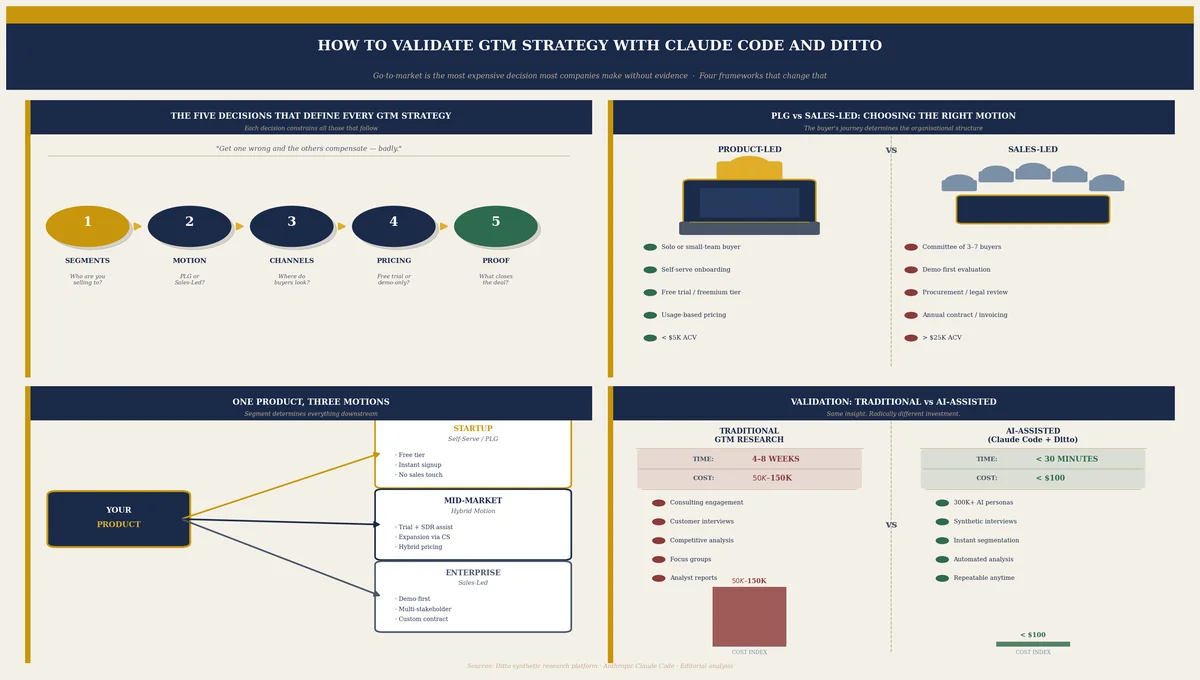
Go-to-market strategy is, by a comfortable margin, the most expensive decision most companies make without evidence. A wrong product feature costs engineering time. A wrong hire costs a severance package and a quarter of lost productivity. A wrong GTM motion costs everything: the wrong salespeople hired for the wrong buyers through the wrong channels at the wrong price, compounding daily for six to twelve months before anyone summons the courage to say it aloud.
The classic version of this mistake is so common it deserves a name. Call it the self-serve delusion: a startup builds a beautiful product-led growth motion, complete with free tier, interactive onboarding, and usage-based pricing, then discovers that its target buyer is a committee of five people at a company with a procurement department that does not know what a free tier is. Or the inverse: a company hires ten account executives and builds a demo-first sales process for a product that buyers would vastly prefer to try on their own for twenty minutes before talking to anyone. Both errors are survivable. Neither is cheap.
The peculiar thing is that these mistakes are, in principle, avoidable. The information required to choose the right GTM motion exists in the heads of your target buyers. They know how they prefer to discover products. They know whether they can make a purchase decision alone or need three colleagues to sign off. They know whether they want a free trial, a demo, or a conversation. The problem has never been that the information does not exist. The problem is that gathering it traditionally costs more than most companies are willing to spend before they have revenue.
This article describes how to validate your GTM strategy in under an hour using Ditto, a synthetic market research platform with over 300,000 AI personas, and Claude Code, Anthropic's agentic development environment. It will not replace a full GTM consulting engagement for a company entering a new continent. It will, however, replace the whiteboard exercise and competitive benchmarking that constitute the GTM strategy process at most companies.
The Five Decisions That Define Every GTM Strategy
Strip away the frameworks, the Gartner quadrants, and the consultant slide decks, and every go-to-market strategy reduces to five interconnected decisions. Get them right and the machinery hums. Get one wrong and the others compensate, badly, like a car with one flat tyre pulling relentlessly to the left.
Segments: Who are you selling to? Not in the abstract ("mid-market SaaS companies") but with enough specificity to determine everything else. A product that sells to a solo founder and a product that sells to a VP of Engineering at a 500-person company require entirely different motions, even if the product is identical. Customer segmentation is the foundation, and if it is wrong, nothing downstream can compensate.
Motion: How does the buyer move from awareness to purchase? Product-led growth (PLG) means the product itself is the primary acquisition and conversion vehicle: free trials, freemium tiers, self-serve onboarding. Sales-led means a human being guides the buyer through evaluation, demo, negotiation, and close. Hybrid means some combination, typically PLG for smaller accounts and sales-led for larger ones. Each motion implies a fundamentally different organisational structure, cost model, and set of hires.
Channels: Where do buyers discover solutions in your category? Content and SEO, paid acquisition, community and word-of-mouth, partner referrals, outbound sales, events and conferences? The channel mix follows from the segment and motion. Enterprise buyers discovered through LinkedIn outbound require a different first touchpoint than startup founders discovered through a Product Hunt launch. Most companies choose channels based on what their marketing team knows how to do, rather than where their buyers actually look.
Pricing and Packaging: Free trial versus demo-only versus enterprise-only. Usage-based versus seat-based versus flat-rate. Monthly versus annual. These are not pricing decisions in isolation; they are GTM decisions that determine who can buy, how quickly they can buy, and what the sales team needs to do (or not do) to close the deal. Pricing research done in isolation from GTM strategy often produces the right numbers for the wrong motion.
Proof Points: What evidence converts a buyer from interested to committed? Case studies, ROI calculators, security certifications, analyst endorsements, free trials, peer reviews on G2? The proof point stack is segment-specific: a startup founder trusts a Product Hunt review; an enterprise CISO trusts a SOC 2 report. Building the wrong proof points for your segment is a common and expensive error.
These five decisions are not independent. They form a chain: the segment determines the motion, the motion determines the channels, the channels determine the pricing model that works, and the pricing model determines the proof points required. Most teams, however, decide each in isolation. Marketing chooses channels. Product chooses the packaging. Sales determines the motion by hiring. The result is a GTM strategy that no one designed but everyone inherited.
The Validation Gap
The reason most companies skip GTM validation is not laziness or arrogance. It is economics.

The Technology Adoption Lifecycle: the chasm between early adopters and the early majority is where most GTM strategies fail. Your motion must match where your buyers sit on this curve. Source: ThinkInsights.
A rigorous GTM validation study through a Gartner-style framework costs $50,000 to $150,000 for a multi-segment comparison. Even a modest engagement with a GTM consultancy runs $15,000 to $50,000 and takes four to eight weeks. By the time the results arrive, the company has often already hired three salespeople and launched a marketing campaign based on assumptions, because they could not afford to wait.
The cost of skipping validation is invisible until it materialises. A PLG motion for enterprise buyers means six months of building self-serve infrastructure that enterprise procurement departments will never use, followed by a painful pivot to sales-led that requires firing product engineers and hiring account executives. A sales-led motion for SMB buyers means hiring expensive account executives to close $500 deals, discovering that the unit economics are upside-down, and then pivoting to self-serve six months later. In both cases, the cost is not merely the wasted budget. It is the wrong people, the wrong systems, the wrong metrics, and the organisational trauma of admitting that the strategy was incorrect.
As Marc Andreessen observed, the market pulls product out of the startup in product-market fit. What he did not say, but what follows logically, is that the market also dictates the motion. You do not get to choose whether your buyers want PLG or sales-led. They have already decided. Your job is to discover their preference, not impose yours.
The Seven-Question GTM Study
This study design tests how your target buyers prefer to discover, evaluate, and purchase products in your category. Claude Code customises the questions with your product details, then runs the study through Ditto's API against ten personas matching your target buyer profile. Seven questions. Seventy responses. Thirty minutes.
Question 1 (Discovery Channels): "How did you find the tools or solutions you currently use for [category]? Walk me through the discovery process."
This is the channel question, and it is deliberately open-ended. You want the buyer's actual discovery narrative, not a multiple-choice selection from a list you curated. Personas reveal whether they searched Google, asked a colleague, saw a LinkedIn post, attended a conference, received an outbound email, or stumbled upon a Product Hunt launch. The aggregate pattern across ten personas tells you where your marketing budget should concentrate. If eight out of ten personas discovered their current solution through peer recommendation, your $50,000 Google Ads budget is aimed at the wrong wall.
Question 2 (Buying Committee Mapping): "When your team evaluates a new [category] solution, who is involved in the decision? What role does each person play?"
This is the single most consequential question in the study, because the answer determines the motion. A solo decision-maker who can swipe a credit card is a PLG buyer. A committee of five, including a budget holder, a technical evaluator, a compliance reviewer, a business stakeholder, and an executive sponsor, is a sales-led buyer. The gap between these two realities is not a matter of degree. It is a matter of kind. Building for one when your buyers operate as the other is the most expensive GTM mistake a company can make.
Question 3 (The Motion Question): "If you were evaluating [your product], would you prefer to: (a) try it yourself with a free trial, (b) see a guided demo from a product expert, (c) have a salesperson walk you through the value and pricing, or (d) some combination? Why?"
This is the direct motion test. The responses will cluster. When eight out of ten personas say "I would want to try it first," that is a PLG signal that should not be ignored. When eight out of ten say "I would need to talk to someone," that is a sales-led signal. When the split is five-five, or when personas say "I would try it first but then want to talk to someone before buying," you are looking at a hybrid motion. Each answer carries implications for your website, your pricing page, your first-touch experience, and your team structure.
Question 4 (Outreach Receptivity): "How do you feel about vendors reaching out to you proactively, via email, LinkedIn, or phone? What makes outbound outreach effective versus annoying?"
This question calibrates your outbound strategy. Some buyer segments are receptive to well-crafted cold outreach; others find it invasive and counterproductive. The qualitative responses reveal not just the binary (receptive or not) but the conditions: "I respond to emails that reference something specific about my company" is actionable intelligence for your sales development team. "I never respond to cold outreach but I do click on retargeting ads" tells you where to redirect budget. "I respond to introductions from people I trust" tells you to invest in a partner channel.
Question 5 (Vendor Frustrations): "What do vendors in [category] do that frustrates you during the buying process? What would you change about how they sell?"
This is the anti-pattern question, and it is arguably as valuable as the positive preference questions. Personas will tell you what not to do, and the specificity is striking. "I hate when vendors require a demo before showing pricing" is a clear instruction: put your pricing on the website. "I hate when vendors send me to a chatbot instead of letting me talk to a person" means your self-serve motion needs a prominent human fallback. "I hate mandatory annual contracts for products I have not tried" tells you that a month-to-month option is not a nice-to-have but a GTM requirement. Building your motion around the avoidance of common frustrations is one of the fastest paths to competitive advantage.
Question 6 (Price-Value Fit): "At [your price point], what would you expect to receive in terms of support, onboarding, and ongoing service? What level of investment justifies a self-serve experience versus a high-touch one?"
This question connects pricing to service expectations, which is a GTM architecture decision. A buyer who expects white-glove onboarding at your price point requires a customer success team, an implementation timeline, and a sales process that sets those expectations. A buyer who expects to be left alone to figure it out requires excellent documentation, in-product guidance, and a support model that scales without headcount. The mismatch between price point and service expectation is a source of churn that many companies misdiagnose as a product problem.
Question 7 (Proof Point Requirements): "What evidence would you need to see before committing to [your product]? Case studies, ROI data, security certifications, peer reviews, a free trial, something else?"
This maps the proof point stack. Different segments require different evidence. Startup founders often say "I just want to try it." Enterprise buyers say "I need three case studies from companies in my industry." Compliance-sensitive buyers say "I need SOC 2 and a security questionnaire." Technical evaluators say "I need API documentation and a sandbox environment." The proof point priority stack, ranked by frequency and emphasis across ten personas, tells you exactly what to build, in what order, to remove friction from your specific buyers' evaluation process.
Reading the Signals: PLG, Sales-Led, or Hybrid
The seven questions produce a rich qualitative dataset. The pattern recognition is where strategy emerges.
PLG Signals
When the data points towards product-led growth, the patterns are unmistakable:
Solo or dual decision-maker. Question 2 responses describe one person, or at most two ("I decide, then my manager rubber-stamps it"). No procurement process. No committee.
Strong free trial preference. Question 3 responses cluster around "I would want to try it first." The desire to experience the product before speaking to anyone is the defining characteristic of a PLG buyer.
Low price sensitivity threshold. Question 6 reveals that buyers at your price point expect self-serve. They do not expect a dedicated account manager for a $49/month tool.
Peer and community discovery. Question 1 shows discovery through Product Hunt, Hacker News, Reddit, colleague recommendations, or social media. Not conferences. Not analyst reports.
Outbound aversion. Question 4 reveals hostility or indifference to cold outreach. These buyers want to find you, not be found.
Sales-Led Signals
The sales-led pattern is equally distinct:
Multi-person buying committee. Question 2 describes three or more stakeholders with distinct roles: budget holder, technical evaluator, business sponsor, compliance reviewer. Decisions take weeks, not minutes.
Demo and conversation preference. Question 3 responses say "I would want to talk to someone" or "I would need a demo tailored to our use case." Self-serve is not a convenience for these buyers; it is a frustration.
High service expectations. Question 6 reveals expectations for onboarding support, dedicated account management, implementation timelines, and SLAs. These buyers are paying for a relationship, not just a product.
Proof point intensity. Question 7 demands case studies, ROI calculators, security certifications, and references. A free trial is insufficient; they need institutional evidence.
Formal discovery channels. Question 1 describes analyst reports (Gartner, Forrester), industry conferences, and structured RFP processes. Not Reddit.
Hybrid Signals
The most common real-world outcome is not a clean PLG or sales-led signal. It is a hybrid, and recognising it early prevents the mistake of forcing a single motion onto a market that requires two.
Hybrid signals include: a split in Question 3 responses (some personas want to try, others want to talk); different buying committee sizes by company size (solo at startups, committee at enterprise); varying service expectations at the same price point; and personas who describe a sequential process ("I would try it first, but then I would need my team to evaluate it before we commit"). The hybrid signal is not ambiguity. It is information: your market has two distinct buying motions, and your GTM architecture needs to accommodate both.
Multi-Segment GTM Validation
The basic study tests GTM preferences with a single audience. The more revealing exercise runs the same seven questions across three distinct segments in parallel, because the most important GTM insight is often that different segments need different motions entirely.
Claude Code orchestrates three simultaneous Ditto studies:
Startup segment: Founders and early-stage operators (age 25 to 40, employed, technology sector). Fast decision-makers, price-sensitive, strong preference for self-serve.
Mid-market segment: Directors and VPs at 100 to 1,000 person companies. Mixed decision patterns: some have purchasing authority, others need approval. Emerging procurement processes.
Enterprise segment: Senior leaders at 1,000+ person companies. Formal procurement, multi-stakeholder evaluation, extended sales cycles. Compliance and security requirements.
Same seven questions. Three audiences. Thirty minutes. The output reveals what a single-segment study cannot: the GTM motion that works for startups may be actively wrong for enterprise, and vice versa.
The revelation, when it comes, is often structurally significant. Startups want self-serve at $49 per month with no sales conversation. Mid-market wants a hybrid: try the product first, then talk to someone before committing to an annual contract. Enterprise wants a sales-led process with a dedicated implementation team and a twelve-month contract. The single pricing page with three tiers (Starter, Professional, Enterprise) may be the wrong abstraction entirely. What you actually need is three distinct buyer journeys, each optimised for its segment's natural purchasing behaviour.
This has implications that extend well beyond the pricing page. The startup segment's preference for self-serve means your marketing should drive directly to product signup, not to a "request a demo" form. The enterprise segment's preference for sales-led means your enterprise marketing should drive to a conversation, not to a free trial that the buyer cannot evaluate without involving four other people. Running both motions from the same website, the same marketing funnel, and the same sales process is the GTM equivalent of asking a Swiss Army knife to compete with a scalpel and a chainsaw simultaneously.
a16z's portfolio is littered with companies that discovered this the hard way: building a single GTM motion, watching it work for one segment and fail for another, then spending a year untangling the architecture. The multi-segment study surfaces the divergence in thirty minutes, before the first hire or the first campaign.
Six Deliverables from a GTM Study
A completed study yields seventy qualitative responses across seven questions from ten personas. Claude Code analyses these and produces six deliverables, each informing a specific GTM execution decision:
Channel Preference Matrix. A ranked map of discovery channels by frequency and emphasis, drawn from Question 1 responses. Tells you where your buyers actually look, as opposed to where your marketing team currently spends. The gap between the two is often startling.
Buying Committee Map. The stakeholder structure derived from Question 2: who is involved, what role they play, who has veto power, and who is the internal champion. For sales-led motions, this map determines your multi-threading strategy. For PLG motions, it determines whether a single user can actually convert without organisational friction.
Motion Recommendation. The synthesised recommendation: PLG, sales-led, or hybrid, grounded in the pattern analysis from all seven questions. Includes the specific signals that drove the recommendation and the confidence level based on response consistency.
Outreach Strategy. How to approach buyers based on their stated preferences from Questions 4 and 5. Includes the outreach channels that work, the messages that resonate, the practices that alienate, and the conditions under which outbound is effective versus counterproductive.
Pricing Perception Report. How your price point maps to service expectations from Question 6. Identifies mismatches between what you charge and what buyers expect to receive, which is often the root cause of early churn that gets misattributed to product quality.
Proof Point Priority Stack. The ranked list of evidence types your buyers require from Question 7, ordered by frequency and emphasis. Tells you exactly what to build next: if eight personas mention case studies and two mention SOC 2, you know where to invest first.
Where GTM Validation Fits in the PMM Stack
GTM strategy is the execution layer. It sits downstream of every other product marketing discipline, which means it benefits from, and indeed requires, the outputs of prior research.
Positioning validation establishes who you are, what makes you different, and who cares. Your GTM motion must be congruent with your positioning: a premium-positioned product sold through aggressive cold outreach sends a contradictory signal.
Customer segmentation defines the audiences your GTM strategy must serve. Without clear segments, the multi-segment GTM validation described above has no foundation.
Messaging testing validates how to communicate your value. Your GTM channels need messages optimised for each: a LinkedIn ad requires different messaging from an outbound email, which requires different messaging from a landing page.
Pricing research validates what the market will pay. GTM strategy determines how the price is delivered: self-serve checkout, sales negotiation, or enterprise contract. The motion shapes the pricing experience.
Competitive intelligence provides the context for GTM differentiation: if every competitor uses a sales-led motion, a PLG approach may be a genuine competitive advantage, or it may signal that the market requires sales-led for structural reasons.
Voice of Customer research provides the raw customer intelligence that informs every GTM decision. Pain priorities, decision criteria, and language patterns all feed the GTM strategy.
GTM validation synthesises all prior research and determines the execution architecture: how you will actually bring this product to these buyers through these channels at this price with this evidence. It is the capstone.
With Ditto and Claude Code, the complete sequence from positioning through GTM validation can be completed in under six hours. Positioning (thirty minutes), segmentation (forty-five minutes), messaging testing with two rounds (seventy minutes), pricing research (thirty minutes), competitive intelligence (forty-five minutes), VoC research (forty-five minutes), GTM validation (thirty minutes). The output is a strategic foundation that typically takes a quarter to build through traditional methods, and that most companies never build at all.
Limitations and the Honest Caveat
Synthetic GTM validation reveals preferences and attitudes. It tells you how buyers say they want to buy. It does not tell you how they actually behave when a salesperson calls, when a free trial expires, or when a procurement process encounters an unexpected compliance requirement.
The gap between stated preference and revealed behaviour is a well-documented phenomenon in behavioural economics. A persona who says "I prefer free trials" may, in practice, never activate the trial because they are too busy. A persona who says "I want to talk to someone" may, in practice, ignore every outbound email because the timing is wrong. The study tells you the direction. Real-world pilots, A/B tests, and early customer conversations confirm the signal.
There is also the question of market dynamics. GTM preferences are not static. A market that was firmly sales-led five years ago may have shifted towards PLG as a new generation of buyers enters decision-making roles. A market that was PLG-friendly may shift towards sales-led as the product category matures and enterprise buyers enter. The Ditto study captures preferences at a moment in time. Running the same study annually, or when you observe a shift in your pipeline behaviour, keeps the GTM strategy calibrated to reality rather than to the assumptions that were true when you launched.
The ninety-five percent correlation between Ditto's synthetic personas and real-world research, validated by EY Americas and in academic studies at Harvard, Cambridge, Stanford, and Oxford, applies to attitudinal research. GTM validation is attitudinal: it captures how buyers prefer to discover, evaluate, and purchase. The correlation is strong. But the caveat remains: validate the motion in-market before scaling it. A four-week pilot with the recommended motion costs far less than six months with the wrong one.
Getting Started
Ditto prevents the most expensive mistake a company can make: committing to a GTM motion before testing whether it matches how buyers actually want to buy. The cost of the wrong motion is not an abstract line item. It is wrong hires, wrong systems, wrong metrics, and six to twelve months of compounding misalignment between how you sell and how your market buys.
Ditto provides the always-available buyer panel. Claude Code handles the orchestration: customising the seven questions with your product details, running the study through Ditto's API, analysing seventy qualitative responses, and producing the six deliverables listed above. Thirty minutes to a validated GTM recommendation. The same process through traditional methods takes four to eight weeks and costs more than most startups spend on GTM strategy in their first year.
The five decisions, segments, motion, channels, pricing, proof points, are interconnected. Making them in isolation is how most companies end up with a GTM strategy that nobody designed. Making them with evidence, in sequence, in a single afternoon, is now possible. The question is not whether your GTM strategy matters. It is whether you are willing to test it before betting the company on it.
The AI Agents for Product Marketing Series
Part 1: How to Validate Product Positioning (guide)
Part 2: How to Build Competitive Battlecards (guide)
Part 3: How to Research Pricing (guide)
Part 4: How to Test Product Messaging (guide)
Part 5: How to Run Voice of Customer Research (guide)
Part 6: How to Segment Customers (guide)
Part 7: How to Validate GTM Strategy with Claude Code and Ditto (guide) — you are here
The Claude Code and Ditto for Product Marketing Series
This article is part of a series on using Claude Code and Ditto for product marketing. Each article explains a specific workflow; each has a corresponding Claude Code technical guide for hands-on implementation.
Part 1: How to Validate Product Positioning with Claude Code and Ditto | Claude Code Guide
Part 2: How to Build Competitive Battlecards with Claude Code and Ditto | Claude Code Guide
Part 3: How to Research Pricing with Claude Code and Ditto | Claude Code Guide
Part 4: How to Test Product Messaging with Claude Code and Ditto | Claude Code Guide
Part 5: How to Run Voice of Customer Research with Claude Code and Ditto | Claude Code Guide
Part 6: How to Segment Customers with Claude Code and Ditto | Claude Code Guide
Part 7: How to Validate GTM Strategy with Claude Code and Ditto (this article) | Claude Code Guide