Six video creators. Three questions. One uncomfortable truth: Vimeo looks like a premium experience, but free still wins when the premium value isn't obvious.
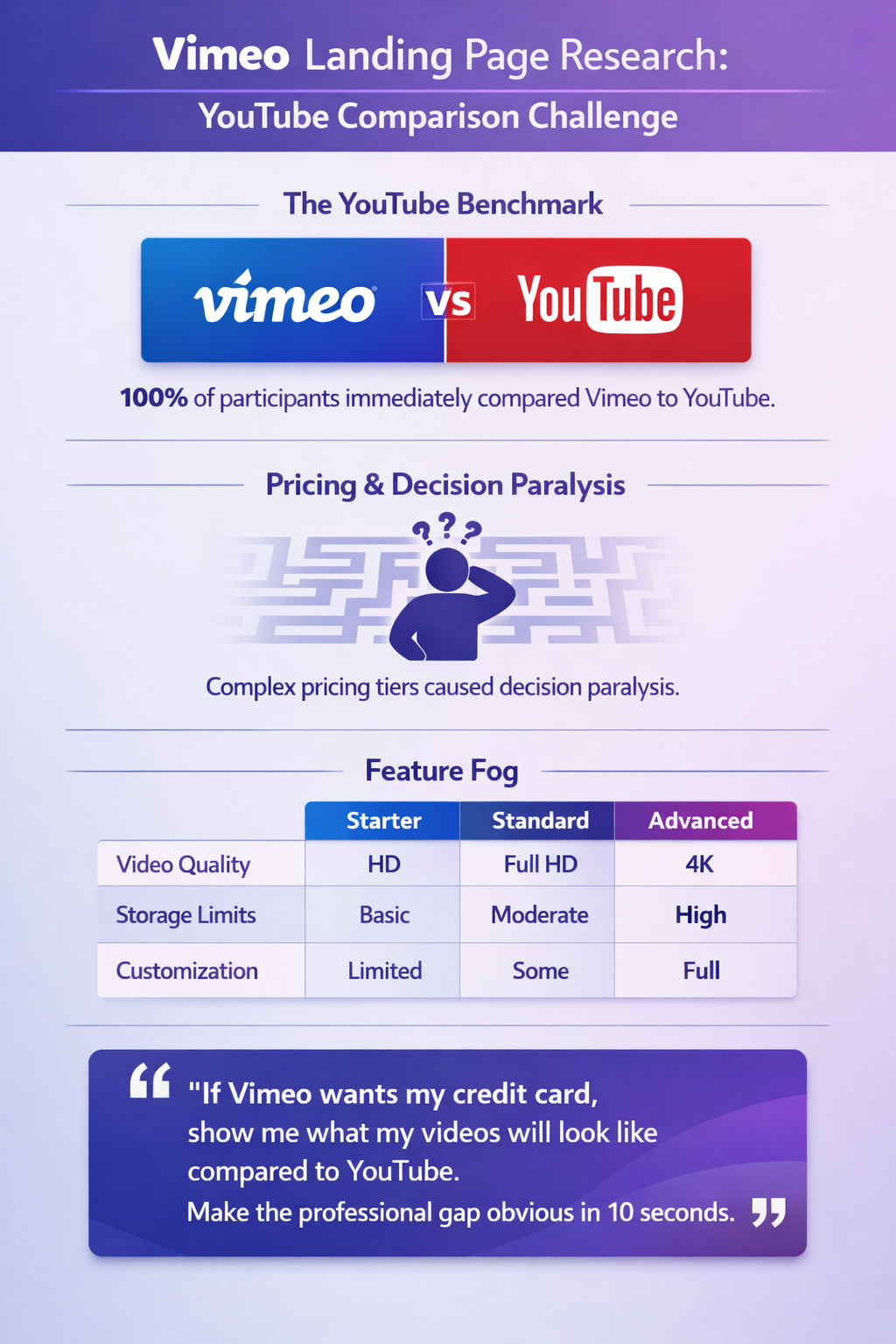
I ran a study with six US consumers to understand how potential customers perceive Vimeo's landing page and value proposition compared to YouTube. The participants ranged from a maintenance technician in Baltimore to a dental operations leader in rural Minnesota, from a solar construction project manager in San Diego to a rural Florida homemaker. None were film industry professionals. All were evaluating whether a paid video platform made sense for their work. The findings reveal a consistent pattern: Vimeo earns aesthetic respect but loses on value clarity. The site looks polished, but the path from 'nice' to 'paid' is blocked by vague tiers, hidden limits, and the unavoidable reality that YouTube is free.
The Participants
The research group included a maintenance technician from Baltimore who films work walkthroughs; an unemployed adult from San Tan Valley, Arizona on a tight budget; a project manager from rural Florida who manages home and supports a spouse's business; a dental operations specialist from rural Minnesota building patient education content; a solar construction project manager from San Diego who documents job sites; and a grant program administrator from rural New Jersey who produces workshop recordings. What united them: all had video hosting needs beyond casual sharing, and all faced the same question of whether to pay for something YouTube gives away.
First Impressions: The Gallery vs The Hardware Store
When asked for their honest first impression of Vimeo and how it compared to YouTube, participants converged on a striking metaphor: Vimeo is the quiet gallery with good lighting, YouTube is the packed hardware store on a Saturday.
The Baltimore technician captured the duality perfectly: "Gut reaction landing on Vimeo: clean, pretty, kinda bougie. The homepage feels like a showroom for filmmakers. Big glossy visuals, lots of white space, copy that says serious creators only. My brain goes, ok cool, looks pro - then immediately, ugh, I can already feel the upsell coming."
This response pattern repeated across participants. The aesthetic reaction was consistently positive. The business reaction was consistently skeptical. Users appreciated the clean player and distraction-free embeds, but immediately noticed the 'pay to really use it' energy that pervaded the experience.
The comparison to YouTube revealed clear trade-offs in users' minds. As the Minnesota dental operations specialist put it: "Vimeo is dinner at the nice place in town. YouTube is the county fair. Both have their place." For reach and discovery, YouTube wins without contest. For control and presentation, Vimeo has the edge. But most participants noted they would still default to YouTube for anything requiring actual audience.
Rural users raised specific concerns about reliability. The Florida participant noted that on satellite internet, 'the big glossy hero video hesitates and chews data, which puts me off right away.' Several participants mentioned Vimeo buffering more than YouTube on spotty connections, which undermines the premium positioning.
Key insight: Vimeo wins on aesthetics and loses on utility. The 'quiet gallery' positioning creates respect but also distance. Users see it as a tool for polished client presentations, not everyday work.
Pricing Clarity: Hidden Limits and the Shell Game
The second question asked whether Vimeo's pricing tiers (Starter, Standard, Advanced, Enterprise) made it clear what users would get at each level and what made them hesitate about paying. The unanimous response: not clear enough, and free is hard to beat.
Short answer: no, it's not clear. Those tier names feel like a shell game. Starter, Standard, Advanced, Enterprise - cool, but what exactly am I paying for at each jump, in plain numbers? I hate digging for the real limits.
This quote from the Baltimore participant captured the frustration every respondent expressed. The tier structure looks organised, but the actual differences feel buried in footnotes and asterisks.
Specific concerns about pricing clarity included:
Storage and bandwidth caps hidden in fine print
Seat counts and collaboration limits unclear between tiers
Live streaming features scattered vaguely across plans
'Contact sales' appearing before users can see real prices
Annual vs monthly pricing creating confusion about actual costs
Feature gates that feel designed to force upgrades
The hesitation to pay centred on one fundamental question: what does paying actually get you that free doesn't? The San Diego project manager articulated it directly: "Zero dollars is hard to beat. YouTube just plays anywhere." Every participant acknowledged Vimeo's advantages, but none could confidently explain why those advantages were worth a subscription fee.
The 'lock-in risk' emerged as a major concern. Multiple participants worried about what happens if they stop paying. Do embeds break? Do videos go dark? Does content become inaccessible? This uncertainty creates friction that delays purchase decisions indefinitely.
Key insight: Pricing isn't the problem. Pricing opacity is. Users aren't saying Vimeo costs too much; they're saying they can't figure out what it costs or what they'd get for it. The tiers read like marketing, not specifications.
What Would Actually Convert Them
The final question asked what Vimeo would need to show or promise to convince users it was worth paying for versus free alternatives. The responses were remarkably specific and consistent, revealing a clear hierarchy of conversion requirements.
Control and privacy topped the list. Users wanted ad-free playback with no random 'related videos' hijacking their content. They wanted domain-level restrictions, password protection, link expiration, and download toggles. They wanted the ability to replace a video file without breaking the embed URL, which multiple participants identified as a key workflow need.
Rural-proof performance came up repeatedly. Resumable uploads that survive dropped connections, adaptive streaming that actually works on weak signals, and offline sync options for mobile. As the rural New Jersey administrator put it: "Kill the asterisks, spell out the limits, and guarantee my embeds never break if I downgrade or miss a payment. If you can't promise that, I stay on free."
Transparent pricing was non-negotiable. Participants demanded clear storage and bandwidth limits in plain language, no surprise throttles or overages, price locks for at least two years, and pro-rated refunds. The Minnesota participant specified a price range: '$20-60 per month for a small team plan with real support and analytics. Beyond that, I need rock-solid uptime, strong security posture, and concierge migration.'
The conversion requirements extended to operational details:
Human support with stated response times, not just ticket queues
Clean data export and no lock-in if they decide to leave
Auto-captions that actually work for technical content
Simple analytics showing who watched and how far, exportable to CSV
Integrations with project management tools without Zapier complexity
The Arizona participant on a tight budget offered the most succinct version: "Cheap - 5 to 10 dollars a month. Month to month. Pay with prepaid. Full Spanish app. No contract. Cancel same day. No ads on my links. If they do that, ok. If not, I stay free."
Key insight: Users know exactly what would make them pay. The list isn't unreasonable: privacy controls, reliable performance, transparent pricing, human support, and data portability. The problem is they can't tell if Vimeo delivers these things without signing up first.
What This Means for Video Platforms
The research reveals a clear conversion gap in premium video hosting. Users recognise the value proposition. They want privacy, control, and professional presentation. They just can't connect those wants to specific paid features because the packaging obscures rather than clarifies.
Several actionable insights emerge from this study:
Show hard numbers, not tier names. Replace 'Starter/Standard/Advanced' with specific caps: '50 GB storage, 200 GB bandwidth, 3 team seats.' Users want specifications, not positioning.
Address the YouTube comparison directly. Don't pretend free alternatives don't exist. Explain specifically what paying gets you: no ads on embeds, replace files without breaking links, domain-level privacy. Make the value concrete.
Guarantee embed stability. Explicitly promise that embeds won't break if a subscription lapses. Offer a grace period. This single reassurance could unlock significant conversion.
Prove rural reliability. Demonstrate performance on weak connections with real tests, not marketing claims. Show upload-resume working on a 5 Mbps connection. Rural users are a real segment with real budgets.
Kill the 'contact sales' barrier. Every feature and price should be visible before signup. The moment users see 'contact sales,' they assume hidden complexity and leave.
The Premium Perception Problem
Vimeo has built a platform that looks premium and functions professionally. The clean player, the distraction-free embeds, the creative community positioning: these aren't accidents. They're deliberate choices that create real differentiation from YouTube's chaotic marketplace.
But premium positioning requires premium clarity. As the Baltimore technician concluded: "Vimeo looks cleaner and more professional. If I was selling courses or doing client-facing embeds, maybe I'd swallow it. But for my life - quick how-tos, walkthroughs, sending a link that just works - free wins. And if a platform can't tell me exactly what I get without a sales call, I'm out."
The opportunity for video platforms is significant, but only for those willing to make the premium value tangible, not just implied.
Want to test your own landing page and value proposition? Ditto lets you run studies like this in hours, not weeks. Book a demo at askditto.io.
What the Research Revealed
We asked real consumers to share their thoughts. Here's what they told us:
What would Vimeo need to show or promise to convince you it is worth paying for versus using free alternatives? Be specific about features, guarantees, or proof points that would move you.
Mark Espinoza, 33, Maintenance Technician, Baltimore city, MD, USA:
Short answer: I’d only pay if it saves me time, keeps my people’s privacy tight, and never embarrasses me with junk after the video. Right now, free works. So to pry open my wallet, I need this: Zero junk playback: No ads, no random “Up next” nonsense, no platform branding slapping me in the face. Custom end screen or just clean fade-out. Chapters and timestamp links that actually work in WhatsApp. Real control: Passwords, link expiry, one-time links, toggle downloads, simple viewer limit. Replace the file without changing the URL. Custom thumbnails that do not get compressed to mashed potatoes. Privacy I can trust: Clear promise you are not selling data or tracking my viewers for ad profiles. Written data policy in plain English and Spanish. 2FA, private-by-default uploads, and audit logs so I can see who viewed what. If you have third-party audits, show them. If not, pues bye. Mobile workflow that survives Baltimore transit: App that resumes uploads after dead zones, background uploads, quick trim, auto-stabilize, noise cut, and a one-tap share link. I shoot on the job, on a bus, in a basement. If the app chokes, I’m out. Good captions for Spanglish: Auto-captions that do not butcher Spanish names and slang. Easy edit. Burn-in or toggle. Bonus if I can upload my own SRT and it just works. Basic privacy tools built in: Quick blur for faces, house numbers, plates. I film inside apartments. People deserve dignity. Quality on bad wifi: Adaptive streaming that stays crisp on weak signal without turning into Minecraft. Show me side-by-side proof against a free platform on a cheap Android over spotty LTE. Simple analytics I actually want: Did they watch, how far, and when. That’s it. No creepy stalker dashboards. Distribution that’s painless: Pretty link, custom alias, QR code I can stick on a work order. Embeds that don’t break in email or basic websites. Support from humans: Fast chat with a real person, evenings and weekends, bilingual. Short how-to clips instead of a 20-page PDF. Transparent pricing, no games: Month-to-month, pause anytime. No “oh that feature is in the Plus-Plus tier” bait-and-switch. Clear storage and bandwidth limits written up front. Refund if uptime falls below what you promise. Proof, not vibes: Give me a full-feature trial with no watermark, let me run an actual job through it for a week. If it lives through a Monday morning on the MTA and a basement boiler room with one bar, dale, I’ll pay. Dealbreakers: Locked features behind surprise tiers, or watermarking unless I pay more. Auto price hikes with cute emails about “new value.” Forced branding or ads anywhere near my videos. Data harvesting buried in the fine print. If you want my money, make my day smoother: record - upload - set privacy - send link - done. No BS, no drama. Mira, show me it runs clean in the real world and I’ll pay without whining. Otherwise, free is fine.
Allison Scavo, 54, Unemployed Adult, Rural, FL, USA:
Short version: I am not paying just to move videos from Point A to Point B. If Vimeo wants my money, they need to save me time, protect my people, and give me clean control without surprises. What would move me: Privacy and control: no ads, no tracking pixels on my viewers, no mining or AI training on my content, period, in writing. Clear domain-level privacy, expiring links, simple passcodes, and the option to let folks download only if I say so. Works on rural internet: resumable uploads that survive a dropped satellite connection, an offline queue that waits for good signal, adaptive streaming that actually plays on two bars, and a clean way to push a downloadable file for our older members with spotty service. Roku or Fire TV app that opens straight to our channel with no junk around it. Live streaming that is boring and reliable: low-latency with DVR rewind, stable at low bitrates, quick-start for Sunday without fiddling, and a one-click simulcast to the free sites while I keep the archive on Vimeo. Ownership and exit: I keep the originals. One-click export of every file, caption, thumbnail, and chapter. Automatic backup to a cloud folder I control. No lock-in tricks. Accessibility: automatic captions that are accurate enough to edit quickly, easy subtitle uploads, audio-only version with one toggle, chapters and timestamps. Clean embeds: no suggested videos, no unrelated branding, works on a basic WordPress site, loads fast on phones, and I can set a custom poster image without hoops. Simple analytics without spying: views, watch time, basic geography, and device type. No creepy viewer-level tracking. A clear privacy statement I can show our church folks. Support and accountability: a named support contact or small-team queue with U.S. phone hours, weekend coverage for live stream windows, a public status page, and a written uptime guarantee with credits if they miss it. Plain costs: flat annual price, clear storage and bandwidth limits, no overage gotchas, price lock for at least 2 years, and a 30 to 60 day refund window if it does not deliver. Month-to-month option without penalty. No forced add-on subscriptions for basics like captions. Values and guardrails: transparent moderation rules that are even-handed and respect faith content. No bait-and-switch policy changes. Proof it works: case studies from rural churches or small contractors using satellite or weak LTE, sample uploads showing a failed-then-resumed transfer, a real live service recorded on a stormy weekend, and plain-English TOS pages I can actually read. If they can check most of that, fine, I will pay and not look back. If not, I will keep using the free stuff and live with the quirks. Stewardship matters, and I am not funding headaches.
Adrian Rayas, 29, Unemployed Adult, San Tan Valley CDP, AZ, USA:
I do not pay now. Free is fine. To pay, I need this: Cheap: 5-10 a month. Month to month. Pay with cash gift cards or prepaid. Full Spanish app. Real WhatsApp chat. No contract. Cancel on WhatsApp same day. No ads on my links. No suggested videos. Password links. Link expiry. Simple. Auto captions: Spanish and English. Low-data upload. Resume on bad signal. Offline download for show-and-tell. Basic trim and merge. Safe music included. Clear storage by hours. No surprise fees. Proof on a cheap Android. Low bars. Plays smooth. Real users like me in Arizona. Show results. 30-day trial. No card. Or easy refund. One-page portfolio in Spanish. My video, my phone. QR code links for flyers and cards. Invoices in Spanish. ITIN ok. No SSN asks. If they do that, ok. If not, I stay free. Vamos viendo.
Diego Cobb, 33, Operations Specialist, Rural, MN, USA:
Short answer: I’ll pay if it saves me time, looks pro, and keeps patients and staff out of algorithm rabbit holes. If you can’t beat free on control, reliability, and support, I’m out. Must-have features Ad-free, no “related videos,” and a truly clean embed that never punts viewers to competitors or clickbait. I do not want a hygiene video ending with a YouTuber’s face.Granular access control: domain-level restrictions, single-use links, expiration dates, IP allowlists for our clinics, password options that don’t require viewers to make an account.Rural-proof streaming: adaptive bitrate that actually works on spotty Starlink or DSL, resumable uploads, and a 480p fallback I can force when bandwidth stinks.Simple branding: white-label player, our logo/colors, and a basic landing page template per clinic location so we’re not cobbling pages together.Review and approvals: version history, time-stamped comments, and shareable review links so a doc can approve a cut on her phone between patients.Collaboration without drama: role-based permissions, folders by clinic, and audit logs so I can see who changed what and when.Solid captions and accessibility: fast auto-captions with 95%+ accuracy or an easy path to fix, proper subtitles, keyboard nav, and good contrast. No excuses here.Analytics that matter: per-video and per-embed stats, drop-off heatmaps, and a dead-simple export. I want to know if patients watched the pre-op section or bailed at minute two.Data portability: original files, captions, chapters, and metadata always downloadable. If I leave, I take my stuff without a scavenger hunt. Guarantees and policies Uptime SLA spelled out with credits that aren’t Monopoly money. If a live stream dies, I’m not eating the egg on my face alone.Clear, posted pricing with no “talk to sales.” Pro-rated refunds on downgrades and no 12-month hostage contracts. Don’t play games with storage or team seats.Privacy and compliance: cookie-light embeds, DPA on request, SOC 2 Type II or equivalent. If you can actually sign a BAA for anything that might touch PHI, say it plainly. If not, say that too so I keep any clinical content scrubbed of identifiers.Support with a human: real-time chat or phone during business hours, stated first-response times, and escalation that doesn’t take a week. Proof points I’d want to see before paying Side-by-side demo on a crummy connection: your player vs YouTube or Drive. Show start time, buffering, and completion rate. Don’t cherry-pick.Case study close to my world: a multi-location healthcare or dental group using you for training and patient education, with measurable outcomes.Security receipts: recent audit letters, uptime history, and a straightforward writeup of how embeds avoid third-party tracking.Trial with our real files for 14-30 days, no credit card, so I can embed on a staging page and see bounce and completion data in situ. Nice-to-haves that would tip me over Offline-ready: a secure mobile app for staff to download training and auto-sync watch progress when back online.Chapters and templates: quick chapter markers, title cards, and lower-thirds we can brand once and reuse so I’m not reinventing the wheel.Live with safety nets: backup stream ingest, auto-record to VOD, low-latency under 5 seconds, and easy simulcast to the socials if we choose.Lightweight editing: browser-based trim, blur, and crop that doesn’t make me boot Premiere for tiny tweaks.Integrations: Drive/Dropbox ingest, Slack or email for approval pings, and a simple webhook so Airtable updates a “status” column when a video is approved.CTAs that aren’t tacky: end-screen buttons for “Book now” or “Download pre-op checklist,” with UTM tags I control. Pricing that feels fair If you hit the must-haves with real support and analytics, I’m comfortable in the $20-$60 per month range for a small team plan. If you give me live with SLA and serious collaboration, $60-$120 is fine. Beyond that, I need rock-solid uptime, strong security posture, and concierge migration. Bottom line: show me the math and mud-tested proof. If you keep my viewers focused, respect privacy, work on bad internet, and give me someone to call when it breaks, I’ll happily pay. If I see hidden fees, forced bundles, or “oops, related videos,” I’m back to free in a heartbeat.
Brianna Bruen, 27, Project Manager, San Diego, CA, USA:
Short version: if I’m going to pay instead of tossing videos on the big free sites, it has to make my job on-site faster, cleaner, and less chaotic. Show me receipts, not fluff. What would actually move me: Granular privacy that sticks: password, link expiry, domain-level restrict, viewer-specific links, and audit logs of who watched what and when. No related junk, no trackers on my embeds, ever. Replace without breaking: I upload a new cut and the URL stays the same. Version history I can roll back to. Folder-level default settings so I’m not babysitting toggles every time. Rural-proof performance: resumable, chunked uploads on spotty LTE; adaptive streaming I can default to a bitrate that won’t choke in the backcountry; offline sync on mobile so a super can review in a dead zone. Compression that respects the footage: publish your encoding ladder and bitrates. Let me force 4K where bandwidth allows, keep originals for download, and show a side-by-side of your encode vs the usual free site. If quality dips below your spec, comp me a month. Frame-accurate review tools: timestamped comments, @mentions, checkboxes for “approved,” exportable comment lists. Watermarking that doesn’t ruin the image. Captions and transcripts that don’t suck: auto-captions with a custom dictionary for technical terms, quick in-browser editor, downloadable SRT and text transcript. At least 95% accuracy or a path to human review. Clean, brandable embeds: no platform logos, no end cards, no suggested anything. Chapters, hotkeys, keyboard-accessible controls for the folks who actually need them. Real analytics, not vanity: per-viewer heatmaps, completion rates by link, drop-off points. CSV export. I need to prove a sub actually watched the safety clip, not that it got “impressions.” Straight-shooting pricing: clear storage and bandwidth limits in plain English, no surprise throttles. 24-month price lock in writing. Prorated refunds. Annual and monthly options. Support that answers: live chat or phone during West Coast business hours with under-2-hour response. Public status page with 12 months of uptime history and an SLA with credits if you miss it. Data ownership and exit plan: I own my files and metadata, period. One-click bulk export of originals, captions, and analytics if I leave. No using my content in your marketing without consent. Integrations that save clicks: simple API, webhooks, and a native hook into common project-management tools or at least a zap-friendly path so links and approvals move automatically. Security that’s grown-up: documented compliance, SSO if I add teammates later, and link-level IP or geo restrict if needed. Not flashy, just competent. Trial that’s real: 30 days with all features, my actual files, no watermarking on test embeds. Give me a test page to measure your transcode times, bitrate, and startup latency. Hard no’s: ads on my content, platform branding I can’t remove, upsell nags mid-workflow, bait-and-switch policy changes, or limits so tight I’m playing Tetris with storage. Price-wise, if you nail the above, I’d stomach around 12-20 bucks a month solo. If it’s a team thing, my employer should be footing it. Otherwise I’ll live with the mess of free and get back to work - it’s too bright and warm today to babysit uploads that stall at 87%.
Jeffrey Mitchell, 36, Administrative Assistant, Rural, NJ, USA:
Short answer - kill the asterisks, spell out the limits, and guarantee my embeds never break if I downgrade or miss a payment. If you can’t promise that, I stay on free. What would move me: Clear limits, no gotchas - One page that lists, in plain counts: storage, monthly bandwidth, upload hours, max resolution, live hours, concurrent lives, viewer caps, seats, API calls. No footnotes. Overage policy spelled out: 80-90-100 percent alerts, no auto-charges, no shutdown mid-cycle. Billing promises - True month-to-month price shown first. Annual is optional, not forced. 24-month price lock for new customers. 60-day notice on any change. One-click downgrade with zero player watermarking, zero embed breakage. If I lapse, a 60-day grace where videos stay up ad-free while I fix the card. Upload that survives bad internet - Desktop uploader with pause-resume and checksums. Chunked uploads that actually continue from 92 percent, not restart. Background mobile upload. Option to send from Drive/Dropbox. Even a paid mail-in ingest would get my attention. Privacy that sticks - Domain lock, passwords, expiring links, per-embed rules, disable downloads per video. No ads, no third-party trackers by default. A documented “no-sell, no-share viewer data” stance. Accessibility and compliance - Autocaptions plus easy SRT upload and editor. Keyboard-friendly player. Meets WCAG 2.1 AA. A “no-cookie” embed mode that passes government-site rules. Player control without games - Remove platform logo at paid tiers. Set colors, thumbnail, chapters, simple CTAs. Replace the source file without changing the URL. Analytics I can use - Unique viewers, watch time, completion rate, top drop-off points, by domain and page. Heatmaps. Filters and CSV export. Keep data at least 13 months. Live, written in English - One concurrent event, X hours per month, 1080p cap, Y viewer cap. DVR, auto-archive to VOD included. Latency spelled out. No mystery “fair use.” Simulcast and cross-post - Push live to YouTube and FB. After live, auto-publish VOD to YouTube with my template. I get reach there, control here. Seats that aren’t stingy - At least 3 seats on the middle tier with basic roles and approvals. Support with teeth - Real human chat or email for all paid tiers, 4-business-hour response target, weekend coverage for live issues. Public status page, incident history, and a 99.9 percent uptime SLA with credits if you miss it. Portability, no lock-in - Bulk export originals, transcodes, captions. Keep URLs stable for 90 days after cancel. Promise not to yank core privacy features up a tier later. Proof, not hype - Case studies from counties, libraries, small schools with real numbers: storage used, monthly bandwidth, cost, issues. A 14-day full-feature trial, no card, where I can embed on a real page. Show upload working on a 5 Mbps connection without stalling. Roadmap honesty - Changelog. 6 months’ notice before deprecations or price shifts. Commit that domain lock, captions, and basic analytics will not be moved up-tier. Public sector break - A straight 20 percent off for government and nonprofits, plus the ability to pause for a month without penalties. Price I’d actually pay: $15-20/month for on-demand hosting with those privacy controls, analytics, and upload-resume that works. $30-40/month if that also covers simple live with clear caps and simulcast. Real talk: stop the fine print, protect my embeds, and don’t punish me for rural uploads. Do that, I’ll move a card over. Otherwise, YouTube plus workarounds is still the least bad option.
Imagine you are looking for a video hosting platform for your business or creative work. You land on Vimeo.com. What is your honest first impression? How does it compare to YouTube in your mind?
Adrian Rayas, 29, Unemployed Adult, San Tan Valley CDP, AZ, USA:
Vimeo looks clean and fancy. Feels quiet and for film people, and I worry it costs money. YouTube is messy but fast, and I find Spanish how-to and soccer there. I stick with YouTube; ads suck, but it works, poco a poco.
Mark Espinoza, 33, Maintenance Technician, Baltimore city, MD, USA:
Gut reaction landing on Vimeo: clean, pretty, kinda bougie. The homepage feels like a showroom for filmmakers. Big glossy visuals, lots of white space, copy that says "serious creators only." My brain goes, ok cool, looks pro - then immediately, ugh, I can already feel the upsell coming. Another subscription, otra contraseña, otra factura. The vibe is polished but a little pretentious. Like a gallery where the guy in a beanie says “we curate.” Compared to YouTube in my head: Vibe: Vimeo is tidy and artsy. YouTube is a loud flea market. I respect Vimeo’s neat shelves, but I actually get stuff done in the chaos of YouTube. Audience: If you need eyeballs, la gente lives on YouTube. Vimeo feels like you send a link to a client or put it on a portfolio, not where randoms discover you. Player look: Vimeo’s player is clean and doesn’t scream for attention. Embeds look classy. YouTube’s player is fine but shoves related junk in your face like a kid hyped on Skittles. Search: I can find a 12-year-old fixing the exact radiator valve I have on YouTube in 30 seconds. Vimeo never crosses my mind for "how to" unless a teacher sends me a link. Comments: Vimeo is quiet. Nice, fewer trolls, but also dead. YouTube comments are a trash fire that sometimes hides the one note that saves your day. Money feel: Vimeo gives me the “pay to really use it” energy. YouTube feels gross with tracking and ads, but it’s easy and free to start. Pick your poison. Trust: YouTube is messy but familiar. Vimeo looks pro, which helps if you want to look legit to clients. Looks matter when you send a link cold. If I’m thinking business or creative work: Vimeo reads like a clean portfolio with nice control. YouTube is the busy street corner where people actually walk by. For my world - quick how-tos, job reels, tenant tips - I’d probably park the public stuff on YouTube and only use Vimeo when I want a cleaner presentation. Pero honestamente, first impression of Vimeo is nice... and slightly eye-roll. It’s beautiful, but I can hear it whispering "upgrade" before I click anything.
Brianna Bruen, 27, Project Manager, San Diego, CA, USA:
First impression of Vimeo: clean, pretty, a little precious. It feels like walking into a quiet gallery where everything is color graded and no one is sweating. The site vibes say polished reels, client presentations, agencies, portfolios. Also gives me that are you ready to pay yet energy before I’ve even done anything, which annoys me. Compared to YouTube in my head: - Vimeo is polish. Nice player, doesn’t yank you into a chaos rabbit hole, looks good embedded on a site. Feels professional, curated, maybe a bit snooty. - YouTube is reach. Loud, dusty, useful, and kind of a mess. Comments are a swamp, ads are relentless, but if I need eyeballs or real feedback, that’s where the humans are. - Out here with my patchy rural signal, YouTube usually limps along. Vimeo sometimes stutters. That alone makes me side-eye it for day-to-day use. - Price vibes: Vimeo feels subscription-y. YouTube feels free-ish but you pay with noise and distractions. If I’m hosting a slick brand video or a portfolio cut for a client, Vimeo looks right. If I’m trying to actually get discovered or build a community, YouTube all day. Gut check: Vimeo is the quiet gallery with nice lighting, YouTube is the packed hardware store on a Saturday.
Diego Cobb, 33, Operations Specialist, Rural, MN, USA:
Gut check landing on Vimeo: clean, calm, a little artsy. Feels like a quiet gallery with white walls and good lighting. The player looks tidy, the home page vibes curated not chaotic. I like that. Also kinda gives me the sense it’s for folks who polish their work, not for tossing up a quick how-to. In my head vs YouTube: Vibe: Vimeo is dinner at the nice place in town. YouTube is the county fair. Both have their place. If I’m showing something to a client or embedding on a site, Vimeo looks more grown-up. Noise: Vimeo feels distraction-free. YouTube is loud on purpose. Great for discovery, terrible if you do not want the algorithm throwing random suggestions next to your brand. Audience: YouTube is where the people are. Vimeo feels like fewer tire-kickers, but also fewer eyeballs. Comments: Vimeo’s tend to be polite or nonexistent. YouTube comments are a swamp unless you babysit them. Playback reliability out here: YouTube almost never chokes for me. Vimeo is fine most days, but I’ve had the odd hiccup on spotty internet. Embedding look: Vimeo embeds just look cleaner to my eye, fewer warts. If I’m dropping a video on a clinic page, that matters. Money stuff: Vimeo smells like tiers and feature gates. I get hives from that. YouTube is free but you pay in ads and distractions. If I’m being blunt: for reach and search, YouTube wins by a mile. For a polished, ad-free presentation where I care about how it looks sitting on a website, Vimeo makes a better first impression. I still side-eye the pricing ladder. What kind of videos are you thinking about here - public marketing, internal training, or more of a creative reel? That changes how I weigh it.
Jeffrey Mitchell, 36, Administrative Assistant, Rural, NJ, USA:
First impression: clean, quiet, a little artsy. Feels like a gallery for video people, not a hangout. I like the uncluttered player and the lack of junk around the video, but I can smell the paid tiers quick. Nice for presentation, not built for hustle. Compared to YouTube, real talk: YouTube is the mall on a Saturday. Loud, messy, but everyone is there. Vimeo is the boutique down the side street. Tidy, respectful, fewer eyes. Control: Vimeo looks better for dropping a polished video on a website without ads or random recommendations. YouTube always tries to drag you into the next thing. Reach: YouTube wins easy. If you want people to actually find you, that is the spot. Bandwidth: On my shaky rural internet, YouTube usually behaves. Vimeo buffers more for me. Annoying. Vibe: Vimeo gives filmmaker-agency energy. YouTube is shop floor energy. I work on the shop floor. Money: Vimeo reads like you pay to unlock basics. YouTube costs time and sanity, not cash. If I needed a clean, no-distraction embed for a client or a workshop, I’d lean Vimeo. If I needed eyeballs and search, it is YouTube, no contest.
Allison Scavo, 54, Unemployed Adult, Rural, FL, USA:
Gut reaction to landing on Vimeo: clean, quiet, a little artsy, and it immediately smells like a subscription. Slick enough, but it feels like it is courting agencies and filmmakers, not a small-town outfit trying to show work without drama. On our satellite, the big glossy hero video hesitates and chews data, which puts me off right away. The copy reads like pitch-deck talk. Pretty, but distant. YouTube in my head is the opposite. Loud, messy, but useful. It is the hardware store of video - not fancy, but it has what I need and it usually loads even when my signal hiccups. I already know where everything is, and people actually go there to watch. My mental scorecard: Vimeo - what I like: clean player, no junky suggested videos at the end, feels more professional when you embed on a website. If I had to show one polished reel to a client, it would look tidy there. Vimeo - what bugs me: the paywall vibe, storage caps, and that coastal-creative tone. Search and discovery feel weak. On slow internet it drags. I do not see a clear human to call if something breaks, just forms and wait-your-turn. YouTube - what I like: search actually finds things, chapters and comments help, and it plays at 360p if my signal dips. Everyone already knows how to click a YouTube link. No monthly to host basic stuff. YouTube - what bugs me: ads, clutter, and the algorithm trying to shove nonsense at me. Embeds look cheap. Policies change whenever they feel like it, and support feels like shouting into a culvert. If I am honest, for our kind of work I’d use YouTube for reach and reliability, maybe unlisted for embeds, because it just works and people are there. Vimeo looks nicer, sure, but it feels like paying just to look fancy, and I do not have patience for one more subscription nibbling at me every month.
Looking at Vimeo pricing tiers (Starter, Standard, Advanced, Enterprise), is it clear what you get at each level? What makes you hesitate about paying for a video platform when YouTube is free?
Jeffrey Mitchell, 36, Administrative Assistant, Rural, NJ, USA:
Short answer - not clear. Starter reads like a teaser. Standard looks like the real one but it’s packed with asterisks. Advanced feels like a junk drawer for live stuff and teams. Enterprise screams sales call. I don’t love guessing which box hides the thing I actually need. What’s muddy to me: Hidden caps - hours, bandwidth, viewers. Feels buried.Seats - how many people can touch the account before it ups the price.Live - which tier really covers it, and what gets throttled.Branding vs player controls - vague lines between “custom” and “more custom.”Analytics - basic vs advanced sounds nice, but what do you actually see.Privacy and embeds - domain lock, passwords, downloads - scattered across tiers.Billing - monthly shown, then nudged to annual, then fine print shifts. I hate that dance. Why I hesitate to pay when YouTube is free: Reach - YouTube has it. Vimeo doesn’t. I’d be paying then still cross-posting.Budget - envelopes are tight. A monthly drain needs a hard payoff, not vibes.Overages - “fair use” clauses and surprise limits make me itchy.Upload reality - rural internet is moody. Paying doesn’t fix slow uploads dropping at 92%.Lock-in - features jump tiers later, prices creep, and you’re stuck.Support gating - real help sitting behind a higher tier rubs me wrong.Downgrade risk - if I lapse, do my embeds break or get watermarked? Hard no. Real talk: until the tiers read like plain English with no gotchas, I’m not moving off free.
Adrian Rayas, 29, Unemployed Adult, San Tan Valley CDP, AZ, USA:
Honestly? Not clear. The tiers look the same to me. Many checkmarks. Big words. I cannot see the real limits. My head hurts reading that stuff. What confuses me: Limits - what happens if I pass them?Live video - which plan is it, exactly?Seats - how many people can use it?Privacy - real private links or not?Support - a real human, in Spanish, or just email?Billing - auto renew, fees, taxes? I do not see it clear. Why I hesitate to pay: YouTube is free.Everyone I know uses it.No card, no contract.Easy link for WhatsApp.Big reach for zero money.If I stop paying, will my videos lock? That scares me.My money is tight. I hate monthly bills.English forms and fine print stress me out. So yeah. I stay with free. If one day I need no ads and a clean player, maybe. For now, no. Vamos viendo.
Allison Scavo, 54, Unemployed Adult, Rural, FL, USA:
Short answer: not really clear, and I do not love paying a monthly meter for videos when YouTube is sitting there free as sunshine. What I see when I look at those tiers: Lots of checkmarks and buzzwords, but the real limits feel buried - things like storage caps, bandwidth, live event limits, seats, or what happens if you go over.Starter vs Standard is kinda understandable. After that, Advanced and Enterprise blur into contact sales, which to me means the price moves and the rules move.Annual vs monthly toggles and per-seat language make it hard to do simple cost-per-year math. I want a straight number, not a shell game.Support looks tiered, but I can’t tell if a human will pick up the phone when it breaks. That matters more to me than fancy “brand kits.” Why I hesitate to pay when YouTube is free: Hidden meters: bandwidth, overages, live hours, viewer caps. I budget tight. I won’t sign up for a plan that punishes success or a surprise spike.Price creep and lock-in: these platforms love to move features up a tier. I do not want to rebuild embeds on our website because someone shuffled the deck.Unclear off-ramp: if I stop paying, do the videos go dark? Can I grab my originals easily? I want ownership, not hostage files.Support: if I’m paying, I expect named accountability. Email tickets and community forums do not cut it when a Sunday livestream hiccups.Connectivity reality: I’m on satellite most days. Uploads are slow and finicky. Paying a premium to watch a progress bar crawl feels foolish.Audience: people are already on YouTube. Discoverability and easy embedding are hard to beat, and the cost is zero. Yes, the ads and junk recommendations annoy me, but free is free.Privacy vs tracking: if I’m paying, I expect minimal tracking and no surprise cookies. If I can’t see plain language on that, I’m out. When I’d actually consider paying: We need clean, ad-free embeds on our business site with no “related” competitor videos.We need tight access control - passworded trainings or domain-locked embeds.We need to swap files without breaking links and get reliable human support.Pricing is flat, with no surprise overages, and I can download everything anytime. Until then, YouTube is “good enough.” I’d rather deal with its annoyances than sign up for a vague plan with footnotes that bite later. Show me simple, all-in pricing and a real support number, and I’ll rethink it. Otherwise, hard pass.
Mark Espinoza, 33, Maintenance Technician, Baltimore city, MD, USA:
Short answer: no, it’s not clear. Those tier names feel like a shell game. Starter, Standard, Advanced, Enterprise - cool, but what exactly am I paying for at each jump, in plain numbers? I hate digging for the real limits. Give me caps, not vibes. Stuff that bugs me on those pages: - Vague features: words like “advanced collaboration” and “brand control” with no straight breakdown. Say how many seats, how many reviews, what privacy options exactly. - Buried limits: storage, bandwidth, viewer caps, max file size - the meaningful stuff is always in footnotes or asterisks. Nah. - Paywalling the useful bits: it reads like the one feature you actually need lives one tier up. Classic upsell. - Contact sales: the second I see that, my eyes roll. I don’t want a demo, I want a price and a cancel button. Why I hesitate to pay when YouTube is free: - Cost vs usage: I might upload a handful of clips in a month, sometimes nothing. Paying a monthly fee for that feels dumb. That’s groceries or dog food, mano. - Subscription creep: sign up, forget, price bumps, weird annual lock-ins. Been there with other tools when my little side hustle flopped - watching money leak out for something I barely use made me salty. - Lock-in risk: if I cancel, do all my embeds die and my links break? With free unlisted YouTube, stuff just... stays. I don’t want my work evaporating because the card expired. - Limits anxiety: “fair use,” overages, hidden thresholds - the kind of fine print that turns a random spike in views into a fee. No gracias. - Playback reality: everyone can open a YouTube link on any crusty phone. I’ve seen Vimeo choke more than once on older devices or spotty Wi‑Fi. Maybe that’s anecdotal, but it sticks. - Audience: if you want reach, people are already on YouTube. I don’t need “discoverability” from a paid platform that still won’t bring me viewers. - Data stuff: making folks enter emails to watch, tracking, whatever. I already tolerate enough data slurping from the big guys - I’m not eager to add another. Look, Vimeo looks cleaner and more professional. If I was selling courses or doing client-facing embeds, maybe I’d swallow it. But for my life - quick how-tos, walkthroughs, sending a link that just works - free wins. And if a platform can’t tell me exactly what I get without a sales call, diache, I’m out.
Diego Cobb, 33, Operations Specialist, Rural, MN, USA:
Short answer: not really. The names are tidy, but the lines between Starter, Standard, and Advanced feel murky, and Enterprise is the classic black box. Too much marketing fluff, not enough hard numbers. If you want my money, stop hiding the ball. What I want to see, side by side, in plain English: Exact upload/storage caps and whether there is any monthly bandwidth limit or overage fees. Seats included vs paid add-ons, and what each seat can actually do. Player control: remove branding, kill related videos, custom domain-level privacy, password options. Website embedding details: will it autoplay, lazy-load, and behave on mobile without drama. Live streaming: number of events, viewer caps, DVR, chat, backups. Analytics: real retention heatmaps, per-embed reporting, export to a spreadsheet without hoops. Integrations: CMS and marketing tools without yet another Zapier daisy chain. Support and SLA timelines in writing, not just “priority.” Why I hesitate to pay when YouTube is free: Zero dollars is hard to beat, and YouTube’s delivery is fast and reliable enough most days. Hidden gotchas: bandwidth caps, “fair use” clauses, or price jumps at renewal. I have a long memory for teaser pricing. Vague tiers that make me gamble on a plan, then upsell me when I hit a wall. Lock-in: moving a whole library later is a slog. I do not want another migration project on my weekend. Support theater: if I’m paying, I want a human who answers when something breaks. If it’s just a ticket abyss, why not stick with free. Rural reality: if the player chokes on spotty internet, I’m paying to be frustrated. That said, I would pay if the value is obvious: no ads or junk suggestions on our site, domain-level privacy, clean embeds, replace-a-video-without-breaking-the-link, and analytics I can actually act on. I’ve had YouTube toss some goofy “related” content after a patient education clip before - not a good look. If a paid plan solves that cleanly and spells out limits in black and white, fine, swipe the card. But as it reads now, it’s still a squint-and-guess situation. What are you trying to do, exactly - embed on a website, run internal training, host paid courses, or livestream events? The use case makes or breaks whether the spend pencils out.
Brianna Bruen, 27, Project Manager, San Diego, CA, USA:
Short take: the tiers feel like a slick grid with fuzzy guts. I’ve poked at that page a few times for work updates and training clips, and I still end up squinting at the fine print. It’s warm and bright out and my patience for marketing fluff is basically toast. What’s clear to me: the general ladder - Starter is bare-bones, Standard is the real entry point, Advanced is for teams and live stuff, Enterprise is the walled garden with security and SLAs. What’s murky: hard numbers. I want exact storage caps, bandwidth ceilings, live limits, and seat counts in plain text. Not asterisks and upsell nudges. Also which tiny-but-critical features sit behind a paywall - things like file replacement without breaking links, domain-locking, or real analytics. If I have to click contact sales, I’m out. Why I hesitate to pay when YouTube is free: Ubiquity: YouTube just plays anywhere. I’ve had a client firewall block Vimeo once and had to re-upload. That kind of nonsense scorches trust. Hidden limits anxiety: I do not want to discover a bandwidth cap or overage fees the night before a stakeholder review. Give me hard numbers, not vibes. Zero discovery payoff: If I’m paying, I’m paying for control, not reach. Vimeo won’t hand you an audience. YouTube at least has search momentum, even if the algorithm is a gremlin. Yet another subscription: I’m already shelling out for cloud storage, project tools, and mapping apps. If the paid tier doesn’t materially reduce headaches, it’s dead weight. What would actually make me pull the trigger: No ads, clean embeds that don’t drag viewers into random recommendations. Domain-level embeds and password options that just work without weird hoops. Replace files without changing the URL and breaking decks or RFIs. Crystal specs on storage, bandwidth, seats - posted, not negotiated. So yeah, I might pay for the polish and control, but the tier descriptions still read like a guessing game. If I’m budgeting between good coffee, trail permits, and a video host, the platform with free, universal playback wins until the paid one stops making me chase footnotes.