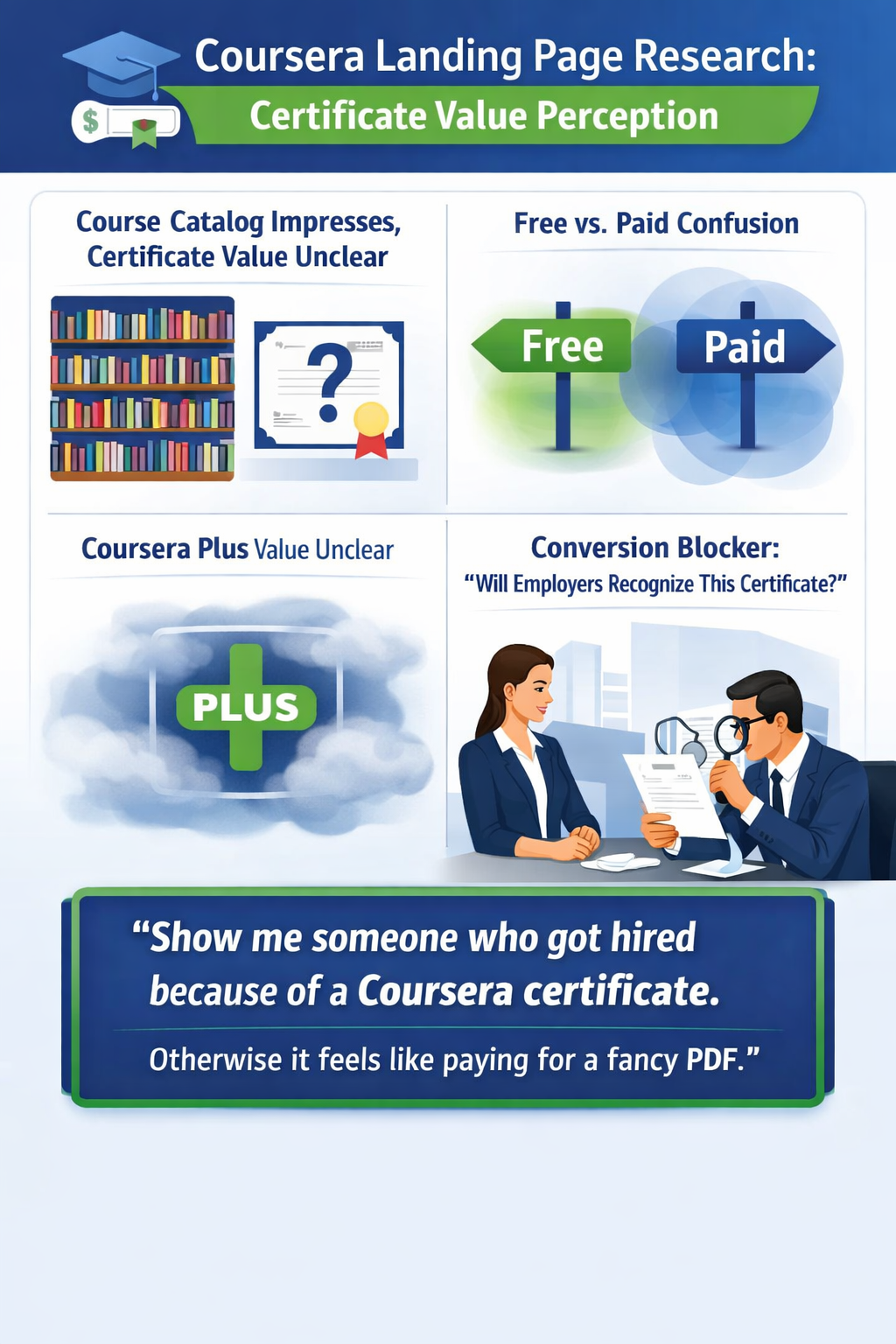
Six learners. Three questions. One brutal verdict: Coursera looks like opportunity, but feels like a gym membership waiting to punish you for life getting in the way.
I ran a study with six US consumers aged 26 to 55 to understand how potential customers perceive Coursera's landing page and value proposition. These weren't career students or tech workers with L&D budgets. They were a project coordinator from North Las Vegas, a stay-at-home parent from rural Oregon, a job seeker from Renton, a retail store manager from rural Indiana, a bilingual single mother from rural Pennsylvania, and a customer success manager from Newark. What united them: all were considering online learning to advance their careers, and all brought healthy scepticism about whether certificates actually deliver value. The findings reveal a consistent pattern: interest undercut by confusion. The platform looks legitimate, but the path from browsing to paying is blocked by pricing complexity, uncertain ROI, and the nagging fear that 'free' really means 'teaser.'
The Participants
The research group included a project coordinator from North Las Vegas who manages RA and partial hearing loss; a stay-at-home parent from rural Oregon raising three kids on a tight budget; a divorced 40-year-old job seeker from Renton, Washington seeking stable daytime work; a retail store manager from rural Indiana focused on career advancement; a bilingual 26-year-old single mother from rural Pennsylvania pursuing a legal support career; and a customer success manager from Newark, New Jersey working from home with her rescue dog Luna. What united them: all were evaluating whether Coursera could deliver real career outcomes, and all approached that evaluation with the practical scepticism of people who count every dollar.
First Impressions: Exciting Until You Start Clicking
When asked for their honest first impression of Coursera's landing page, participants described a consistent emotional arc: initial excitement, rapidly followed by overwhelm. The site looks legitimate and full of potential. Then the complexity kicks in.
The Newark customer success manager captured the pattern: "Gut reaction: cautiously interested, mildly overwhelmed. It looks polished, legit, and full of potential... but my eyes start twitching a bit at all the labels and badges flying around." This combination of optimism and anxiety repeated across every participant.
The university logos and partner names create immediate credibility. Big-name institutions signal real educational value, which matters to users seeking career advancement. But that credibility quickly collides with navigation complexity. Course, specialisation, professional certificate, degree: the distinctions aren't obvious, and users resent having to decode a glossary to pick a learning path.
The rural Oregon parent expressed the frustration directly: "Course, certificate, specialization, degree... it all blurs. I just want a straight path from A to B, not a maze." For users with limited time and bandwidth, complexity isn't just annoying. It's a deal-breaker.
Rural users flagged specific concerns about the site's media-heavy design. Video content that streams fine in cities becomes a burden on capped data plans and unreliable connections. As the Indiana retail manager noted: 'Videos eat my gigs, especially with this snow. I need PDFs and audio, not autoplay.'
Key insight: Coursera creates excitement that it then squanders through complexity. Users want to believe the platform can help them, but the information architecture makes finding the right path feel like work.
Pricing Clarity: The Shell Game Nobody Wants to Play
The second question asked whether Coursera's pricing structure (free courses, paid certificates, Coursera Plus subscription) was clear. The response was unanimous and emphatic: not clear enough. Every participant described a version of the same frustration: what starts as 'free' quickly reveals hidden paywalls, and the true cost is buried until deep in the enrollment flow.
Short answer: it is not clear enough. The labels and the pricing models fight each other, and the 'start for free' stuff still feels like a trap.
This quote from the Renton job seeker encapsulates the universal experience. The pricing architecture creates three distinct sources of confusion that compound each other.
First, the free tier feels like a teaser. Users can watch videos, but quizzes, graded assignments, and certificates sit behind the paywall. The line between 'free' and 'paid' isn't clear until users have already invested time, which feels like a bait-and-switch.
Second, monthly billing punishes real life. Specialisations that bill by the month create anxiety for users whose schedules aren't predictable. As the rural Pennsylvania single mother put it: "Monthly billing tied to pace. One bad week and the cost jumps. That monthly model punishes mom life: if Mateo gets sick and I slow down, the bill keeps ticking."
Third, Coursera Plus obscures more than it clarifies. The subscription model promises 'all you can eat,' but users can't tell which courses are actually included until they've committed. As the North Las Vegas project coordinator observed: "The subscription pitch sounds like all you can eat, but I still end up asking which courses are actually included, how long I keep access, and whether I'll get nickeled by add-ons."
Specific hesitation factors included:
Auto-renew traps and trials that flip to subscriptions
Total cost obscured by 'starts at' language and conditional pricing
Access rules unclear: what happens to content when the subscription ends
Time estimates that feel aspirational rather than realistic for working adults
Hidden requirements: proctored exams, required software, 'lab' fees
Key insight: Coursera's pricing creates more questions than it answers. Users aren't objecting to paying; they're objecting to not knowing what they're paying for or whether it's worth it. The complexity signals risk, not value.
What Would Prove Certificate Value
The final question asked what Coursera would need to show users to make them confident a certificate was worth the investment. The responses were remarkably specific and consistent, revealing a clear hierarchy of proof requirements that goes far beyond marketing claims.
Local, verifiable outcomes topped every participant's list. Users don't want national statistics. They want proof that employers in their specific region, industry, and job category actually recognise Coursera credentials. The Renton job seeker demanded: "Verified placement rate for the last 12 months, Puget Sound only. Show raw counts, job titles, full-time vs contract, and pay bands."
Named employers with signed statements matter more than logo walls. Users want to see job postings that explicitly list Coursera certificates as accepted or preferred, with links they can verify themselves. As the rural Pennsylvania mother specified: "Named local employers. A live list of companies in PA that actually hired grads from that exact certificate in the last 12 months, with job titles, starting pay, and if it was remote or on-site."
Guarantees with teeth would move hesitant users to action. Multiple participants described variants of the same requirement: if I complete the certificate, do the career steps, and don't get interviews within a reasonable timeframe, refund me. The North Las Vegas project coordinator framed it clearly: "Interview-or-refund. If I finish and meet your criteria and do not get at least one interview in my target job family within 90 days, give me my money back. Terms in plain English, no gotchas."
The proof requirements extended to practical realities:
Credit transfer agreements with local community colleges, verified and documented
Alumni contact information for graduates in the same region and job category
Time estimates calibrated for working adults with unpredictable schedules
Device and connectivity requirements stated upfront, with offline options
Bilingual support for users whose primary language isn't English
The rural Indiana retail manager offered the most direct summary: "I do not trust certificates unless you show hard proof it pays. Not stories. Receipts."
Key insight: Users aren't asking for miracles. They're asking for evidence. Local placement data, employer verification, and outcome guarantees would convert sceptical browsers into paying learners. Marketing claims without receipts create distrust, not interest.
What This Means for Online Learning Platforms
The research reveals a clear credibility gap in online credentials. Users believe online learning can deliver value. They want to invest in their careers. But they won't pay based on promises alone, and they've learned to be suspicious of anything that hides the true cost or outcome likelihood.
Several actionable insights emerge from this study:
Show total cost upfront. Move away from 'starts at' and monthly-meter pricing toward flat, all-in pricing. If a certificate costs $300 total regardless of pace, say so. Predictability beats flexibility for budget-conscious learners.
Publish local outcomes. National statistics don't convince individual users. Break down placement data by metro area, job category, and industry. Let users filter for outcomes that match their situation.
Make employer recognition verifiable. Link to actual job postings that accept the credential. Get named testimonials from hiring managers with LinkedIn profiles users can check. Logos without context read as marketing, not proof.
Offer meaningful guarantees. An interview-or-refund policy would dramatically reduce perceived risk. Even partial refunds for completers who don't see outcomes would signal confidence in the credential's value.
Design for interrupted learning. Monthly billing that punishes schedule disruption alienates the users who need flexibility most. Offer pause options, grace periods, and pace-independent pricing.
The Trust Deficit
Coursera has built a platform that looks like opportunity. University partnerships, professional certificates, career-oriented positioning: these aren't accidents. They're deliberate signals designed to attract learners seeking advancement.
But looking like opportunity isn't the same as proving value. As the Newark customer success manager concluded: "If all you have is glossy ads and transform your future language... hard pass. I am not paying to collect stickers."
The opportunity for online learning platforms is enormous, but only for those willing to make outcomes tangible, pricing transparent, and guarantees meaningful. Users are ready to invest in their careers. They just need proof that the investment will pay off.
Want to test your own landing page and value proposition? Ditto lets you run studies like this in hours, not weeks. Book a demo at askditto.io.
What the Research Revealed
We asked real consumers to share their thoughts. Here's what they told us:
Looking at Coursera pricing - free courses, paid certificates, Coursera Plus subscription - is it clear what you pay for and what you get? What makes you hesitate before paying for an online course?
Katie Ruane, 55, Project Coordinator, North Las Vegas city, NV, USA:
Short answer: kind of clear at 10,000 feet, muddy on final. The buckets make sense - free, pay-per-certificate, subscription - but the edges blur. Free usually reads like "watch the videos," then the graded stuff and the certificate live behind the paywall. The subscription pitch sounds like "all you can eat," but I still end up asking which courses are actually included, how long I keep access, and whether I’ll get nickeled by add-ons. If every course card showed included or not, total price for the cert, and expected time-to-complete at a realistic pace, I’d feel better. As it stands, I smell upsell in a few corners. What makes me hesitate before paying: Fuzzy ROI: Will any manager actually care about this certificate, or is it just a badge sticker. Time honesty: If it says 2 months at 5 hours a week, is that real for a human with shift work and a sore wrist, or fantasy speed. Access rules: Do I lose everything when I pause the subscription, or do I keep materials and quizzes for reference. Trials and cancellations: Auto-renew gotchas. I want a one-click cancel, not a scavenger hunt. Hidden costs: Proctored exams, required software, "labs," or surprise fees that blow up the budget. Inclusion in the sub: Which courses are covered vs special snowflakes that still want separate payment. Accessibility: Reliable captions, transcripts, playback controls. If I have to dig, I pass. Scheduling friction: Peer-graded deadlines or cohort windows that do not play nice with 4 a.m. starts. Show me price, pace, recognition, and access in big font up front, and I’m more willing to swipe. Hide the ball and I taxi back to the gate. Copy.
Adriana Williams, 44, Stay-at-Home Parent, Rural, OR, USA:
Short answer: not clear enough. It looks like three buckets - free, pay-per-certificate, and the big subscription - but the edges are slippery and the fine print does a lot of heavy lifting. Free: Feels like a teaser. I can watch some stuff, but the minute I want quizzes, graded work, or a printable proof, the paywall pops up. I keep asking, what exactly is included, forever, not just during some trial window. Paid certificates: The monthly-billing vibe makes my eye twitch. If the pace slips because a kid gets sick or our internet cuts out, I pay more. I want a flat total, not a meter running on my stress level. Also unclear what extras are hiding behind another fee. Coursera Plus: Reads like gym membership energy. Big promise, recurring charge, and poof if I forget to cancel. I also cannot tell at a glance which courses are actually included, what I keep after I stop, and what disappears. What makes me hesitate before paying: Fuzzy total cost: I will not do math games. Show me one number, all-in, start to finish. Trial creep: Anything that flips to a subscription if I blink is a no. Time honesty: If it says 5 to 10 hours a week, I assume 10 to 15. Monthly billing punishes real life. Value proof: I want plain examples of people getting real jobs nearby with this exact certificate, not vague marketing fluff. Access after paying: Do I keep the materials and certificate forever or does it vanish when I cancel. Spell it out. Internet reality: If I cannot download videos for offline, or if the app is fussy on a budget phone, it is useless to me. Hidden requirements: Surprise software, locked labs, or extra fees mid-course make me feel hustled. Refund and cancel friction: Tiny windows, hard-to-find buttons, or hoops to jump through make me pause. Jargon soup: Course vs specialization vs professional certificate... If I cannot map it to a job title I recognize, I am not swiping my card. Bottom line: it still feels muddy. Until I see a clear, one-price path with offline-friendly materials and plain outcomes, my wallet stays zipped.
Justin Langford, 40, Job Seeker, Renton city, WA, USA:
Bottom line: it is not clear enough. The labels and the pricing models fight each other, and the start for free stuff still feels like a trap. How it reads to me: - Free courses: feels like audit-only. Lots of graded parts locked. I do not know what I actually get until I click three pages in. - Paid certificates: price per course looks ok, but specializations bill by the month. If I slip a week, I pay more. Total cost is fuzzy. - Coursera Plus: subscription creep. Not all courses are included, and I do not see that filter called out cleanly. I worry I will forget to cancel. What makes me hesitate before paying: - No clean total cost and time to complete up front on the first screen. - Monthly billing tied to pace. One bad week and the cost jumps. - Employer value is unclear. In my lane, OSHA 10 or forklift beats a random MOOC badge. - Access after cancel is muddy. Do I lose content and graded work the second I stop paying. - Hidden extras: software, cloud credits, proctor fees, or a webcam rule my Chromebook might fail. - Refund window and auto-renew fine print. I do not want to fight support to stop charges. - Quality swing. Some courses look solid, others look like slide dumps. Hard to tell before paying. - Financial aid forms feel like a hassle for small dollars, and I dislike handing over more data. So I hold my wallet until I see one-time price, hours per week, total weeks, and proof a hiring manager will care. If that is not obvious in under a minute, I back out.
Iesha Wilcox, 31, Retail Store Manager, Rural, IN, USA:
Short answer: not clear. It looks simple on the homepage, then you click in and it turns into a shell game. Free looks free until a quiz or the certificate is locked. Paid stuff flips between a one-time price and monthly. The subscription sits there like a trap if my week gets messy. What makes me hit the brakes: Price games - "starts at," coupons, bundles. I want one number, not a scavenger hunt. Monthly billing - if I slip a week because I close three nights, the bill keeps ticking. That bugs me. What do I actually get - certificate only or any real feedback, projects, downloads. It’s fuzzy. Data caps - videos eat my gigs, especially with this snow. I need PDFs and audio, not autoplay. Trial anxiety - I’ll forget to cancel, then I’m mad at myself and them. Work value - will my boss care or is it just a shiny badge. If it won’t move me toward ops or DC, I’m not paying. Time honesty - "2 hours a week" usually means 5 once you count quizzes and replays. I hate surprises. Refunds - rules feel buried. If it’s a pain to get a refund, I won’t even start. If they showed a flat price, total hours, included features, and proof it matters for retail ops on one clean screen, I’d think about it. Right now it feels pushy and risky, so I back out, probably.
Alexiss Barrera, 26, Stay-at-Home Parent, Rural, PA, USA:
Gut check? It’s not super clear. “Free course” feels like you can watch videos but you can’t do the graded stuff or get the paper, so it’s a teaser. “Paid certificate” is closer, but the “starts at $X per month” with tiny auto-renew notes makes me side-eye it. “Plus” just makes me do math - is the one thing I actually want included or not, and do I lose everything when I stop paying. I want one flat price in big numbers, Spanish-friendly flagged, and a straight answer on if a local law office would actually respect it. If I have to click around three pages, I’m out. That $49-59 a month is my grocery envelope for a few days, so I count every dollar. What makes me hesitate: Auto-renew and trials - I know I’ll forget to cancel and get charged. Monthly model punishes mom life - if Mateo gets sick and I slow down, the bill keeps ticking. Recognition - will a local office care about this certificate or is it just a nice PDF. What’s included - subtitles good in Spanish or half-baked, graded assignments locked, surprise fees or “projects” that need extra tools. Clarity on access - do I keep materials after I finish or does everything vanish when the month ends. Time honesty - “4 months at 10 hrs a week” is cute; be real about time for someone with a kid and church and life. Cancellation - can I pause easily from my phone, or do I have to hunt a hidden button. Device and internet - can I do it on my phone with spotty rural Wi‑Fi, or do they expect a fancy laptop. So yeah, I’m interested, but if the price and what-you-get aren’t plain on one screen, I close it and make arroz instead.
Leslie Alvarez, 30, Customer Success Manager, Newark, NJ, USA:
Short answer: it’s sort of clear at the headline level, but the details feel murky once you click in. I get free audit vs pay for certificate vs Plus... then I start drilling down and the fine print makes me sigh. What trips me up with their pricing clarity: Audit vs paid: they say “learn for free,” but it’s not always obvious up front which pieces are locked until you start. Graded stuff, quizzes, projects, and the actual certificate often sit behind the paywall in a way that feels half-hidden.One-time vs subscription: some pages push a one-time course fee, others push a monthly “specialization” that auto-renews. Toggling between them is clunky, and I end up wondering what’s the cheapest path to finish on my timeline.Coursera Plus eligibility: “Included with Plus” badges help, but not everything is included, and you only realize certain big-ticket programs are excluded after a few clicks. That’s when I open a spreadsheet... which is ridiculous for picking a class.Trials and renewals: free trials that roll into monthly billing always make me set 2 calendar reminders. Anything that requires that much diligence to avoid surprise charges is not transparent enough for me. What makes me hesitate before paying, period: ROI and signaling: will this actually move me toward CX ops or training, or is it just a shiny badge? If I can’t picture how it lands on my resume or in a portfolio, I stall.Time reality: I work from home, I’ve got Luna’s walks, shelter volunteering, and winter brain fog. If I can’t finish in 4-6 focused weeks, a subscription turns into gym-membership purgatory.Content freshness: if the videos look 2018 and the tools are outdated, I’m out. I don’t want to learn dead workflows.Project quality: I want hands-on work I can show. Busywork quizzes with no deliverable make paying feel pointless.Access rules: do I lose everything the second I stop paying? Can I download slides or notes? With my rural internet acting up on snow days, offline matters.Cancellation friction: any hint of “find the tiny link to cancel” or weird billing cycles is a no gracias. Clear end dates and refunds, please.Instructor presence: ghost-town discussion boards and MIA mentors are a red flag. If support is slow, I’m not paying.Hidden costs: taxes, currency quirks, or add-on fees at checkout irritate me. Tell me the real number up front. On a cold, slushy day like this, I’m extra cautious. If it’s a tight, one-time fee with visible outcomes and I can finish before the weather thaws, I’ll pay. If it’s “subscribe and maybe you get what you need,” I close the tab and make tea. What are you trying to study, exactly? If I know the goal, I can tell you where I personally would feel okay paying vs where I’d hold my wallet.
Imagine you want to learn a new skill or get a certification for your career. You land on Coursera.org. What is your honest first impression? Does it feel overwhelming, exciting, or confusing?
Justin Langford, 40, Job Seeker, Renton city, WA, USA:
Honest take: it looks clean and legit, and the big search bar helps. But I feel a bit overwhelmed fast because pricing and time-to-complete are not obvious, and the labels like course vs specialization vs certificate blur together. The constant start for free language makes me wary of a subscription I do not want. I’d scan for total cost and duration on the first page, and if I cannot see both in under a minute, I back out.
Alexiss Barrera, 26, Stay-at-Home Parent, Rural, PA, USA:
Honest first take? It looks clean and kind of fancy with all the university names, so exciting for like two seconds. Then it turns a little overwhelming because there are a million tiles and buzzwords, and I’m squinting like, ok, pero cuánto cuesta en serio. If the first thing I see is “start free” or “trial,” my brain goes straight to ugh I’m gonna forget to cancel and get charged, so that’s a turnoff. I want a big, plain price up front, monthly vs one-time, and a quick filter for “Spanish-friendly” and “cert good for real jobs.” If I can’t tell in 30 seconds whether a paralegal-type course leads to something a local office would respect, I lose patience and bounce. On my phone it feels busy, like I need to know the secret path to the right class. So yeah - exciting vibe, but also confusing and a bit salesy, and I’m counting dollars like, if this is $49 a month, that’s groceries for Mateo for a few days.
Katie Ruane, 55, Project Coordinator, North Las Vegas city, NV, USA:
First glance, it looks slick and legit. Big promises up top, lots of logos, tidy search bar. Emotionally, it’s a mix: a little exciting because the menu looks deep, a little overwhelming because it’s the buffet line at a hub airport, and not really confusing. I’m already sniffing for the upsell - the start for free stuff that turns into a timer - and I want price, time to complete, and who recognizes the certificate right up front. If I can see captions, transcripts, and playback controls without spelunking, I relax. If I have to click three screens to learn the real cost, I’m out. Net-net: promising platform, mild noise, decent signage. Feels like finding your gate at LAX - doable, but keep your head on a swivel.
Leslie Alvarez, 30, Customer Success Manager, Newark, NJ, USA:
Gut reaction: cautiously interested, mildly overwhelmed. It looks polished, legit, and full of potential... but my eyes start twitching a bit at all the labels and badges flying around. Here’s what hits me as I land on it: Exciting: Big-name partners splashed up front makes me think, OK, this could actually help me level up. I like seeing structured paths and clear outcomes called out. If I’m eyeing CX ops or training, that feels relevant. Overwhelming: So many flavors - course, specialization, professional certificate, degree - and the difference isn't instantly obvious. I don’t want to decode a glossary just to pick a lane. Confusing: Pricing. Is it monthly, per course, per bundle? How long will this realistically take and what’s the total cost? If I have to click three times to find that, I get annoyed. Trust-building: Clean design, search feels front-and-center, and I do like seeing ratings and “beginner/intermediate” tags. That nudges me to keep browsing instead of bouncing. Annoying: Any pop-up nudging me to sign in or download the app before I even know if the thing fits... no thanks. I want the syllabus, effort per week, and start flexibility upfront. Practical vibe check: It does feel like there’s a clear path if I commit. But it also feels like I might accidentally overpay if I don’t read carefully. Hidden friction is a no from me. So, net: mostly excited, with a side of “show me the fine print now”. If the price, time, and credential difference are crystal clear on the first click, I’m in. If it’s vague or salesy, I close the tab and go compare elsewhere while I sip coffee and wait out this slushy cold.
Adriana Williams, 44, Stay-at-Home Parent, Rural, OR, USA:
Gut check? Cautiously skeptical. First glance is slick and shiny, with a big search bar and fancy college logos shouting at me. Part of me goes, ok, maybe this could help me learn something on my own time. The bigger part goes, here we go again with the buzzwords and fine print. Overwhelming: Course, certificate, specialization, degree... it all blurs. I just want a straight path from A to B, not a maze. Confusing price vibes: Lots of Start free language, not a clean total. My brain starts yelling, what is this going to cost me by the end, per month, per course, any surprise fees. Do not make me play detective. Some excitement: Big-name schools do give it a legit feel, and learning from home while the kids are at school sounds decent in theory. Practical hangups: Feels video heavy. Out here with data caps and dropouts, that is a nonstarter unless I can download. If I have to sit at the library to stream lectures, I am out. Trust gap: I want plain proof that a certificate like this actually lands a paycheck around here. Not a vague claim. Real examples. Real job titles. Time honesty: Show me the hours per week and the total weeks in big letters. If it says 5 to 10 hours, I read 10 to 15. Commitment anxiety: Trials that roll into subscriptions set off my nope alarm. I need clear cancel-by dates and no penalties if life goes sideways. Bottom line: it looks polished and maybe useful, but it also smells like it could nickel-and-dime me if I blink. I would feel overwhelmed first, a little excited if I spot a simple, beginner-friendly path, and mostly confused until they spell out total cost, timeline, and outcomes in plain English. If that stuff is front and center, I lean in. If not, I bounce.
Iesha Wilcox, 31, Retail Store Manager, Rural, IN, USA:
Gut reaction? Overwhelming and a bit salesy. Big banners, big promises, too many paths. My brain goes, okay, how much, how long, will this actually help me at work, or is it just fluff. I like the clean look at first, then it turns noisy fast. Tons of options. Feels like a maze. I get twitchy about price. It hints at free, then I have to click three times to see the real number. That bugs me. My internet is capped and slow today with the snow, so all the video talk makes me cringe. I need downloads, transcripts, low data. I don’t see that up front. Search pulls a lot of tech stuff when I type inventory. I want practical retail ops, not learn-to-code this week. Subscriptions and free trials make me worry I’ll forget to cancel and get hit next month. If it showed clear price, weekly hours, and job fit on one screen, I’d be more excited, probably. Right now it’s kind of exciting in theory, but mostly confusing and pushy. I’d back out and check my community college page, I think. Might come back later if I’m less fried and the roads aren’t iced over.
What would Coursera need to show you to make you confident a certificate is worth the investment? Be specific about proof of outcomes, employer recognition, or guarantees you would want.
Justin Langford, 40, Job Seeker, Renton city, WA, USA:
Bottom line: I’d need hard numbers and local employer buy-in, not slogans. If they want my money, show me this: Verified placement rate for the last 12 months, Puget Sound only. Show raw counts, job titles, full-time vs contract, and pay bands.Employer recognition in writing. Job posts or hiring manager statements that the cert meets minimums for entry roles in warehousing, logistics, or facilities.Standards mapping. Clear tie to recognized third-party certs or badges, with exam vouchers included. No extra fees later.Assessment quality. Proctored tests and graded projects reviewed by humans, with rubrics and turnaround times. A portfolio I can link on LinkedIn.Interview pipeline. Scheduled employer events for Seattle area, with a target number of interviews per completer.Outcome guarantee. If I finish on time, do coaching, and apply to a set number of roles, then job in 180 days or full refund and continued support.Total cost upfront. Tuition, materials, proctoring, retakes, and the real average time-to-complete. No surprises.Subscription control. Clear next bill date, one-click cancel, no auto-renew traps, and the ability to pause without penalties.Alumni proof. An outcomes dashboard with anonymized but checkable profiles and titles. Optional contact to 2-3 grads.Skills delta. Pre and post assessments that show gain, not just a completion badge.Local tools exposure. Hands-on with common WMS and CMMS tools used around here. Not just theory.Career support. Resume rewrite for ops roles, mock interviews with folks who have actually hired for shift leads and coordinators. So I’d stack that against Renton Tech’s price and placement stats. If Coursera beats them on verified placement and refund terms, then it’s worth it. If not, I pass.
Alexiss Barrera, 26, Stay-at-Home Parent, Rural, PA, USA:
Short answer: I’m not paying for a shiny badge. I need proof it pays off in my zip code, con términos claros, and a real safety net if it doesn’t. What I’d need to see, specifically: Named local employers: A live list of companies in PA that actually hired grads from that exact certificate in the last 12 months, with job titles, starting pay, and if it was remote or on-site. For legal support, tell me straight if county courts, legal aid, or firms in Harrisburg, Allentown, or Philly count it at all. If it’s not enough for paralegal roles, say it clearly. Audited outcomes: Not marketing fluff. Real numbers by region: completion rate, time to finish, percent employed in-field within 6 months, median starting pay, and how many needed extra time. Third-party verified, not self-reported. Guarantee with teeth: If I complete on time, use your career help, and apply to X roles, then either a refund or you secure at least one interview. For certificates tied to exams, include a voucher and a pass-or-free-retake guarantee. Work experience built in: Externship or project pipeline with named partners, plus human feedback on assignments. Show me three sample projects employers reviewed, not just auto-graded quizzes. Transfer and stacking: Credit agreements I can see online. If I finish, it should count toward an associate’s or an ABA-recognized paralegal program. Spell out how many credits transfer and to which schools near me. Total cost, no surprises: Full price breakdown upfront, including books, software, exam fees, and proctoring. Pay with debit, no auto-renew by default, easy cancel, and a 14-day refund window. Real financial aid, not a maze of essays. Schedule fit for a mom: Exact weekly hour range, real deadlines, pause option if my kid gets sick, offline downloads for videos, and low-bandwidth mode. Show a sample week calendar. Bilingual support: Advisor and career coaching in English y español, resume review in both, and live chat that answers within minutes. Employer verification: A public link to verify my certificate, plus a printable certificate with a code. No goofy badges only. Alumni I can message: A directory or FB group with grads in central PA I can DM. I want to hear what their paycheck looks like now vs before. Tech needs listed: Tell me upfront if I need a newer laptop, certain RAM, or paid software. I’m not buying surprise apps at week 3. Bottom line: if you show me 1) local employers who hire from that program, 2) audited placement and pay numbers for my region, and 3) a real refund-or-interview guarantee, then sí, I’d consider it. If any of that is fuzzy or buried in fine print, I’m out, porque $300 here is two weeks of groceries.
Katie Ruane, 55, Project Coordinator, North Las Vegas city, NV, USA:
Short version: show me proof in my lane and my zip code, with real numbers and real employers. Glossy testimonials won't cut it. Proof of outcomes Placement data for Las Vegas and West Coast ops roles, not generic national fluff. Percent in-role within 6 months, job titles, median pay change. Show sample sizes and the survey method. Before-after snapshots that I can verify. Example: 42 out of 110 grads moved into crew scheduling or ops coordinator roles in 180 days. List the companies and locations. Portfolio quality I can compare. Post anonymized capstones with rubrics and scores so I can see what “passing” actually looks like. Retention numbers. How many grads are still in-role at 12 months. If it does not stick, I do not care. Employer recognition Current job postings that say this cert is accepted or preferred. Screenshots with dates and links. Aviation, logistics, airports, ground ops. Not just tech companies in San Francisco. Signed statements from hiring managers in my sector saying they recognize the cert and what it signals. Name, title, org. Verifiable on LinkedIn. No anonymous “Fortune 500” nonsense. Partner employers offering fast-track interviews for completers, with the number of interview slots per quarter listed. I want to see a pipeline, not a promise. Curriculum mapped to real regs and tools we use daily. If you say it covers crew rest logic, show me the module that mirrors Part 117-style constraints and an irregular ops recovery scenario. Guarantees Interview-or-refund. If I finish and meet your criteria and do not get at least one interview in my target job family within 90 days, give me my money back. Terms in plain English, no gotchas. Total cost lock. One price that covers the whole path, proctoring, and certificates. No surprise “exam fees.” If you upsell, I am out. Transfer credit in writing. A signed articulation with a local college so the cert converts to actual credits. Show the registrar’s page, not a blog post. Accessibility guarantee. Full transcripts and clear audio. If the content is not hearing-aid friendly or the captions are junk, I get a partial refund. Pause-without-penalty. Life happens. If I need to halt for a month due to shift changes or a flare-up, I do not lose access or pay again. Do that and I’ll take you seriously. Otherwise, it feels like paying for a gold star sticker. Show your math or move along.
Adriana Williams, 44, Stay-at-Home Parent, Rural, OR, USA:
If I’m paying real money, I want receipts, not hype. Show me proof I can take to the bank, not glossy ads and vague “career boost” fluff. Hard proof of outcomes, by where I live: Third-party audited stats broken out for rural Oregon or at least rural counties: completion rates for working parents, time-to-first-interview, time-to-job offer, and median pay bump 3 and 12 months after. Names and towns of real grads I can message or call. Not stock photos - actual people who will say “I did X certificate, now I’m working at Y doing Z.” Before-after job titles and pay bands, with sample resumes that got interviews. Employer recognition that actually matters here: Signed statements or MOUs from local employers - hospital network, school district, county offices, lumber operations, mid-size contractors - saying “we accept this certificate in place of a 2-year degree,” or “certificate holders get guaranteed interviews.” Live job postings within 60 miles that list this exact certificate as accepted or preferred, not just “nice to have.” Screenshots and links, current, not two years old. A contact person at those employers who will confirm it over the phone. Money-back or job-outcome guarantees: All-in flat price - includes exams, labs, proctoring, and the piece of paper. No subscriptions, no auto-renew, no upsells. 30-60 day refund if it’s a bad fit, no 20 hoops to jump through. Pass guarantee: if I fail, free retake and extra coaching. Outcome guarantee: if I finish and apply to X partner employers within 90 days and don’t land an interview, I get a partial refund or credit to a different program. Price lock for 12 months if life happens and I need to pause. Practical, rural-proof delivery: Offline downloads and printable workbooks. Tell me data usage up front - “about 2 GB per week” - so I don’t blow my cap. Works on an older laptop; list simple specs. If special software is needed, you provide it inside the price. Real phone support in Pacific time with humans, posted hours. Clear weekly time estimate and deadlines I can actually juggle around school pickups. Pause without penalties. Pricing that respects tight budgets: Sliding-scale or scholarship for low-income families, SNAP/OHP friendly documentation. Pay-after-pass or pay-per-module with a hard cap, no interest. Accept prepaid debit, no “credit card on file or you’re locked out.” Trust signals that aren’t fake: Partnerships with the local community college, library, or high school CTE - and credit-by-exam toward an actual degree if I want it later. Certificate does not “expire” in 12 months. If updates are needed, low-cost refresher, not a whole new buy. Plain-English privacy: you’re not selling my data or spamming me forever. Career help that does more than send me blog posts: Mock interviews by phone, resume tailored to the exact job I’m aiming at, local job fair invites, and introductions to partner employers. Proof that at least some grads got hired with no degree, just the certificate, for roles I could realistically do - office admin, bookkeeping, IT support, facilities scheduling, that kind of lane. If you can’t show me those receipts, it reads like another bill with a fancy logo. Do this right, and yeah, I’d actually consider it. Otherwise, I’ll stick with the community college and keep my money in the envelope.
Leslie Alvarez, 30, Customer Success Manager, Newark, NJ, USA:
Short version: show me proof, not sizzle. If I am putting real money and nights into a cert in this weather, it needs to be predictable, measurable, and actually move the needle. If you cannot show this, I assume the value is mostly marketing. Hard outcomes with receipts - Publish placement stats by role title I actually care about, not vague buckets. I want to see CX ops coordinator, CX analyst, training specialist, onboarding specialist... with sample sizes, median time to first offer, and pay bands split by NJ vs remote. - Show before-after income for career switchers and upskillers separately. Include the denominator and your methodology, ideally audited by a third party. - Real completion rates, average time-to-complete for working adults at 5-8 hours per week, not fantasy timelines. - External validation: pass rates for any aligned industry exams, with how many sat, how many passed. - Portfolio proof: link to 3-5 graduate portfolios so I can see deliverables that look like real work - process docs, SOPs, churn analysis, QA rubrics, training decks, dashboards. If it is all pretty slides, I am out. Employer recognition that is verifiable - Public list of employers that have hired grads recently, plus 2-3 hiring manager quotes with LinkedIn links. Not stock headshots. - Screenshots or links to job postings that explicitly accept the cert as a degree alternative or list it as preferred. - Actual partnerships or MOUs with regional employers and remote-first teams, not "we talked to companies once." - ATS alignment: show me the top 25 keywords the program teaches mapped to real postings and a resume parse test that scores above a threshold. Quality of instruction and tools - Instructor bios with real operating experience in CX ops or training. I want to know who answers when I am stuck. - Access to hands-on labs for major CRMs, spreadsheets, SQL, and basic analytics built in. No surprise tool licenses or upsells. - Rubrics upfront for every graded assignment and a sample graded capstone so I know what "good" looks like. Guarantees that protect my downside - Clean refund window of at least 14-30 days, self-serve cancel, no phone-tree circus. - Price lock for the cohort and a total-cost invoice upfront. No drip fees, no auto-renew surprise. - Outcome protection: if I complete on time, do the career tasks, apply to a reasonable number of roles, and still do not land interviews or an offer within 6 months, give me a meaningful refund or extended coaching plus retake access. Put it in writing. - If there is an external exam, include the exam fee and one retake voucher. Career services that are not fluff - 1:1 resume and LinkedIn edits with before-after examples that got callbacks. Not templates, actual annotated changes. - Mock interviews with people who have hired for these roles, not student peers. - Targeted project matching with small businesses or nonprofits so I graduate with at least one real stakeholder deliverable. Logistics that respect a working adult in a rural area - Offline downloads, mobile-friendly quizzes, transcripts, bilingual captions. I live on the fringe - internet hiccups happen. - Live sessions optional and not scheduled past 8 pm ET. I am not staying up all night to chase a badge. - Clear weekly time estimates and pacing buffers. Tell me the grind honestly. Transparent comparisons - Side-by-side against a community college certificate and a typical bootcamp: total cost, hours, tool access, outcomes, support response times. If you beat them, prove it. Localizable ROI - An ROI calculator using my zip code and remote job counts that shows break-even months at different salary outcomes. Include taxes and realistic job search timelines. Privacy and ethics - No selling my data to recruiter spam farms. Opt-out by default. If you run a job marketplace, state the match rates and response times. If you can check those boxes, I will pay without whining. If all you have is glossy ads and "transform your future" language... hard pass. I am not paying to collect stickers.
Iesha Wilcox, 31, Retail Store Manager, Rural, IN, USA:
Short answer: I do not trust certificates unless you show hard proof it pays. Not stories. Receipts. It is freezing here and my internet cap is tight, so I am extra picky right now. Proof it moves pay or title: show me local numbers. Median pay bump of at least $2 an hour within 12 months for people who finished, same job family as me. Count everyone who finished, not just the top 10 percent. Show sample pay stubs or verified ranges, Indiana or nearby counties. Real employer recognition: screenshots of job postings in grocery retail or DCs that say this exact cert is required or preferred, with pay ranges. I want to see my chain or a direct competitor listed, plus a DC within 50 miles. If our HR will count it for promotion, put that in writing. Placement proof: 6 and 12 month outcomes. How many people finished, how many got promoted, how many got interviews. List company names and county, not just brand logos. Put the denominator right there. Guarantee with teeth: finish on time, pass the projects, do the career steps, and if I do not get at least two interviews or an internal panel within 6 months, refund me 100 percent. No store credit. No runaround. Total price, no tricks: one figure that includes everything. No extra fee for grading, proctor, or a printed certificate. Tell me exactly how long I keep access. Monthly subs creep, so cap the total cost in writing. Time fit for shift work: average weekly hours for people who work 45-50 hours. Completion rates for folks with rotating schedules. I want proof that people like me actually finish. Projects that match my work: show a sample capstone that looks like a shrink dashboard, demand forecast, vendor scorecard, or schedule build in a spreadsheet. If it is just multiple choice videos, I am out. Manager testimonials, not influencer fluff: two short videos from hiring managers in grocery or DC ops in Indiana saying they hired or promoted people because of this cert, and why. Names and titles visible. Credit carryover: proof my local community college will take it for credit toward a certificate or associate. Signed statement, not a vague “may transfer.” Low data, offline mode: full course downloads to phone or laptop, quizzes work offline, small file sizes. Tell me GB per week. My fixed wireless is capped and it is snowing, so that matters. Support windows: live help after 8 pm or early morning, weekend slots, quick grader turnaround. List response times. I cannot sit in a queue forever. Local partners: hiring events or interview vouchers with partner employers near me. Not just coastal cities. Put the map up with counts per county. Try-before-pay: a real 7 day trial for the first module with a graded piece, not a teaser video. If it feels thin, I cancel and pay nothing. Clear skill test: a short pre-assessment that tells me if I will keep up. If I fail, point me to a cheaper prep instead of upselling me junk. If you check most of that, I will consider it. Otherwise I will stick with an Ivy Tech night class and call it a day, probably.