What happens when your entire business model gets absorbed into a free AI tool? This question keeps me up at night, and it should worry Chegg's leadership too: what happens when your entire business model gets absorbed by a free tool? That's the existential crisis facing Chegg right now, and honestly, it's fascinating.
Chegg built a $3 billion company on homework help. Then ChatGPT dropped and suddenly every student has a free, unlimited answer machine in their pocket. I wanted to understand: in a world where AI gives you 70-80% of the answer for free, what would make anyone still pay $16 a month?
So I ran a study with 6 American consumers using Ditto's synthetic research platform. What they told me was brutally honest, strategically actionable, and, I think, a roadmap for any EdTech company facing the AI tsunami.
The Participants
The group ranged from a 14-year-old high school student in Fresno to a 55-year-old agronomy director in North Carolina paying for his kids' education. We had a 26-year-old sales manager who's also a part-time marketing student, a rural Florida sales pro who owns his home outright and hates subscription creep, and a 74-year-old retired veteran in Pennsylvania who values "measure twice, cut once" practicality.
This wasn't a homogeneous student panel. This was real Americans across age, geography, and economic circumstances, all evaluating whether Chegg deserves their money in 2026.
First Impressions: "A Crutch Wrapped in a Subscription"
The initial reactions were... not kind. The phrases that kept recurring: "subscription trap", "paying rent on your own brain", and "pay-to-win vibes".
One participant, Hunter from rural Florida, put it bluntly:
"Gut reaction: it feels like paying rent on your own brain. $16 a month to chase answers gives me subscription-itch. I already hate how everything wants a monthly drip."
A 14-year-old high school student Joel captured the generational perspective perfectly: "Kinda pay-to-win vibes. Like homework microtransactions. Expert answers sounds fancy, but it mostly reads like a paywall for stuff you can usually piece together if you're patient."
The retired veteran Vicki in Pennsylvania was even more skeptical: "Feels like one more subscription trap trying to live on your credit card... I've watched kids lean on sites like that and then freeze on tests. That dog won't hunt."
Key insight: The baseline perception of Chegg in 2026 is "answer vending machine with auto-renew." That's a brutal starting position when free AI does most of the same thing.
The AI Elephant in the Room
I asked directly: given that ChatGPT and other AI tools now answer homework questions for free, what would make you still pay $16/month for Chegg?
The consensus was devastating for Chegg's current positioning. As Camesha, a 26-year-old sales rep and part-time marketing student, summarised:
"I'm not paying $16 if it's just another bot with a paywall. Free AI gets me 70% there."
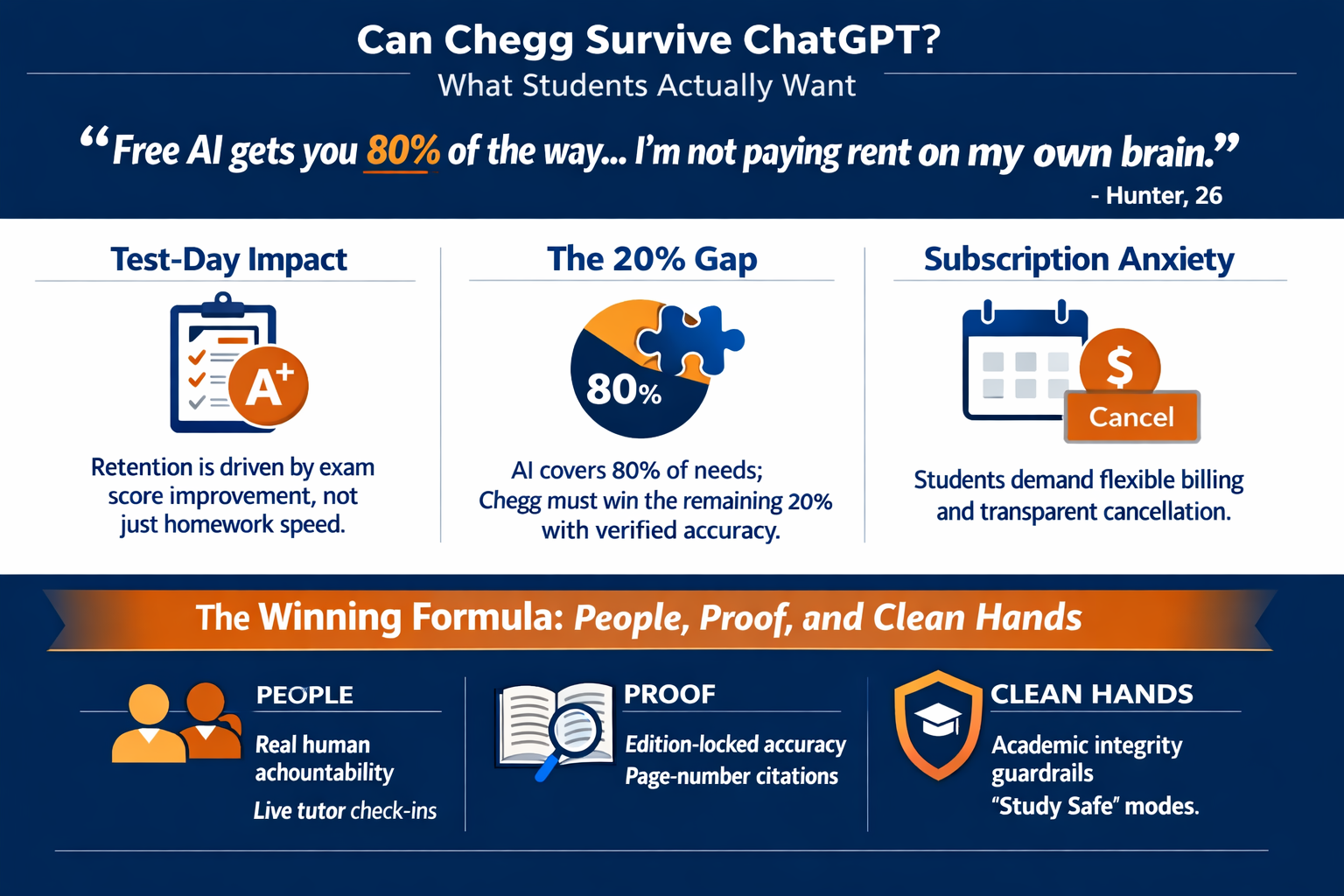
Hunter was even more specific: "Free AI gets you 80% of the way fast enough, and I'm not itching to add another drip to the budget."
So the baseline has shifted dramatically. Free AI now provides 70-80% of what students need. That remaining 20-30% is where Chegg has to prove its value, and participants were very specific about what that looks like.
"People, Proof, and Clean Hands": What Would Make Students Pay
Vicki, the Pennsylvania veteran, crystallised what Chegg needs to offer that AI can't: "People, proof, and clean hands." Let me break that down.
People: Real Human Accountability
Every single participant mentioned wanting real humans who could be held accountable. Not chatbots. Named, credentialed tutors who will look at your work and tell you specifically where you went wrong.
Joel, the 14-year-old, said: "If I can snap a pic of my algebra and they circle the dumb sign flip, that's value."
Camesha wanted "two or three 10 to 15 minute live drop-ins per month with a verified tutor. Not a chat bot. Actual person, screen share, fix my stuck step."
Proof: Verified Accuracy with Receipts
Participants were deeply skeptical of "expert answers" as a claim. They wanted:
Edition-locked solutions tied to the exact textbook, chapter, and problem number
Page-number citations so they can verify the source
Money-back guarantees if the solution is wrong
Accuracy scoreboards showing solver track records and revision history
Hunter put it sharply: "Not vibes, a paper trail. If they miss it, money-back. No fuzzy summaries. Show me the fence posts."
Clean Hands: Academic Integrity Protection
This was perhaps the most surprising finding. Multiple participants wanted Chegg to make cheating harder, not easier.
They asked for:
"Honor-code safe mode": coaching without final answers, plus session logs you could show a professor
"Answer blur + teach mode": hide the final answer until you try a step
Integrity guardrails that refuse to spit out final answers on graded prompts
Vicki explained: "Coaching without final answers, plus a session log you could show your professor to prove you learned, not cheated."
Joel was refreshingly honest: "I'm not saying I'm an angel, pero I don't want to fry my brain for the real exam."
Key insight: Students aren't asking for easier cheating. They're asking for a tool that helps them actually learn while protecting them from academic integrity issues. That's a massive product opportunity.
The Retention Trigger: "Test-Day Impact"
I asked each participant what would be the single biggest factor in deciding to keep or cancel a Chegg subscription.
The answer was unanimous and crystal clear: does it improve my test scores?
Joel, the high school student, nailed it:
"The ONE thing is test-day impact. If Chegg's human step-checks and practice actually bump my next quizzes/tests by like 5 to 10 points within one billing cycle, I keep it. If my scores stay flat and it just makes homework faster, I cancel without blinking, porque I'm not paying rent on my own brain."
Terry, the agronomy director paying for his kids' subscriptions, was equally direct:
"If it's just an answer vending machine, I cancel that day. I will not bankroll shortcuts that don't hold up under exam conditions."
Vicki said: "If after a month my quiz scores tick up and I can work a fresh problem cold without peeking, I keep it. If I still feel dependent on their answers or it smells like shortcut city, I cancel that day. No sense paying for training wheels that don't come off."
Key insight: The retention metric Chegg should obsess over isn't homework completion, it's test score improvement. Students will only stay subscribed if they see measurable grade improvement on exams, not just faster homework.
The Subscription Trap Anxiety
One theme emerged repeatedly: deep anxiety about subscription mechanics. This isn't unique to Chegg, but it's worth noting how strongly it affects purchase decisions.
Participants demanded:
Clear cancel buttons that work
No auto-renew games
Pay-as-you-go or day pass options
US-based phone support
Prepaid codes (especially for younger users avoiding credit card commitments)
Hunter captured the mindset: "Subscription creep: 16 bucks sounds small till you forget to cancel and you've bled it for a semester. That's gas for the mower or a sack of chicken thighs."
Several participants mentioned they'd only subscribe for "one heavy month" during finals and then cancel. The ideal Chegg customer journey might actually be: short-term heavy user who converts to annual during a brutal semester.
Key insight: Subscription trust is a major barrier. Offering transparent, flexible billing (including day passes and prepaid codes) might actually increase lifetime value by reducing purchase anxiety.
What This Means for EdTech Product Managers
This research reveals a clear product strategy for any EdTech company facing AI disruption:
Stop competing on answer delivery. AI wins that race. Compete on learning outcomes.
Build human touchpoints. Live tutors, even 10-15 minute drop-ins, are the moat AI can't easily cross.
Create "study safe mode". Help students prove they learned, not just copied. This is a differentiator, not a limitation.
Tie everything to test performance. The retention trigger is grade improvement, not homework completion.
Fix your billing anxiety. Offer day passes, prepaid codes, and one-tap cancel. Trust drives trials.
Edition-lock your content. Generic solutions are worthless. Match the exact textbook and course.
The meta-insight: students don't want answers. They want skills that transfer to test day. Any EdTech product that can prove it delivers that outcome has a defensible position against free AI.
The Bottom Line
Chegg's existential challenge is real, but it's not hopeless. The research suggests a clear path: stop being an answer vending machine and start being a learning verification system.
The winning formula, according to these consumers: "People, proof, and clean hands", real humans who can be held accountable, verified accuracy with receipts, and integrity guardrails that help students prove they actually learned something.
As Terry, the father paying for his kids' educational tools, put it: "If it's just an answer vending machine, I cancel that day. I will not bankroll shortcuts that don't hold up under exam conditions."
That's the bar. Meet it or get disrupted.
Want to test your own product positioning with real consumer insights? Ditto lets you run studies like this in hours, not weeks. Book a demo at askditto.io.
What the Research Revealed
We asked real consumers to share their thoughts. Here's what they told us:
Looking at Chegg.com - their main pitch is 24/7 homework help with expert answers and textbook solutions for about $16/month. What is your first impression? Does this feel worth the money, and why or why not?
Hunter Freudenberger, 26, Sales Manager, Rural, FL, USA:
Gut reaction: it feels like paying rent on your own brain. $16 a month to chase answers gives me subscription-itch. I already hate how everything wants a monthly drip. Is it worth it? For me, no. Couple reasons: Subscription creep: 16 bucks sounds small till you forget to cancel and you've bled it for a semester. That's gas for the mower or a sack of chicken thighs. Quality feels hit-or-miss: "Expert answers" is a squishy promise. I've seen buddies get half-baked steps that look confident but wobble if you actually check the math. Integrity risk: Professors aren't dumb. If you're just copy-pasting solutions, that can bite you. I don't love tying my grade to some company's answer mill.
Camesha Villalpando, 26, Sales Representative, Sterling Heights, MI, USA:
Gut reaction: feels like a paid panic button. Useful in a pinch, a little skeevy vibe around the whole "expert answers" thing. At 16 bucks, the price is fine, but I immediately wonder what the caps and upsells are and how annoying it is to cancel.
Terry Gerber, 55, Director of Agronomy, Cary town, NC, USA:
First impression: feels like a crutch wrapped in a subscription. $16 a month is cheap only if you're in it often, and only if it actually teaches you how to work the problems, not just copy them. I get twitchy about anything that sells shortcuts to anxious students and auto-renews quietly in the background.
ChatGPT and other AI tools can now answer homework questions for free. Given that, what would make you still pay $16/month for Chegg instead of just using free AI?
Vicki Williamson, 74, Retiree (Community Involved), Rural, PA, USA:
Short answer? I still wouldn't pay unless they offered things AI flat-out can't. Free AI spits out steps fast enough. If Chegg wants sixteen bucks, it has to beat that with people, proof, and clean hands. Real human, named, accountable tutor with credentials. Page-number citations tied to the exact textbook edition and problem set. Honor-code safe mode: coaching without final answers, plus a session log you could show your professor to prove you learned, not cheated. Clear cancel, U.S.-based phone support, pay-as-you-go or day passes. No auto-renew games.
Joel Sauceda, 14, High School Student, Fresno, CA, USA:
Gut check with free AI everywhere? I still wouldn't pay unless Chegg gives me something AI can't or won't. If I'm dropping $16, it needs to feel like skills that stick, not just prettier copy-paste. What would actually tempt me: Real human eyes on my steps - quick 5 to 10 min check-ins where a tutor marks my scratch work and tells me exactly where I messed up, not just the final answer. Receipts, not vibes - every solution tied to a textbook edition, page, or a legit source link.
Hunter Freudenberger, 26, Sales Manager, Rural, FL, USA:
Short answer: I still wouldn't pay monthly. Free AI gets you 80% of the way fast enough, and I'm not itching to add another drip to the budget. If Chegg wanted to pry $16 out of me instead of me just hammering free AI, it'd need to offer stuff AI can't or won't do, with receipts: Proven-correct, cited solutions. Live human backup on a clock. Integrity-safe workflow. Privacy I can believe.
If you were using Chegg and considering whether to keep paying or cancel, what would be the ONE thing that would make you definitely keep it vs definitely cancel?
Joel Sauceda, 14, High School Student, Fresno, CA, USA:
The ONE thing is test-day impact. If Chegg's human step-checks and practice actually bump my next quizzes/tests by like 5 to 10 points within one billing cycle, I keep it. If my scores stay flat and it just makes homework faster, I cancel without blinking, porque I'm not paying rent on my own brain. Free AI already covers the vibes; I'm only paying if it turns into receipts on grades.
Terry Gerber, 55, Director of Agronomy, Cary town, NC, USA:
One thing: proof it builds real mastery that shows up on tests. If, over a few weeks, I see my kid go from stuck to working fresh problems cold and quiz/exam scores tick up, I keep it. If it's just an answer vending machine or usage drops off, I cancel that day. I will not bankroll shortcuts that don't hold up under exam conditions.
Vicki Williamson, 74, Retiree (Community Involved), Rural, PA, USA:
Proof I'm actually learning, not just copying. If after a month my quiz scores tick up and I can work a fresh problem cold without peeking, I keep it. If I still feel dependent on their answers or it smells like shortcut city, I cancel that day. No sense paying for training wheels that don't come off.