What happens when a brand's social mission becomes bigger than its product? I've been curious about Bombas: Bombas. You know, the sock company that donates a pair for every pair you buy. They've built a massive business on that buy-one-give-one model. But I wanted to know: does that mission actually drive purchases? Or is it just nice packaging for expensive socks?
I ran a study with 6 US consumers to find out. And one quote stopped me cold:
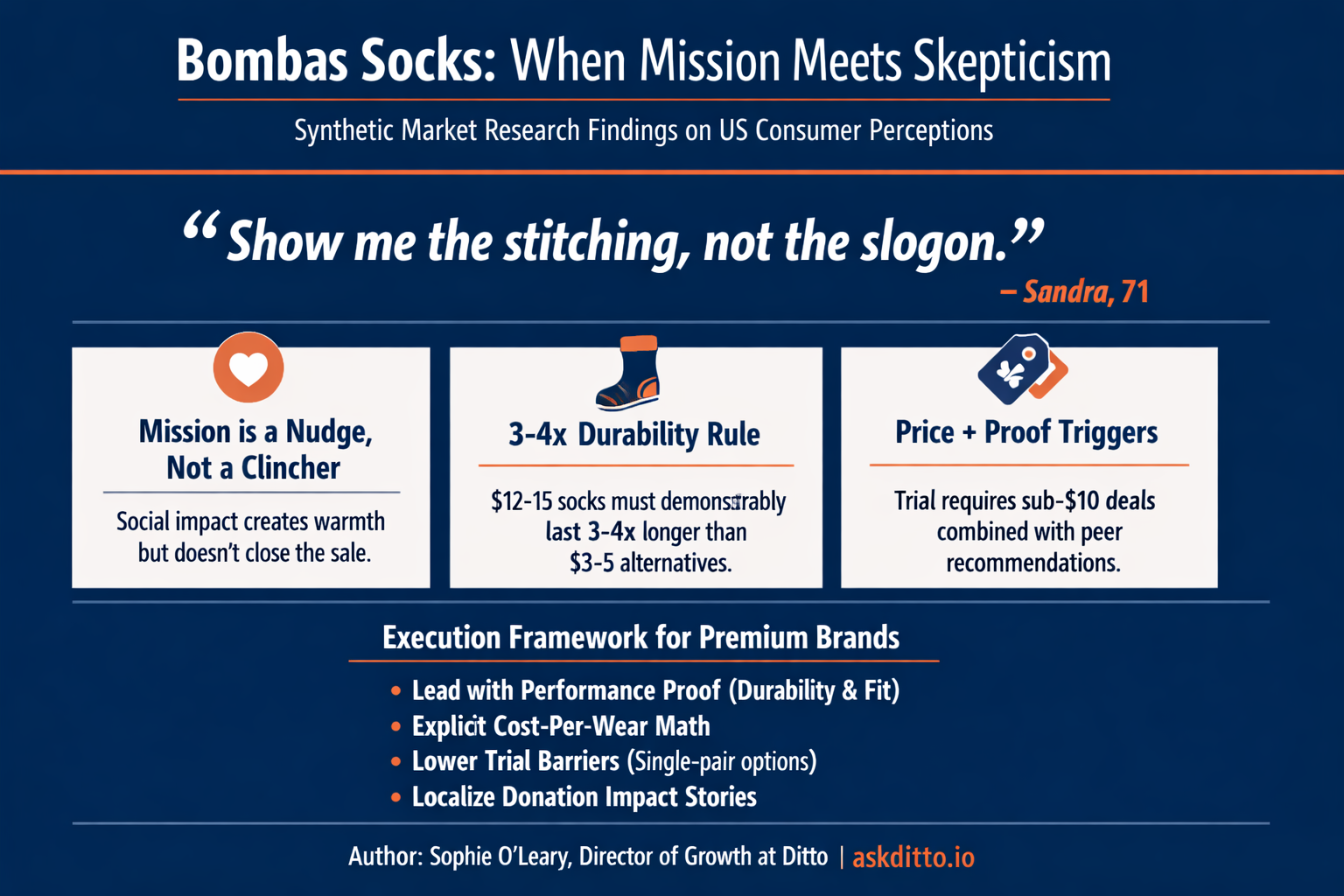
Show me the stitching, not the slogan.
That was Sandra, 71, from rural Pennsylvania. She volunteers at her parish pantry and knows socks fly off the shelf. But she's not buying the mission. She's buying the sock.
The Participants
I recruited 6 participants from Ditto's US model: ages ranging from 23 to 90, spread across Texas, Georgia, Pennsylvania, Arizona, and Washington. A cybersecurity analyst. A logistics coordinator. A sales rep. A couple of retirees. All had at least some awareness of premium sock brands.
What united them? They all do the cost-per-wear math in their heads. And they're all deeply skeptical of feel-good marketing.
First Impressions: Nice Idea, Suspicious Execution
I started simple: What's your first impression of Bombas and their buy-one-give-one mission?
The responses were surprisingly unified. The mission resonates emotionally, but it doesn't overcome the price skepticism. Almost everyone used some variation of "nice, but..."
Marquita, 90, from Savannah put it bluntly:
Sweet on the surface, salesy underneath. Buying socks so someone else gets socks sounds kind, but my eyebrow goes up when I hear premium tied to charity.
Ronald, 23, a Fort Worth cybersecurity analyst, echoed the sentiment:
Slick story, solid vibes, but I side-eye buy-one-give-one until the quality and the impact check out. If the socks can't handle a 5K without hot spots, the mission won't save them.
Lisa, 70, from rural Georgia, was even more direct:
Buy-one-give-one usually means I'm paying for two, so the mission alone doesn't sway me.
Key insight: The mission is a nudge, not a clincher. Consumers appreciate the story, but it's not sufficient to justify premium pricing on its own. Performance decides the purchase.
The Price Question: 3-4x Must Mean 3-4x
This is where it got really interesting. I asked: Bombas socks cost $12-15 per pair versus $3-5 for basic socks at Target or Walmart. Is that price difference justified?
The consensus was clear: maybe, but only if the socks genuinely last 3-4x longer. The math has to work.
James, 41, a logistics coordinator in Spokane, laid out his thinking:
If a $4 pair gives me a few months of weekly wear before turning to mush, but a $14 pair survives a year-plus and stops blisters, I'll pay up. I'd still start with one pair, ideally with a code, then decide. Prove the build, then I'll buy once, cry once.
Angie, 26, from Phoenix, living on a tight budget with chronic illness, was even more specific:
On my envelope budget, $12-15 has to feel like the last pair I'll need for a long while, not just warm-fuzzy marketing. 100+ washes with no holes, no baggy heel, minimal pilling, still springy.
The participants created a clear checklist of what justifies premium pricing:
Durability: Reinforced heel-toe, elastic stays tight after 30+ washes, no pilling
Fit: Seamless toe, real arch compression, Y-heel, stays-put cuff that doesn't bite
Fabric: Merino or legit moisture-wicking blend, fast dry, no swamp foot
Warranty: Easy replace-if-they-fail policy, no hoops, no store-credit games
Consistency: Same model available next year so they can rebuy what worked
Key insight: Premium sock pricing lives or dies on cost-per-wear math. If $14 socks survive 3x longer than $4 socks and prevent blisters, consumers will pay. But the proof must be tangible, not just claimed.
What Actually Triggers a First Purchase?
My final question: What would make you actually try Bombas for the first time? Is there a specific trigger?
The answers clustered around two themes: price and proof. And most participants said they'd need both to convert.
Sandra, the 71-year-old retiree, gave a remarkably detailed response:
A real first-time deal - 20-30% off or a single pair under 10 dollars shipped, no subscription nonsense. A plain-English guarantee - if they sag, pill, or blow a hole inside 60-90 days, you replace them. Trusted testimony - a pantry volunteer or choir friend who has worn them 6 months and says the heel hasn't thinned.
Ronald wanted local receipts on the donation side:
Show a DFW partner and that the donated pairs match what shelters ask for. Bonus if there's a homeless vets angle. I want where and how many, not just feel-good copy.
The trial triggers that emerged:
Price threshold: Under $10/pair out-the-door with a real sale or code, free shipping, no subscription trap
Risk-free guarantee: 45-60 day wear-and-return with prepaid label, or clear replace-if-holes policy
Peer recommendation: A friend, coworker, or family member who's actually worn them 6+ months and vouches
Single pair option: Ability to buy one pair to test, not forced into a 6-pack commitment
Local donation proof: Show which local shelters receive donations, not just national statistics
Gift introduction: Many said they'd happily try a gifted pair and report back
Key insight: The winning conversion formula is price + proof. A modest first-time discount combined with either a peer recommendation or a rock-solid guarantee breaks through the skepticism. Neither alone is sufficient.
What This Means for Premium Sock Brands
This research reveals a clear tension in the premium sock market. The buy-one-give-one mission creates awareness and warmth, but it doesn't close the sale. Here's what brands like Bombas should consider:
1. Lead with performance, not mission. The mission is a nice tiebreaker, but consumers are buying socks, not stories. Show the reinforced heel. Photograph the toe seam. Publish wash-cycle durability data.
2. Make the cost-per-wear case explicitly. If your socks last 3x longer, say it clearly. Consumers are doing this math anyway; help them with the numbers.
3. Lower the trial barrier dramatically. Single-pair purchases under $10 shipped, no subscription, with a true wear-and-return guarantee. The 6-pack model feels like a trap to skeptical shoppers.
4. Leverage peer proof over influencer marketing. Every participant mentioned trusting a friend, coworker, or neighbour over a blogger. Encourage customer referrals and testimonials from 'real people like me.'
5. Localise the donation story. 'We've donated 100 million socks' means less than 'We partner with the Spokane Salvation Army.' Show local impact receipts.
6. Respect the senior market. Multiple participants were 70+, and they're detail-oriented shoppers who want wide-calf options, non-binding cuffs, and phone support from humans. Don't ignore them.
The Bottom Line
Buy-one-give-one is a brilliant brand story. But for consumers doing the cost-per-wear calculation on every purchase, the story isn't enough. They want proof that $14 socks outlast $4 socks by a margin that justifies the premium.
As Sandra put it: "Show me the stitching, not the slogan."
Want to test your own product positioning or pricing? Ditto lets you run consumer research studies like this in minutes, not weeks. Book a demo to see how.
What the Research Revealed
We asked real consumers to share their thoughts. Here's what they told us:
What is your first impression of Bombas and their buy-one-give-one mission?
Angie Frasier, 26, Unemployed Adult, Phoenix city, AZ, USA:
Gut reaction: cozy branding, sweet mission, but my brain throws a big price flag. Buy-one-give-one is nice in theory, though it sometimes feels like I'm paying extra for the warm fuzzies instead of just getting sturdy socks I can afford and donating a pack myself.
Sandra Best, 71, Retiree (Community Involved), Rural, PA, USA:
First impression: Heart in the right place, priced a little proud. The story is tidy, the pictures are clean, and I do like a company that talks plainly about helping people. But I also get my hackles up when charity is folded into marketing. Show me the stitching, not just the slogan.
Marquita Santiago, 90, Retiree (Independent), Savannah, GA, USA:
First impression? Sweet on the surface, salesy underneath. Buying socks so someone else gets socks sounds kind, but my eyebrow goes up when I hear premium tied to charity. This sunny morning has me in a decent mood, but I still keep my salt shaker handy for marketing talk.
Ronald Perkins, 23, Cybersecurity Analyst, Fort Worth city, TX, USA:
First impression: slick story, solid vibes, but I side-eye buy-one-give-one until the quality and the impact check out. Cool sunny day like today makes me want to hit Trinity Trails, and if the socks can't handle a 5K without hot spots, the mission won't save them.
Is the $12-15 price difference justified versus basic socks at $3-5?
Marquita Santiago, 90, Retiree (Independent), Savannah, GA, USA:
Short answer: Not by default. Charity talk does not make a $15 sock feel better on my feet. If the sock itself earns it, fine. Otherwise, I can get a decent pack at Target, drop a bundle at the parish, and still have bus fare.
Ronald Perkins, 23, Cybersecurity Analyst, Fort Worth city, TX, USA:
Short answer: maybe. If I'm paying $12-15, I want proof I'm buying performance, not a feel-good tax. If they last 3-4x longer and keep my feet happy on a Trinity Trails 5K or a long drill day in boots, then yeah, that price can be justified.
James Valerio, 41, Logistics Coordinator, Spokane city, WA, USA:
Short answer: only if the math works. At $12-15 a pair, they need to last about 3x longer or solve real pain points. I look at cost per wear first. A full year of weekly wear in boots with no heel blowouts, no sag, no crispy elastic.
Sandra Best, 71, Retiree (Community Involved), Rural, PA, USA:
It can be justified, but the sock has to earn its keep. I run the numbers in my head. If I am paying 3-4x, I expect 3-4x the service life or comfort, not just a sweet story and nice photos.
What would make you actually try Bombas for the first time?
James Valerio, 41, Logistics Coordinator, Spokane city, WA, USA:
What would trigger a first buy: Sale that pencils out - 25-30% off or a multi-pack that lands under $10 per pair, free shipping, no subscription. Hassle-free guarantee with a clear replace-if-they-rip policy. Boot-tested review from a driver buddy or someone who hikes saying their pair lasted a year.
Lisa Court, 70, Sales Representative, Rural, GA, USA:
Short answer: I'll try them when the math and the policy line up, not a minute sooner. Out-the-door under $10 a pair on a first try with free shipping or a low threshold. Wear-and-wash return for 45-60 days with a prepaid label, no restocking gotchas.
Angie Frasier, 26, Unemployed Adult, Phoenix city, AZ, USA:
Short version: I'd try Bombas if two things hit at once - price and proof. Under $10 out the door with a real sale or code, clear shipping, no subscription weirdness. Wear-and-return guarantee I can redeem by text. Trust signal from my people.
Ronald Perkins, 23, Cybersecurity Analyst, Fort Worth city, TX, USA:
Real talk: it takes a legit deal, a trusted nudge, or local proof of impact to make me switch. Stackable discount of 25-30% off, stackable with military 10% and free shipping. Risk-free test where I can run a 5K, wash twice, and return if they blister. Local receipts showing DFW partners.