Here's something I've been curious about for a while: organic veg box subscriptions. The promise is lovely. Fresh, seasonal produce, delivered to your door, supporting local farms. But here's what I wanted to know: do actual UK consumers buy into this, or does it feel like homework in a cardboard box?
So I ran a study. Six UK consumers, health-conscious shoppers aged 28-55, three questions about organic veg boxes. And honestly? Some of the responses made me wince. Others made me laugh out loud. All of them are worth reading if you're in the organic food space.
Who We Spoke To
Our panel included six UK consumers from Leeds, Birmingham, Croydon, and Barnet. A mix of operations managers, project managers, facilities managers, logistics coordinators, audio engineers, and stay-at-home parents. Ages ranged from 35 to 54. All shop for groceries regularly and have at least some interest in organic or sustainably-sourced food. In other words: exactly the people a veg box company would want to convert.
First Impressions: Nice Idea, But...
We asked: "Organic vegetable box subscriptions promise fresh, seasonal produce delivered to your door weekly. What is your honest reaction to this concept? Would you consider signing up, and what would make you hesitate?"
The consensus? The concept is appealing in theory. Fresh, seasonal, fewer food miles, support for local farms. But the reality check kicks in fast.
"Nice story, pricey reality." One respondent summed it up perfectly. The glossy marketing doesn't match the lived experience of meal planning, tight budgets, and small fridges.
The hesitations were remarkably consistent across all six participants:
Unpredictable contents - "A random swede or fennel throws the plan." Nobody wants to Google what to do with kohlrabi on a Tuesday night.
Cost versus supermarket - Most participants can piece together an organic haul for £12-14 at Aldi or Lidl. Paying more for less control feels wrong.
Delivery faff - Boxes dumped in communal hallways, missed drops, soggy deliveries in bad weather. One respondent noted: "With storms knocking deliveries about lately, I'd worry about a soggy box arriving late on choir night."
Subscription traps - Hard to cancel, auto-renew, guilt-trippy emails. "I want skip weeks with two taps and cancel without a phone call."
Waste guilt - Small fridges, picky kids, mystery vegetables that sit and die. "If I only use 70% then a £20 box becomes £28 a kilo in my head."
Key insight: The concept appeals to values (sustainability, supporting farms) but fails on practicality (control, cost, convenience). The gap between the two is where customers drop off.
The Price Ceiling: £18 Is the Line
We asked: "A medium organic veg box costs around £16 per week delivered. At what weekly price does an organic veg box subscription go from 'worth trying' to 'not worth the hassle' compared to just buying organic at the supermarket?"
This is where it gets specific. And the numbers were remarkably consistent.
At £16 they'll give it a go. Past £18? "Not worth the faff compared to just buying organic at Aldi." At £20+ it's a hard no from everyone.
One respondent broke down the maths: "Simple math for me: £12 ok, £14 if perfect, £15+ I just buy my own and pocket the £3-4 a week, which is £12-£16 a month."
Another was even more direct: "I'm not paying nineteen quid to gamble on fennel."
What would justify the premium price?
Staples guaranteed - 70-80% predictable basics (onions, carrots, potatoes, greens), not lucky dip
Real swaps - At least 2-3 items changeable without app gymnastics
Freshness that lasts - Crisp on day 5, not limp by Wednesday
Clear pricing comparison - Show like-for-like versus supermarket organic
Zero-friction flexibility - Skip in two taps, no lock-in, no notice periods
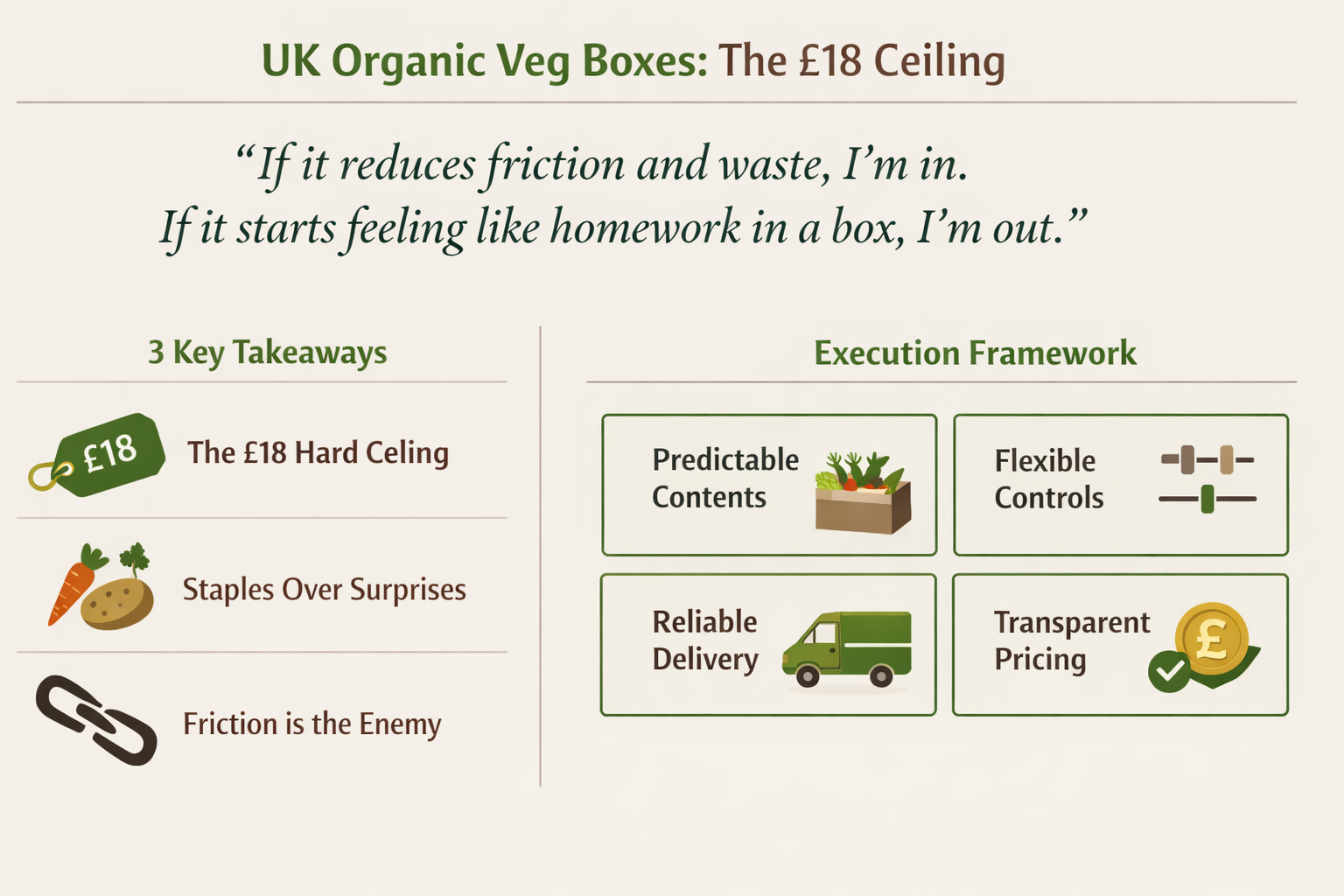
Key insight: The price ceiling is £18/week. Above that, even values-led consumers will defect to supermarket organic. The premium has to be justified by tangible benefits: better freshness, less waste, more control.
What Drives Commitment vs Churn
We asked: "What would convince you to commit to a weekly organic veg box subscription rather than just buying organic produce when you feel like it at the supermarket? And honestly, what would make you cancel after the first few weeks?"
This question surfaced the most actionable insights. The pattern was clear: commitment happens when the box removes friction. Churn happens when it adds homework.
"If it reduces friction and waste, I'm in. If it starts feeling like homework in a box, I'm out."
That quote lives rent-free in my head now.
What drives commitment:
Replaces the shop - "£16-ish and it replaces staples I'd buy anyway - onions, carrots, greens, spuds - not a kale lottery."
Predictable delivery - "Predictable Friday morning drop with safe leave and clear updates, so I can batch cook Sunday."
Flexible skips - "On solo-parent weeks, and swap 1-2 items so the kids will actually eat it."
Minimal packaging - "Reusable crate, no plastic confetti."
Transparency - "Real transparency about where it's grown. No leafy-branding fluff."
What triggers cancellation:
Price creep - "Past £18 or sneaky fees" is an instant cancel trigger
Lucky dip vibes - "Three odd roots and limp leaves by Wednesday"
Delivery faff - "Late-night drops, soggy boxes, vague comms"
Rigid admin - "Lock-ins, clunky pauses, guilt-trippy emails"
Doesn't replace the shop - "If I'm still topping up, and I'm binning food the kids won't touch"
One respondent summed up the tolerance threshold: "One bad week I'll tolerate, two and I'm gone."
Key insight: Retention is about friction reduction, not added value. The box has to slot into existing routines, not create new chores. "No surprise turnips" isn't a joke, it's a product requirement.
What This Means for Organic Food Subscription Brands
If you're running an organic veg box service, here's what the research suggests:
Lock pricing below £18 - That's the ceiling. Above it, you're fighting an uphill battle against Aldi and the local market.
Lead with staples, not surprises - 70-80% predictable basics, 20% seasonal discovery. Nobody wants a kale lottery.
Make skips and swaps frictionless - Two taps, no guilt emails, no notice periods. Life is unpredictable.
Delivery reliability is non-negotiable - Safe drop, clear windows, instant credits for misses. One bad week is tolerated, two is fatal.
Show the maths - Side-by-side pricing versus supermarket organic. Transparency builds trust.
Earn the first month - Trial pricing, no lock-ins, prove value before asking for commitment.
The Bottom Line
Organic veg box subscriptions have a genuine appeal. Consumers like the values: sustainability, supporting local farms, reducing food miles. But the execution has to match the promise.
The moment a subscription feels like "homework in a box", customers leave. The moment pricing creeps past £18, they defect to supermarket organic. The moment delivery becomes unreliable, trust evaporates.
The winners in this space will be the ones who obsess over friction reduction. Predictable contents. Flexible controls. Reliable delivery. Transparent pricing. These aren't nice-to-haves. They're the difference between a loyal subscriber and a cancellation after week three.
This study was run using Ditto's synthetic research platform. We surveyed 6 UK consumers in under 20 minutes. If you're curious what your customers really think about your product, pricing, or positioning, book a demo at askditto.io.
What the Research Revealed
We asked real consumers to share their thoughts. Here's a selection of their responses:
Question 1: Initial Reaction to Organic Veg Box Subscriptions
Participant | Response |
|---|---|
Alex, 45, Project Manager, Leeds | "I like the spirit of it. Fresh, seasonal, fewer food miles. When I did a trial box in lockdown, the celeriac and kale were great for Sunday batch cook. Would I sign up now? Maybe, but not weekly. Co-parenting means some weeks the fridge gets cleared, some weeks it doesn't, and I hate waste." |
Simon, 54, Audio Engineer, Croydon | "Nice idea, but subscriptions make me twitchy. We do fine with Lidl and Croydon market, pick what we'll actually eat, and it's cheaper. I'd maybe try a one-off month to see if it's proper stuff and not a box of kale and guilt." |
Craig, 37, Logistics Coordinator, Leeds | "Nice story, pricey reality. I see a glossy box, mystery veg, and a nudge to cook stuff I did not ask for. I plan meals round Aldi, the market, and my kid. A box tells me what to eat. I do not like that." |
Question 2: Price Sensitivity
Participant | Response |
|---|---|
Daniel, 42, Operations Manager, Leeds | "£14 delivered is my ceiling to try. At £15 I start questioning it. At £16+ it tips to not worth the faff vs just picking organic bits at Sainsbury's or Aldi." |
Steve, 48, Facilities Manager, Birmingham | "Under £14 delivered is worth a punt. £16 is on the fence. £18+ and I'm thinking nah, too dear for a box I can't fully choose. Not being funny, but I'm not paying nineteen quid to gamble on fennel." |
Anton, 35, Stay-at-Home Parent, Barnet | "£16 a week? Too high. I try if it is £10-12. Maybe £13 if I pick my own. Over £14, I just buy in Lidl or Morrisons." |
Question 3: Commitment vs Cancellation Triggers
Participant | Response |
|---|---|
Alex, 45, Project Manager, Leeds | "I'd commit if it slots cleanly into how we actually live, not as a worthy extra that creates homework. If it reduces friction and waste, I'm in. If it starts feeling like homework in a box, I'm out." |
Daniel, 42, Operations Manager, Leeds | "I'd only commit weekly if it removes admin, beats faff, and fits my Sunday batch-cook. No surprise turnips. One bad week I'll tolerate, two and I'm gone." |
Steve, 48, Facilities Manager, Birmingham | "Make it boringly reliable and better value than me grabbing bits after work, even in grim weather. If I have to chase you or Google what to do with a knobbly thing on a Tuesday, I'll cancel and not look back." |