Here's something that's been rattling around in my head: Turo has been around for over a decade now, positioning itself as the 'Airbnb for cars'. The concept is dead simple. Instead of queueing at the Hertz counter, you rent directly from someone's driveway. Sounds grand, right? But when I actually put this to Canadian consumers, the response was fierce interesting. Not a single person said 'yeah, sounds lovely'. Every single one of them wanted receipts.
I ran a study with 6 Canadian consumers from across the country, from Fort McMurray to Surrey to Terrebonne. What they told me fundamentally challenged some assumptions about peer-to-peer marketplaces. Turns out, trust isn't built with glossy photos and five-star ratings. It's built with boring, documented, verifiable proof.
The Study Setup
I recruited participants from British Columbia, Alberta, Ontario, and Quebec, all with some prior rental experience or interest in car sharing. Ages ranged from young families to retirees, incomes from under $25K to $74K. The common thread? They all drive in Canada, which means they all deal with the particular joy of winter.
I asked them three questions. First, their gut reaction to Turo's website. Second, what would make them actually trust renting from a stranger. Third, what would make them choose Turo over the boring counter at Hertz or Enterprise. The answers were unanimous in ways I genuinely didn't expect.
The Airbnb Comparison Lands, But Creates Suspicion
Every participant immediately clocked Turo as 'Airbnb for cars'. That mental model transfers perfectly. But here's where it gets interesting. The slick website actually worked against them. As Ryan, a 37-year-old single dad from Fort McMurray put it:
Looks like Airbnb for cars. Clean layout, big search box, nice photos. Also a bit too slick, which makes me think fees hiding around the corner.
That 'too slick' concern came up repeatedly. Robert, a 71-year-old retiree from Kitchener, said: 'Slick site, shiny cars, lots of smiles. Feels like Airbnb for wheels, which is cute, but I care a lot more about the fine print than the hero photos.'
Key insight: The Airbnb comparison gets consumers in the door conceptually, but the polished marketing creates price suspicion. They've learned that pretty websites often hide 'mystery costs'.
Trust Is Receipts, Not Vibes
This was the quote that stopped me cold. Olivier, a 32-year-old from Saanich, BC, put it perfectly:
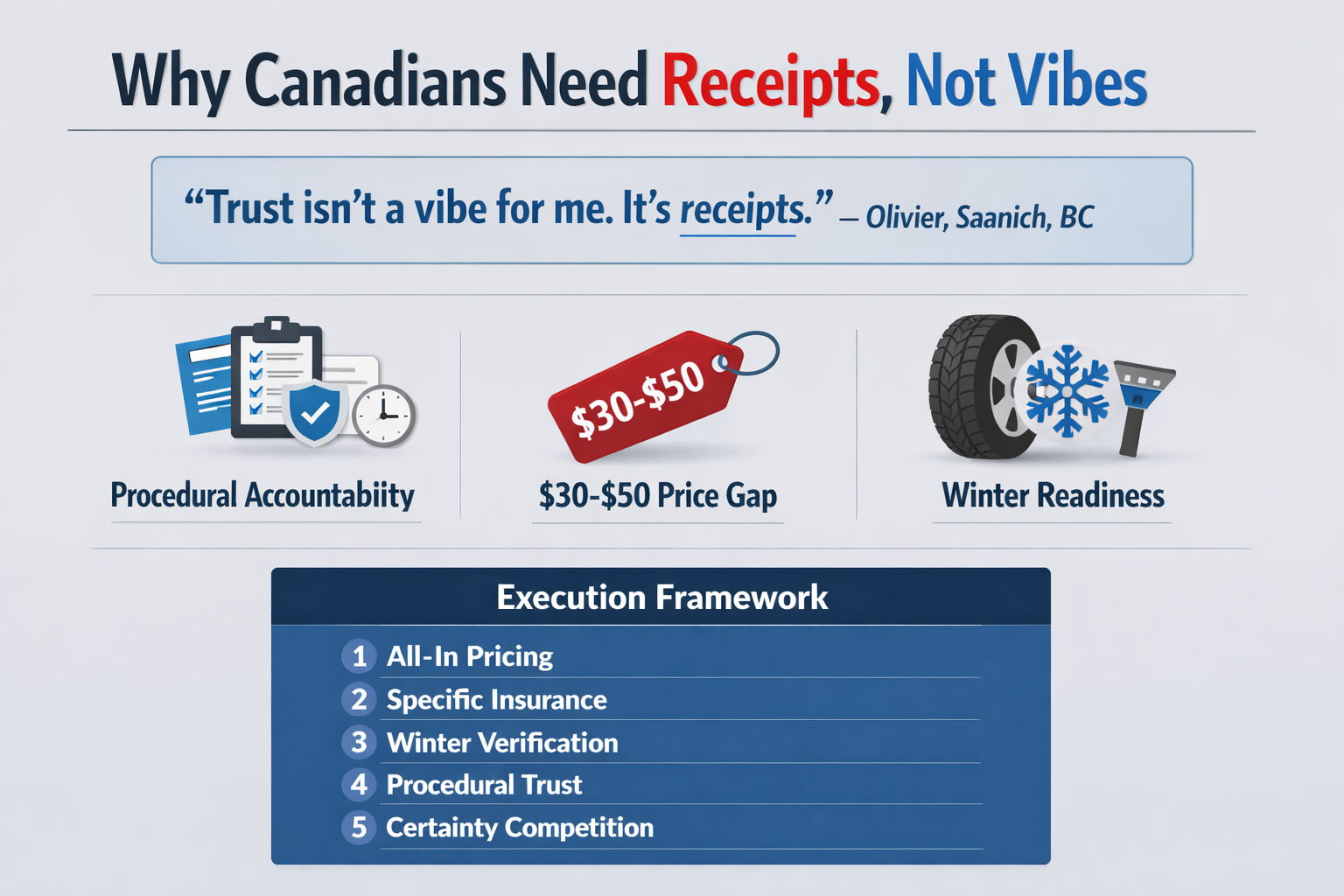
Trust isn't a vibe for me. It's receipts.
Jaysus, that's the whole thing in six words. When I asked what signals would make them comfortable handing over their credit card, every single participant gave me a laundry list of procedural, verifiable requirements. Not 'the host seemed nice' or 'the photos looked good'. They wanted:
Plain-English insurance: Show the deductible, who's primary, and province-specific clarity (especially for BC with ICBC and Quebec rules)
Mandatory photo check-in/out: Not optional, with guided angles, timestamped, so there's no 'he said, she said' over curb rash later
Host track record: 4.8+ ratings with lots of trips, low cancellation rates, recent reviews mentioning punctual handoffs
All-in pricing up front: Every fee, tax, cleaning charge, and mileage cap visible before clicking 'Book'
Roadside with real backup: 24/7 Canadian phone number, stated tow response times, guaranteed replacement if the car dies
Emily, a 14-year-old from Surrey (answering on behalf of her family's perspective), summed it up: 'If I have to dig for any of that, I'm not trusting it.'
Key insight: Peer-to-peer trust isn't about personal connection. It's about the platform demonstrating procedural accountability. Consumers want the 'boring, documented stuff' they can point to later.
Price Has To Be Obviously Cheaper
The value proposition only works if the savings are crystal clear. And not just a little cheaper. Ryan from Fort McMurray was specific:
All-in price is clearly lower by a real margin - like 30 to 50 bucks a day after every fee and tax.
If Turo is only marginally cheaper, they'll 'take the boring counter'. The risk-reward calculation is stark. Ethan from Terrebonne put it this way: 'If the math is a wash once Turo fees land, I'll buy predictability.'
The 'boring desk' came up in nearly every response. That phrase tells you everything. Traditional rental companies aren't aspirational, they're just reliable. If Turo can't beat them on price by a meaningful margin and match them on certainty, consumers default to boring.
Key insight: Price sensitivity isn't just about affordability. It's about justifying the additional cognitive load of peer-to-peer. $30-50/day cheaper is the threshold where consumers start considering the switch.
Winter Readiness Is Table Stakes in Canada
I cannot overstate how much winter came up. Every single participant mentioned winter tires, block heaters, scrapers, or cold-weather reliability. Lucas, a 9-year-old from Windsor speaking for his family, asked: 'Do they have snow tires right now? It is so cold here.'
Ryan from Fort McMurray was emphatic:
Winter-ready proof is shown in photos - snowflake tires, block heater cord, scraper, full washer fluid, no warning lights. I'm not freezing at a plug-in stall trying to wake up a dead battery at 2 a.m.
Robert from Kitchener wouldn't even consider it in severe weather: 'February deep-freeze with any whiff of flakiness - I want a boring desk, a paper receipt, and a hot Tim's on the way out.'
The message is clear: in Canadian markets, winter gear isn't a nice-to-have filter. It's a gating factor. If consumers can't verify snowflake tires in the listing photos, they're out, regardless of price.
Key insight: For Canadian peer-to-peer car sharing, winter readiness verification (visible snowflake tires, equipment lists) is as important as host ratings. Absence is a dealbreaker even at attractive prices.
What This Means for Peer-to-Peer Marketplaces
This research challenges some comfortable assumptions about how trust works in sharing economies. The Airbnb playbook, community, ratings, personal connection, doesn't translate directly to cars. Here's what the data suggests:
Show all-in pricing before the book button: Total cost including deposit holds, release timing, and every fee must be visible before checkout. Surprises kill trust faster than bad reviews.
Make insurance boring and specific: Generic 'you might be covered' language fails. Consumers want province-specific explanations (ICBC, Quebec rules) with exact deductibles.
Verify winter readiness visibly: In Canada, winter tires aren't a premium feature. They're baseline. Consider seasonal verification badges and equipment checklists.
Build trust through procedural accountability: Low cancellation rates, response times, and recent local reviews matter more than star ratings. Surface the operational data.
Compete on certainty, not just price: Every participant mentioned the 'boring counter' as their fallback. The competition isn't another app, it's the predictable, standardized experience of traditional rentals.
About This Study
This research was conducted using Ditto's synthetic consumer research platform. We recruited 6 Canadian personas from Ontario, Quebec, British Columbia, and Alberta, ranging from age 9 to 71, with household incomes from under $25K to $74K. All had prior car rental experience or interest in car sharing. Participants answered three open-ended questions about their perceptions of peer-to-peer car sharing and the trust signals they'd require before booking.
Want to test your own marketplace positioning with real consumer voices? Ditto lets you run studies like this in hours, not weeks. Book a demo at askditto.io.
What the Research Revealed
We asked real consumers to share their thoughts. Here's what they told us:
You are looking at Turo's website for the first time. They describe themselves as a peer-to-peer car sharing marketplace where you can rent cars directly from owners. What is your first impression? Does the concept appeal to you?
Ryan Patel, 37, Concierge, Fort McMurray, AB, Canada:
First impression: Looks like Airbnb for cars. Clean layout, big search box, nice photos. Also a bit too slick, which makes me think fees hiding around the corner. Up here, rentals at the airport get silly, so I get the appeal if it actually saves money and time. Does it appeal: Kind of. If my Focus acts up or I need a truck for a dump run, sure. For a weekend Edmonton run with Maya, maybe. I would not list my own car - I need it for work and school runs, and I do not want to argue about a scuff some stranger swears they did not make.
Olivier Martin, 32, Unemployed Adult, Saanich, BC, Canada:
First glance, it's the Airbnb-for-cars vibe: glossy photos, simple filters, easy pitch. The concept kind of appeals for specific jobs... like grabbing a pickup for a reclaimed-cedar run or a wagon when I've got Juniper and a muddy trail day. I like that the money goes to a person, not a faceless counter that tries to upsell floor mats. But my gut tightens at the usual platform stuff where your time gets chewed up by someone else's flakiness.
Robert Clarke, 71, Retiree, Kitchener, ON, Canada:
First impression? Slick site, shiny cars, lots of smiles. Feels like Airbnb for wheels, which is cute, but I care a lot more about the fine print than the hero photos. The concept could work for me as a renter once in a blue moon - say I need a minivan for the grandkids or an AWD for a Bruce run - but I'm not standing around in -24 waiting for some guy with a key box.
What would make you trust renting from a stranger? What signals would you need to see before handing over your credit card?
Olivier Martin, 32, Unemployed Adult, Saanich, BC, Canada:
Trust isn't a vibe for me - it's receipts. If I'm renting a stranger's car, I want hard signals that the boring stuff is dialed so I'm not stranded at YYJ in the drizzle with a gear bag and a shedding dog. Host track record: lots of completed trips, near-perfect ratings, and reviews that mention punctual handoffs and no last-minute cancels. Insurance clarity in BC: plain-English coverage, who's primary with ICBC, the exact deductible cap, and examples of real claims getting paid without a knife fight. Photo protocol: mandatory, timestamped check-in and check-out with guided angles. Not optional. I already shoot a full lap on rentals - I'm not doing a trust fall.
Emily Kim, 14, High School Student, Surrey, BC, Canada:
Trusting a stranger's car? I'd need receipts, not vibes. If my parents were actually paying, these are the musts or I'm out: All-in price upfront - total with cleaning, delivery, extra km, taxes, and any deposit hold shown before checkout. No mystery adds after. Insurance in plain words - in BC terms. What's covered, exact deductible, who pays for a rock chip. Short, not legal soup. Host proof - verified ID, lots of recent reviews that mention pickup being easy, no smoke smell, and that the car didn't bail last minute.
Ryan Patel, 37, Concierge, Fort McMurray, AB, Canada:
Gut check? Renting from a stranger is a big ask. I need proof they run it like a real operation, not vibes. It is flurries and -1 here, so I am not rolling the dice on someone's side hustle. Signals I need to see: Insurance, in plain numbers - what I am covered for in Alberta, exact deductible, who pays for stone chips and towing. Shown before I click Book. Winter-ready proof - clear photos of the snowflake tires, block heater cord, scraper, jumper cables, washer fluid topped. I am not freezing at a plug-in stall trying to wake up a dead battery at 2 a.m.
If you needed to rent a car for a weekend trip, what would make you choose Turo over a traditional rental company like Hertz or Enterprise?
Ethan Clarke, 32, Administrative Assistant, Terrebonne, QC, Canada:
Quick take: for a weekend, I'd pick based on control vs certainty. It's -10C and snowing sideways, so winter readiness and backup plans matter. I'd choose Turo if: Specific vehicle - wagon with a roof box, true AWD with proper winters and slush mats, or a truck with a hitch. Or I want to try an EV without dealer nonsense. Convenience - pickup a few blocks from my place instead of schlepping to an airport counter. Lockbox or remote unlock that actually works. Host signals are strong - 4.8+ rating, 50+ trips, recent winter-ready reviews, low cancel rate.
Robert Clarke, 71, Retiree, Kitchener, ON, Canada:
If it solves a real problem better and cheaper, I'll try the new thing. If it smells like hassle, I pick the boring counter and keep my weekend intact. At -24, my tolerance for cute ideas is near zero. I'd stick with Hertz/Enterprise if: Weather is nasty and I want an indoor counter, heated garage pickup, and a process that works even when the app decides to nap. I need dead-simple reliability - if a car's a dud, they swap it. Fleet backup beats host roulette. No flake risk - no waiting on someone's cousin with a lockbox code. Clock's ticking, weekend's short.
Emily Kim, 14, High School Student, Surrey, BC, Canada:
If we actually needed a weekend car, I'd only pick Turo if it beats a rental in like real, practical ways, not just vibes. I'd choose Turo if: The exact car fits the trip - AWD SUV with the mountain-snowflake tires shown in a close-up pic, roof or ski rack, and it's clearly unscented. Pickup is easy - near Guildford or the host delivers to our building at a normal hour. No 'meet me behind a warehouse' nonsense. All-in price and small hold - total costs upfront and the deposit hold is not massive. If it's not at least like $100 cheaper for the weekend, why bother.