
A Cambridge computational social scientist walks into a London coffee shop, opens his laptop, and simulates 33,000 people arguing about climate policy. This is not the setup to a joke. It is, roughly speaking, the founding story of Artificial Societies, the synthetic research startup that emerged from James He's doctoral work at Cambridge and landed in Y Combinator's Winter 2025 batch with a thesis so elegant it deserves to be taken seriously: people don't make decisions in isolation, so why on earth would you simulate them that way?
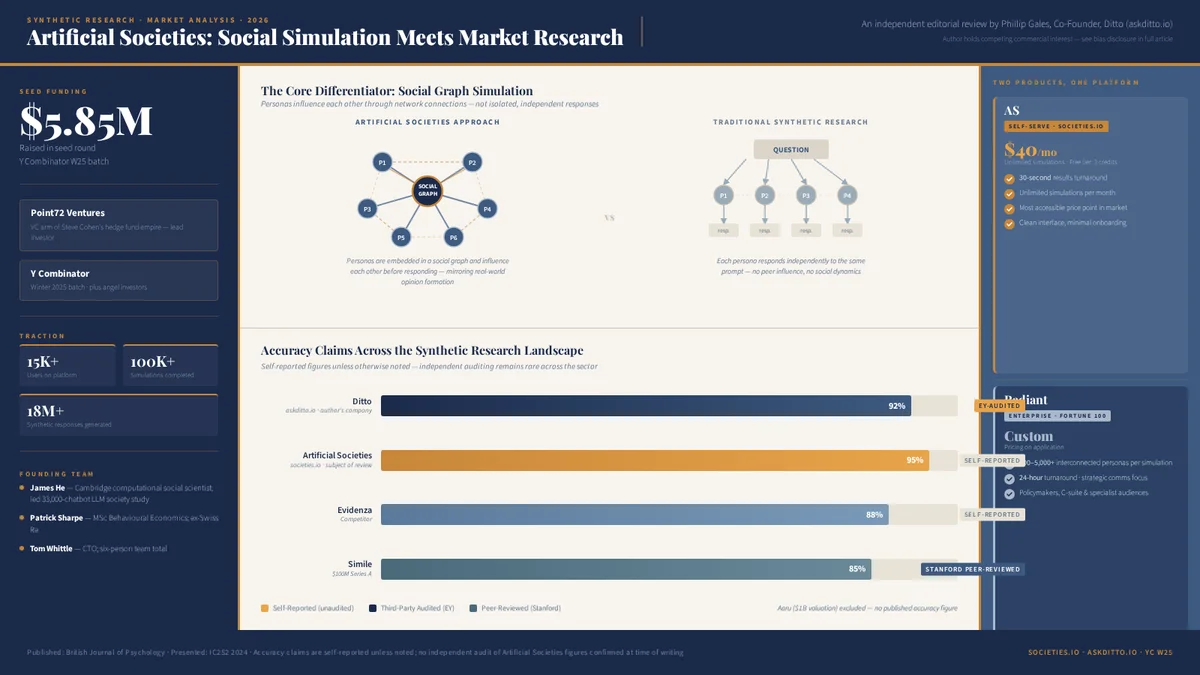
The company raised a $5.85 million seed round from Point72 Ventures, the venture arm of Steve Cohen's hedge fund empire, alongside Y Combinator and a handful of angels who presumably read the British Journal of Psychology paper and thought, "Yes, this is worth a bet." The product launched publicly in late 2025, and as of early 2026, Artificial Societies claims over 15,000 users and 100,000 simulations completed.
I've spent the past fortnight pulling apart everything publicly available about the platform, the team, the technology, and the competitive claims. Here's what I found. And yes, I run a competing company, so I'll address that directly before we go any further.
A note on bias
I'm a co-founder at Ditto, which operates in the same synthetic research market as Artificial Societies. I have every commercial incentive to dismiss a competitor. I've tried not to. This review is based entirely on public information: the Artificial Societies website, published research, Y Combinator materials, Hacker News discussions, and the company's own marketing claims. Where I make comparisons to Ditto, I'll flag them explicitly. If you think I've been unfair, I'd genuinely like to hear about it.
What Artificial Societies Actually Does
Artificial Societies runs two distinct products under one roof, and understanding the split is essential to understanding what the company is trying to be.
AS (self-serve) is the platform most people will encounter first. It's available at societies.io, costs $40 per month for unlimited simulations after a free tier of three credits, and returns results in roughly 30 seconds. You define a population, pose a question or scenario, and the platform simulates how that population would respond. The interface is clean, the onboarding is minimal, and the price point is, frankly, extraordinary. At $40 per month for unlimited use, AS is by some distance the most accessible synthetic research platform on the market.
Radiant is the enterprise offering, and it operates in an entirely different register. Positioned for Fortune 100 strategic communications teams, Radiant promises access to "unreachable audiences" such as policymakers, C-suite executives, and specialist professional populations that traditional research panels struggle to recruit. Turnaround is 24 hours rather than 30 seconds, the simulation scale ranges from 300 to 5,000+ interconnected personas, and pricing is custom. If AS is the democratised tool for startups and solo researchers, Radiant is the white-glove service for corporate strategy teams that need to understand how a regulatory announcement will land with 3,000 simulated financial advisers.
The critical technical differentiator across both products is what Artificial Societies calls the "social graph simulation layer." Rather than generating individual personas who answer questions independently, the platform constructs networks of personas that influence each other. A simulated consumer doesn't just have demographics and preferences; they have neighbours, colleagues, and social media connections whose opinions shape their own. This is the thesis that makes Artificial Societies genuinely interesting.
The Social Network Thesis
Here is where Artificial Societies earns its intellectual keep. Most synthetic research platforms, Ditto included, operate on a fundamentally individualistic model. You create a persona with certain attributes, ask it questions, and receive answers that reflect that individual's simulated perspective. The persona might be a 34-year-old marketing director in Chicago who drinks oat milk and votes Democrat, but she exists in splendid isolation. Her opinions are her own. Nobody else in the study has influenced them.
Artificial Societies rejects this premise. Their argument, grounded in James He's Cambridge research, is that human decision-making is fundamentally social. People don't form opinions in a vacuum; they form them through conversation, exposure, peer pressure, and the slow osmosis of ideas through networks. A consumer's view of a new product isn't just a function of their demographics and the product's features. It's a function of what their friends think, what they've seen on social media, and whether the idea has reached them through a trusted connection or a cold advertisement.
The platform operationalises this by constructing networks of 300 to 5,000+ personas that interact with each other before, during, and after the research scenario is introduced. The simulation models how ideas spread through the network, how opinions cluster and polarise, how early adopters influence laggards, and how consensus forms or fails to form. James He's published work in the British Journal of Psychology demonstrated this approach with a study of 33,000 LLM-powered chatbots, the first large-scale simulation of its kind.
This is genuinely novel. It means Artificial Societies is strongest in precisely the domains where social dynamics matter most: predicting social media virality, modelling message spread through populations, forecasting how public opinion shifts in response to events, and understanding how word-of-mouth affects product adoption. If you want to know whether a specific campaign message will go viral on Twitter, a network simulation is arguably more useful than a panel of individually surveyed personas.
The limitation is the mirror image of the strength. For deep individual consumer research, the kind where you want to understand one person's emotional reaction to a product experience, the network layer adds complexity without necessarily adding insight. Not every research question is a social dynamics question.
The Team
Artificial Societies is a team of six, which makes the scope of their ambition either admirably lean or mildly terrifying, depending on your perspective.
James He is the CEO and the intellectual engine. His Cambridge doctoral work on large-scale LLM societies produced the first published study simulating tens of thousands of AI agents interacting in structured social networks. He's the reason the company exists and the reason the social graph thesis has academic credibility.
Patrick Sharpe is the commercial co-founder. MSc in Behavioural Economics, previously at Swiss Re (the reinsurance giant), and credited with scaling a previous consultancy venture by 3x. He brings the enterprise sales muscle and, presumably, the Radiant product vision.
Tom Whittle is the CTO, responsible for the platform engineering that makes 30-second simulations and 5,000-persona networks technically feasible.
Six people building two products (one self-serve, one enterprise), maintaining a social graph simulation engine, and serving 15,000 users is an extraordinary amount of surface area for a tiny team. Y Combinator companies are famously lean, and the $5.85 million seed from Point72 Ventures gives them runway, but the gap between "promising research prototype" and "enterprise-grade platform" is where many startups stumble.
Validation and Accuracy
Artificial Societies publishes several accuracy claims on their website and in investor materials:
95% of human self-replication level (their headline accuracy metric)
90% internal coherence across simulated responses
80%+ accuracy in social media prediction tasks
R² = 0.78 for LinkedIn post engagement prediction
The academic credentials are real. James He's work has been published in the British Journal of Psychology and presented at IC2S2 2024, the International Conference on Computational Social Science. These are legitimate venues with peer review processes.
However, and this is important, the commercial accuracy claims are self-reported. They have not, to my knowledge, been independently audited by a third party. This matters because self-reported accuracy in synthetic research is roughly as reliable as self-reported accuracy in any field: probably directionally correct, but impossible to fully evaluate without independent verification.
For comparison, Ditto's 92% overlap with traditional focus groups was audited by EY across 50+ parallel studies. Evidenza claims 88% accuracy, also self-reported. Simile cites 85% accuracy from a Stanford peer-reviewed paper. The validation landscape in synthetic research is still maturing, and the gap between "published in a journal" and "independently audited in commercial conditions" remains significant across the entire field.
Pricing: Genuinely Aggressive
This is where Artificial Societies makes its most compelling case for attention. The pricing structure is remarkably simple:
Free tier: 3 credits to test the platform
Pro ($40/month): Unlimited simulations
Enterprise (Radiant): Custom pricing for Fortune 100 clients
At $40 per month for unlimited use, AS is the most price-accessible synthetic research platform by a wide margin. For context, the broader AI consumer panel market spans an enormous range:
Enterprise platforms (Simile, Aaru): $100,000+/year, demo-only access
Professional platforms (Ditto, Evidenza): $50,000-$75,000/year with unlimited studies
Mid-market tools (Quantilope, Remesh): $22,000+/year
Self-serve budget (Artificial Societies): $480/year for unlimited use
The honesty compels me to say this plainly: if you're a solo researcher, a startup founder, or an academic who wants to experiment with synthetic research without a five-figure commitment, Artificial Societies is the obvious place to start. The $40 price point removes every financial barrier. The question, as always, is whether what you get at $40 per month is comparable to what you get at $50,000 per year. The answer depends entirely on what you're trying to do.
The Persona Sourcing Question
Artificial Societies builds its personas from "publicly available social media profiles." This is stated clearly on their website and has been discussed in Hacker News threads about the company. It is both the platform's greatest enabler and its most significant methodological limitation.
The approach works brilliantly for populations that are active and expressive online. If you want to simulate how Twitter users will react to a brand campaign, or how LinkedIn professionals will engage with a thought leadership post, you're drawing from exactly the right source material. The R² = 0.78 LinkedIn engagement prediction makes perfect sense in this context: the personas are built from LinkedIn data, so they predict LinkedIn behaviour well.
But what about populations that aren't well-represented on social media? Hacker News commenters, who are rarely accused of pulling punches, flagged this as the platform's biggest limitation. Elderly consumers, rural populations, developing market demographics, offline-first communities, and anyone who doesn't leave a substantial digital footprint are, by construction, underrepresented in a persona model built from social media profiles.
This isn't a fatal flaw. It's a scope constraint. Every synthetic research platform has them. Ditto's personas are grounded in census data, which gives broader demographic coverage but lacks the social network dimension. Simile's personas are built from qualitative interviews, which provides depth but limits scale. The question for any buyer is whether the platform's data foundation matches the population they need to understand.
Traction: Impressive Numbers, Limited Proof
The headline numbers are striking:
15,000+ users
100,000+ simulations completed
18 million+ individual responses generated
For a company that launched publicly in late 2025, these are impressive adoption metrics, particularly given the $40 price point which presumably drives significant self-serve uptake. The ratio of simulations to users (roughly 6.7 per user) suggests reasonable engagement beyond initial trial.
The notable gap is between these aggregate numbers and verifiable customer evidence. The only named enterprise customer I've been able to identify is Teneo, the global CEO advisory firm, which is referenced in Artificial Societies' marketing materials. One named customer out of 15,000 users is a significant verification gap.
This could mean several things. It could mean the customer base is overwhelmingly self-serve (individual researchers and small teams using the $40/month plan) with limited enterprise penetration. It could mean enterprise customers have requested confidentiality. Or it could mean the 15,000 figure includes free-tier sign-ups who never converted. Without more transparency, it's impossible to assess the commercial maturity of the platform.
Strengths
Genuinely novel approach: The social graph simulation is not marketing differentiation for its own sake. It represents a fundamentally different model of how synthetic personas should work, grounded in legitimate social science. No other platform in the market does this.
Aggressive pricing: $40/month for unlimited simulations is category-defining accessibility. It removes the financial barrier that keeps most synthetic research confined to enterprise budgets.
YC + Point72 backing: Y Combinator provides network and credibility; Point72 Ventures provides capital and a signal that quantitative investors see commercial potential.
Speed: 30-second simulation results on the self-serve platform. This is fast enough to integrate into iterative workflows rather than treating research as a distinct project.
Academic pedigree: James He's Cambridge work and the British Journal of Psychology publication provide genuine academic grounding, not just marketing claims about "proprietary AI."
Limitations
One named customer: Teneo is the only identifiable enterprise customer. For a platform claiming 15,000 users and 100,000 simulations, the absence of case studies, testimonials, or named references is a gap that enterprise buyers will notice.
Self-reported validation: The 95% accuracy claim has not been independently audited. In a market where credibility is everything, self-reported metrics carry less weight than third-party verification.
Social media bias in persona sourcing: Building personas from public social media profiles inherently overrepresents digitally active populations and underrepresents offline demographics. This limits the platform's reliability for certain research populations.
Tiny team: Six people running two products, an API, enterprise sales, and a simulation engine. The ambition-to-headcount ratio is extreme, even by YC standards.
Near-zero content and thought leadership: The company's blog is sparse, there's minimal educational content, and their public documentation is limited. For a platform built on cutting-edge research, the absence of public intellectual engagement is a missed opportunity.
The Bottom Line
Artificial Societies is the most intellectually interesting player in synthetic research. That's not a throwaway compliment. The social graph thesis is a genuinely differentiated approach to a problem that every other platform, including mine, solves by simulating individuals in isolation. The idea that you should model how opinions spread through networks rather than simply polling individual personas is elegant, grounded in real social science, and addresses a genuine blind spot in the field.
But intellectual interest and commercial maturity are different things. The platform is strongest where social dynamics matter most: message spread, virality prediction, opinion formation, and public sentiment modelling. For these use cases, the network simulation layer offers something genuinely unavailable elsewhere. If you're a communications team trying to predict how a message will propagate, or a brand trying to understand word-of-mouth dynamics, Artificial Societies deserves serious evaluation.
For deep individual consumer research, the kind where you need to understand how a specific persona reacts to a product concept, a pricing page, or a brand positioning, the social network layer is less obviously advantageous. Platforms like Ditto that focus on individual persona depth, census-grounded demographics, and integration with design tools (Figma, Canva, Framer) may be more practical for product and marketing teams.
The $40/month price point is a genuine gift to the field. It means anyone can experiment with synthetic research without a procurement process. The trade-off is that you're getting social simulation breadth rather than individual research depth, and the validation evidence, while academically grounded, hasn't yet been independently verified in commercial conditions.
Artificial Societies is early. One named customer, six employees, and $5.85 million in seed funding. The next 12 months will determine whether the social graph thesis translates from an elegant idea into a defensible market position. I'll be watching with genuine interest, and yes, a competitive eye.
Phillip Gales is co-founder at Ditto, a synthetic market research platform. This review is based on publicly available information as of March 2026. For a broader view of the market, see our 2026 synthetic research market map.