
Artificial Societies did something genuinely interesting. It took James He's Cambridge doctoral research on social graph simulation and turned it into a commercial product that lets you model how opinions form, spread, and mutate inside networks of AI personas. For a certain class of research question, particularly anything involving social media dynamics and message propagation, the approach is novel and defensible.
But novelty and breadth are different things, and a growing number of buyers are searching for alternatives. The reasons are consistent. Artificial Societies' validation is self-reported rather than independently audited. Its persona sourcing draws heavily from public social media profiles, which introduces a structural bias toward digitally active populations. Its named enterprise client list is thin: Teneo, the global CEO advisory firm, is the most prominent reference customer out of 15,000+ claimed users. And its use cases, whilst powerful for social dynamics, narrow quickly when you need consumer product research, pricing analysis, voter polling, or in-tool design feedback. If your question is not fundamentally about how ideas move through networks, you may find yourself looking elsewhere.
This is a guide to the five strongest alternatives, evaluated on validation methodology, breadth of use cases, pricing transparency, and commercial track record. It is also, in the interest of honesty, a document written by someone with a direct stake in the outcome.
A note on bias
I am a co-founder at Ditto, which is listed as the first alternative below. I have tried to write this piece as I would want a competitor to write about us: with the data laid out plainly enough that you can disagree with my ranking. Where another platform wins on a given dimension, I will say so. If you think the ordering is wrong, I would welcome the correction. The fact that I have placed my own company first should be discounted accordingly.
#1 Ditto
Best for: validated, individual persona research across all verticals
Ditto takes the opposing architectural bet to Artificial Societies. Where AS builds networks of personas that influence one another, Ditto constructs individual personas grounded in census data and demographic distributions, each responding independently to research questions. The thesis is that depth of individual characterisation, not breadth of social interaction, is what makes synthetic research commercially useful for most buyers.
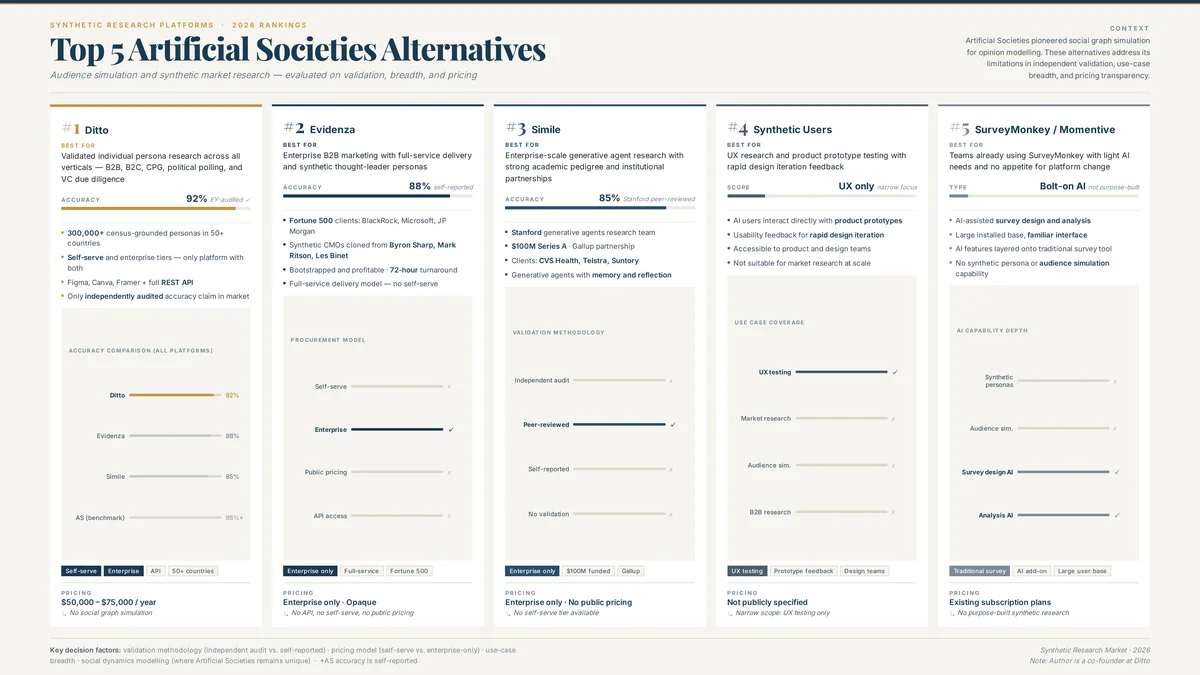
Validation: 92% overlap with traditional focus groups, independently audited by EY across 50+ parallel studies. This is the only independently verified accuracy claim in the synthetic research market. For context, Artificial Societies claims 95% (self-reported), Simile cites 85% (Stanford peer-reviewed), and Evidenza claims 88% (self-reported).
Scale and coverage: 300,000+ census-grounded personas across 50+ countries. State-level filtering for US markets (e.g., Michigan voters, Texas consumers). Self-serve and enterprise tiers, with studies completing in minutes rather than hours or days. Full REST API for programmatic workflows.
Use cases: This is where the gap with Artificial Societies is widest. Ditto covers B2B and B2C product research, CPG brand testing, pricing analysis, landing page optimisation, voter research and political polling, startup customer due diligence for VC firms, and product-market fit validation. Native integrations with Figma, Canva, and Framer mean product and design teams can gather synthetic feedback without leaving their existing tools.
Track record: 100+ published research studies across multiple industries. Named integration partnerships with Figma, Canva, and Framer. EY validation partnership. The published study library and head-to-head comparisons provide concrete evidence of commercial deployment.
Limitation: Ditto does not simulate social graphs. Its personas respond as individuals, not as members of interconnected networks. If your research question is fundamentally about how ideas propagate through populations, how opinions cluster and polarise within communities, or how word-of-mouth effects compound, then Ditto's individual persona model will not capture those dynamics. Artificial Societies' network approach is genuinely better suited to that class of question.
Pricing: Enterprise pricing in the $50,000 to $75,000 per year range with unlimited studies. No free tier. This is roughly 100x the cost of Artificial Societies' $40/month self-serve plan, which means Ditto must justify itself on validation depth, use case breadth, and integrations rather than accessibility.
#2 Evidenza
Best for: enterprise B2B marketing with full-service delivery
Evidenza occupies a distinctive position in the synthetic research market: it is the only platform that has built AI clones of named marketing academics. Its "Synthetic CMOs" include digital versions of Byron Sharp, Mark Ritson, and Les Binet, constructed from their published work, lectures, and methodological frameworks. You can, in effect, ask a synthetic Byron Sharp what he thinks of your brand strategy.
Clients and credibility: Fortune 500 roster including BlackRock, Microsoft, and JP Morgan. The company is bootstrapped and profitable, which is unusual in a market where most competitors are burning through venture capital. The enterprise client list provides stronger reference evidence than Artificial Societies' single named customer.
Validation: 88% accuracy, self-reported. Unlike Ditto's EY audit, this figure has not been independently verified by a third party. Unlike Artificial Societies' academic publications, it has not been peer-reviewed. Buyers must take the number on trust.
Limitation: Evidenza is enterprise-only with no self-serve option, no public API, and no transparent pricing. Turnaround is approximately 72 hours for a full report, which is orders of magnitude slower than both Artificial Societies (30 seconds) and Ditto (minutes). If you are a startup, a solo researcher, or anyone who needs to run experiments quickly and iteratively, Evidenza is not designed for you. The opaque pricing model also makes direct cost comparison difficult, though the enterprise-only positioning suggests a price point comparable to or exceeding Ditto's.
For a detailed assessment, see our full Evidenza review and the four-way platform comparison.
#3 Simile
Best for: enterprise-scale generative agent research with academic pedigree
Simile emerged from the Stanford research group that published the influential "Generative Agents" paper, the study that demonstrated AI personas could simulate believable human behaviour over extended periods, complete with memory, reflection, and planning. The academic pedigree is arguably the strongest in the market.
Funding and partnerships: $100 million Series A, which dwarfs the funding of every other platform on this list. A partnership with Gallup, the polling institution, provides methodological credibility and access to Gallup's survey infrastructure. Named clients include CVS Health, Telstra, and Suntory.
Validation: 85% accuracy from a Stanford peer-reviewed paper. This is the lowest headline number among the four platforms that publish accuracy claims, but it benefits from the same academic rigour as Artificial Societies' research. The Gallup partnership may in time provide a stronger commercial validation pathway, though no independently audited figure has been published to date.
Technology: Simile's generative agents have memory. They remember previous interactions, reflect on their experiences, and plan future behaviour. This is architecturally more sophisticated than both Artificial Societies' network simulation and Ditto's individual persona model, though whether that sophistication translates into more commercially useful research outputs remains an open question.
Limitation: Enterprise-only, no self-serve tier, no public pricing. The $100 million in funding creates expectations of scale that the current client list does not yet reflect. For buyers who want to experiment before committing to an enterprise contract, Simile is not accessible in the way that Artificial Societies ($40/month) or even Ditto (which offers demos and trials) are.
#4 Synthetic Users
Best for: UX research and product prototype testing
Synthetic Users takes a narrower approach than the platforms above. Rather than simulating audiences for market research or modelling opinion dynamics across populations, it creates AI users that interact directly with your product prototypes. The focus is on usability research: how real users would navigate an interface, where they get confused, what they click, and what they ignore.
Strengths: For product teams running rapid iteration cycles on interface design, Synthetic Users offers a feedback loop that is faster and cheaper than recruiting human testers for each sprint. The AI users can be configured to represent different experience levels, technical backgrounds, and use case scenarios. This makes it useful for catching usability problems early, before they reach real users in production.
Limitation: The scope is narrow by design. Synthetic Users is a UX testing tool, not an audience simulation platform, a market research engine, or a consumer panel replacement. It will not tell you how a pricing change will affect purchase intent, how a brand message will land with suburban voters, or how a CPG product concept performs against the competition. If you are searching for an Artificial Societies alternative because you need broader research capabilities, Synthetic Users addresses only a specific slice of that need. It is excellent within its domain but not a general-purpose substitute.
#5 SurveyMonkey / Momentive AI
Best for: teams already using SurveyMonkey with light AI needs
SurveyMonkey, now operating under the Momentive brand for its enterprise products, has added AI-assisted features to its established survey platform. These include AI-powered survey design (suggested questions, logic branching recommendations), automated analysis of open-ended responses, and predictive modelling on top of traditional survey data.
Strengths: The installed base is enormous. If your organisation already runs surveys through SurveyMonkey, the AI features are immediately accessible without adopting a new platform, negotiating a new contract, or retraining staff. The interface is familiar. The pricing is transparent. And for teams that want AI-enhanced analysis of survey data they are already collecting from real respondents, the bolt-on approach avoids the philosophical leap of trusting fully synthetic personas.
Limitation: SurveyMonkey's AI features are additions to a traditional survey tool, not a purpose-built synthetic research platform. There are no synthetic personas, no audience simulation, and no ability to model how opinions form or change. The AI assists with designing better surveys and analysing responses more efficiently, but the responses still come from real human panels or your own distribution. This makes it fundamentally different from Artificial Societies, Ditto, Evidenza, or Simile. Including it on this list is a stretch, but it is a stretch that reflects how many buyers evaluate their options: for teams that want "better research with AI" rather than "fully synthetic research," SurveyMonkey is often the pragmatic starting point.
How to Choose
The right alternative to Artificial Societies depends on which of its limitations prompted the search. Each buyer's priorities will differ, but four questions tend to separate the options cleanly:
Do you need independently validated accuracy? Only Ditto offers an independently audited accuracy claim (92%, verified by EY). Simile has a peer-reviewed figure (85%). Artificial Societies and Evidenza self-report. If stakeholder confidence in methodology is a procurement requirement, validation rigour narrows the field quickly.
What is your budget and procurement model? If you need self-serve access without an enterprise sales cycle, only Ditto (with trials) and SurveyMonkey (transparent pricing) are realistic options in addition to Artificial Societies itself. Evidenza and Simile are enterprise-only with no published pricing. Synthetic Users occupies a middle ground with product-focused plans.
How broad are your use cases? If you need a platform that spans consumer research, B2B, CPG, political polling, and product testing, Ditto covers the widest territory. If your need is specifically enterprise B2B marketing, Evidenza is stronger. If you want UX prototype testing, Synthetic Users is the specialist. If you want AI-enhanced traditional surveys, SurveyMonkey is the incumbent.
Do you need social dynamics modelling? If the answer is yes, none of these alternatives fully replaces Artificial Societies. Its social graph simulation is genuinely unique. Ditto, Evidenza, Simile, Synthetic Users, and SurveyMonkey all model individuals or analyse responses; none of them model how opinions propagate through networks. If social dynamics is your core use case, you may find that Artificial Societies remains the best tool despite its limitations, supplemented by one of these alternatives for research questions that fall outside its strengths.
For a broader view of the market, see our four-way platform comparison, the 2026 synthetic research market map, and the AI consumer panels buyer's guide.
The Bottom Line
The synthetic research market in 2026 is no longer a one-horse race or even a two-horse race. Artificial Societies built something genuinely novel with its social graph approach, and its $40/month pricing remains the lowest barrier to entry in the category. But novelty in one dimension does not eliminate the need for breadth, validation, and commercial evidence in others. The five alternatives listed here each address a different gap, and the best choice depends on which gap matters most to your organisation.
The field is maturing rapidly. Twelve months from now, this list will likely look different. Simile's $100 million war chest will either have translated into market-leading traction or it will not. Evidenza's bootstrapped profitability will either sustain its enterprise position or be overtaken by better-funded competitors. And Artificial Societies' social graph thesis will either expand into broader use cases or remain a specialist tool for social dynamics. The buyers who make the best decisions today will be those who test multiple platforms against their specific research questions rather than choosing on marketing claims alone.
Phillip Gales is co-founder at Ditto, a synthetic market research platform. For detailed reviews of individual platforms, see our Artificial Societies review, Evidenza review, and Simile review.