
In 2024, the synthetic research market had roughly two players worth discussing. By March 2026, it has four serious contenders, each with a genuinely different thesis about how AI should replace or augment traditional market research. The shift has been swift, well-funded, and intellectually diverse in a way that few emerging technology categories manage.
This guide compares them across 15 dimensions. It is intended to be useful for buyers: the research directors, product leads, and agency strategists who need to evaluate these platforms without wading through press releases and investor decks. The four platforms are Ditto, Evidenza, Simile, and Artificial Societies.
Disclosure: I am co-founder at Ditto, one of the four platforms reviewed. I have tried to be fair and evidence-based throughout, but you should factor that interest into your reading. Where claims are sourced from a platform's own materials, I say so. Where independent validation exists, I note the auditor.
The Four Theses
Each platform has a distinct philosophy about what synthetic research should be. These are not minor implementation differences. They represent fundamentally different bets about how AI personas should be built, validated, and deployed. Understanding the thesis behind each platform matters at least as much as comparing feature lists.
Ditto: Census-Grounded Individual Personas
Ditto grounds synthetic personas in population-level data: census demographics, consumer behaviour patterns, attitudinal surveys, and regional preference data across 50+ countries. The result is 300,000+ pre-built personas calibrated against real-world distributions. Published validation shows 92% correlation with real focus groups across 50+ parallel studies, audited independently by EY. The platform is fully self-serve with a complete API, and returns results in minutes rather than days. Use cases span the broadest range of any platform in this comparison: B2B, B2C, CPG, political/voter research, product testing, and venture capital due diligence.
Evidenza: Enterprise Consulting Meets Synthetic Data
Founded by Peter Weinberg and Jon Lombardo, who previously co-founded LinkedIn's B2B Institute and produced some of the most widely cited work in B2B marketing (the 95:5 Rule, the Laws of Growth in B2B). Evidenza creates "Impersonas" trained on analyst reports, Reddit, government filings, and proprietary data. The model is full-service: you brief the team, they run the study, and you receive results within 72 hours. The signature feature is "Synthetic CMOs", AI clones of marketing luminaries including Byron Sharp and Mark Ritson, whom marketers can consult for strategic feedback. The customer list is remarkable: BlackRock, Microsoft, JP Morgan, Nestle, EY, ServiceNow, Salesforce, Mars, Dentsu. The focus is squarely on B2B marketing and enterprise go-to-market strategy.
Simile: Stanford Generative Agents
Simile emerged from stealth on 12th February 2026 with $100 million in Series A funding from Index Ventures. Founded by the Stanford team that literally invented generative agents (Joon Sung Park, Michael Bernstein, Percy Liang), plus commercial operator Lainie Yallen. Backed personally by Fei-Fei Li and Andrej Karpathy. The technology trains individual AI agents on qualitative interviews with real people, giving them memory, reflection, and planning capabilities. The Gallup partnership promises probability-based synthetic panels grounded in the gold standard of opinion research. Known customers include CVS Health, Telstra, Suntory, and Wealthfront. Enterprise-only access, with the broadest ambitions for behaviour prediction of any platform in the market.
Artificial Societies: Social Network Simulation
Backed by Y Combinator (W25) and Point72 Ventures, Artificial Societies takes the most architecturally distinctive approach. Rather than simulating individuals in isolation, it simulates entire social networks: personas influence each other within a graph, modelling how ideas spread and opinions form through social contagion. The database contains 500,000 to 2.5 million AI personas, primarily sourced from social media data. Self-serve access at $40/month, with enterprise custom pricing. The sweet spot is social media strategy and strategic communications, predicting not just what individuals think, but how messages propagate through populations.
Head-to-Head: 15 Dimensions
What follows is a structured comparison across every dimension that matters when evaluating these platforms. Rich Text does not support tables, so each dimension gets its own subheading with a direct assessment of all four platforms.
1. Validation Accuracy
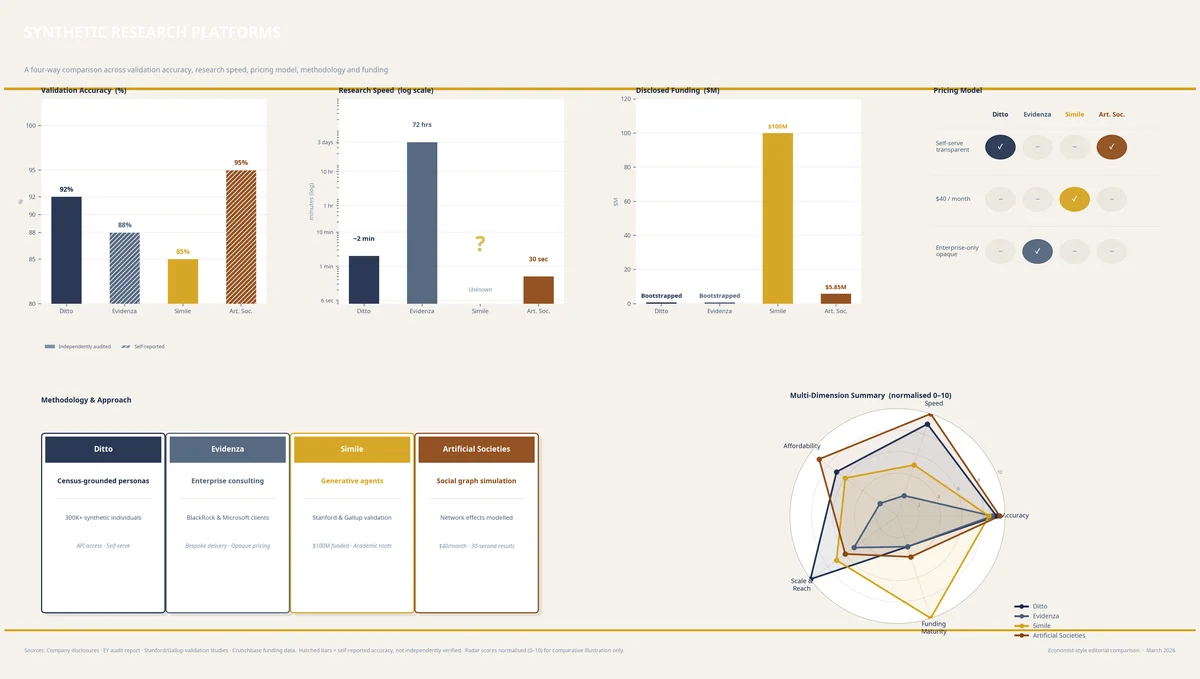
Ditto: 92% correlation with real focus groups, audited by EY across 50+ parallel studies. This is the only independently verified figure in the market. Evidenza: 88% average accuracy across 100+ head-to-head tests (self-reported). EY CMO Toni Clayton-Hine separately reported 95% correlation. Simile: 85% of human self-replication accuracy on the General Social Survey across 1,052 participants (Stanford/Gallup research). Artificial Societies: 95% human replication level (self-reported). Note: only Ditto has an independent third-party audit. The others cite internal benchmarks or customer testimonials. See Section 5 for why this distinction matters.
2. Pricing
Ditto: Transparent, published pricing. Self-serve access. Evidenza: Enterprise-only, pricing not published. Estimated $50,000-$100,000+ per engagement based on comparable full-service research pricing. Simile: Enterprise-only, pricing not published. Estimated $100,000+/year given the $100M raise and Fortune 500 customer base. Artificial Societies: $40/month self-serve for unlimited simulations. Enterprise pricing is custom. The cheapest entry point in the market by a significant margin.
3. Speed to Results
Ditto: Minutes. Create a study, ask questions, receive responses. The entire workflow from brief to shareable report typically takes under an hour. Evidenza: 72-hour turnaround. This is a full-service model: you brief the Evidenza team, they design and run the study, and deliver results. Faster than traditional research, but not instant. Simile: Not publicly documented. Enterprise onboarding likely involves weeks of setup. Artificial Societies: 30 seconds for self-serve simulations. 4 hours for enterprise-grade analysis. The fastest raw output of any platform.
4. Self-Serve Access
Ditto: Yes. Create an account and run a study immediately. No sales call required. Evidenza: No. Full-service only. A self-serve platform has been announced as "coming soon" but is not yet available. Simile: No. Enterprise-only, demo required. Artificial Societies: Yes. $40/month plan available immediately. The only other platform besides Ditto offering genuine self-serve access.
5. API Access
Ditto: Full REST API with comprehensive documentation. Notably, Ditto offers a Claude Code integration that allows developers to run entire research workflows programmatically. This is unique in the market. Evidenza: No public API. Simile: No public API. Enterprise integrations may be available on request. Artificial Societies: No public API documented. Enterprise-only integrations possible.
6. Persona Count and Coverage
Ditto: 300,000+ pre-built personas spanning 50+ countries. Census-grounded with demographic, psychographic, and behavioural attributes. Evidenza: "Thousands" of Impersonas per study, but the total database size is not publicly quantified. Simile: Grounded in Gallup's probability-based panels. The total number of trained agents is not disclosed, but the approach emphasises depth (agents trained on real interviews) over breadth. Artificial Societies: 500,000 to 2.5 million AI personas, primarily sourced from social media profiles. The largest raw number, though the provenance differs significantly from census-grounded approaches.
7. Design and Product Integrations
Ditto: Integrations with Figma, Canva, and Framer, allowing product teams to gather synthetic feedback directly within their design tools. This is a meaningful differentiator for product and UX teams. Evidenza: No design tool integrations. Simile: No design tool integrations. Artificial Societies: No design tool integrations. Ditto is the only platform with in-tool feedback capabilities.
8. Use Case Breadth
Ditto: The broadest range: B2B, B2C, CPG brand research, product testing, pricing research, political/voter research, venture capital due diligence, and competitive analysis. This breadth is partly a function of the self-serve model, which allows anyone to design a study for any audience. Evidenza: Primarily B2B marketing and enterprise go-to-market strategy. The Synthetic CMO feature is specifically designed for marketing leadership. Simile: Enterprise behaviour prediction. The generative agents architecture is built for complex behavioural simulation, not quick concept tests. Artificial Societies: Social media prediction and strategic communications. The social graph architecture is optimised for understanding message propagation, not individual product feedback.
9. Enterprise Client Base
Evidenza: The most impressive named client list in the market: BlackRock, Microsoft, JP Morgan, Nestle, EY, ServiceNow, Salesforce, Mars, Dentsu. Over 100 enterprise clients reported. This is genuinely remarkable for what appears to be a bootstrapped company. Simile: CVS Health, Telstra, Suntory, Wealthfront, Banco Itau. Strong brands, and the Gallup partnership adds institutional credibility. Ditto: 100+ published studies, with clients spanning CPG brands, agencies, political campaigns, and VC firms. Artificial Societies: Teneo is the primary named enterprise client. The platform is younger and the enterprise pipeline is less established.
10. Funding
Simile: $100 million Series A from Index Ventures (February 2026). By far the most capital raised. Artificial Societies: $5.85 million (Y Combinator W25, Point72 Ventures, Kindred Capital). Evidenza: Apparently bootstrapped and profitable. They reportedly generated seven figures in revenue before exiting stealth mode, suggesting a capital-efficient model. No venture funding disclosed. Ditto: Funding details not publicly disclosed.
11. Content and SEO Presence
Ditto: 50+ published articles with full GEO (Generative Engine Optimisation), structured for both traditional search and AI-generated answers. The deepest content library in the category, covering buyer's guides, market maps, competitor reviews, and methodology explanations. Evidenza: Approximately 20 pages of content. Growing but not yet comprehensive. Simile: Minimal public content. The site uses noindex directives, suggesting they are not pursuing organic search at this stage. Artificial Societies: Approximately 5 pages of content. Early stage.
12. Unique Differentiating Feature
Ditto: Claude Code integration. The ability to run complete research workflows programmatically through an AI coding assistant is genuinely novel. No other platform offers anything comparable. Evidenza: Synthetic CMOs. AI clones of Byron Sharp, Mark Ritson, Les Binet, and Peter Field. For marketing leaders who want strategic feedback from the discipline's most influential thinkers, this is a compelling (and slightly surreal) feature. Simile: Gallup partnership. Access to Gallup's probability-based panel methodology, the gold standard of opinion research, gives Simile a validation story that no other platform can match on pedigree alone. Artificial Societies: Social graph simulation. The only platform that models inter-persona influence, making it uniquely suited to predicting how ideas and messages propagate through social networks.
13. Geographic Coverage
Ditto: 50+ countries with state-level and regional filtering. The broadest geographic reach, including granular sub-national targeting (e.g., Michigan voters, Texas consumers). Evidenza: Coverage not publicly specified. Enterprise clients suggest US and European markets. Simile: Coverage not publicly specified. The Gallup partnership suggests potential for broad international coverage, but current availability is unclear. Artificial Societies: Coverage tied to social media data sources. Likely strongest in English-speaking markets.
14. Academic and Institutional Backing
Ditto: EY validation partnership (independent audit of 92% correlation). Evidenza: Advisory board includes Mark Ritson (Melbourne Business School), Linda Boff (former GE CMO). LinkedIn B2B Institute heritage brings Ehrenberg-Bass/Wharton connections. Simile: The strongest academic pedigree: Stanford HAI, founded by the generative agents research team (Park, Bernstein, Liang). Endorsed by Fei-Fei Li and Andrej Karpathy. Artificial Societies: Cambridge University connections (co-founder Maximilian Eber). Point72 Ventures backing adds quantitative finance credibility. All four platforms have genuine academic or institutional connections, which is unusual for an emerging category.
15. Team Size
Evidenza: Approximately 21 people including advisors. Lean for the client list they serve. Artificial Societies: 6 people. The smallest team, which is either impressive efficiency or an early-stage constraint depending on your perspective. Simile: Stanford stealth team. Size not publicly disclosed, but the $100M raise suggests plans for rapid expansion. Ditto: Team size not publicly disclosed.
Which Platform for Which Use Case?
The right platform depends on what you are trying to do. This decision framework is deliberately opinionated:
Brand or marketing research at a Fortune 500? Evidenza or Simile. Both have the enterprise client lists, the full-service delivery model, and the institutional credibility that procurement teams require. Evidenza edges it for B2B marketing; Simile for complex behavioural prediction.
Product testing, pricing research, or CPG brand research? Ditto. The combination of self-serve access, design tool integrations (Figma, Canva, Framer), and the broadest use case coverage makes it the natural choice for product-led organisations.
Social media strategy or message spread prediction? Artificial Societies. The social graph architecture is purpose-built for understanding how content propagates. No other platform models inter-persona influence.
Developer or API integration, or always-on research? Ditto. The only platform with a full public API and Claude Code integration. If you want research embedded in your engineering workflow, there is currently no alternative.
Budget-conscious experimentation? Artificial Societies at $40/month is the cheapest entry point. Ditto offers self-serve access at a higher price point but with broader capabilities.
Political or voter research? Ditto. The only platform with published voter research studies, state-level filtering, and a track record in political campaign applications. No other platform in this comparison has demonstrated this capability.
Want independent validation proof? Ditto. The EY-audited 92% correlation figure is the only independently verified accuracy claim in the market. If your organisation requires third-party validation evidence, this is currently the only option.
The Validation Question
The headline numbers are 92%, 88%, 85%, and 95%. Lined up like that, you might assume Artificial Societies is the most accurate and Simile the least. You would be wrong. These numbers measure fundamentally different things, and conflating them is one of the most common mistakes buyers make when evaluating synthetic research platforms.
Ditto's 92% is correlation with real focus groups across 50+ parallel studies, independently audited by EY. The methodology: run the same study with both synthetic personas and real human participants, then measure the overlap in findings. This is the most direct test of whether synthetic research produces results you could act on.
Evidenza's 88% is an internal similarity score across 100+ head-to-head tests. The methodology has not been published in detail. EY CMO Toni Clayton-Hine separately reported 95% correlation with their Global Brand Survey, and Dentsu achieved 0.87 correlation with their CCS panel. These are impressive testimonials, but they are customer-reported, not independently audited.
Simile's 85% is replication accuracy on the General Social Survey across 1,052 participants. The methodology: train AI agents on qualitative interviews with real people, then test whether the agents replicate those people's survey responses. This measures something subtly different from the others, namely whether an AI can replicate a specific individual's views, not whether a synthetic panel produces the same aggregate findings as a real one.
Artificial Societies' 95% is a self-reported "human replication level." The methodology has not been published in detail. Without knowing what is being replicated, against what benchmark, and by whom, this number is difficult to evaluate.
The upshot: buyers should ask three questions of any validation claim. Validated against what? By whom? Published where? Only one platform in this comparison currently has a clear answer to all three.
The Market Is Big Enough
It is tempting to read a comparison like this as a zero-sum contest. It is not. Traditional market research is a $90 billion+ industry globally. If synthetic captures even 10% of that spend, the addressable market is $9 billion. All four platforms can thrive, because they are not competing primarily with each other. They are competing with the status quo: six-week timelines, $50,000 focus group bills, and the sheer organisational friction of commissioning traditional research.
Qualtrics has already added synthetic respondents to its platform (Edge Audiences). Toluna is building hybrid synthetic/real panels (HarmonAIze). YouGov acquired Yabble. The incumbents are not ignoring this. But the pure-play platforms reviewed here have the advantage of architectural focus: they are not retrofitting synthetic capabilities onto legacy infrastructure. They are building from first principles.
The real question for buyers is not which platform will win. It is which approach fits your specific needs, your budget, and how much you value independent validation over institutional brand names. The answer is different for every organisation, and that is precisely why the market supports four genuinely distinct approaches.
Disclosure and Conclusion
I am co-founder at Ditto, so take this comparison with appropriate salt. I have tried to be fair. Evidenza's enterprise client list is genuinely impressive, and the fact that they appear to have built it without venture capital is a remarkable achievement. Simile's Stanford pedigree is unmatched, and the Gallup partnership gives them a validation pathway that no amount of money can buy. Artificial Societies' social graph approach is the most intellectually interesting idea in the space, and their $40/month price point makes them accessible in a way that the others are not.
Where Ditto excels, and where I believe the market will ultimately reward focus, is in accessibility, speed, and independent validation. Self-serve access means you can evaluate the platform today, not after a six-week procurement process. Minutes-not-days speed means research can inform decisions rather than ratify them. And an independently audited 92% correlation figure means you do not have to take our word for it.
The best platform depends on your use case, your budget, and your tolerance for opacity. If you are a Fortune 500 CMO with a six-figure research budget and a preference for white-glove service, Evidenza or Simile will serve you well. If you are a product manager who needs answers this week, a political strategist who needs voter sentiment by state, or a developer who wants research in their API pipeline, Ditto is built for you. And if you want to understand how a message will spread through a social network before you post it, Artificial Societies is the only game in town.
The synthetic research market is not a winner-take-all race. It is a land grab across a $90 billion industry, and there is room for all four theses to prove themselves. The organisations that benefit most will be those that start evaluating now, while the technology is still young enough to confer a genuine competitive advantage.
For a broader overview of the full synthetic research landscape including hybrid platforms and AI-enhanced traditional tools, see the 2026 Market Map. For a deep dive on Simile specifically, see our Simile AI Review and Simile vs Ditto comparison.