
If you have spent any time evaluating synthetic research platforms, you have almost certainly encountered Evidenza AI. Founded by Jon Lombardo and Peter Weinberg of LinkedIn B2B Institute fame, it is arguably the most prominent name in the space. It is also, for many buyers, the wrong fit. The reasons are structural rather than qualitative: Evidenza is enterprise-only with no self-serve access, delivers results in approximately 72 hours, publishes no pricing, and offers no API. For teams that need speed, transparency, or the ability to run research without a sales conversation, the search for alternatives begins almost immediately.
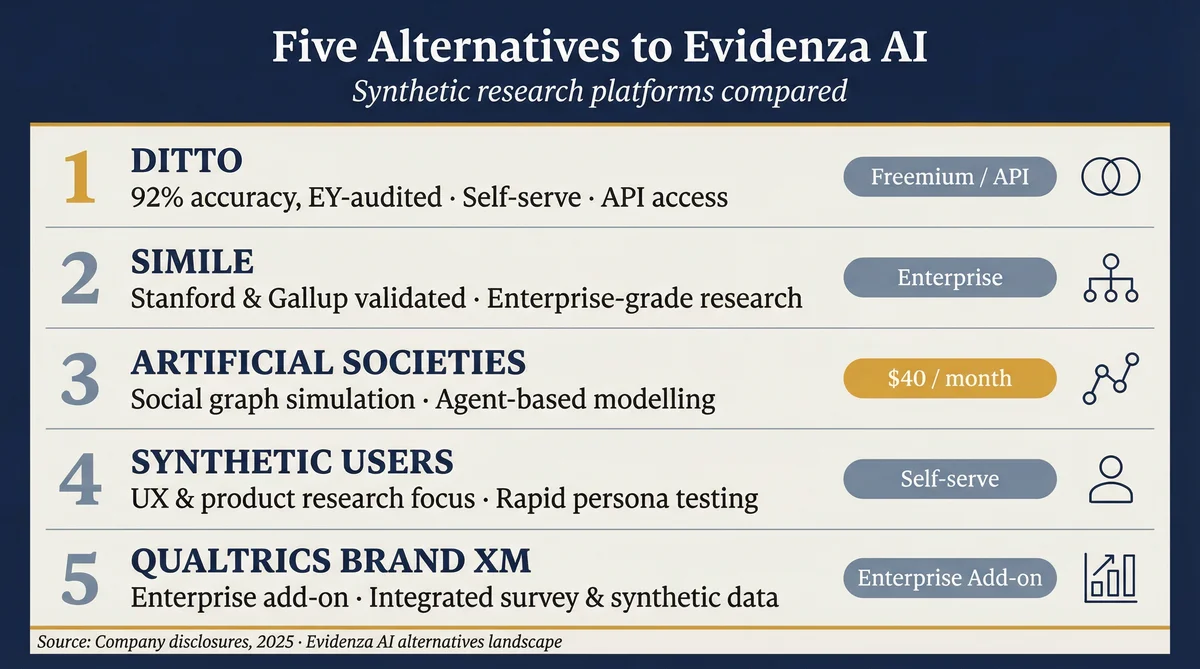
This article evaluates five platforms that buyers commonly consider when Evidenza does not match their requirements. We have tried to be genuinely fair about the strengths and limitations of each, including our own. For a broader market overview, see the 2026 synthetic research market map and the AI consumer panels buyer's guide.
Disclosure: The author is co-founder at Ditto, which is listed as alternative #1 below. We have attempted to present each platform fairly and cite third-party sources where possible. The reader should weigh this piece accordingly.
#1 Ditto
Best for: Self-serve, API-first, independently validated synthetic research
Ditto is a self-serve synthetic research platform with a full REST API. Where Evidenza operates as a managed service, Ditto operates as infrastructure: users create accounts, design studies through a web interface or API, recruit from a panel of over 300,000 synthetic personas across 50+ countries, and receive AI-analysed results in minutes. There is no waiting period, no intermediary, and no sales conversation required to begin.
The platform's accuracy has been independently audited by EY, which ran 50+ parallel studies comparing synthetic persona responses against traditional focus group outcomes and found 92% overlap. This is, at the time of writing, the only independent third-party validation published by any synthetic research platform. The distinction matters: an audited figure is verifiable in a way that self-reported accuracy claims are not. For a detailed comparison, see our Evidenza vs Ditto head-to-head analysis.
Ditto covers a broad range of use cases: B2B and B2C market research, CPG brand testing, political polling and voter sentiment, product development, pricing research, and startup due diligence. Native integrations with Figma, Canva, and Framer allow design and product teams to gather consumer feedback without leaving their existing tools. The REST API enables automated research pipelines, embedding studies into CI/CD workflows, and programmatic access to consumer insights.
Pricing: Self-serve tiers available; enterprise plans at $50,000-$75,000/year with unlimited studies and full API access
Speed: Minutes. A typical 10-persona, 7-question study completes in under 15 minutes
Validation: 92% overlap with traditional focus groups, independently audited by EY
Panel: 300,000+ synthetic personas, 50+ countries, state-level US filtering
Integrations: Figma, Canva, Framer, REST API
Key limitation: No full-service delivery model. Users must design their own studies and interpret their own results. For organisations that want a vendor to handle methodology and analysis end-to-end, this requires more internal research capability than Evidenza's managed approach.
#2 Simile
Best for: Enterprise-scale generative agent research with academic pedigree
Simile (formerly Simulated) is the best-funded company in the synthetic research space, having raised a $100 million Series A led by Andreessen Horowitz. Founded by a Stanford team that published foundational research on generative agents, Simile has built its platform around large-scale agent simulations. The company has secured a partnership with Gallup, which lends its methodology considerable credibility, and counts CVS Health, Telstra, Suntory, and Wealthfront among its clients.
Simile's accuracy has been peer-reviewed at Stanford, with published research reporting 85% alignment with traditional survey outcomes. This is a meaningful validation, though it is worth noting that the research was conducted by the founding team rather than an independent third party. The Gallup partnership adds methodological rigour, particularly for public opinion and consumer sentiment research. For a deeper analysis, see our four-way platform comparison.
Pricing: Enterprise-only, no published pricing. Given the $100M raise and Fortune 500 client list, expect six-figure annual contracts
Speed: Not publicly documented; enterprise workflow suggests days rather than minutes
Validation: 85% accuracy, Stanford peer-reviewed
Clients: CVS Health, Telstra, Suntory, Wealthfront
Key limitation: Enterprise-only with no self-serve access, no public pricing, and no documented API. Buyers cannot evaluate the platform without engaging sales. The model is structurally similar to Evidenza in this regard, which means it may not solve the access problem that drove the search for alternatives in the first place.
#3 Artificial Societies
Best for: Social network simulation and message propagation research on a budget
Artificial Societies takes a distinctive approach to synthetic research. Rather than simulating individual consumer responses to survey questions, it simulates social networks: how messages propagate, how opinions form through peer influence, and how information cascades through communities. Founded by a Cambridge team and backed by Y Combinator and Point72 Ventures, it is the most affordable platform on this list at $40 per month for its base tier.
The company reports 95% accuracy, though this figure is self-reported and the validation methodology has not been independently published. The social graph simulation capability is genuinely unique in the market. No other platform models opinion propagation through simulated networks, which makes Artificial Societies particularly interesting for communications strategy, PR crisis modelling, and political messaging research.
Pricing: From $40/month, making it the most accessible platform by a considerable margin
Speed: Self-serve, results within the platform
Validation: 95% accuracy (self-reported, no published independent validation)
Backing: Y Combinator, Point72 Ventures, Cambridge founding team
Key limitation: Only one named customer (Teneo) at the time of writing. The 95% accuracy claim is self-reported with no published methodology for independent verification. The social simulation approach, while novel, is a different category of tool from individual consumer research. Buyers seeking direct consumer feedback on products, packaging, or messaging may find the output format unfamiliar.
#4 Synthetic Users
Best for: UX research and product usability testing
Synthetic Users has carved out a focused niche in user experience research. The platform creates AI personas that interact with product prototypes, interfaces, and user flows, providing feedback on usability, navigation, and design decisions. For product teams running frequent usability studies, it offers a faster alternative to recruiting human testers for each iteration.
The value proposition is clear for its target audience: designers and product managers who need rapid feedback on interface changes, onboarding flows, and feature layouts. Rather than waiting days for a traditional usability study, teams can test variations in hours. The platform is built specifically for the design-to-development workflow, which gives it depth in UX that broader platforms may lack.
Pricing: Self-serve tiers available, positioned for product teams and design agencies
Speed: Hours for usability feedback
Focus: Interface testing, prototype feedback, UX research
Key limitation: Narrow use case. Synthetic Users is purpose-built for UX and product testing, not for brand research, market sizing, pricing studies, competitive positioning, or consumer sentiment analysis. If your research needs extend beyond interface design, you will need a second platform for everything else. The specialisation is a strength for pure UX teams but a constraint for organisations with broader research requirements.
#5 Qualtrics Brand XM
Best for: Enterprises already invested in the Qualtrics ecosystem
Qualtrics needs little introduction. It is the dominant enterprise survey platform, used by thousands of organisations worldwide for customer experience, employee engagement, and market research. Brand XM is its brand tracking and research module, and Qualtrics has been steadily adding AI-powered features, including synthetic data augmentation and AI-assisted analysis, to its existing survey infrastructure.
The advantage for existing Qualtrics customers is clear: AI features integrate directly into workflows they already use, with data flowing into dashboards they already monitor. Enterprise-grade compliance (SOC 2, HIPAA, GDPR), established procurement relationships, and a massive existing customer base reduce adoption friction to near zero for organisations already in the ecosystem.
Pricing: Enterprise contracts, typically bundled with broader Qualtrics XM suite. Expect six-figure annual commitments
Speed: Faster than traditional surveys with AI augmentation, but not real-time synthetic research
Compliance: SOC 2, HIPAA, GDPR, FedRAMP. The strongest compliance portfolio on this list
Integration: Native within the Qualtrics ecosystem; Salesforce, SAP, and enterprise stack connectors
Key limitation: Qualtrics' AI features are add-ons to a traditional survey platform, not a purpose-built synthetic research engine. The synthetic capabilities augment rather than replace conventional survey methodology. For buyers specifically seeking a synthetic-first approach, where AI personas replace human respondents entirely, Qualtrics is a hybrid rather than a pure play. The pricing also reflects the broader XM suite rather than synthetic research alone, which can make it expensive for teams that only need the AI features.
How to Choose: A Decision Framework
The right platform depends on four variables: budget, speed requirements, use case breadth, and validation needs. Here is a framework for narrowing the field.
If budget is the primary constraint, Artificial Societies at $40/month is the clear starting point, provided its social simulation approach fits your research questions. Ditto's self-serve tiers offer broader research capabilities at a higher but still accessible price point.
If speed is non-negotiable, Ditto (minutes) is the fastest platform on the list. Synthetic Users offers rapid UX feedback. Simile and Qualtrics operate on enterprise timelines. Artificial Societies falls somewhere in between.
If your use case is narrow, match the platform to the niche. Synthetic Users for UX testing. Artificial Societies for social propagation modelling. Qualtrics Brand XM if you are already in that ecosystem and want AI augmentation rather than a new vendor relationship.
If your use case is broad, spanning B2B, B2C, CPG, product, and potentially political research, Ditto and Simile offer the widest coverage. Ditto is accessible through self-serve; Simile requires an enterprise engagement.
If independently validated accuracy is a procurement requirement, Ditto's EY audit is currently the only third-party validation published in this market. Simile's Stanford peer review is credible but conducted by the founding team. Evidenza, Artificial Societies, and Qualtrics rely on self-reported figures or client testimonials.
If API access matters, Ditto is the only platform on this list with a documented, publicly available REST API. This is a binary qualifier: either you need programmatic access or you do not. If you do, the field narrows to one.
The Bigger Picture
The fact that buyers are actively searching for Evidenza alternatives tells us something about where the market is heading. Evidenza built an impressive platform for a specific buyer: the Fortune 500 CMO with a six-figure budget and a research team accustomed to working with agencies. That buyer exists, and Evidenza serves them well.
But the broader market increasingly expects self-serve access, transparent pricing, API-first architecture, and independently verified accuracy claims. The platforms on this list represent different bets on which of those expectations will prove most important. Simile is betting on scale and academic credibility. Artificial Societies is betting on novel methodology and accessibility. Synthetic Users is betting on depth in a single vertical. Qualtrics is betting on ecosystem lock-in. Ditto is betting on speed, transparency, and breadth.
None of these bets is obviously wrong. The synthetic research market is early enough that multiple approaches can coexist. But for buyers evaluating options today, the differences are material, and choosing the wrong platform for your specific needs is a more expensive mistake than choosing none at all.
Phillip Gales is co-founder at Ditto. For individual platform analyses, see our Evidenza AI Review, Simile Review, and Artificial Societies Review. For the full competitive landscape, see the 2026 Market Map and Buyer's Guide.