
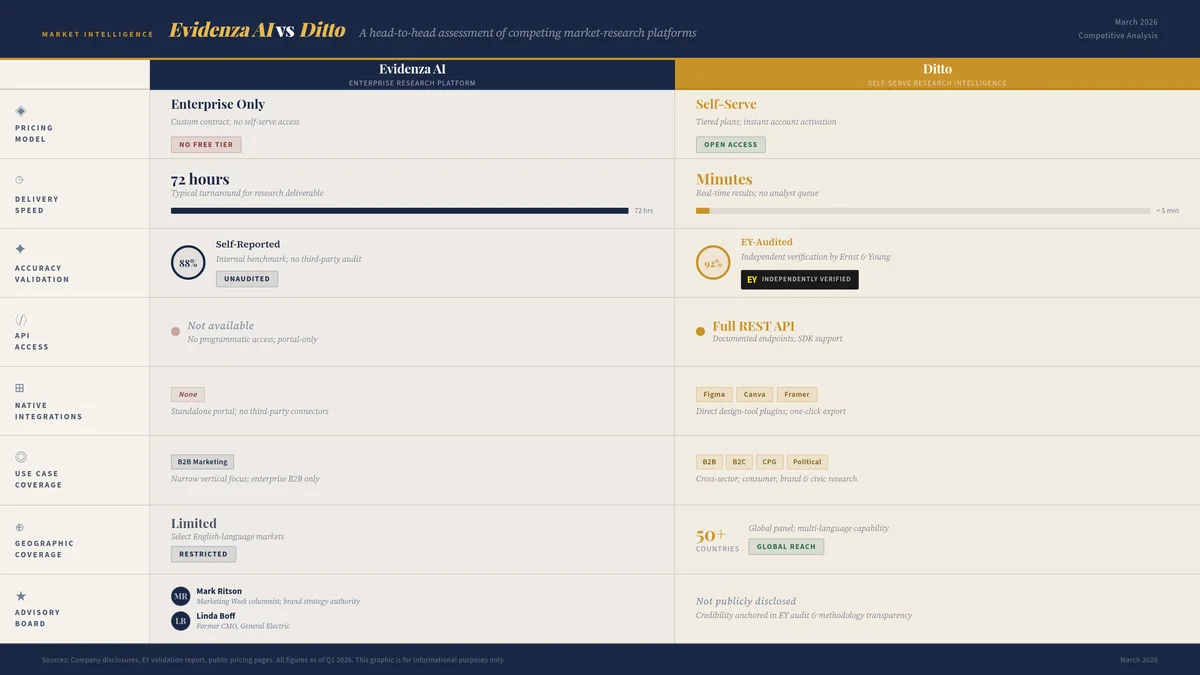
Two platforms. Two philosophies. One market. Evidenza AI and Ditto both promise to replace traditional market research with synthetic respondents, but the resemblance largely ends there. Evidenza is a full-service enterprise operation: you brief the team, wait 72 hours, and receive a polished report. Ditto is a self-serve platform with a REST API: you design a study, press run, and have results in minutes. The question for buyers is not which platform is better in the abstract, but which model fits how they actually work.
This article is a head-to-head comparison across eight dimensions that matter to procurement teams, research directors, and product managers evaluating synthetic market research tools. We have tried to be precise about what is known, what is estimated, and what remains opaque. For a broader market overview, see our four-way platform comparison and the 2026 market map.
Disclosure: The author is co-founder at Ditto. This piece attempts a fair comparison, but the reader should weigh it accordingly. Where possible, we cite third-party sources. Where we cannot, we say so.
The Core Difference: Enterprise Full-Service vs Self-Serve Platform
Before examining individual dimensions, it is worth understanding the architectural choice that drives every other difference between these two platforms.
Evidenza operates as a managed research service. There is no public sign-up page, no dashboard where users configure studies, and no API. Clients engage through a sales conversation, submit research briefs, and receive completed reports approximately 72 hours later. The Evidenza team handles methodology design, persona configuration, analysis, and deliverable formatting. This is, in essence, a traditional research consultancy accelerated by AI. It is a model that works exceptionally well for enterprise clients with complex requirements and the budget to match.
Ditto operates as a platform. Users create accounts, design studies through a web interface or API, recruit synthetic personas from a panel of 300,000+, and receive analysed results in minutes. There is no human intermediary. The trade-off is that users must understand what they want to ask and how to interpret what they receive, but the speed and cost advantages are substantial. For a deeper look at Evidenza's standalone capabilities, see our full Evidenza AI review.
Neither model is inherently superior. The right choice depends on the buyer's research maturity, speed requirements, budget, and integration needs. What follows is a dimension-by-dimension breakdown.
Head-to-Head: Eight Dimensions Compared
1. Pricing
Evidenza: Enterprise-only, no published pricing. Based on client profile (BlackRock, Microsoft, JP Morgan, Dentsu, Salesforce) and delivery model, we estimate annual contracts in the range of $50,000 to $100,000. Evidenza does not disclose per-study costs.
Ditto: Self-serve and enterprise tiers. Enterprise plans run $50,000 to $75,000 per year with unlimited studies and full API access. Self-serve tiers are available at lower price points for smaller teams.
Verdict: At the enterprise level, pricing is broadly comparable. Ditto's advantage is accessibility: teams that cannot justify a six-figure annual commitment can still access the platform. Evidenza's opaque pricing creates friction for procurement teams comparing options.
2. Speed to Insight
Evidenza: Approximately 72 hours from brief to deliverable. This includes methodology design, synthetic panel configuration, analysis, and report formatting by the Evidenza team.
Ditto: Minutes. Users design a study, recruit synthetic personas, ask questions, and receive AI-analysed insights without human intermediation. A typical 10-persona, 7-question study completes in under 15 minutes.
Verdict: This is the starkest difference between the two platforms. If your research calendar operates in weeks, 72 hours is fast. If your product team needs consumer sentiment on a packaging concept before tomorrow's standup, it is not. The gap is not incremental; it is structural.
3. Validation and Accuracy
Evidenza: Reports 88% average similarity between synthetic and traditional research outputs. This figure is self-reported, based on internal benchmarking. Client-specific data points: Salesforce reported 0.81 correlation, Dentsu reported 0.87 correlation. EY described the correlation as "very strong" in a client capacity, not an audit capacity.
Ditto: 92% overlap with traditional focus group results, independently audited by EY across 50+ parallel studies. The audit methodology and results are published. The distinction between self-reported and independently audited is not trivial; it is the difference between a marketing claim and a verified finding.
Verdict: Ditto's independent EY audit is a meaningful differentiator. Evidenza's client testimonials are credible, but they are not a substitute for third-party verification. Both platforms would benefit from additional published validation, particularly across different verticals and geographies.
4. API Access
Evidenza: None. There is no documented API, no webhook support, and no programmatic way to trigger or retrieve studies. All interaction is mediated through the Evidenza team.
Ditto: Full REST API with documented endpoints for creating research groups, launching studies, asking questions, polling for results, triggering analysis, and generating share links. Studies can be embedded into CI/CD pipelines, triggered from Slack, or integrated into product analytics dashboards.
Verdict: For any team that wants to embed research into automated workflows, the absence of an API is disqualifying. This is not a feature gap; it is a category difference. Evidenza is a service you hire. Ditto is infrastructure you build on.
5. Integrations
Evidenza: No public integrations. Research is delivered as standalone reports. There is no documented connection to design tools, project management platforms, or analytics systems.
Ditto: Native integrations with Figma, Canva, and Framer, allowing designers and product managers to test creative assets, landing pages, and marketing materials directly within their existing tools. API enables custom integrations with any platform.
Verdict: The Figma, Canva, and Framer integrations are particularly significant for product and design teams that want to test consumer reactions without leaving their workflow. Evidenza's report-based delivery model does not accommodate this use case.
6. Use Cases and Vertical Coverage
Evidenza: Primarily B2B marketing research, reflecting the founders' B2B Institute heritage. Modules cover segmentation, positioning, creative testing, measurement, and custom research. The Synthetic CMO feature targets marketing strategists specifically. Client list skews heavily toward enterprise technology and financial services.
Ditto: B2B, B2C, CPG, political polling, academic research, startup due diligence, and product development. Active use cases span consumer packaged goods brand testing, voter sentiment analysis, landing page optimisation, pricing research, and competitive positioning studies.
Verdict: Evidenza is deep in one vertical. Ditto is broad across many. If your needs are exclusively B2B enterprise marketing, Evidenza's specialisation is a strength. If you operate across consumer and business verticals, or need research for product, design, and strategy teams beyond marketing, Ditto's breadth is the better fit.
7. Geographic Coverage
Evidenza: Geographic reach is not publicly documented. Client list (BlackRock, Microsoft, Salesforce) suggests global capability, but the specifics of available markets, languages, and cultural calibration are unclear.
Ditto: 50+ countries with synthetic personas calibrated to local census data, cultural norms, and consumer behaviour. State-level filtering available for US political research. Documented coverage across North America, Europe, Asia-Pacific, and Latin America. Panel of 300,000+ synthetic personas.
Verdict: Ditto's published geographic coverage is more transparent and granular. Evidenza may well have comparable reach, but without documentation, buyers cannot evaluate it without entering a sales process.
8. Synthetic Panel Size
Evidenza: Panel size is not publicly quantified. Evidenza uses the term "Impersonas" for its synthetic respondents, but does not disclose how many are available or how they are constructed.
Ditto: 300,000+ synthetic personas, each grounded in demographic and psychographic data from census sources. Personas are filterable by country, state, age, gender, income, and custom attributes.
Verdict: Panel size is an imperfect proxy for quality, but transparency about the panel matters for buyers assessing representativeness. Ditto's published figure allows independent evaluation; Evidenza's silence on the topic does not.
Where Evidenza Wins
A fair comparison must acknowledge where Evidenza holds genuine advantages, and there are several.
Fortune 500 credibility. BlackRock, Microsoft, JP Morgan, Salesforce, and Dentsu are not organisations that adopt tools casually. The client list is a powerful signal of enterprise readiness and deliverable quality.
Advisory board. Mark Ritson, Linda Boff (former GE CMO), Tomer Cohen (LinkedIn CPO), and Stefano Puntoni (Wharton). This is the most distinguished advisory board in the synthetic research space, and it lends Evidenza intellectual credibility that no amount of marketing can manufacture.
Thought leadership depth. Founders Jon Lombardo and Peter Weinberg built LinkedIn's B2B Institute, which produced some of the most widely cited research in modern marketing (the 95-5 rule, the importance of brand in B2B). They understand marketing science at a theoretical level that most technology founders do not.
The Synthetic CMO. AI clones of Byron Sharp, Mark Ritson, Les Binet, and Peter Field that provide strategic feedback informed by their published works. This is a genuinely novel feature with no equivalent in the market. For enterprise marketing teams that want to pressure-test strategy against established frameworks, it is compelling.
Bootstrapped profitability. Zero venture capital, already profitable. In a market where competitors have raised nine-figure sums and are still burning cash, this is not merely impressive; it is evidence of product-market fit.
These are not marginal advantages. For a Fortune 500 CMO evaluating platforms, the combination of elite clients, elite advisors, and proven profitability is a genuinely strong proposition.
Where Ditto Wins
Speed. Minutes versus 72 hours. For teams operating in agile sprints, making daily creative decisions, or responding to market events in real time, this is not a marginal difference. It is a different category of tool.
Self-serve access. No sales conversation required. Users can sign up, design a study, and have results before an Evidenza sales call would be scheduled. This matters for product managers, designers, and researchers who need answers now, not next quarter.
API and developer ecosystem. Full REST API enables automated research pipelines, integration with product analytics, and embedding of consumer insights directly into development workflows. For platform teams, this is infrastructure, not software.
Design tool integrations. Figma, Canva, and Framer integrations allow creative teams to test consumer reactions to visual assets without context-switching. No other synthetic research platform offers this.
Independent validation. 92% overlap with traditional focus groups, audited by EY across 50+ studies. Independent verification reduces buyer risk and simplifies procurement due diligence.
Vertical breadth. B2B, B2C, CPG, political, academic, and startup use cases from a single platform. Buyers who need research across multiple verticals do not need to procure multiple tools.
Transparent pricing and panel data. Published pricing tiers, documented panel size (300,000+), and listed geographic coverage allow buyers to evaluate fit before engaging sales.
Validation: The Audit Question
The accuracy question deserves its own section because it is the single most important factor in synthetic research adoption. If the outputs are not reliable, nothing else matters.
Evidenza's 88% similarity figure is credible but self-reported. The supporting data points (Salesforce at 0.81, Dentsu at 0.87, EY's qualitative endorsement) come from clients using the platform, not from independent auditors testing it. There is nothing wrong with client testimonials, but they are not the same as an audit. A client saying "this works for us" is different from an auditor saying "this works, and here is the methodology we used to verify it."
Ditto's 92% figure comes from an independent EY audit that ran 50+ parallel studies comparing synthetic persona responses against traditional focus group outcomes. The methodology, sample design, and statistical approach are documented. This does not make Ditto's figure unimpeachable, but it does make it independently verifiable, which is what procurement teams and research directors need to defend the decision internally.
For the broader market context on validation approaches, see our 2026 Buyer's Guide, which covers accuracy claims across all major platforms.
Who Should Choose Evidenza
Evidenza is the right choice for organisations that meet most of these criteria:
Enterprise with a six-figure annual research budget and willingness to commit to an annual contract without self-serve evaluation
Primarily B2B marketing research needs (segmentation, positioning, creative testing, brand measurement)
Value a full-service model where methodology design and analysis are handled by the vendor's team
Want access to the Synthetic CMO feature for strategic pressure-testing against established marketing frameworks
Do not require API access, design tool integrations, or sub-day turnaround times
Prioritise vendor prestige and advisory board calibre as procurement criteria
If your organisation resembles BlackRock, Microsoft, or Salesforce in scale and research sophistication, Evidenza is built for you.
Who Should Choose Ditto
Ditto is the right choice for organisations that meet most of these criteria:
Need research results in minutes, not days, because decisions cannot wait 72 hours
Require API access to embed research into automated workflows, product pipelines, or analytics dashboards
Operate across multiple verticals (B2B, B2C, CPG, political) and want a single research platform
Have design and product teams using Figma, Canva, or Framer who want in-tool consumer feedback
Prioritise independently audited validation over client testimonials when justifying procurement decisions
Want to evaluate the platform through self-serve access before committing to an enterprise contract
Need geographic granularity, including state-level filtering for US markets
The Verdict
Evidenza and Ditto are not direct substitutes. They serve different buyers with different needs at different speeds. The comparison is less "which is better" and more "which model fits your organisation."
Evidenza excels at what it has chosen to do: deliver enterprise-grade, full-service synthetic research to Fortune 500 marketing teams. The client list is formidable. The advisory board is unmatched. The Synthetic CMO concept is genuinely innovative. And the bootstrapped profitability suggests the model is commercially sound. For large organisations with patience, budget, and B2B-centric research needs, it is a strong option.
Ditto excels at what it has chosen to do: provide fast, self-serve, API-first synthetic research across a broad range of verticals and geographies. The independent EY validation, design tool integrations, and minutes-to-insight speed address a fundamentally different set of buyer needs. For teams that prize speed, flexibility, and independent verification, it is the stronger fit.
The deeper question is where the market is heading. The trend in enterprise software broadly is toward self-serve, API-first, and transparent pricing. Research, historically one of the slowest and most opaque professional services, is being pulled in the same direction. Evidenza's current model is defensible today. Whether it remains so in three years, as buyers increasingly expect instant access and programmable infrastructure, is the strategic question both platforms must answer.
Phillip Gales is co-founder at Ditto. For an in-depth review of Evidenza as a standalone platform, see our Evidenza AI Review 2026. For the full competitive landscape, see the 2026 Market Map and Buyer's Guide.