
Zero venture capital. No seed round, no Series A, no breathless TechCrunch announcement. Evidenza AI, the synthetic research platform founded by two alumni of LinkedIn's B2B Institute, is already profitable. And their client list reads like a who's who of institutional finance and enterprise technology: BlackRock, Microsoft, JP Morgan, Dentsu, Salesforce. That, by any measure, is remarkable.
In a market where competitors are burning through nine-figure war chests to acquire customers, Evidenza has done something unfashionable: built a business that makes money. The question is whether their enterprise-only, full-service model can hold ground as the synthetic research market accelerates toward self-serve, API-first platforms that deliver results in minutes rather than days.
Disclosure: I'm co-founder at Ditto, which competes in the synthetic research space. I've tried to be fair. You can judge whether I've succeeded.
What Evidenza Actually Does
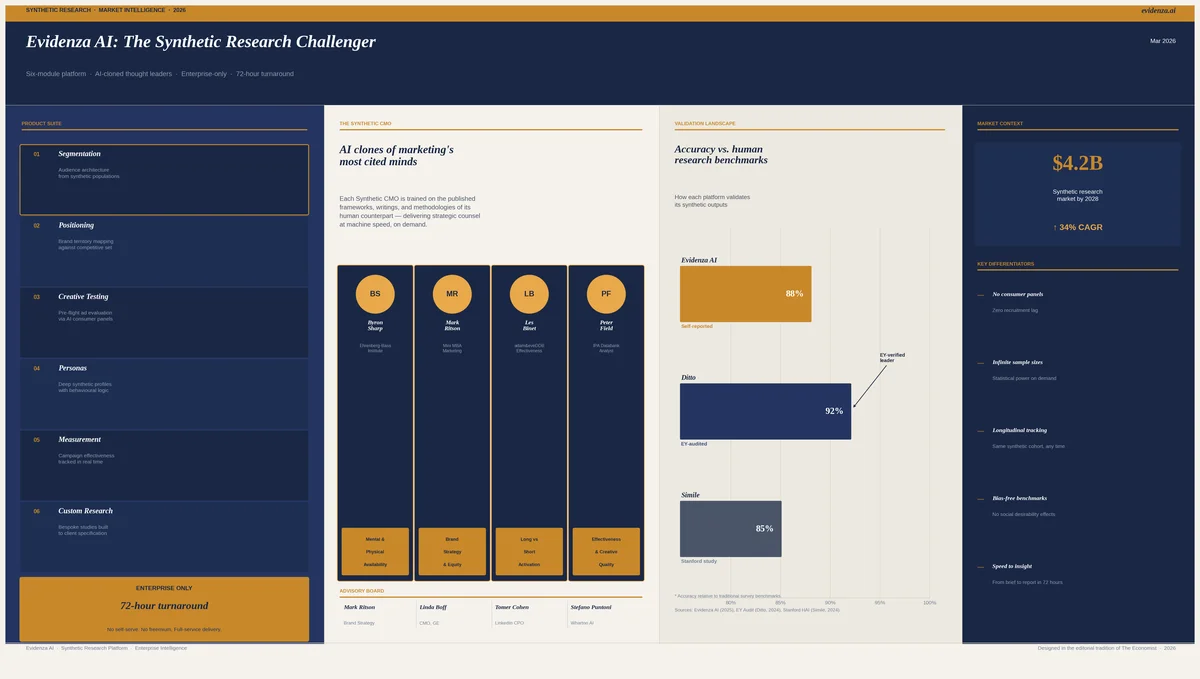
Evidenza describes itself as an AI-powered market research platform that delivers "human-quality insights at machine speed." The core proposition is six interlocking product modules, each targeting a specific research function that enterprises currently spend weeks or months executing with traditional agencies:
Segmentation: AI-driven audience segmentation that identifies distinct consumer groups and their behavioural drivers
Positioning: Brand positioning analysis using synthetic respondents to test messaging and value propositions
Creative Testing: Pre-launch evaluation of advertising concepts, packaging, and campaign materials
Personas: Or rather, "Impersonas" in Evidenza's terminology. Synthetic customer profiles built from behavioural data, not demographic stereotypes
Measurement: Campaign effectiveness tracking using synthetic panels as a proxy for real-world performance
Custom Research: Bespoke research projects designed for enterprise clients with specific, complex requirements
The naming convention is worth noting. Evidenza uses "Impersonas" rather than personas, which is both a trademark play and a genuine philosophical distinction. Traditional personas are fictional composites. Impersonas, Evidenza claims, are data-driven synthetic representations that behave like real consumers. Whether the distinction is meaningful or merely semantic depends on the underlying model, which Evidenza does not publicly document.
The delivery model is full-service with a 72-hour turnaround. You don't log in, drag sliders, and get results. You brief the Evidenza team, they configure the research, and you receive a polished report three days later. This is a deliberate strategic choice, not a technical limitation, and it shapes everything about who the platform serves and who it doesn't.
The Synthetic CMO: Cloning Marketing's Greatest Minds
This is where Evidenza gets genuinely fascinating. The platform offers what it calls "Synthetic CMOs": AI clones of some of the most influential thinkers in marketing science. We're talking Byron Sharp (author of How Brands Grow), Mark Ritson (Marketing Week columnist and brand strategy authority), Les Binet and Peter Field (the godfathers of effectiveness research). The idea is that you can run your marketing strategy past these synthetic advisors and receive feedback informed by their published thinking.
Let that sink in for a moment. A CMO at a mid-cap FMCG company can, in theory, ask a synthetic Byron Sharp whether their brand-building strategy is consistent with the laws of growth. A media planner can consult a synthetic Binet & Field on the optimal balance between brand and activation spend. It's audacious, slightly absurd, and genuinely compelling all at once.
Now, let's be precise about what this is and isn't. These Synthetic CMOs are trained on the published works, frameworks, and publicly stated positions of these thinkers. They are not neural clones with access to private thinking. If you ask the synthetic Mark Ritson something he's never written about, you'll get an extrapolation, not a revelation. But for organisations that want to pressure-test decisions against established marketing science, it's a clever and potentially valuable tool.
At Ditto, we've taken a different but complementary approach. We don't clone the advisor; we clone the customer. Our synthetic personas represent the people who actually buy the product, grounded in census data and validated against real focus groups. Both approaches have merit. The ideal workflow might well use Evidenza's Synthetic CMO to refine strategy and Ditto's synthetic consumers to validate whether real people would respond as the theory predicts.
The Team and Advisory Board
Evidenza was founded by Jon Lombardo and Peter Weinberg, who spent years at LinkedIn's B2B Institute researching effectiveness in B2B marketing. The B2B Institute produced some of the most widely cited research in modern marketing, including work on the 95-5 rule (95% of B2B buyers aren't in-market at any given time) and the importance of brand building in B2B. Lombardo and Weinberg didn't just work there; they were its intellectual architects.
But it's the advisory board that truly sets Evidenza apart in this market. Consider the roster:
Mark Ritson: Professor of Marketing, brand strategist, Marketing Week columnist. One of the most influential voices in marketing today.
Linda Boff: Former CMO of GE, where she led the company's transformation into a B2B brand powerhouse. Board director at multiple public companies.
Tomer Cohen: Chief Product Officer at LinkedIn. The person responsible for the platform where most B2B marketing happens.
Stefano Puntoni: Professor of Marketing at the Wharton School. One of the leading academic voices on AI in marketing.
This is, without exaggeration, the most impressive advisory board in the synthetic research space. It's a collection of people who don't need to lend their names to anything. When Ritson, Boff, Cohen, and a Wharton professor all back the same platform, it signals something meaningful about the underlying technology and commercial viability.
The B2B Institute pedigree also explains Evidenza's positioning. This is a platform built by people who understand enterprise marketing at a theoretical level. They're not Silicon Valley engineers who stumbled into market research; they're marketing scientists who realised AI could accelerate their discipline.
Validation and Accuracy: The Numbers
Accuracy claims in synthetic research are a minefield. Every platform has a number, and the methodologies behind those numbers vary enormously. Evidenza reports an 88% average similarity between its synthetic research outputs and traditional research results. Let's unpack what that means and, crucially, how it was measured.
The 88% figure appears to be self-reported, based on internal benchmarking across multiple client projects. Evidenza also cites several client-specific validation points:
EY: Described the "correlation" as "very strong." This is a client testimonial, not an independent audit. EY was evaluating the platform as a user, not certifying it as an auditor.
Salesforce: Reported 0.81 correlation between Evidenza's synthetic research and traditional research findings.
Dentsu: Achieved 0.87 correlation in a comparative study.
These are credible data points from credible organisations. But context matters. Compare with other platforms in the 2026 synthetic research landscape:
Ditto: 92% overlap with traditional focus groups, independently audited by EY across 50+ parallel studies. The distinction between self-reported and independently audited is significant.
Simile: 85% accuracy replicating General Social Survey responses, published in peer-reviewed research. (See our full Simile review.)
Aaru: 90% median correlation in EY's Global Wealth Research Report recreation.
The honest assessment: Evidenza's validation data is solid but not independently audited at the level a sceptic would demand. An 88% similarity figure, without published methodology, peer review, or third-party audit, is a marketing claim rather than a scientific finding. That doesn't mean it's wrong. It means we can't verify it with the same confidence as figures that have been independently tested.
Evidenza would strengthen its position considerably by commissioning an independent audit. The clients are clearly impressed. The question is whether that impression can be formalised into something the broader market can evaluate.
The Enterprise-Only Model
Evidenza's delivery model is, by design, the opposite of self-serve. There is no public signup page. There is no API. There is no free trial, no freemium tier, no "start a study in 60 seconds" onboarding flow. You contact the team, brief them on your research needs, and receive results in approximately 72 hours.
This is a perfectly legitimate business model. McKinsey doesn't offer a self-serve strategy tool. Investment banks don't have a "build your own M&A model" web app. Full-service research has existed for decades because some problems genuinely benefit from expert configuration, thoughtful methodology design, and polished deliverables.
The question is whether the market is moving away from this model. The trend data suggests it is. Synthetic market research exists precisely because traditional research is too slow and too expensive for the pace of modern business. If your synthetic platform still requires a 72-hour turnaround and a sales conversation to access, you've solved the cost problem but not the speed problem.
For comparison, Ditto delivers results in minutes through a self-serve platform with a full API. Users can create a study, recruit synthetic personas, ask questions, and receive analysed insights without ever speaking to a human. Both models have their place. Complex enterprise research with high stakes arguably benefits from the Evidenza approach. A product manager who needs quick consumer sentiment on a packaging change at 3pm on a Thursday does not.
The absence of an API is particularly notable. In 2026, enterprise software without API access is an increasingly hard sell. Product teams want to embed research into their workflows, trigger studies from Slack or Jira, pipe results into dashboards. Evidenza's current architecture doesn't support any of this. It's a consulting engagement disguised as a software product, and that's a constraint that will matter more as the market matures.
The Dentsu Partnership
Evidenza's partnership with Dentsu, the world's largest media agency network by some measures, is strategically significant. Dentsu reported 0.87 correlation between Evidenza outputs and traditional research, and the partnership gives Evidenza distribution through Dentsu's global client base.
This is smart for both parties. Dentsu gets to offer clients a faster, cheaper alternative to traditional research without building the technology in-house. Evidenza gets access to a pipeline of Fortune 500 research briefs without a direct enterprise sales team. The 72-hour turnaround model also aligns well with agency workflows, where projects are typically briefed and managed by account teams rather than executed self-serve by clients.
For the broader market, the Dentsu partnership signals that traditional research agencies see synthetic platforms as complementary tools rather than existential threats. This is important. The biggest risk to synthetic research adoption isn't technology; it's institutional resistance from the research establishment. When Dentsu embraces synthetic research, it gives permission for every other agency to do the same.
Pricing: What Does Evidenza Cost?
Evidenza does not publish pricing. There is no pricing page on the website, no indicative tiers, no "starting at" figure. Access requires a direct conversation with the sales team.
Based on Evidenza's client profile (BlackRock, Microsoft, JP Morgan, Dentsu, Salesforce), its enterprise-only delivery model, and its positioning as a full-service research platform, we estimate annual contracts in the range of $50,000 to $100,000 per year. This is consistent with the pricing of other full-service enterprise research platforms and reflects the bespoke, consultative nature of the engagement.
For context across the synthetic research market:
Enterprise full-service (Evidenza, Aaru): Estimated $50,000-$100,000+/year, no self-serve
Professional self-serve (Ditto): $50,000-$75,000/year with unlimited studies, full API, minutes to results
Mid-market tools (Quantilope, Remesh): $22,000+/year
Pay-per-respondent (Synthetic Users): $2-$27 per synthetic respondent
Budget options (Artificial Societies): Free to $40/month
The lack of transparent pricing is a friction point. Enterprise buyers are accustomed to opaque pricing in software, but the synthetic research market is young enough that pricing transparency could be a competitive advantage. Buyers evaluating multiple platforms will naturally gravitate toward the ones that let them understand costs before committing to a sales process.
Strengths and Limitations
Where Evidenza Excels
Client list: BlackRock, Microsoft, JP Morgan, Salesforce, Dentsu. These are not speculative logos. These are organisations that do not adopt tools lightly.
Advisory board: Ritson, Boff, Cohen, Puntoni. The most impressive collection of marketing and AI talent advising any platform in this space.
Thought leadership: The B2B Institute background means Evidenza's founders understand marketing science at a level most tech founders don't. They're not guessing what marketers need; they've spent careers researching it.
Bootstrapped profitability: In a market where competitors have raised $100M+ and are still burning cash, Evidenza is profitable with $0 in external funding. That's not just impressive; it's a signal of genuine product-market fit.
The Synthetic CMO concept: Genuinely novel. No other platform offers AI clones of specific marketing thinkers. It's clever, differentiated, and addresses a real need for strategic pressure-testing.
Where Evidenza Falls Short
No self-serve access: In a market trending toward instant, self-serve research, Evidenza's 72-hour, brief-the-team model feels increasingly out of step.
No API: Enterprise software without API access limits integration into modern product and marketing workflows.
B2B-centric: The team's B2B Institute heritage is a strength for B2B use cases but may limit appeal for consumer brands, FMCG, and other B2C verticals.
Opaque pricing: No public pricing creates friction for buyers comparing platforms. Transparency would help, not hurt.
72-hour turnaround: Three days is faster than traditional research but dramatically slower than platforms that deliver in minutes. For time-sensitive decisions, this is a dealbreaker.
Validation methodology: The 88% figure needs independent verification. Self-reported accuracy, however credible the clients citing it, is not the same as an independent audit.
The Bottom Line
Evidenza is the enterprise incumbent of synthetic research. It's built by marketing scientists, advised by marketing legends, and used by some of the world's largest organisations. The Synthetic CMO concept is genuinely innovative. The bootstrapped profitability is genuinely impressive. The Dentsu partnership is genuinely strategic. There are a lot of genuine things to admire here.
But the market is moving fast, and Evidenza's full-service model is a double-edged sword. If you're a Fortune 500 CMO with a six-figure research budget and the patience for a 72-hour turnaround, Evidenza is compelling. The advisory board alone signals that this is a serious platform built by serious people.
If you need speed, self-serve access, API integration, or use cases beyond B2B marketing, the fit is less obvious. Platforms like Ditto offer results in minutes with full API access and published, independently audited validation. Simile brings Stanford-grade behavioural science with a $100M war chest. The market has options, and the right choice depends on your specific needs, budget, and tolerance for turnaround time.
What's clear is that synthetic research is no longer experimental. When BlackRock and JP Morgan are using it, the debate about whether it works has effectively ended. The remaining questions are about how it works best, for whom, and at what price. Evidenza has answered those questions for the enterprise segment. Whether it can expand beyond that segment, or whether it even wants to, will determine its trajectory in the years ahead.
Phillip Gales is co-founder at Ditto, the synthetic market research platform. For an overview of the full market, see our 2026 Market Map and Buyer's Guide.