
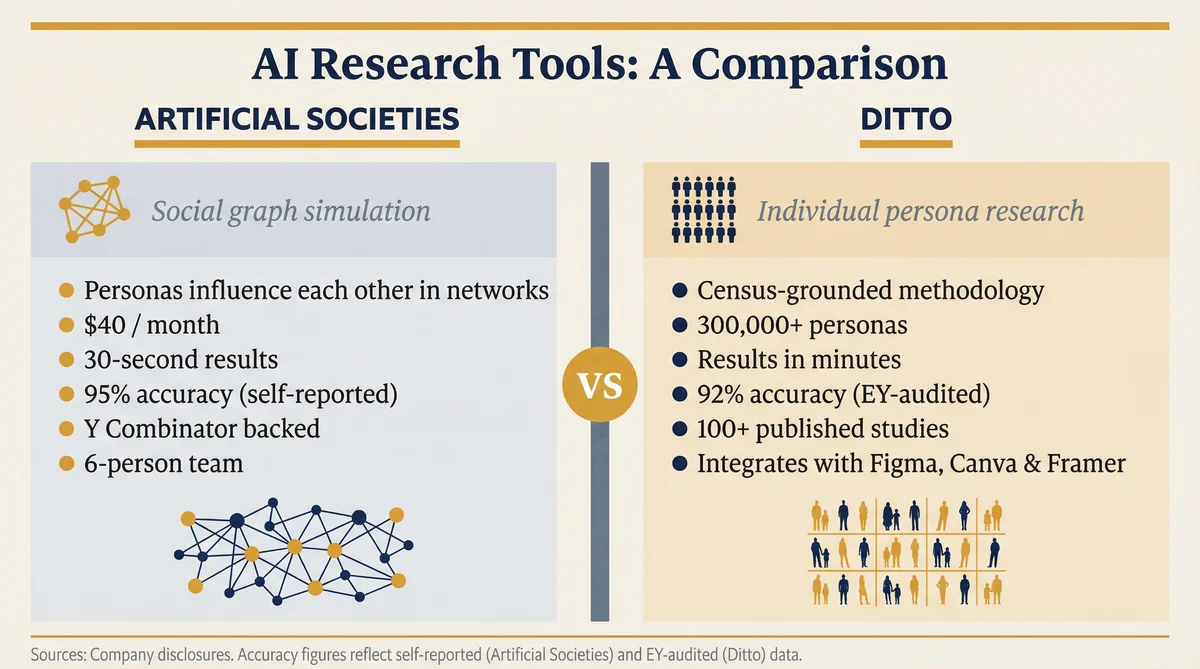
Two companies. The same question. Radically different answers. Both Artificial Societies and Ditto set out to replace traditional consumer research with synthetic alternatives, AI personas that stand in for real respondents. But where Artificial Societies builds networks of personas that argue, influence, and persuade one another in simulated social graphs, Ditto interrogates individual personas one at a time, each grounded in census-weighted demographic data and validated against real-world focus groups. One platform models the crowd. The other models the person. The distinction sounds academic. It is anything but.
This is a head-to-head comparison of the two platforms across every dimension that matters to a buyer: validation methodology, pricing, use cases, track record, API maturity, and geographic coverage. I have tried to be fair. I have not always succeeded, because I co-founded one of the two companies under discussion, and intellectual honesty requires me to say so before we go any further.
A note on bias
I am a co-founder at Ditto. I have a direct commercial interest in the outcome of any comparison between Ditto and its competitors. I have attempted to write this piece as I would want a competitor to write about us: honestly, with credit where it is due, and with the data laid out plainly enough that you can disagree with my interpretation. Where Artificial Societies wins, I will say so. Where the evidence is ambiguous, I will say that too. If you think I have been unfair anywhere in what follows, I would genuinely welcome the correction.
The Philosophical Divide: Networks vs Individuals
The fundamental disagreement between these two platforms is not about pricing or features. It is about how human beings form opinions.
Artificial Societies, built on James He's Cambridge doctoral research and published in the British Journal of Psychology, operates on the premise that opinions are social phenomena. People do not decide what they think about a product, a policy, or a brand in isolation. They are influenced by peers, shaped by social media exposure, and nudged by the slow drift of consensus within their networks. The platform therefore constructs networks of 300 to 5,000+ AI personas that interact with one another before delivering their responses. A simulated consumer in this framework has not merely been asked a question; she has discussed it with her simulated neighbours, been exposed to their arguments, and arrived at a view that reflects the social dynamics of her network.
Ditto takes the opposing view, or rather, a different view entirely. Each persona is constructed as a distinct individual, grounded in census data and demographic distributions, and responds independently. The persona does not know what her neighbours think because she has no neighbours. Her responses reflect her own constructed identity: her age, income, location, values, media consumption, and life stage. The platform's thesis is that depth of individual characterisation, not breadth of social interaction, is what makes synthetic research commercially useful.
Neither approach is wrong. They are answers to different questions. If you want to know how a message will spread through a population, you need a network. If you want to know how a specific customer segment will react to a price increase, you need well-characterised individuals. The trouble starts when either platform claims to do both equally well.
Head-to-Head Comparison
Validation
Artificial Societies claims 95% of human self-replication level, supported by James He's published research and presentations at IC2S2 2024 (the International Conference on Computational Social Science). The academic credentials are real. The limitation is that the commercial accuracy claims have not been independently audited by a third party. The 95% figure is self-reported.
Ditto claims 92% overlap with traditional focus groups, audited by EY across 50+ parallel studies. The EY verification means the accuracy claim has been tested under commercial conditions by an independent auditor, not merely reported by the company that produced it.
The raw numbers favour Artificial Societies (95% vs 92%). The methodology favours Ditto (independently audited vs self-reported). A buyer must decide which they trust more: a higher number or a verified one. For context, Simile cites 85% accuracy from a Stanford peer-reviewed paper, and Evidenza claims 88%, also self-reported. The entire field is still maturing its approach to validation.
Approach
Artificial Societies: Social graph simulation. Personas are constructed from publicly available social media profiles and placed into networks where they influence one another. The platform models how ideas propagate, how opinions cluster and polarise, and how consensus emerges or fractures. This is strongest for research questions involving social dynamics: virality, message spread, opinion formation, and public sentiment shifts.
Ditto: Individual persona responses. Personas are grounded in census data and demographic distributions, each responding independently to research questions. The platform integrates with design tools (Figma, Canva, Framer) for in-context product testing. This is strongest for consumer research questions: product concepts, pricing sensitivity, brand positioning, and landing page optimisation.
Pricing
This is where Artificial Societies wins most decisively, and credit is due. Their pricing is genuinely aggressive:
Artificial Societies: Free tier (3 credits), then $40/month for unlimited simulations. That is $480 per year for unlimited use.
Ditto: Enterprise pricing in the $50,000 to $75,000 per year range, with unlimited studies included.
The gap is not subtle. At roughly 100x the price, Ditto must justify itself on depth, validation, integrations, and support rather than accessibility. For solo researchers, startups, academics, and anyone who wants to experiment with synthetic research without a procurement process, Artificial Societies is the obvious entry point. The question, as with any dramatic price differential, is whether $40 per month delivers comparable insight to $50,000 per year. For social dynamics research, it may well do. For deep consumer research with design tool integrations and audited validation, the comparison becomes less straightforward.
Speed
Artificial Societies: Approximately 30 seconds for self-serve simulations. The Radiant enterprise product takes up to 24 hours for larger, more complex simulations of 300 to 5,000+ personas.
Ditto: Minutes per study, depending on group size and question count. A typical 10-persona, 7-question study completes in 3 to 8 minutes.
For iterative testing, where speed of feedback matters more than depth of analysis, Artificial Societies' 30-second turnaround is a meaningful advantage. It is fast enough to integrate into a real-time workflow rather than treating research as a separate project.
Use Cases
Artificial Societies is purpose-built for social dynamics research: predicting social media virality, modelling message propagation through populations, forecasting public opinion shifts, understanding word-of-mouth effects, and simulating how strategic communications will land with specific audiences. The Radiant enterprise product targets Fortune 100 communications teams who need to model "unreachable audiences" such as policymakers and C-suite executives.
Ditto covers a broader range of use cases: consumer product research, CPG brand testing, pricing analysis, landing page optimisation, voter research and political polling, product-market fit validation, and B2C customer feedback. The platform's integrations with Figma, Canva, and Framer position it for product and design teams who want feedback inside their existing tools.
Track Record
Artificial Societies: 15,000+ users, 100,000+ simulations, 18 million+ responses generated. One named enterprise customer (Teneo, the global CEO advisory firm). The platform launched publicly in late 2025.
Ditto: 100+ published research studies, with named clients across CPG, B2C technology, political campaigns, and startup due diligence. EY validation partnership. Integration partnerships with Figma, Canva, and Framer.
Artificial Societies' aggregate numbers are impressive for a company barely six months old. The gap is in verifiable evidence: one named customer out of 15,000 users leaves enterprise buyers with limited reference points. Ditto's published study library and named integrations provide more tangible proof of commercial deployment, though at a fraction of the user volume.
Content and Thought Leadership
Artificial Societies' public content footprint is minimal. The company blog is sparse, educational materials are limited, and there is little in the way of publicly available methodology documentation. For a platform grounded in genuinely interesting academic research, this is a missed opportunity.
Ditto publishes extensively: research study articles, competitor reviews, market comparisons, methodology guides, and SEO-optimised content designed to educate the market on synthetic research as a category. Whether this reflects deeper commitment to the space or simply more marketing resource is a matter of interpretation.
API Maturity
Both platforms offer API access, but at different levels of maturity. Ditto's API supports full programmatic workflows: group creation with demographic filters, study design, question submission, asynchronous polling, study completion, and shareable link generation. Artificial Societies offers API access, though public documentation is more limited. For teams building automated research pipelines, API depth matters.
Country Coverage
Artificial Societies: Claims global coverage through social media-sourced personas. The depth and reliability of coverage varies by the availability of public social media data in each market.
Ditto: Explicit coverage of the USA, UK, Canada, and Germany, with census-grounded persona data for each. State-level filtering is available for US markets (e.g., Michigan voters, Texas consumers).
Where Artificial Societies Wins
Fairness demands plainness. Here is where Artificial Societies holds genuine advantages:
Social graph novelty. No other synthetic research platform models how opinions propagate through networks. This is not marketing differentiation for its own sake; it represents a fundamentally different theory of how people form views, grounded in James He's published Cambridge research. For social dynamics questions, this approach is arguably superior to individual persona models.
Pricing. $40 per month for unlimited simulations is extraordinary. It democratises access to synthetic research in a way that no other platform has attempted. The entire field benefits when the barrier to experimentation drops to the cost of a modest subscription.
Speed. Thirty-second results make Artificial Societies fast enough for real-time iterative testing. This is meaningfully different from platforms that take minutes or hours to return results.
Academic pedigree. The British Journal of Psychology publication and the IC2S2 presentations provide genuine intellectual credibility. This is peer-reviewed social science, not marketing copy dressed up as methodology.
Low-stakes experimentation. The combination of aggressive pricing and fast turnaround means a researcher can run dozens of exploratory simulations in an afternoon at negligible cost. For hypothesis generation and rapid iteration, this workflow is compelling.
Where Ditto Wins
Independent validation. The EY audit across 50+ parallel studies provides a level of third-party verification that no other platform in the market currently matches. For enterprise buyers who need to justify synthetic research to internal stakeholders, independently audited accuracy is a fundamentally different proposition from self-reported metrics.
Breadth of use cases. Consumer product testing, CPG research, voter polling, landing page optimisation, pricing analysis, and startup due diligence. Ditto's individual persona model is domain-agnostic in a way that social graph simulation is not.
Design tool integrations. Native integrations with Figma, Canva, and Framer mean product teams can gather synthetic feedback without leaving their design environment. Artificial Societies has no comparable integration story.
Published track record. Over 100 published research studies across multiple industries and use cases. Named clients. Public methodology. The evidence base for commercial viability is substantially deeper.
Census-grounded personas. Ditto's personas are built from census data and demographic distributions, which provides more reliable coverage of populations that are underrepresented on social media: elderly consumers, rural demographics, offline-first communities, and developing markets.
State-level political research. For US political campaigns and voter research, Ditto offers state-filtered persona groups (e.g., Michigan voters, Pennsylvania swing voters) grounded in census data rather than social media activity. This is a meaningful differentiator for political use cases.
The Validation Gap
This deserves its own section because it is the single most important consideration for any serious buyer. Validation in synthetic research is not a solved problem. The entire field is young, and the methodologies for proving that AI personas reliably simulate human responses are still evolving.
Artificial Societies' 95% figure comes from academic work that has been peer-reviewed and published. This is more rigorous than a marketing claim, but it is not the same as a commercial audit. Peer review confirms that the methodology is sound and the results are reproducible under the conditions described in the paper. It does not confirm that the commercial platform delivers the same accuracy across the full range of research questions that paying customers will ask.
Ditto's 92% figure comes from an EY audit conducted under commercial conditions across 50+ parallel studies comparing synthetic responses to traditional focus group results. This is less flattering as a headline number but more useful as a buying signal, because it tells you what the platform actually delivers in practice rather than what it achieves under controlled experimental conditions.
Neither approach is perfect. The ideal would be continuous, independent, real-time validation published openly. No platform in the market offers this yet. But the gap between "peer-reviewed academic paper" and "independent commercial audit" is one that buyers should understand clearly.
The Track Record Gap
Artificial Societies has been publicly available for approximately six months. Ditto has been operating for considerably longer. Comparing track records across different time horizons is inherently unfair, and I want to acknowledge that before making the comparison anyway.
Artificial Societies names one enterprise customer: Teneo. They claim 15,000 users and 100,000 simulations, which suggests strong self-serve adoption at the $40 price point. But the gap between aggregate usage metrics and verifiable enterprise evidence is wide. An enterprise buyer evaluating Artificial Societies today has limited reference customers to speak with, limited case studies to review, and limited public evidence of the platform being used in high-stakes commercial decisions.
Ditto has published over 100 research studies spanning CPG, B2C technology, political campaigns, and startup customer diligence. The EY partnership provides institutional credibility. The integration partnerships with Figma, Canva, and Framer demonstrate commercial adoption by product and design teams.
Time will narrow this gap. Artificial Societies is a Y Combinator company with $5.85 million in seed funding from Point72 Ventures. They have the capital and the network to build enterprise traction if the product delivers. But as of early 2026, the evidence base favours Ditto by a considerable margin.
Who Should Choose Artificial Societies
Communications and PR teams who need to model how a message will spread through a population, predict social media response, or simulate public opinion dynamics. The social graph layer is purpose-built for these questions.
Solo researchers and academics who want to experiment with synthetic research at minimal cost. At $40 per month, the financial barrier is effectively zero.
Social media strategists who need to predict engagement, virality, and audience reaction to content. The R² = 0.78 LinkedIn engagement prediction suggests real predictive power for social platform behaviour.
Early-stage startups that need directional consumer signal without the budget for enterprise research tools. The combination of speed and price makes it viable for rapid hypothesis testing.
Anyone curious about synthetic research who wants to understand the category before committing to an enterprise contract. Artificial Societies is the lowest-risk way to get started.
Who Should Choose Ditto
Consumer product teams who need to test product concepts, pricing, packaging, and positioning with demographically representative personas. Census-grounded individual personas are better suited to these questions than social graph simulations.
CPG brands that want to understand consumer reaction to new products, brand extensions, or market entry strategies. Ditto's published CPG research library demonstrates domain expertise.
Product and design teams who work in Figma, Canva, or Framer and want synthetic feedback integrated into their existing workflows. No other platform offers comparable design tool integrations.
Political campaigns that need state-level voter research with census-grounded demographic accuracy. The state-filtered persona groups provide more reliable political research than social media-sourced alternatives.
Enterprise buyers who need independently validated accuracy, named reference customers, and an established track record before presenting synthetic research to internal stakeholders. The EY audit and 100+ published studies provide institutional credibility that a six-month-old platform cannot yet match.
Venture capital firms conducting startup customer diligence who need structured, defensible consumer research to support investment decisions.
The Verdict
These are not interchangeable products. They are different tools built on different theories of how synthetic research should work, and they serve different buyers well.
Artificial Societies is the more intellectually ambitious platform. The social graph thesis is genuinely novel, the pricing is category-defining, and the academic foundations are real. If your research questions are fundamentally about social dynamics, how ideas spread, how opinions form in populations, how messages land in networked communities, then Artificial Societies offers something no other platform can match. The trade-offs are equally clear: self-reported validation, one named enterprise customer, limited content, and persona sourcing that skews toward digitally active populations.
Ditto is the more commercially proven platform. The EY-audited validation, the 100+ published studies, the design tool integrations, and the breadth of use cases provide a foundation of evidence that enterprise buyers can evaluate concretely. The trade-off is price: at roughly 100 times the cost of Artificial Societies' self-serve plan, Ditto must justify itself on depth, reliability, and integration rather than accessibility.
The honest answer for most buyers is that these platforms are complementary rather than competitive. A communications team modelling message propagation and a product team testing landing page copy are asking fundamentally different questions. The fact that both questions can now be answered with synthetic research, at price points ranging from $40 per month to $75,000 per year, is the real story. The market is growing fast enough to accommodate both approaches. Whether it will continue to do so is a question for the next review.
Phillip Gales is co-founder at Ditto, a synthetic market research platform. For a broader view of the market, see our four-way platform comparison and the 2026 synthetic research market map.