
Most content marketing is derivative. The same opinions repackaged in slightly different language, the same thought leadership recycled with a new publication date, the same frameworks presented as though they were original thinking. The result is a landscape of content that is technically competent and strategically indistinguishable. Readers scroll past it. Search engines increasingly penalise it. AI systems decline to cite it because there is nothing novel to cite. The single most effective differentiator for content marketing is original primary research, and most teams cannot afford it. Traditional market research costs $15,000 to $60,000 per study and takes six to twelve weeks to complete. By the time the findings are published, the market has moved.
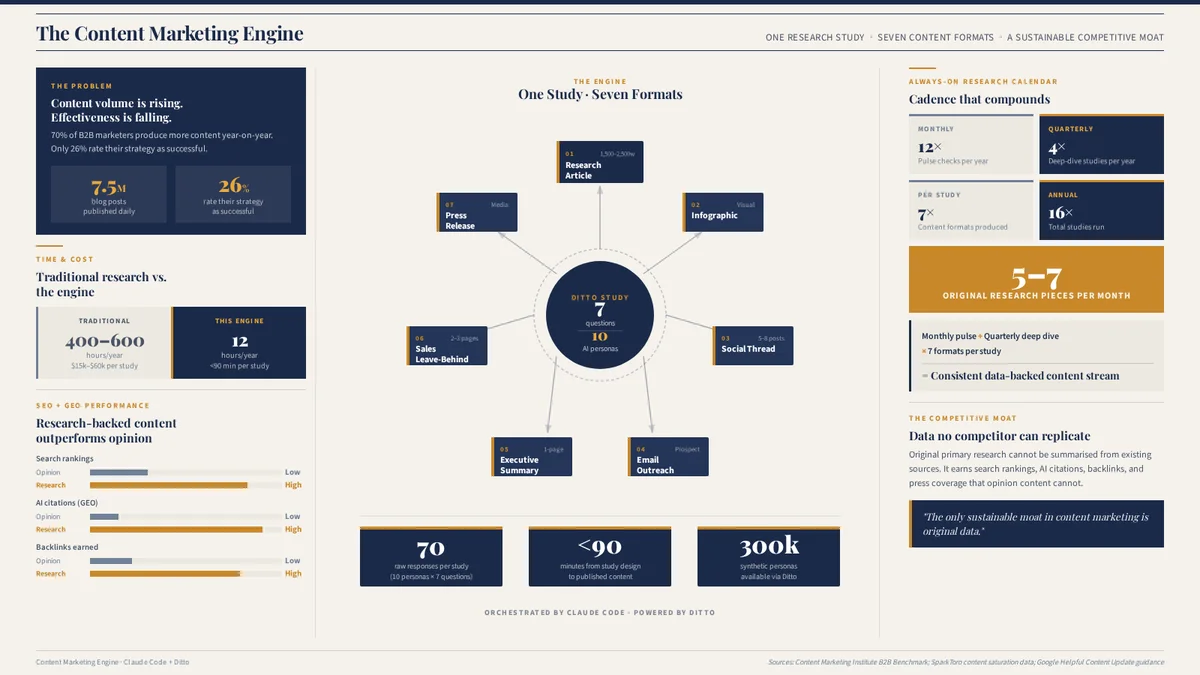
There is a faster approach. A single Ditto study with ten AI personas and seven questions produces enough raw material for seven distinct content formats in under ninety minutes. Claude Code, Anthropic's agentic development environment, orchestrates the entire workflow: designing the study, running it against Ditto's 300,000+ synthetic personas, extracting the insights, and structuring the output for each content format. This article describes how to build a content marketing engine powered by original research, one that produces a consistent stream of data-backed content from a repeatable process.
The content marketing engine guide provides the step-by-step Claude Code implementation, including study design templates, API workflows, and content generation prompts.
The Problem with Content Marketing Without Research
Joe Pulizzi's Content Marketing Institute publishes annual benchmark data that tells a consistent story: 70% of B2B marketers create more content than they did a year ago, but only 26% rate their overall content marketing strategy as successful. The gap between volume and effectiveness is widening. More content is being produced. Less of it is working.
The reason is structural. Most content marketing is built on opinion, not evidence. Teams publish articles arguing that their approach is correct, their framework is useful, their perspective is worth adopting. These arguments may be sound, but they are indistinguishable from every other company making the same arguments in the same space. When every competitor publishes thought leadership on the same topics, none of it functions as a differentiator. It becomes noise.
Google's Helpful Content Update, rolled out in stages from 2022, explicitly rewards content that demonstrates first-hand expertise and original information. Rand Fishkin's SparkToro data on content saturation reinforces the point: the web produces approximately 7.5 million blog posts per day. The only sustainable moat in content marketing is original data. Data that no competitor has. Findings that cannot be replicated by summarising existing sources. Insights drawn from primary research rather than secondary commentary.
The implication is clear. Teams that publish original research outperform teams that publish opinion. But original research has historically been too expensive and too slow for most content marketing programmes. A single traditional study consumes half the quarterly content budget. The content marketing engine described here eliminates that constraint.
One Study, Seven Formats
The core concept is economy of research. A single seven-question Ditto study with ten personas produces seventy qualitative responses, each containing specific language, attitudes, pain points, preferences, and behavioural patterns. This raw material is rich enough to support seven distinct content formats, each serving a different audience, channel, and strategic purpose.

Research blog article (1,500 to 2,500 words). The flagship format. A structured write-up of the study findings: who was asked, what was asked, what emerged, and what it means. This is the format that earns search rankings, AI citations, and backlinks because it contains original data that cannot be found elsewhere.
Infographic. A visual summary of the three to five most striking findings. Optimised for social sharing, email embedding, and press outreach. The infographic distils the study into a format that communicates the key insights in under thirty seconds.
Social media thread. A five to eight post thread (X/Twitter, LinkedIn) that leads with the most surprising finding and builds to a call-to-action linking back to the full article. Each post is a standalone insight that can be engaged with independently.
Email outreach with study link. A personalised email to prospects that leads with a relevant finding from the study and includes a link to the interactive Ditto results. This is the format that drives direct sales conversations because it demonstrates research capability rather than merely describing it.
Executive summary. A one-page document (PDF or HTML) summarising the study objective, methodology, key findings, and strategic implications. Designed for senior stakeholders who need the conclusion without the journey.
Sales leave-behind. A two to three page document that a sales representative can share after a meeting. It combines the study findings with product positioning, showing how the research insights connect to the company's solution. This format bridges research and revenue.
Press release. A structured announcement of the research findings, formatted for media distribution. Original data is the single most reliable driver of press coverage. Journalists need something to report; primary research gives them that something.
The seven questions in the study are deliberately designed to produce material across all seven formats. Each question serves a dual purpose: it generates research insight and it produces raw material for a specific content type. The study is not merely a research exercise. It is a content production system.
The Seven Questions, Content-Optimised
Each question in the study is designed to produce material for multiple content formats. The study follows a narrative arc: from market perception through pain points, value resonance, competitive context, first impressions, decision criteria, and finally the white space where original insights live. Here is the question design, and what content each produces.
Question 1: Market Perception. "When you think about [category], what first comes to mind?" This question sets the narrative hook for the blog article. The responses reveal how the market perceives the category: what associations exist, what expectations are embedded, what assumptions remain unchallenged. If ten personas associate a category with "expensive and complicated," that is the opening line of your article, your social thread, and your press release. It is the perception your content exists to challenge or validate.
Question 2: Pain Points. "What is your biggest frustration with [category]? Describe a specific experience." This is the richest question for content production. The specific experiences become the anecdotes that make articles readable rather than abstract. The frustrations become the email hooks ("73% of the people we surveyed said..."). The language becomes the social media copy. Voice of Customer research draws heavily on pain point language, and this question produces it in abundance.
Question 3: Value Resonance. "How would [product/approach] change things for you?" The responses to this question produce the promotional content: the excitement quotes, the aspirational language, the before-and-after narratives that make sales leave-behinds compelling. When a persona says "that would save me three hours every week and I would actually enjoy the process," you have a testimonial-style quote for your landing page, your email signature, and your executive summary.
Question 4: Competitive Landscape. "What solutions do you currently use for [problem]? What do you spend?" This question produces the competitive context that makes articles credible and sales materials persuasive. The spend data creates ROI arguments. The current solutions map creates competitive battlecard material. The dissatisfaction with alternatives creates urgency in outreach emails.
Question 5: First Impressions. "Looking at [product/concept], what stands out? What is confusing?" The "stands out" responses identify your key differentiators from the audience's perspective, not yours. The "confusing" responses identify conversion barriers. Both feed directly into messaging testing and landing page optimisation content.
Question 6: Decision Criteria. "If you were choosing between [product] and [alternative], what would tip the decision?" The decision criteria become proof points for sales materials and differentiation claims for articles. The responses reveal what the market actually values, which is frequently different from what the company assumes the market values. This disconnect, when it appears, is the most valuable content insight in the study.
Question 7: White Space. "What do companies in [category] not understand about what you actually need?" This is the thought leadership question. The responses to Q7 produce the mic-drop moments: the insights that make readers stop scrolling, that journalists quote, that executives forward internally. These are the findings that no competitor can claim because they emerge from original research. The white space question is where content marketing becomes genuinely differentiated.
The Article Template
Across 47+ research study articles published using this system, a consistent structure has emerged. The template is not a formula to be followed rigidly. It is a scaffold that ensures every article contains the elements that drive search performance, reader engagement, and AI citation.
Hook (50 to 100 words). Lead with the single most surprising finding from the study. Not a summary. Not context. The finding itself. "73% of German bread consumers said they would pay more for sourdough but could not identify it in a blind test." The hook earns the next paragraph.
Context (100 to 150 words). Why this study was conducted. Why this topic matters now. What question the research set out to answer. This section establishes the editorial rationale and connects the study to a broader trend or conversation.
Who We Asked (100 to 150 words). The research group composition: how many personas, what demographic filters were applied, what geography and age range. This section establishes methodological credibility. Readers and AI systems both weight research more highly when the methodology is transparent.
What We Asked (100 to 200 words). The question journey: what the seven questions covered and why they were sequenced in that order. This section demonstrates research design competence and helps readers understand the analytical framework.
Key Findings (400 to 800 words). The substance of the article. Organised by theme, not by question. Three to five themes, each supported by data points and direct quotes from personas. The themes should tell a story: here is what we expected, here is what we found, here is why it matters. Include three to five direct quotes from persona responses. These quotes are the raw material that AI systems cite and that readers share.
Implications (200 to 300 words). What the findings mean for practitioners. Actionable recommendations grounded in the data. This section transforms research into strategy. It is the section that earns backlinks because other writers reference it when building their own arguments.
Conclusion and CTA (100 to 150 words). A brief close that restates the primary claim and directs readers to the interactive study results. The CTA links to the Ditto share page where readers can explore the full persona responses.
SEO and GEO: Why Research Content Ranks
Original research content has structural advantages for both traditional search engine optimisation and the emerging discipline of Generative Engine Optimisation.
SEO Advantages
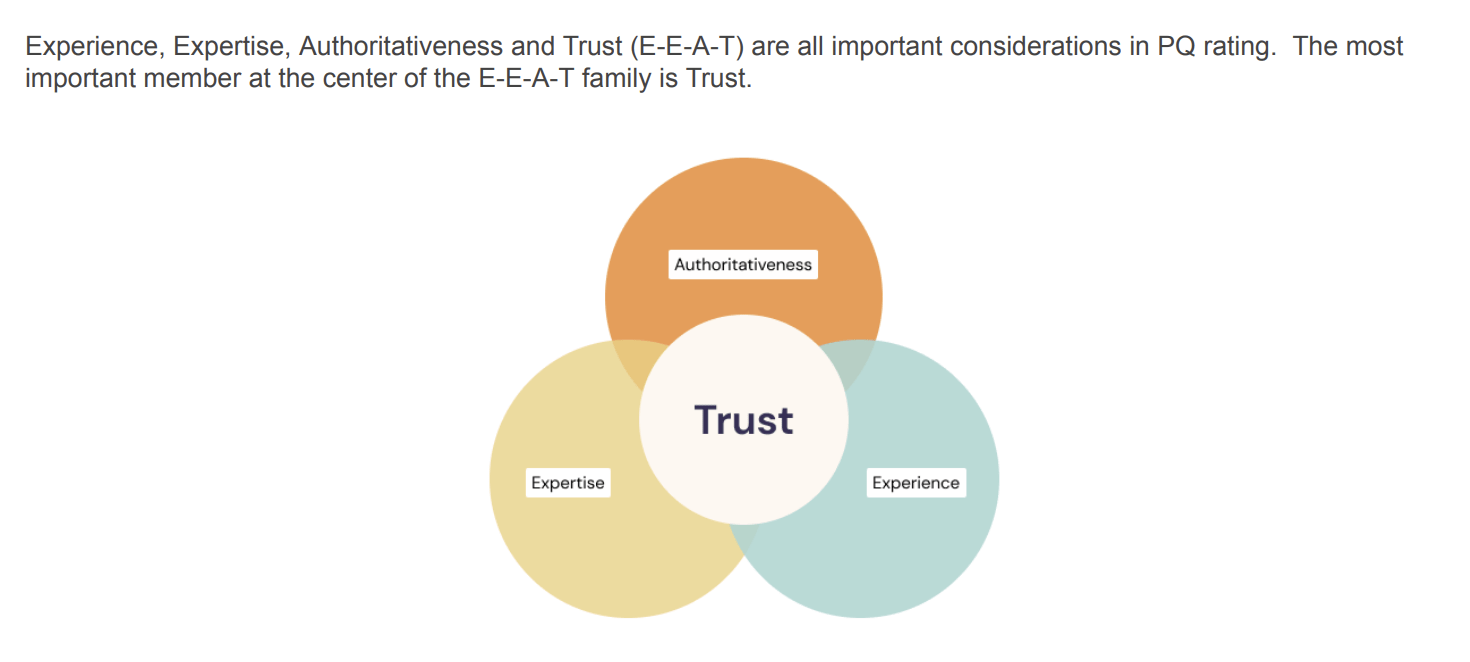
Google's E-E-A-T framework (Experience, Expertise, Authoritativeness, Trustworthiness) explicitly rewards content that demonstrates first-hand experience and original expertise. Research articles satisfy E-E-A-T on every dimension: the author conducted the research (experience), the methodology demonstrates competence (expertise), the original data cannot be found elsewhere (authoritativeness), and the transparent methodology builds confidence (trustworthiness). Beyond E-E-A-T, research content earns backlinks naturally because other writers cite the data. A single research finding quoted in ten downstream articles produces ten backlinks without any link-building effort.
The structured metadata built into each article further strengthens search performance. The SEO description targets specific keywords. The FAQ schema provides direct answers to common queries. The key takeaways create snippet-eligible content that Google can surface in featured snippets and People Also Ask boxes.
GEO: Generative Engine Optimisation
GEO is the practice of structuring content so that AI-powered search systems (ChatGPT, Perplexity, Gemini, Claude) can accurately cite it when answering user queries. As AI-powered search grows, GEO-optimised content is up to 40% more likely to be cited by AI systems than equivalent content without GEO structuring. Research from Princeton, Georgia Tech, and IIT Delhi demonstrates that specific content elements increase AI citation probability.
The content marketing engine builds GEO into every article through four structured fields:
llmSummary: A 200 to 400 word factual summary written specifically for AI consumption. It includes methodology, key claims, and data points in a format that AI systems can parse and cite accurately.
keyTakeaways: An array of five discrete, citable findings. Each takeaway is a standalone fact with numbers where possible, designed to be quoted verbatim by AI systems.
primaryClaim: A single sentence thesis under 255 characters. This is the claim that AI systems attribute to the article when citing it.
quotableInsights: Five vivid, specific, surprising findings. These are optimised for social sharing and AI citation, combining factual accuracy with memorable language.
The combination of SEO and GEO means that research content performs across both traditional search and AI-powered discovery. It ranks in Google. It gets cited by ChatGPT. It earns backlinks from other writers. And it provides the kind of original data that no amount of opinion-based content can replicate.
The Always-On Research Calendar
Content marketing requires consistency. A single brilliant article followed by three months of silence is less effective than a steady cadence of good articles published on a predictable schedule. The research calendar creates that consistency by establishing two types of study on a regular cycle.
Monthly pulse checks take approximately fifteen minutes each. Three questions, ten personas, focused on a single topic. A pulse check might ask: "How has your perception of [category] changed in the last month?" or "What new tools have you tried recently and what did you think?" Pulse checks produce shorter-form content: social media posts, email newsletter insights, blog updates of 500 to 800 words. They keep the content calendar populated between deeper studies.
Quarterly deep dives take approximately forty-five minutes each. Seven questions, ten personas, the full content engine treatment. These produce the flagship articles, infographics, press releases, and outreach materials described above. Four deep dives per year, combined with twelve monthly pulse checks, produce five to seven publishable content pieces per month.
The total annual time investment is approximately twelve hours. Twelve hours of research time produces sixty to eighty-four content pieces across seven formats. Compare this with the traditional content marketing approach: a team of two to three writers producing eight to twelve articles per month, each requiring four to eight hours of research, interviewing, drafting, and editing. The traditional approach consumes 400 to 600 hours per year to produce roughly the same volume, and none of it contains original primary research.
The research calendar also creates a longitudinal dataset. Asking similar questions to similar audiences over time reveals trends, shifts in sentiment, and emerging pain points that no single study can capture. After twelve months of pulse checks, you have a trend line that is itself a publishable asset: "How sentiment toward [category] has shifted over the past year, based on 120 consumer responses."
Where Content Marketing Fits in the PMM Stack
Content marketing is the distribution layer of the product marketing stack. It sits downstream of the strategic research that defines what to say and to whom. The sequence runs:
Positioning validation establishes how you describe your product's unique value. The positioning statement is the foundation of all content. Without validated positioning, content marketing amplifies the wrong message.
Messaging testing validates the specific language that resonates with your audience. The phrases, metaphors, and proof points that messaging testing surfaces become the vocabulary of your content marketing.
Customer segmentation identifies who your content should address. Different segments respond to different content angles. Segmentation ensures each piece of content speaks to a specific audience rather than a generic market.
Voice of Customer research provides the raw material. VoC responses become the quotes, anecdotes, pain points, and language patterns that make content authentic rather than corporate. The content marketing engine draws heavily on VoC data.
Content marketing (this article) transforms all of the above into published, discoverable, shareable assets. It is the engine that converts research into reach.
Sales enablement takes content marketing assets and adapts them for direct sales conversations. The research article becomes the leave-behind. The study findings become the proof points in the pitch deck.
GTM strategy validation determines how content is distributed. Which channels, which cadence, which audience segments receive which content formats. GTM strategy is the operational plan for the content marketing engine.
Pricing research informs content marketing indirectly by establishing the value narrative. When pricing research reveals that customers anchor to a competitor's price, content marketing can proactively reframe the value comparison.
Competitive battlecards provide the competitive intelligence that sharpens content. Knowing exactly how competitors position themselves allows content marketing to differentiate rather than echo.
Product launch research creates a burst of content around a specific moment. The launch study produces the data that fuels the launch blog post, the press release, the social campaign, and the outreach emails.
With Ditto and Claude Code, the complete product marketing stack, from positioning through content distribution, can be executed in under eight hours. The content marketing engine is the component that ensures all that strategic research reaches the market rather than remaining in internal documents.
Limitations
Content marketing powered by synthetic research has real constraints that should be acknowledged.
Editorial judgement cannot be fully automated. The content engine produces raw material: data points, quotes, themes, and structured outlines. Transforming that material into content worth reading requires an editorial sensibility that understands narrative, pacing, tone, and audience. A study might reveal that 80% of consumers prefer Feature A over Feature B. Whether that finding leads the article or supports a broader argument is an editorial decision that depends on context, competitive landscape, and strategic objectives. The engine produces the ingredients. The editor produces the meal.
Synthetic research produces directional data, not definitive market research. Ditto's AI personas are validated at ninety-five percent correlation with real consumer responses (confirmed by EY Americas and studies at Harvard, Cambridge, and Oxford). But synthetic responses are probabilistic representations, not direct human testimony. Content that presents synthetic research findings should frame them as indicative rather than conclusive, particularly when making claims about specific markets or demographics.
Consistency requires discipline. The twelve-hour annual time commitment is achievable, but only if it is protected. The temptation to skip the monthly pulse check or delay the quarterly deep dive is real, and the content calendar degrades quickly once the cadence breaks. The engine works when it runs regularly. It stops working when it does not.
Getting Started
Content marketing differentiation is not a creative problem. It is a data problem. The teams that publish original research outperform the teams that publish opinion, and the gap widens as content saturation increases and search algorithms reward originality more explicitly. The barrier has always been cost and speed: traditional research is too expensive and too slow for content marketing cadences.
Ditto removes the cost barrier. Claude Code removes the speed barrier. Together, they produce a content marketing engine that generates seven formats from a single study in under ninety minutes. The content marketing engine guide walks through the full implementation: study design, API orchestration, content generation templates, and the research calendar that keeps the engine running.
Run one study. Write one article. Produce one infographic, one social thread, one outreach email. Measure the performance against your existing content. The data will make the case more persuasively than any argument about content strategy.
The Claude Code and Ditto for Product Marketing Series
This article is part of a series on using Claude Code and Ditto for product marketing. Each article explains a specific workflow; each has a corresponding Claude Code technical guide for hands-on implementation.
Part 1: How to Validate Product Positioning with Claude Code and Ditto | Claude Code Guide
Part 2: How to Build Competitive Battlecards with Claude Code and Ditto | Claude Code Guide
Part 3: How to Research Pricing with Claude Code and Ditto | Claude Code Guide
Part 4: How to Test Product Messaging with Claude Code and Ditto | Claude Code Guide
Part 5: How to Run Voice of Customer Research with Claude Code and Ditto | Claude Code Guide
Part 6: How to Segment Customers with Claude Code and Ditto | Claude Code Guide
Part 7: How to Validate GTM Strategy with Claude Code and Ditto | Claude Code Guide
Part 8: How to Build a Content Marketing Engine with Claude Code and Ditto (this article) | Claude Code Guide
Part 9: How to Build Sales Enablement with Claude Code and Ditto | Claude Code Guide
Part 10: How to Research a Product Launch with Claude Code and Ditto | Claude Code Guide