
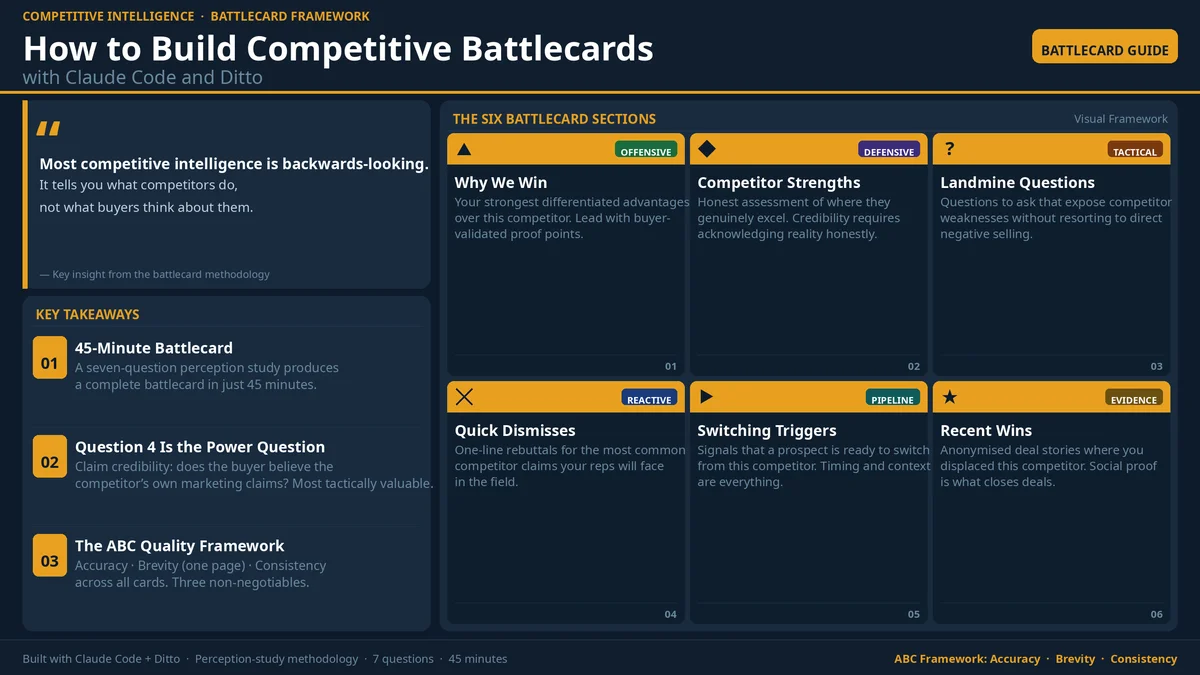
Most competitive intelligence is backwards-looking. Tools such as Klue and Crayon track what competitors do: pricing changes, feature launches, job postings. That information is useful. But it does not tell you the thing that actually decides deals: what buyers think about the competitor. Do they believe the marketing claims? What would trigger a switch? Where do they perceive genuine weakness?
That perception layer is the hardest to obtain. Traditional win/loss interviews take weeks, suffer from small samples, and struggle with recruitment. This guide shows you how to get it in about forty-five minutes, using Claude Code and Ditto's Competitive Intelligence Guide. The output is a finished competitive battlecard, built on what synthetic consumers actually said rather than what your sales team suspects.
This is the second article in a practical series on running product research from your terminal. Each article takes one of Ditto's Claude Code Guides and walks you through exactly what to do as a human to get Claude Code to execute it. The first article covered positioning validation.
Why Customer Perception Beats Competitor Data
The Competitive Intelligence Guide identifies three layers of competitive intelligence. The first two are well served by existing tools:
Layer 1: Data collection tells you what the competitor is. Website changes, feature launches, pricing updates. Klue, Crayon, G2, and SimilarWeb cover this thoroughly.
Layer 2: Business context tells you what the competitor is planning. Hiring patterns signal strategy shifts. Pricing changes signal repositioning. Analyst reports and tools such as Klue handle this adequately.
Layer 3: Customer perception tells you what the market thinks about the competitor. Do buyers believe their claims? What triggers switching? How do they compare you? This is where existing tools fall short.
Layer 3 matters most because 68% of sales opportunities are competitive. In those conversations, the outcome depends on how well your team understands buyer perception, not competitor features. A battlecard built on perception data equips your sales team with language that resonates because it came from the people they are selling to.
What You Need Before You Start
Claude Code installed and working in your terminal. If you do not have it yet, see Anthropic's setup guide.
A Ditto API key. The free tier works for a single-competitor study. Run this in your Claude Code terminal to authenticate:
Get Your API Key
curl -sL https://app.askditto.io/scripts/free-tier-auth.sh | bash
This opens Google sign-in in your browser, captures your API key, and saves it to ~/.ditto_free_tier.env. The script is open and readable.
A clear picture of your competitive landscape. Before you open Claude Code, write down four things:
Your product name and what it does (one sentence)
The specific competitor you want to benchmark against
The competitor's primary marketing claim (the headline on their website, the thing they want buyers to believe)
Your target buyer (job title, company size, or market segment)
You will paste these into your prompt. Claude Code needs them to customise the seven study questions.
A Note on the Free Tier
The free tier gives you approximately twelve personas from a shared US adult panel. This is enough to run a competitive perception study against one competitor and produce a usable battlecard.
The full Competitive Intelligence Guide describes multi-competitor parallel studies (one study per competitor, run simultaneously), quarterly tracking cadences, and claim credibility testing. For those capabilities, you will need a paid Ditto plan which unlocks custom research groups, larger panels, and demographic filtering. The free tier is an excellent starting point; it tells you whether perception-based competitive intelligence is useful for your team before you invest further.
Step 1: Give Claude Code the Guide
Open Claude Code in your terminal. Paste the following prompt, replacing the bracketed sections with your competitive context:
I want to build a competitive battlecard for my product versus a specific competitor, using Ditto's synthetic research API.
My product: [PRODUCT NAME] - [one sentence description]
Competitor: [COMPETITOR NAME]
Their primary marketing claim: "[THE HEADLINE CLAIM FROM THEIR WEBSITE]"
Target buyer: [WHO YOUR BUYER IS]
Please follow this guide exactly:
https://askditto.io/claude-code-guide/competitive-intelligence-guide
Use my Ditto API key from ~/.ditto_free_tier.env
Run the full 7-question competitive perception study with the free tier panel, then generate the complete competitive battlecard.
That is the entire instruction. Claude Code will read the guide, understand the seven-question framework, authenticate with your API key, and execute the study autonomously.
Step 2: What Happens Next
Once you send the prompt, Claude Code works through the guide's workflow:
Researches the competitor (website, pricing page, G2 reviews) to identify their stated positioning and key claims
Creates a research group of ten synthetic personas matching your buyer profile
Asks seven questions sequentially, each targeting a specific competitive intelligence need: brand awareness, head-to-head decision drivers, strengths and weaknesses, claim credibility, proof requirements, switching triggers, and value versus premium positioning
Completes the study and triggers automated analysis
Generates the battlecard structured according to the guide's six-section format
The full cycle takes roughly twenty to forty-five minutes. You do not need to do anything during this time. Claude Code handles the API calls, polling, error handling, and synthesis.
What the Seven Questions Reveal
The guide's study design targets six sections of a standard competitive battlecard. Understanding the mapping helps you interpret results and ask sharper follow-up questions:
Q1: Brand awareness. Which tools come to mind first when personas think about your category? The names they volunteer are your real competitors. If they name someone you never considered, your competitive set is wrong.
Q2: Head-to-head decision drivers. What tips the decision when your product is placed directly against the competitor? Responses favouring you become your "Why We Win" section. Responses favouring the competitor become "Competitor Strengths" with honest talking points.
Q3: One strength, one weakness. The weakness the competitor is cited for becomes the foundation for your landmine questions: high-impact discovery questions that expose competitor gaps without sounding adversarial.
Q4: Claim credibility. The most tactically valuable question. You feed the competitor's primary marketing claim to personas and ask whether they believe it. The reasons for scepticism become your quick-dismiss talking points and discovery questions.
Q5: Proof requirements. What evidence would buyers need to choose you? The delta between what they require and what you can currently demonstrate tells marketing exactly what content to create next.
Q6: Switching triggers. What events create openings: price increases, buggy releases, lost integrations? What barriers slow adoption? Together, these tell you when to reach out and what to bring.
Q7: Value versus premium. If buyers prefer the competitor with unlimited budget but choose you when budget is tight, you have a value perception problem. If the reverse, you have premium positioning to leverage.
Step 3: Reading Your Battlecard
After the study completes, Claude Code will synthesise the responses into a structured battlecard. Ask it to format the output as the guide specifies:
Please give me:
1. The complete competitive battlecard (all six sections)
2. The three most surprising perception findings
3. Specific quotes I can use in sales conversations
4. Recommended landmine questions for discovery calls
The six battlecard sections are:
Why We Win: the top three or four reasons customers choose you, in customer language, with evidence from the study
Competitor Strengths: an honest assessment of where the competitor excels, paired with how to respond when prospects raise these points
Landmine Questions: high-impact questions that expose competitor gaps without sounding adversarial
Quick Dismisses: one or two sentence rebuttals for the competitor's most common claims
Switching Triggers: events and frustrations that create openings, plus barriers to prepare for
Recent Wins: this section is supplemented from your CRM rather than the study
The guide emphasises the ABC quality framework for battlecards: Accuracy (one inaccuracy and the card gets binned), Brevity (one page maximum, scannable in sixty seconds during a live call), and Consistency (standardised format across all competitor cards so reps know where to find each section).
Worked Example: A SaaS Analytics Platform
To make this concrete, here is what the prompt looks like for a fictional product:
I want to build a competitive battlecard for my product versus a specific competitor, using Ditto's synthetic research API.
My product: DataPulse - real-time product analytics for B2B SaaS teams
Competitor: Mixpanel
Their primary marketing claim: "Self-serve analytics that help you convert, engage, and retain more users"
Target buyer: Product managers and growth leads at Series A-C SaaS companies
Please follow this guide exactly:
https://askditto.io/claude-code-guide/competitive-intelligence-guide
Use my Ditto API key from ~/.ditto_free_tier.env
Run the full 7-question competitive perception study with the free tier panel, then generate the complete competitive battlecard.
In a hypothetical study using this prompt, the results might reveal that seven out of ten personas associated Mixpanel primarily with mobile analytics, not general product analytics. The marketing claim about "self-serve" generated moderate scepticism: personas noted that Mixpanel's reporting requires technical setup despite the self-serve positioning. And when asked about switching triggers, the most cited reason was pricing complexity at scale.
Those are three findings that directly shape a battlecard. The competitive landscape question confirms Mixpanel's strongest association (mobile). The claim credibility question surfaces a vulnerability (self-serve positioning versus technical reality). And the switching trigger question identifies when to engage prospects (contract renewal season, after a surprise bill). None of this would surface from tracking Mixpanel's feature releases or job postings.
Going Further
The free tier gives you a usable battlecard against one competitor. If the results prove valuable and you want to scale, the guide describes several advanced techniques available on paid plans:
Multi-competitor parallel studies: run one study per competitor simultaneously. The guide recommends separate studies rather than a single multi-competitor study, because questions reference the specific competitor's name and claims.
Quarterly competitive tracking: repeat the same study every quarter to detect perception shifts. Has the competitor's claim credibility improved? Have new switching triggers emerged? The guide provides a tracking framework for comparing results over time.
Claim credibility deep-dives: isolate a single competitor claim and test it across different buyer segments. Does the "self-serve" claim land differently with technical buyers versus business buyers?
Custom demographic targeting: recruit personas matching your actual ICP by age, employment, education, and location rather than using the shared panel.
You may need to upgrade to a paid tier to perform this work fully. But a single free tier study will tell you whether perception-based competitive intelligence is worth investing in for your team.
What Comes Next
This is the second article in the How To series. Each article takes one of Ditto's Claude Code Guides and shows you, step by step, how to instruct Claude Code to execute it. The first article covered positioning validation. Coming next:
How to Test Product Messaging with Claude Code using the Product Messaging Guide
How to Run Pricing Research with Claude Code using the Pricing Research Guide
How to Build a Customer Segmentation Study with Claude Code using the Customer Segmentation Guide
The guides are written for Claude Code. These articles are written for you.