
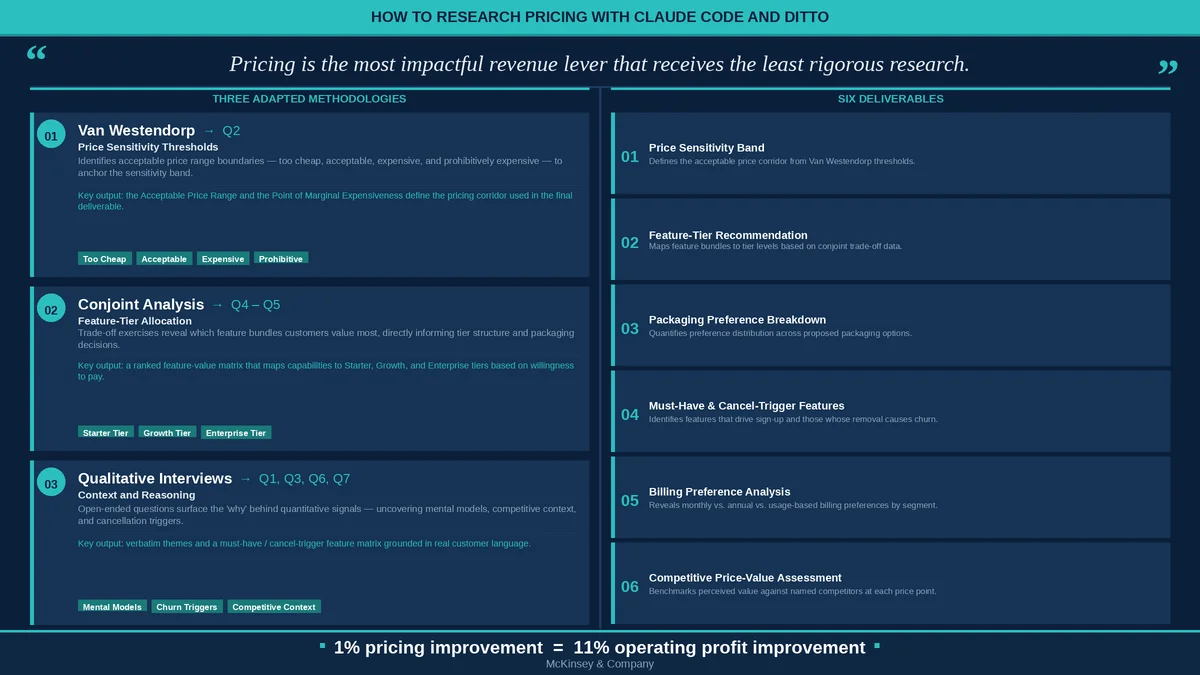
A 1% improvement in pricing yields an 11% improvement in operating profit, according to McKinsey. Yet the average SaaS company spends only six hours on pricing over the lifetime of the product, according to Paddle's pricing research. Pricing is the most impactful revenue lever that receives the least rigorous research.
The root cause is access. Conjoint analysis costs $30,000 to $100,000 and takes four to eight weeks. Simon-Kucher engagements start at six figures. Even a basic Van Westendorp survey needs two to four weeks and 200 respondents. Most companies skip formal pricing research entirely and guess.
This guide shows you how to run a structured pricing study in about thirty minutes, using Claude Code and Ditto's Pricing Research Guide. You will not get a statistically precise optimal price point. You will get something more useful for most pricing decisions: a price sensitivity band, feature-tier preferences, and the qualitative reasoning behind why people react the way they do.
This is the third article in a practical series on running product research from your terminal. Each article takes one of Ditto's Claude Code Guides and walks you through exactly what to do as a human to get Claude Code to execute it. Previous articles covered positioning validation and competitive battlecards.
What This Replaces
The Pricing Research Guide adapts three established pricing methodologies into a single seven-question study:
Van Westendorp Price Sensitivity Meter: developed in 1976, the original asks four questions to map an acceptable price range. The guide adapts this into Question 2, which tests gut reactions to two specific price points and asks for the walk-away threshold. You get the directional signal without needing 200 respondents.
Conjoint analysis: traditionally presents feature-and-price combinations to reveal implicit willingness to pay. The guide adapts this into Questions 4 and 5, which ask directly which features are table-stakes versus premium, and which single feature justifies the subscription.
Qualitative pricing interviews: open-ended conversations about value and price perception. Questions 1, 3, 6, and 7 draw from this tradition, capturing the emotional and contextual dimensions: how people feel about what they pay, what packaging model they prefer, and whether a competitor's lower price would trigger switching.
The key distinction: Ditto pricing studies do not produce a single optimal price point. They produce a price sensitivity band (acceptable range), feature-tier preferences (what goes where), and qualitative reasoning (why). For most pricing decisions, that qualitative depth is more actionable than a precise number with no context.
What You Need Before You Start
Claude Code installed and working in your terminal. If you do not have it yet, see Anthropic's setup guide.
A Ditto API key. The free tier works for a basic pricing test. Run this in your Claude Code terminal to authenticate:
Get Your API Key
curl -sL https://app.askditto.io/scripts/free-tier-auth.sh | bash
This opens Google sign-in in your browser, captures your API key, and saves it to ~/.ditto_free_tier.env. The script is open and readable.
Your product and pricing context. Before you open Claude Code, write down five things:
Your product name and what it does (one sentence)
Two candidate price points you want to test (bracket your expected price: one lower, one higher)
Your feature list (six to eight features covering core, differentiators, and premium add-ons)
Your key differentiator (the feature or capability competitors lack)
Your target buyer (who makes or influences the purchase decision)
Claude Code needs these to customise the seven study questions. The two price points are particularly important: they anchor Question 2 and set the frame for the entire study.
A Note on the Free Tier
The free tier gives you approximately twelve personas from a shared US adult panel. This is enough to run a meaningful pricing study and identify directional patterns in price sensitivity, packaging preferences, and feature-tier allocation.
The full Pricing Research Guide describes cross-segment pricing studies (testing the same price points against different buyer segments), multiple anchor point testing, and feature-tier deep-dives. For those capabilities, you will need a paid Ditto plan which unlocks custom research groups, larger panels, and demographic filtering. The free tier tells you whether this approach to pricing research is useful for your team before you invest further.
Step 1: Give Claude Code the Guide
Open Claude Code in your terminal. Paste the following prompt, replacing the bracketed sections with your pricing context:
I want to research pricing for my product using Ditto's synthetic research API.
My product: [PRODUCT NAME] - [one sentence description]
Price points to test: [PRICE A] (lower) and [PRICE B] (higher)
Key features: [LIST 6-8 FEATURES]
Key differentiator vs competitors: [YOUR UNIQUE FEATURE]
Target buyer: [WHO MAKES THE PURCHASE DECISION]
Please follow this guide exactly:
https://askditto.io/claude-code-guide/pricing-research-guide
Use my Ditto API key from ~/.ditto_free_tier.env
Run the full 7-question pricing study with the free tier panel, then give me the six deliverables.
That is the entire instruction. Claude Code will read the guide, understand the seven-question framework, research your competitors' pricing for context, and execute the study autonomously.
Step 2: What Happens Next
Once you send the prompt, Claude Code works through the guide's workflow:
Researches your product and competitors to identify the competitive price range and set intelligent anchor points for Question 2
Creates a research group of ten synthetic personas matching your buyer profile
Asks seven questions in deliberate sequence: current spend benchmark, price sensitivity, packaging preference, feature-tier allocation, must-have identification, billing preference, and competitive price-value trade-off
Completes the study and triggers automated analysis
Generates the six deliverables specified in the guide
The full cycle takes roughly fifteen to thirty minutes. The question sequence is deliberate: Question 1 establishes current spend context before introducing your pricing. Question 2 tests specific prices while that benchmark is fresh. Questions 3 to 5 explore packaging and features. Question 7 stress-tests against a competitor last, so it does not anchor earlier responses.
What the Seven Questions Reveal
Each question targets a specific dimension of pricing perception. Understanding the mapping helps you interpret results:
Q1: Current spend benchmark. What do personas currently pay for solutions in your category, and how do they feel about it? This establishes the reference frame. If most people pay $50/month and feel it is fair, testing a $500/month price point will trigger sticker shock regardless of your value.
Q2: Price sensitivity and thresholds. Adapted from Van Westendorp. Tests gut reactions to your two candidate price points and asks for the walk-away threshold. The gap between your higher price and the walk-away number is your pricing headroom.
Q3: Packaging preference. Free tier, mid-tier, or premium all-in-one? The reasoning matters more than the choice: personas who prefer the free tier because they distrust new tools suggest an adoption problem, not a pricing problem.
Q4: Feature-tier allocation. Which features belong in every plan versus premium-only? This is where pricing strategy meets product strategy. Features that eight out of ten personas call table-stakes should not be gated behind your highest tier.
Q5: Must-have versus cancel trigger. The single feature people would keep above all others is your core value. The feature whose removal triggers cancellation is your retention floor. These two answers should heavily influence what goes in your entry-level plan.
Q6: Billing preference. Annual versus monthly, and the reasoning. The conditions under which people commit to annual billing reveal what trust signals or incentives actually move behaviour, not just what percentage discount they want.
Q7: Competitive price-value trade-off. A competitor offers less at a lower price. Would they switch? This is the stress test. If personas say yes, your differentiator is not justifying the premium. If they say no, you have evidence that your positioning supports your pricing.
Step 3: Reading Your Results
After the study completes, Claude Code will present its analysis. Ask it to structure the output as the guide specifies:
Please give me the six pricing deliverables:
1. Price sensitivity band (acceptable range with reasoning)
2. Feature-tier recommendation (what goes in each plan)
3. Packaging preference breakdown (free/mid/premium split)
4. Must-have and cancel-trigger features
5. Billing preference analysis (annual vs monthly conditions)
6. Competitive price-value assessment
Pay particular attention to the gap between Q1 and Q2. If personas currently pay $50/month and feel it is fair, but react positively to your $79/month price point, you have room. If they react negatively to $79 and their walk-away is $60, your pricing needs to account for migration cost from the status quo.
Also watch for contradictions between Q4 and Q5. Features that personas say they would pay extra for (Q4) but would cancel without (Q5) are being mis-categorised. Those are core value, not premium add-ons.
Worked Example: A Project Management Tool
To make this concrete, here is what the prompt looks like for a fictional product:
I want to research pricing for my product using Ditto's synthetic research API.
My product: TaskFlow - project management for remote teams of 5-50 people
Price points to test: $12/user/month (lower) and $29/user/month (higher)
Key features: Kanban boards, Gantt charts, time tracking, resource allocation, AI task prioritisation, client portal, custom workflows, Slack integration
Key differentiator vs competitors: AI task prioritisation that predicts bottlenecks
Target buyer: Team leads and operations managers at remote-first companies
Please follow this guide exactly:
https://askditto.io/claude-code-guide/pricing-research-guide
Use my Ditto API key from ~/.ditto_free_tier.env
Run the full 7-question pricing study with the free tier panel, then give me the six deliverables.
In a hypothetical study, the results might reveal that personas currently pay $8 to $15 per user per month and consider it fair. The $12 price point generates positive reactions ("reasonable, competitive"). The $29 price point generates resistance ("I would need to see the AI actually work before paying that"). Walk-away threshold clusters around $20.
Feature-tier allocation shows that Kanban boards, time tracking, and Slack integration are near-universal table-stakes. AI task prioritisation is the feature most cited as worth paying extra for, but also the feature personas are most sceptical about. The must-have (Q5) is time tracking. The cancel trigger is losing Slack integration.
Those findings directly shape a pricing decision. The entry plan at $12/user should include Kanban, time tracking, and Slack. The premium plan at $29/user needs a trial or proof mechanism for the AI feature, because scepticism rather than price is the barrier. And the gap between $15 (current spend comfort) and $20 (walk-away) is your manoeuvring room.
Going Further
The free tier gives you a solid directional read on pricing. If the results prove valuable and you want more precision, the guide describes several advanced techniques available on paid plans:
Cross-segment pricing: run identical studies against different buyer segments (SMB versus mid-market versus enterprise) to see how price sensitivity varies. The guide recommends separate studies per segment with ten personas each.
Multiple anchor point testing: test three or four price points across separate studies to map the full sensitivity curve rather than testing just two.
Feature-tier deep-dives: isolate controversial features from Q4 and run targeted follow-up studies asking why personas categorised them as they did.
Custom demographic targeting: recruit personas matching your actual customer base by age, employment, education, and location for more representative results.
You may need to upgrade to a paid tier to perform this work fully. But a single free tier study will tell you whether your pricing is in the right range, whether your tier structure makes sense, and whether your differentiator justifies a premium.
What Comes Next
This is the third article in the How To series. Each article takes one of Ditto's Claude Code Guides and shows you, step by step, how to instruct Claude Code to execute it. Previous articles covered positioning validation and competitive battlecards. Coming next:
How to Test Product Messaging with Claude Code using the Product Messaging Guide
How to Build Customer Segments with Claude Code using the Customer Segmentation Guide
The guides are written for Claude Code. These articles are written for you.