
The Single Most Expensive Mistake in Product Development
Most products fail. This is not news. What's genuinely odd is that we've known the primary cause for decades, and yet founders and product managers keep making the same mistake: they build things nobody asked for.
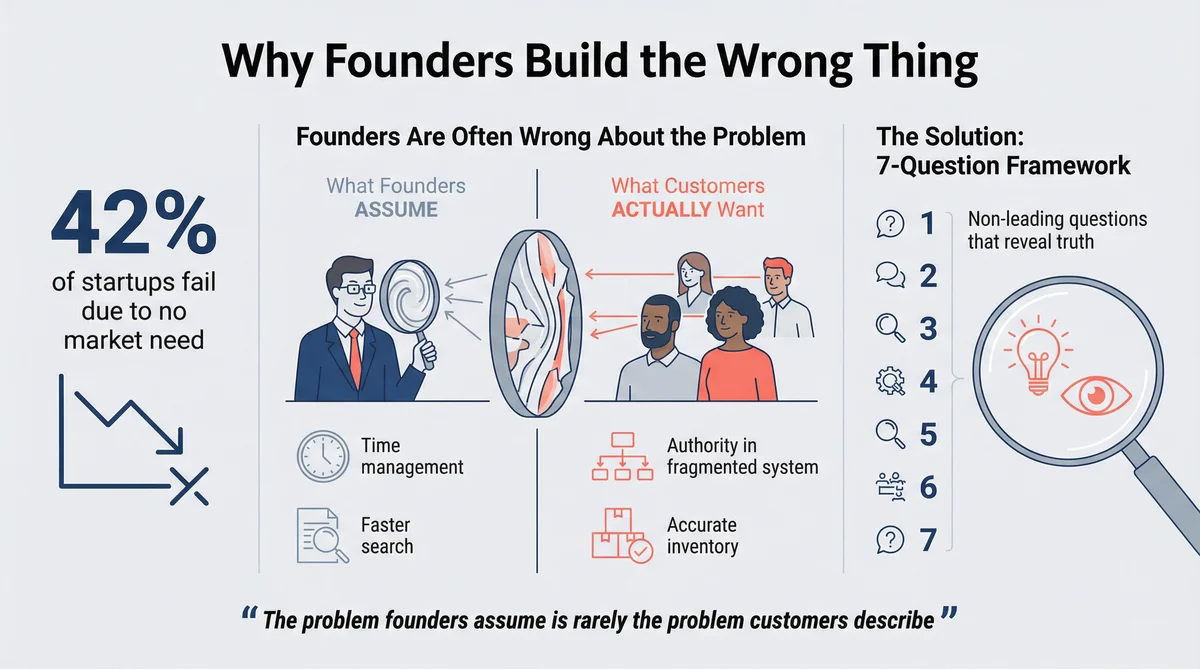
Y Combinator's famous motto, "Build something people want," exists precisely because this is so difficult to do. CB Insights data shows 42% of startups fail because there's no market need for their product. Not because of funding. Not because of competition. Not because of team issues. Because they built something nobody wanted.
The root cause? Poor problem framing. The product manager who asks "What features should we add?" before asking "What problem are we actually solving?" has already set the project up for failure. It's the equivalent of a doctor prescribing medication before diagnosing the illness.
This article is the first in a 12-part series on how to perform world-class product research using Claude Code and Ditto. We start here because problem framing is where everything else begins. Get this wrong, and nothing downstream will save you.
What Is Problem Framing?
Problem framing is the discipline of defining what problem you're solving, for whom, and why it matters now.
It sounds deceptively simple. In practice, it requires resisting the constant gravitational pull toward "solution speak." Stakeholders walk into meetings with features they want. Engineers suggest technical approaches. Executives have visions. Everyone has opinions about what to build. Very few people want to pause and ask: what's the actual problem?
The best problem framers operate like investigators. They remain curious when everyone else is certain. When someone says "We need a mobile app," they ask "Why?" When the answer is "Because competitors have one," they ask "What problem does the app solve that our current solution doesn't?" They keep asking until they reach something that sounds like human need rather than technical specification.
The Problem Statement Template
A well-framed problem follows this structure: [Target user] needs a way to [user need/goal] because [insight about why current solutions fail].
For example:
"Middle managers need a way to track project status across teams because existing tools require manual updates that nobody has time for."
"First-time parents need a way to understand infant sleep patterns because contradictory advice creates anxiety and exhaustion."
"Small business owners need a way to forecast cash flow because spreadsheets can't connect to their banking and invoicing systems."
Notice what's absent from these statements: any mention of specific features, technologies, or solutions. The problem statement constrains the problem, not the solution.
Why Problem Framing Is Harder Than It Sounds
Three forces conspire against good problem framing:
1. Solution Attachment
Founders often start with a solution they're excited about. "We're building an AI-powered dashboard" is a solution. The problem might be "executives can't get timely information about their business" - but if you've already committed to "AI-powered dashboard," you've closed off alternative approaches that might solve the problem better, faster, or cheaper.
2. Proxy Problems
Sometimes the stated problem isn't the real problem. "We need better collaboration tools" might actually mean "We have unclear roles and responsibilities, so people duplicate work and step on each other's toes." Better collaboration tools won't fix an organisational design problem.
3. Assumed Knowledge
Product managers frequently assume they understand the problem because they've experienced something similar themselves. This is particularly dangerous because it feels like empathy but is actually projection. Your experience is not your customer's experience.
How Ditto Transforms Problem Framing
Traditional problem framing requires either extensive customer interviews (expensive, slow) or dangerous assumptions (free, fast, wrong). Ditto offers a third path: synthetic research with statistically-grounded AI personas that can validate your problem hypothesis in hours rather than weeks.
Ditto is a synthetic market research platform with 300,000+ personas based on census data and behavioural research. EY validated 95% correlation with traditional research methods. You can:
Create research groups with demographic filters (country, state, age, gender, parental status, education, employment)
Ask open-ended qualitative questions to 6-20 personas
Receive rich, narrative responses (not yes/no)
Get AI-generated insights: segments, divergences, shared mindsets
Share results with stakeholders
Complete studies in minutes, not weeks
Case Study: CareQuarter's Problem Discovery
CareQuarter was exploring elder care coordination services. The founding hypothesis was straightforward: adult children managing ageing parents are overwhelmed by TIME - too many tasks, not enough hours.
Their first Ditto study recruited 12 synthetic personas: US adults aged 45-65, all managing healthcare for at least one ageing parent. Seven open-ended questions explored healthcare admin burden, moments of highest stress, and current coping mechanisms.
What the research revealed was unexpected.
The pain wasn't primarily about time. The dominant theme that emerged across nearly every persona was:
"I'm responsible without real authority in a system that's chopped into pieces."
This was not the expected finding. The research revealed that the pain is structural: these customers are the de facto care coordinators for a healthcare system that provides no formal role, no legal standing, and no unified record for the person doing the coordination.
Specific pain points that surfaced:
Portal fragmentation: Every provider, pharmacy, lab, and insurer uses a different system. The family caregiver becomes the "human API" connecting them.
Prior authorisation ping-pong: Insurer blames provider, provider blames insurer, pharmacy shrugs. The caregiver is the only one who follows through.
HIPAA purgatory: Legal authorisation signed but not visible in provider systems. Treated as a stranger despite being the primary decision-maker.
Friday 4pm fires: Hospital discharge calls that arrive at the worst possible moment, with nothing arranged.
The 2am worry spiral: Persistent background anxiety about what's being missed.
The strategic implication: CareQuarter didn't need to build a task management app or a reminder service. The research pointed toward a fundamentally different product: a human coordinator with real legal standing to act on behalf of the family.
That phrase - "responsible without authority" - came from participants, not assumptions. View the actual CareQuarter study →
Real-World Example: MotorMinds
MotorMinds, an auto parts sourcing startup, ran exactly this workflow. Their hypothesis: auto service shop owners waste significant time on parts sourcing due to unreliable inventory data.
The study recruited 10 auto service professionals using the 7-question non-leading framework. No mention of MotorMinds' solution. No description of AI or automation. Just questions about how they currently source parts and what frustrates them.
What the Research Revealed:
The problem was real - and worse than expected:
Time sink: 10-20+ hours per week on parts sourcing
Quantified cost: "$400-$800/week in lost profit" (direct quote from a former parts counter worker)
#1 Pain: "Ghost inventory" - parts listed as available that aren't
Severity score: Average 8.3/10 frustration rating
Participant voices told the story:
James Neri, a maintenance technician: "Every day. Almost every job needs a part."
Michael Mclimans, an automotive tech: "If it says 10:30, it rolls in at 10:30. No mid-year misses."
Sonny Carrizales, a former auto parts salesman, quantified the cost precisely: "$400-$800 per week in lost profit" from sourcing delays and errors.
But here's where problem framing gets interesting.
The magic wand question ("If you could fix ONE thing...") revealed something unexpected. The consensus wasn't "faster search" or "better prices." It was:
"Real, guaranteed ETAs with tracking at quote time, VIN-locked."
Founders assumed the problem was speed - finding parts faster. Participants revealed the problem was accuracy - trusting that the part is actually available and will arrive when promised.
View the actual MotorMinds study →
The Pattern: Founders Are Often Wrong About the Problem
These examples aren't anomalies. Across multiple problem framing studies, we've seen a consistent pattern: the problem founders assume is rarely the problem customers describe.
In every case, the research reframed the problem in a way that changed the product direction. This is why problem framing isn't optional - it's the difference between building something people want and building something you assumed they wanted.
The 7-Question Framework for Problem Validation
The goal is to discover whether your hypothesis is correct, not to confirm what you already believe. Avoid describing any solution. Let participants tell YOU what they want.
1. Establish context: "Walk me through a typical day when you need to [do task]. What does that process look like?"
2. Surface problems: "What's the most frustrating part of [task]? Tell me about a time when it was particularly painful."
3. Quantify impact: "How much time per week do you spend dealing with [problem]? What's the cost of that?"
4. Validate problem exists: "On a scale of 1-10, how big of a problem is this for you? Why that number?"
5. Explore alternatives: "What do you currently do to deal with this? What works? What doesn't?"
6. Test importance: "If you could fix ONE thing, what would it be and why?"
7. Check active seeking: "Have you ever looked for solutions? What happened?"
Common Mistakes in Problem Framing
Mistake 1: Framing the Problem as the Absence of a Solution
"We need a mobile app" is not a problem statement. Neither is "We need better analytics" or "We need an AI assistant." These are solutions masquerading as problems. Ask "Why?" until you reach human need.
Mistake 2: Framing Too Broadly
"Improve the user experience" is too broad to be useful. Narrow to specific user, specific context, specific task.
Mistake 3: Assuming You Know the Problem
The most dangerous assumption is that you understand the problem because you've experienced something similar. Your experience as a PM is not the same as your customer's experience.
Mistake 4: Skipping Validation Because You "Don't Have Time"
The irony: teams skip problem validation to save time, then spend 6-12 months building something nobody wants. With Ditto and Claude Code, a validation study takes hours, not weeks.
What Good Output Looks Like
At the end of problem framing, you should have:
Validated problem statement in customer language - not what you assumed, what participants actually said
Evidence of problem severity - time cost, money cost, emotional intensity, quantified wherever possible
Initial understanding of current workarounds - what people do today and why it's not good enough
Unexpected insight - what did you learn that you didn't expect? This often becomes your differentiation
Go/no-go signal - clear decision about whether to proceed
What Comes Next
Problem framing establishes that a problem worth solving exists. It doesn't tell you how deep the problem goes, who has it most acutely, what solutions exist today, or what solution would work.
The next stage, Discovery Research, takes your validated problem and explores it deeply. You'll understand not just that the problem exists, but how people experience it, what triggers it, and what they've tried before.
Explore the Research Yourself
All the studies referenced in this article are publicly available:
CareQuarter Phase 1: Pain Discovery - 12 personas on elder care coordination
MotorMinds: Auto Parts Sourcing - 10 auto service professionals
PatientCompanion: Elder Care Communication - 20 healthcare staff
Ready to run your own problem validation study? Learn more at askditto.io