
Tim Walz Drops Re‑Election Bid: What Minnesota Voters Want Next (Synthetic Focus Group)
Politics is kind of like a group chat: one person leaves unexpectedly and suddenly everyone is like wait, who’s driving now?
With headlines swirling about Minnesota Governor Tim Walz stepping back from his re‑election bid amid a fraud scandal, we ran a rapid-response synthetic focus group to answer two very human questions:
How are people reacting emotionally? (Spoiler: “please don’t make my life harder” energy.)
What do they want the next governor to focus on? (Spoiler: your rent. Always your rent.)
This is a great example of how Ditto can help you get a directional read on voter sentiment fast - especially when the news cycle decides to do a backflip.
Quick note: This is synthetic market research. The “participants” below are digital twins (synthetic personas), not real individuals. Think: fast, privacy-safe, directional insight - not a replacement for polling.
What’s in this article
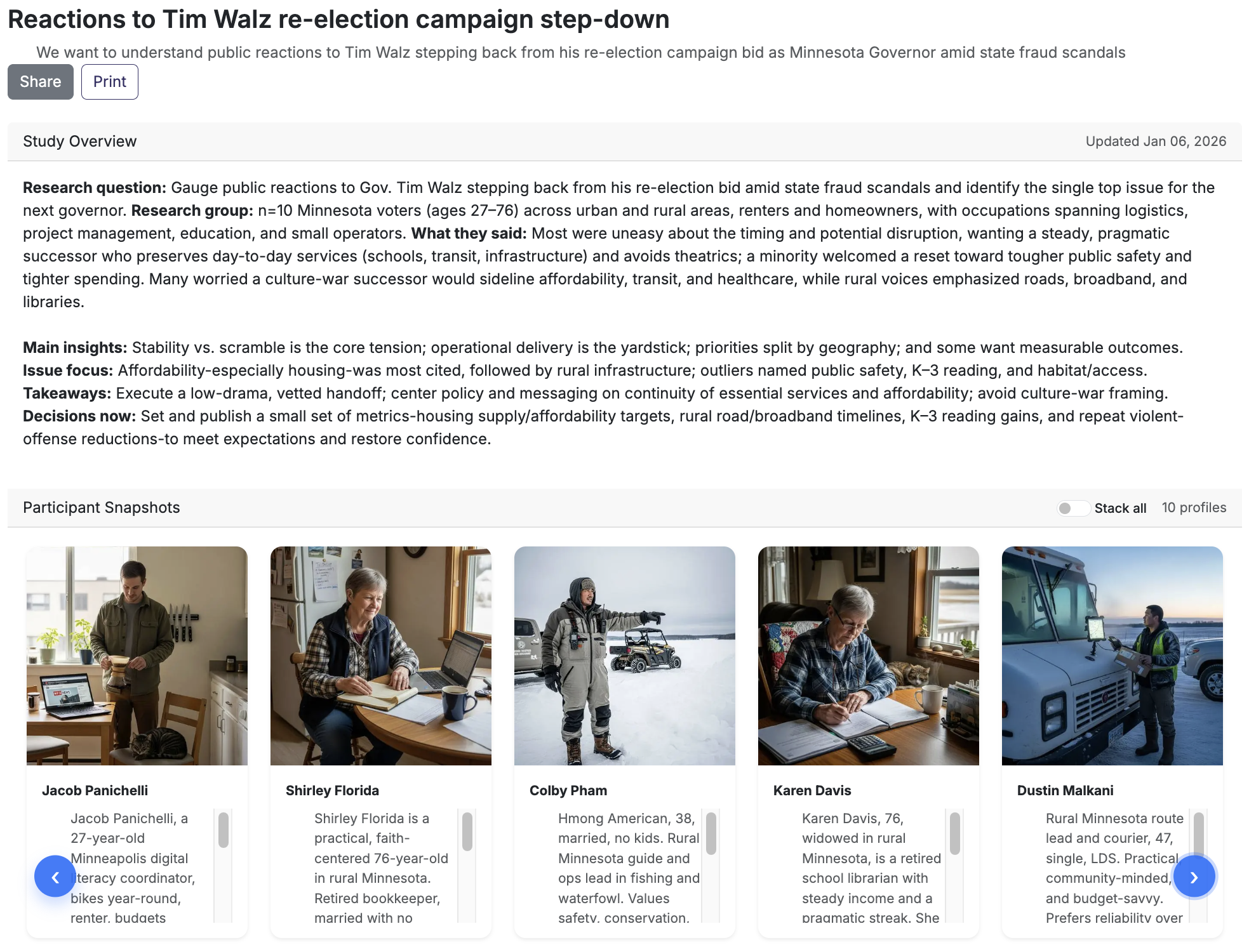
Study at a glance
We ran a small, qualitative synthetic study right after the story broke. The goal wasn’t to “predict an election.” It was to capture the first-wave reaction and the single issue people want prioritized next.
Study: Reactions to Tim Walz stepping back from the re‑election campaign
Updated: Jan 06, 2026
Sample: n=10 Minnesota voter digital twins (ages 27–76)
Coverage: urban + rural, renters + homeowners, mixed occupations
Prompts: (1) reaction, (2) top issue for the next governor
Audience: choosing synthetic personas (aka, who’s in the room)
I wanted a spread that felt like Minnesota: a mix of Twin Cities / suburban / rural realities, plus a range of ages, life stages, and “please don’t break my daily routine” priorities.
Our synthetic panel included people like:
younger urban renters (Minneapolis / St. Paul / Bloomington energy)
older rural retirees (practical, community-rooted, cost-conscious)
rural logistics / operations folks (delivery-first, no-nonsense)
mid-career suburban professionals (steady fiscal management vibes)
education-sector professionals (metrics, outcomes, show-your-work)
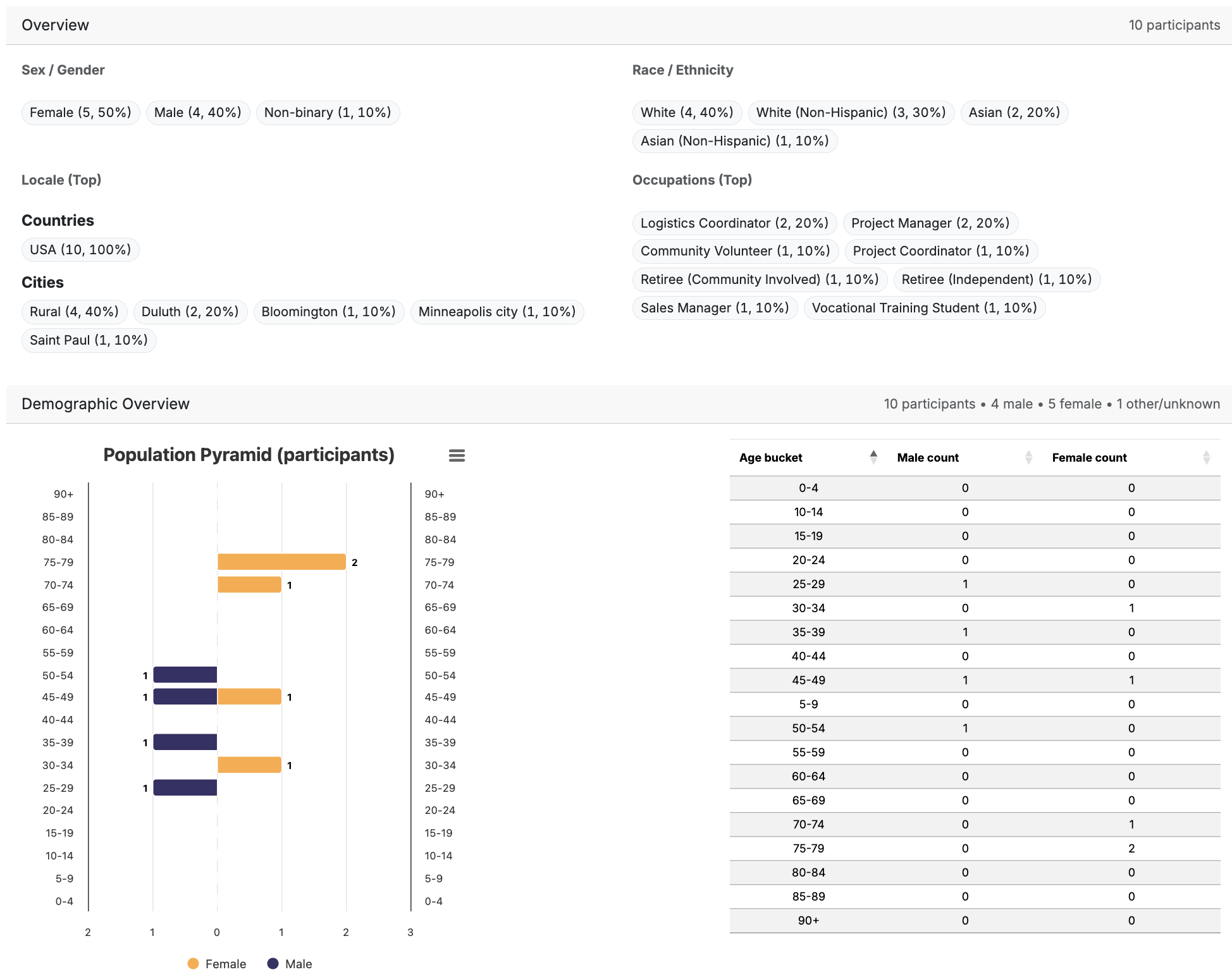
If you’ve ever tried to communicate to “Minnesota voters” like they’re one single blob… they’re not. They’re a set of overlapping priorities that shift by geography, age, and day-to-day lived experience.
Question 1: “What’s your reaction to Walz stepping back?”
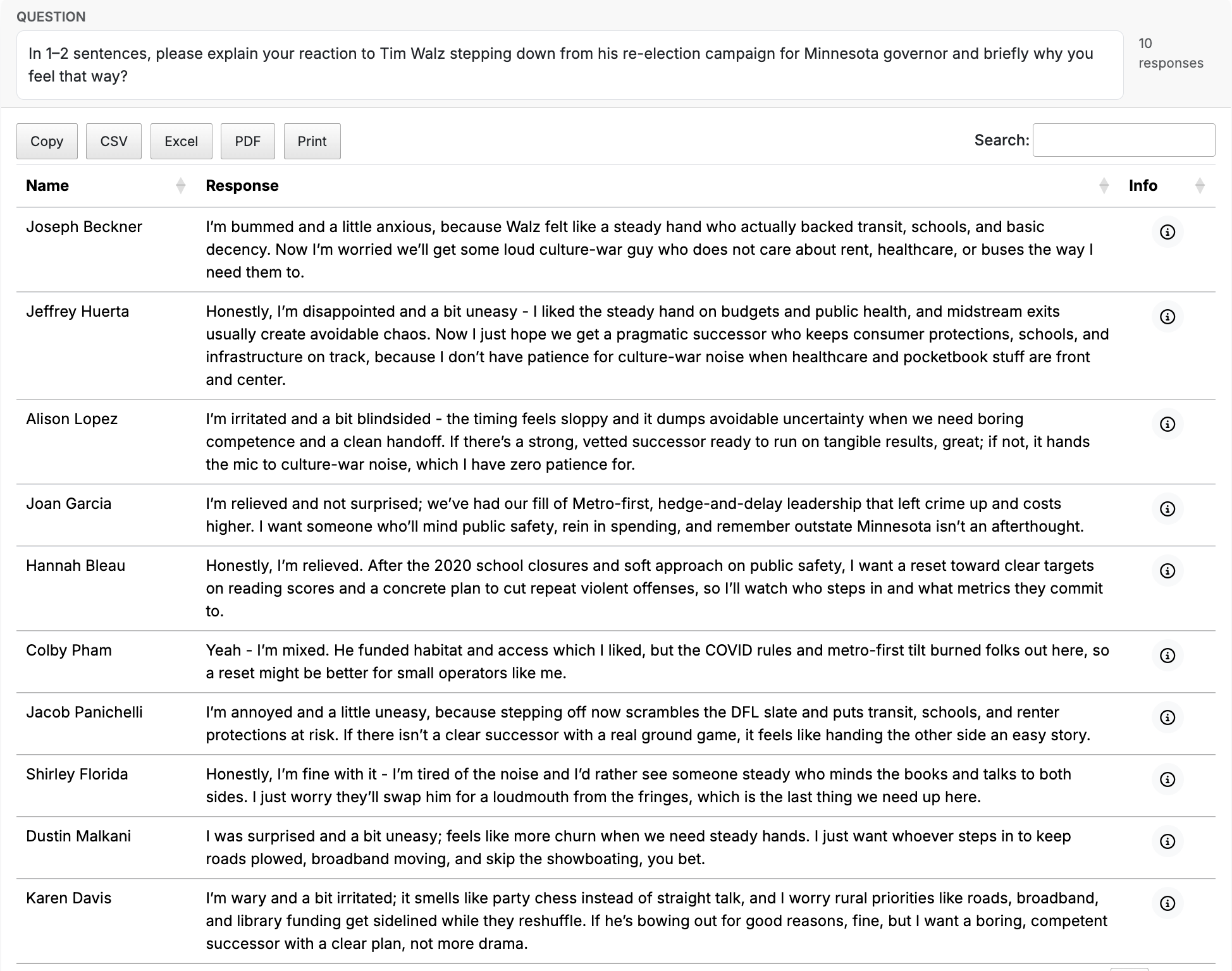
The dominant emotional note wasn’t partisan joy or rage. It was more like: “Oh no. Are we about to have a chaotic transition?”
Across the board, people wanted a competent, low-drama handoff that keeps essential services moving. (Boring competence: objectively the hottest political aesthetic.)
The big themes we saw
Stability vs. scramble The timing created anxiety. Even people who weren’t exactly fans of Walz still wanted a “steady hand” outcome.
“Keep the lights on” governance The yardstick wasn’t ideology - it was operational delivery: schools, transit, roads, infrastructure, basic services.
Fear of culture-war whiplash A recurring worry: a loud successor who shifts focus away from affordability, healthcare, transit, and day-to-day needs.
A minority welcomed a reset Some respondents saw the moment as an opportunity to push harder on public safety, spending restraint, and measurable outcomes.
A few quotes that capture the vibe
“The timing feels sloppy and it dumps avoidable uncertainty when we need boring competence and a clean handoff.”
- Alison (synthetic persona)
“Now I’m worried we’ll get some loud culture-war guy who does not care about rent, healthcare, or buses...”
- Joseph (synthetic persona)
“Keep roads plowed, broadband moving, and skip the showboating.”
- Dustin (synthetic persona)
Net-net: the emotional center of gravity is service continuity. People don’t want a political performance. They want their day to keep working.
Question 2: “What’s the single issue the next governor should focus on?”
This question was intentionally brutal. No “top five priorities.” No “it depends.” Just: pick one.
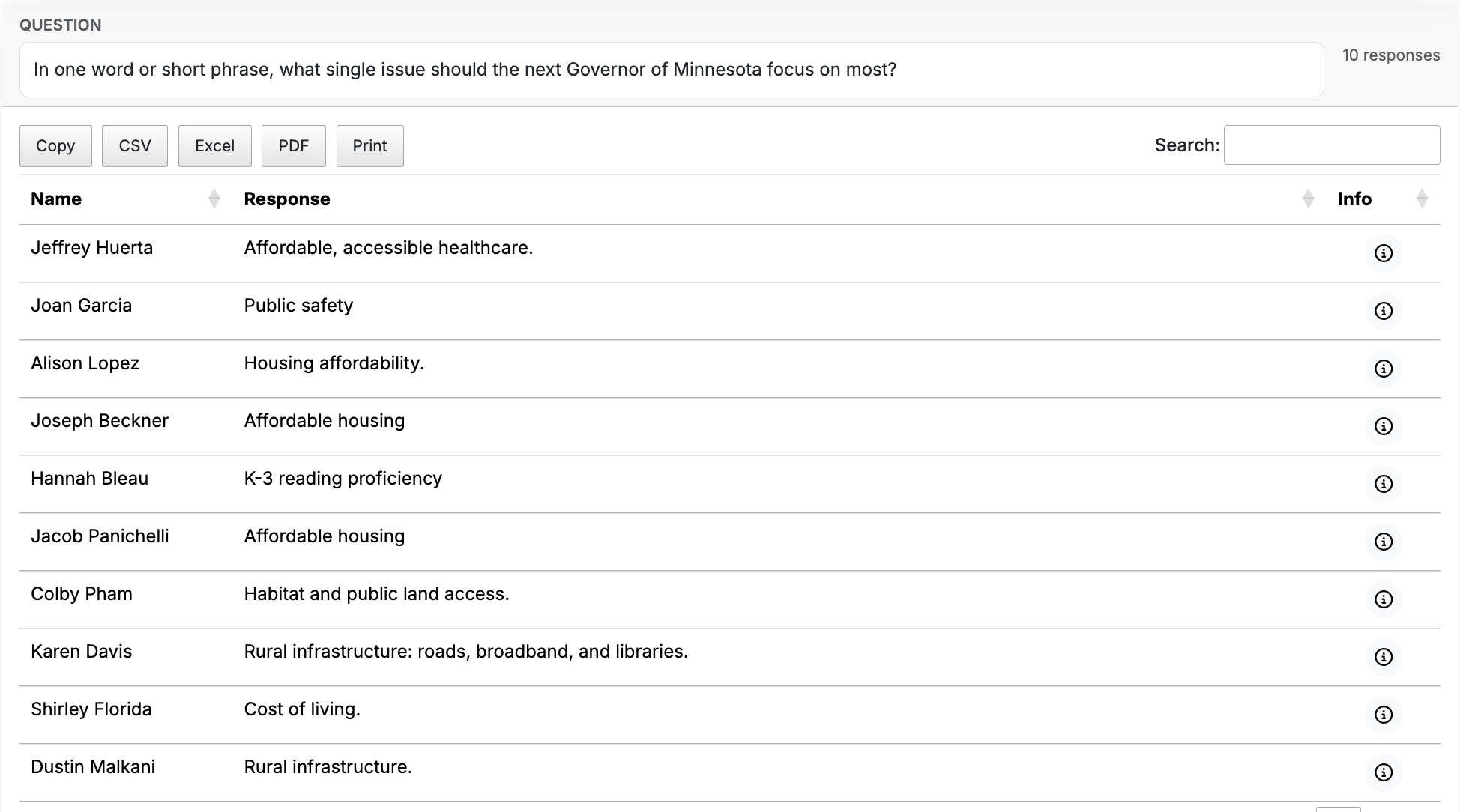
Results (n=10): the top issue is affordability - especially housing
If you’re shocked, I would like to gently introduce you to the year 2026. 🙂
Issue | Mentions | What it sounded like |
|---|---|---|
Affordability (especially housing) | 5 / 10 | Short, direct: “Housing affordability.” |
Rural infrastructure (roads, broadband, libraries) | 2 / 10 | “Keep outstate services working. Fix what’s breaking.” |
K–3 reading proficiency | 1 / 10 | Outcome-driven education focus. |
Habitat / public land access | 1 / 10 | Local economy + recreation + conservation. |
Public safety | 1 / 10 | Tougher stance / clearer enforcement. |
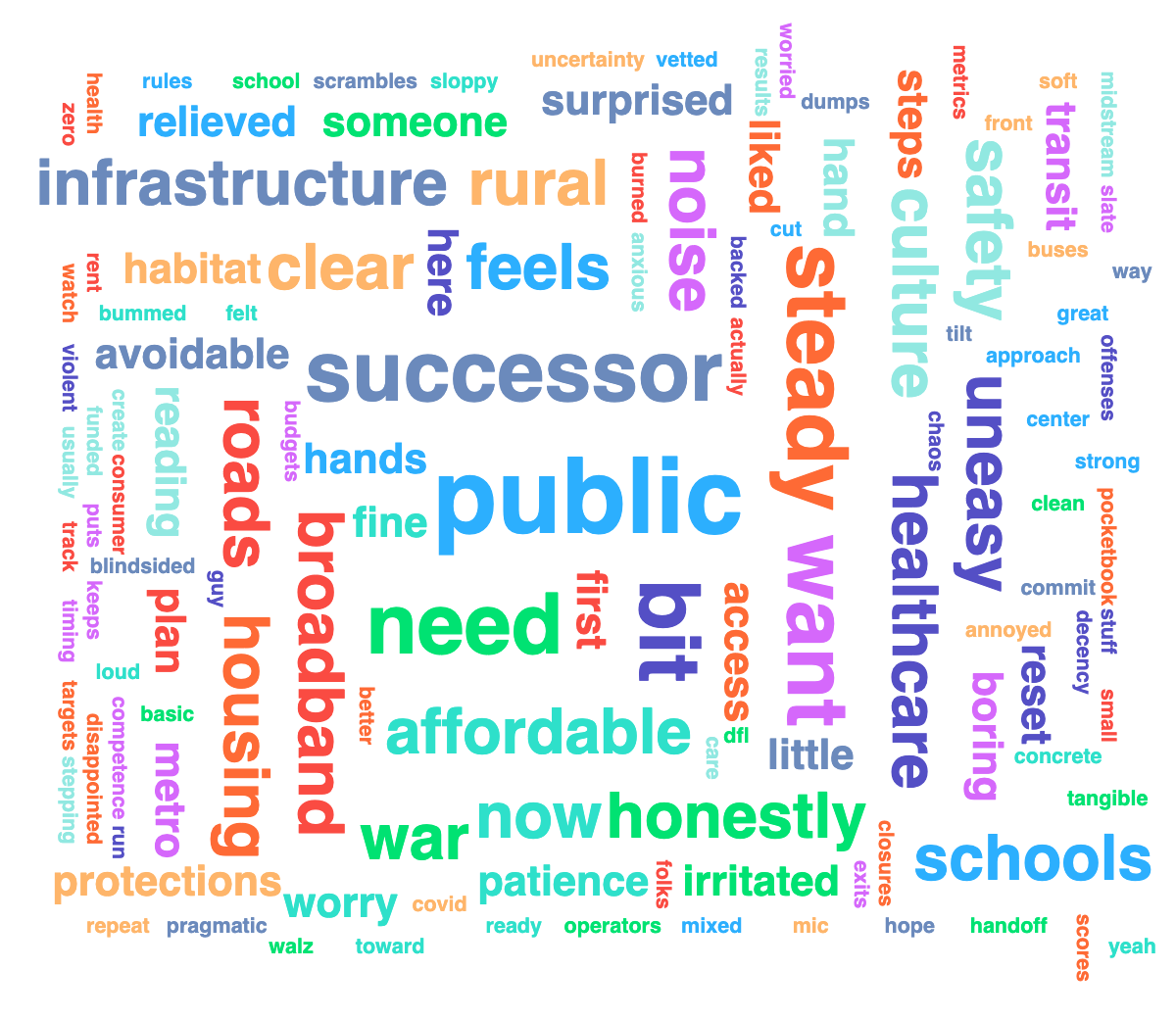
The interesting part is that even when the “headline” is about scandal and leadership turbulence, people still swing back to: “Okay, but can I afford my life?”
The five “voter vibe” segments we saw
These are not “political tribes.” They’re priority clusters - what people use to decide whether leadership feels safe, serious, and useful.
1) Younger urban renters: “Please don’t derail housing + transit.”
High anxiety about disruption. The fear is that a messy transition turns into a policy detour away from affordability, transit, and renter protections.
2) Older rural retirees: “Reset is fine - just be tough on spending and safety.”
More openness to a course correction, plus emphasis on cost restraint, public safety, and practical local services.
3) Rural logistics / operations: “Plow. Maintain. Deliver. Repeat.”
These respondents evaluate leadership through operational reliability. Politics is background noise; service delivery is the signal.
4) Mid-career suburban pros: “Steady fiscal management, no culture-war circus.”
A “show-me-the-plan” mindset. Impatient with theatrics. Sensitive to governance competence and measurable delivery.
5) Education-sector: “Publish the metrics or it didn’t happen.”
Program-level outcomes matter: K–3 reading, repeat violent offense reduction, concrete benchmarks.
The common thread across segments is kind of romantic, honestly: low-drama competence + make life more affordable. (If only all relationships were this clear.)
Summary: so what did we learn?
If I had to boil the whole thing down into the stuff I’d actually use if I were trying to understand the moment (and not melt down in Slack):
Stability vs. scramble is the emotional core. The immediate reaction isn’t “yay” or “boo.” It’s “please don’t break my routines.”
Operational delivery is the yardstick. “Keep services running” beats ideology: roads, schools, transit, broadband, basic infrastructure.
Affordability is the #1 issue - housing especially. Even in a scandal-driven news cycle, the top priority is still cost of living.
Rural vs. urban priorities split fast. Urban renters worry about housing/transit. Rural voices emphasize roads, broadband, libraries, and reliability.
People want measurable outcomes. Some respondents specifically want transparent tracking on education and public safety outcomes.
Also: there’s a broad sensitivity to “culture-war” framing. Not everyone uses that phrase, but the underlying reaction is clear: don’t turn governance into a spectacle.

And zooming out: this is exactly where synthetic market research shines. You can pressure-test reactions to breaking news, identify priority splits, and pull out what people actually mean by “leadership” before you invest time and budget into the wrong assumptions.
If we went deeper, here’s what I’d ask next
Two questions gets you the emotional temperature. Follow-up questions get you why (and what changes minds). Here are the next prompts we’d run to deepen the analysis:
How familiar are you with the fraud scandal details? (and how severe do you think it is?)
What do you believe is the primary reason Walz stepped back?
Has this changed your trust in Walz / the DFL / Minnesota state government overall?
How likely are you to vote for a gubernatorial candidate endorsed by Walz?
Rank the leadership qualities you want most right now: integrity, operational competence, fiscal discipline, transparency, anti-fraud enforcement, bipartisanship, continuity of services, affordability focus
Which actions would restore confidence? independent investigation, public audit release, leadership changes, stronger oversight, fund recovery, whistleblower protections, transparency dashboards