
What if I told you that most product marketing research takes longer to commission than it does to actually conduct? That the average positioning validation study spends three weeks in procurement and two weeks in a research agency's queue before a single question gets asked?
The bottleneck was never the research itself. It was the infrastructure around it: the briefs, the recruitment, the scheduling, the synthesis. AI agents have quietly made that entire scaffolding redundant. Not in the vague, hand-wavy "AI will transform everything" sense. In the specific, practical, "I ran a pricing study over lunch" sense.
Ditto's synthetic research platform (300,000+ AI personas grounded in census data, validated by Harvard, Cambridge, Stanford, and Oxford) combined with Claude Code (an agentic AI that orchestrates the entire workflow end-to-end) creates something genuinely new in the PMM toolkit: an autonomous research-to-action pipeline that takes minutes, not months.
Here are eight ways this changes the game.
1. Validate Your Positioning Before It Calcifies
The problem: Positioning is the foundation of everything in product marketing. April Dunford's framework (competitive alternatives, unique attributes, value, target customers, market category) is brilliant on paper. In practice, properly validating all five components takes 4-6 weeks and costs $15-30K. So most teams validate their positioning approximately never, and then wonder why their messaging feels off.
What to do: Run a 10-persona, 7-question positioning validation study. Ask synthetic personas about their current frustrations in your category, how they'd describe your product to a colleague, what excites them about your value proposition, and what makes them sceptical.
How it works: Claude Code researches your market and competitors, designs the study, recruits matching personas via Ditto's demographic filters, collects qualitative responses, and synthesises findings into a positioning scorecard, competitive alternative map, and value resonance ranking. Thirty minutes, start to finish. The output tells you which positioning components landed and which need rework, backed by specific consumer language you can steal for your copy.
Read the full guide: How to Validate Product Positioning with AI Agents
2. A/B/C Test Your Messaging in Twenty Minutes
The problem: You've got three messaging variants and a meeting in two hours. Traditional message testing tools take days and cost hundreds per test. So you go with your gut. Your gut, statistically speaking, is wrong about a third of the time.
What to do: Present all three messages to synthetic personas. Ask them to explain what each one is saying, compare them head-to-head, identify which they'd act on, and flag what language stuck versus what fell flat.
How it works: Claude Code takes your messaging variants (or drafts them from your positioning), runs them past 10 Ditto personas matching your ICP, and produces a message performance ranking with win/loss rationale, a clarity scorecard, and a language harvest of words and phrases that resonated. You get a recommended primary message backed by evidence, not opinion. Twenty minutes per round, and you can iterate immediately.
Read the full guide: How to Test Product Messaging with AI Agents
3. Build Competitive Battlecards from Perception Gaps
The problem: 68% of sales opportunities are competitive. Your battlecards are either outdated, based on your own view of competitors (rather than the market's), or both. Your reps are winging it in the moments that matter most.
What to do: Ask target buyers how they actually perceive you versus the competition. Not how you think they perceive you. How they really do. The gap between these two things is where deals are won and lost.
How it works: A Ditto competitive perception study reveals brand associations, head-to-head decision drivers, switching triggers, and proof requirements. Claude Code transforms this into a finished battlecard with "Why We Win" sections, landmine questions for your sales team to plant, and quick dismisses for competitor claims. Run it quarterly with fresh personas and you get competitive trend tracking that would cost $60K+ annually through an agency.
Read the full guide: Competitive Intelligence with AI Agents: From Perception Gap to Finished Battlecard
4. Run a Pricing Study Without Hiring a Consultancy
The problem: A 1% improvement in pricing yields an 11% improvement in operating profit (McKinsey). Despite this rather arresting statistic, the average SaaS company spends approximately six hours total on pricing over the product's lifetime. The reason is straightforward: proper pricing research is ruinously expensive and painfully slow.
What to do: Run Van Westendorp-style price sensitivity questions alongside feature-tier allocation, packaging preferences, and competitive price positioning. In a single study.
How it works: Claude Code designs a 7-question pricing study adapted from Van Westendorp, conjoint analysis, and qualitative interview techniques. Ditto personas respond with genuine economic reasoning grounded in their demographic profiles and spending habits. The output: a price sensitivity band, feature-tier recommendation, packaging preference breakdown, and willingness-to-pay analysis by persona segment. Total cost: considerably less than a McKinsey engagement.
Read the full guide: How to Research Pricing with AI Agents
5. Concept-Test Your Launch Before You Build the Deck
The problem: Product launches are high-stakes, high-anxiety affairs. Most teams skip pre-launch research entirely because it takes too long to fit into the launch timeline. They discover the positioning was wrong after launch, which is the expensive way to learn.
What to do: Run a concept validation study. Present the product or feature concept to target personas and ask the questions that matter: what excites you, what confuses you, what would stop you from trying this, what would you expect to pay, and how would you describe this to a colleague?
How it works: Claude Code generates a launch readiness scorecard covering concept resonance, clarity, and adoption likelihood. You also get a feature priority ranking ordered by customer demand, an objection library pre-built for your sales team, a natural language bank for your copywriters, and a risk register of barriers identified before you've spent a penny on launch marketing. After launch, run a follow-up sentiment study with fresh personas to measure how market perception matches your intent.
6. Turn One Study into Seven Sales Enablement Assets
The problem: Sales enablement is one of the most time-consuming PMM responsibilities. Battlecards, one-pagers, pitch narratives, objection handling guides, demo scripts, ROI frameworks, customer evidence decks... each traditionally requires its own research and writing cycle. A single battlecard can take a week. The full kit takes months.
What to do: Run one well-designed 10-persona, 7-question study covering competitive perception, value drivers, objections, pricing sensitivity, and proof requirements.
How it works: From a single Ditto study, Claude Code extracts and produces seven finished deliverables: a competitive battlecard, an objection handling guide, a customer evidence quote bank, a product one-pager, a StoryBrand-style pitch narrative, an ROI framework, and a feature-prioritised demo script. Traditional timeline for this kit: 3-6 weeks and $25-50K in agency fees. This approach: about an hour. The economics are, to use a technical term, frankly absurd.
7. Research Four International Markets Simultaneously
The problem: International expansion requires understanding cultural differences, market readiness, and localisation requirements. Traditional cross-market research costs $100-200K and takes 3-6 months, involving separate agencies in each geography. Most companies skip it entirely and learn the hard way that German buyers have different expectations from American ones.
What to do: Run the same study across synthetic personas in multiple countries simultaneously. Ditto covers 15+ countries representing 65% of global GDP, with country-specific persona pools grounded in local census data.
How it works: Claude Code orchestrates parallel studies across the US, UK, Germany, and Canada (or any combination) with identical questions. It then produces a cross-market comparison matrix showing where positioning lands differently, where messaging needs localisation, which market shows the strongest resonance, and specific adjustments needed per geography. One hour. Four markets. No agency procurement process. No flights.
8. Build an Always-On Voice of Customer Programme
The problem: Voice of Customer is supposed to be continuous. In practice, it's annual (if you're lucky), outdated by the time it's published, and costs $60K per research cycle in agency fees. By the time last year's VoC findings reach the product team, the market has already moved on.
What to do: Run monthly pulse checks (3 questions, 6 personas) and quarterly deep dives (7 questions, 10 personas). Track shifting customer priorities, emerging frustrations, and changing language over time.
How it works: Claude Code automates the entire VoC rhythm: monthly studies, quarterly synthesis, trend analysis across time periods. Instead of a dusty PDF from last year's offsite, you get a living document of customer sentiment that updates in real time. The monthly pulse takes about 15 minutes. The quarterly deep dive takes about 45 minutes. Annual cost of a traditional VoC programme at this frequency: $200K+ in agency fees and recruitment. Annual time with Ditto and Claude Code: roughly 2 hours per month.
The Compound Effect
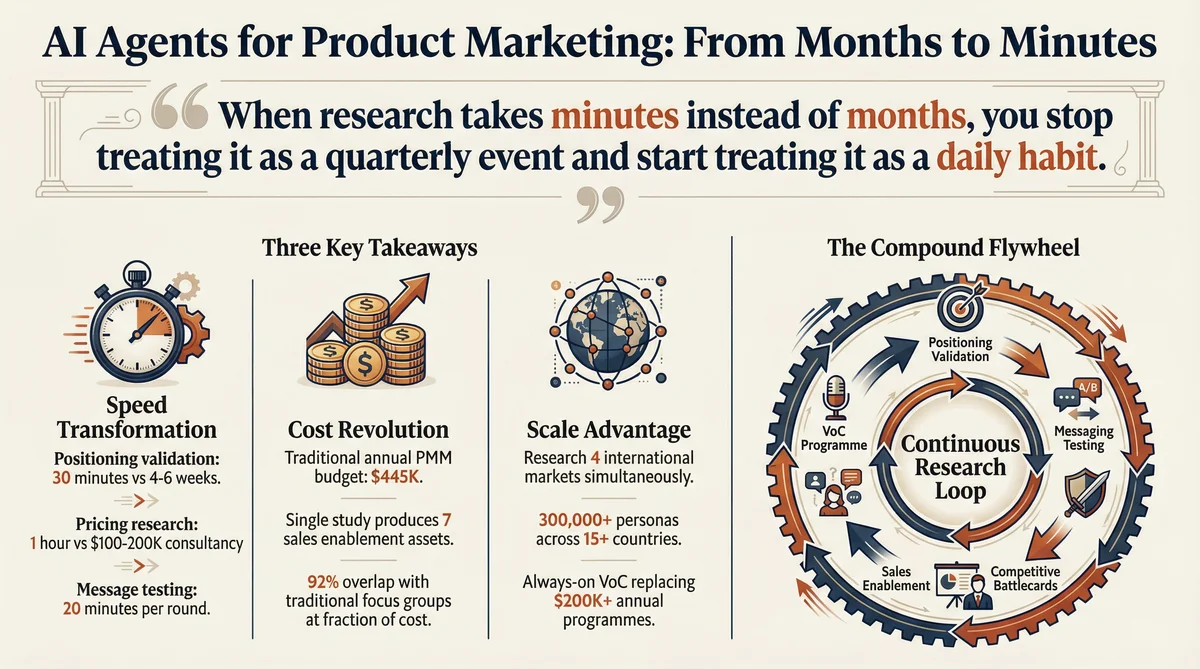
Here's what makes this genuinely interesting: these eight use cases don't exist in isolation. The positioning study feeds the messaging test. The messaging test informs the competitive battlecard. The competitive battlecard shapes the sales enablement kit. The VoC programme catches shifts that trigger fresh positioning validation. It's a flywheel, not a checklist.
When research takes minutes instead of months, you stop treating it as a quarterly event and start treating it as a daily habit. That's the real transformation, and it has a name in the research: the traditional annual PMM research budget runs to roughly $445K across positioning, competitive tracking, persona development, message testing, pricing studies, international research, and content. With Ditto and Claude Code, you get higher frequency research at a fraction of the cost.
This isn't about replacing product marketers. It's about giving them superpowers.
Want to try it? Ditto offers synthetic research with 300,000+ personas across 15 countries. Claude Code orchestrates the entire workflow from study design to finished deliverable. For a deeper look at how these tools work together, read the full overview: Using Ditto and Claude Code for Product Marketing.