
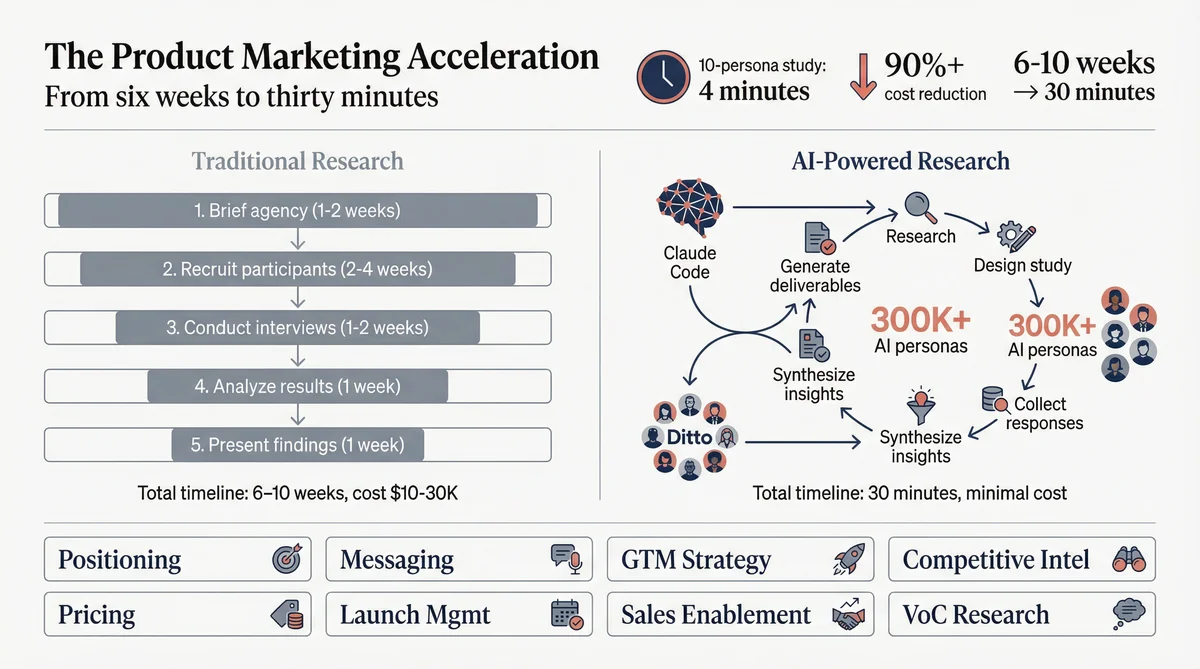
Product marketing has a timing problem. The discipline is built on research, validation, and iteration, yet the tools available to most teams operate at a pace that belongs to a different era. A positioning study takes six weeks. A message test costs five thousand dollars and arrives after the campaign has already launched. A competitive battlecard is outdated by the time it reaches the sales team. The result is that product marketers, who should be the most data-driven people in the building, end up relying on instinct far more often than they would like to admit.
This is the first article in a series exploring how two tools, working in combination, can fundamentally change the economics and tempo of product marketing. Those tools are Ditto, a synthetic market research platform with 300,000+ AI personas grounded in census data and behavioural research, and Claude Code, Anthropic's agentic coding environment that can orchestrate complex multi-step workflows autonomously. Together, they form something genuinely new: an always-available research and execution engine for every phase of the product marketing lifecycle.
In subsequent articles, we will go deep on each discipline. This piece provides the overview: what product marketing actually requires, where the bottlenecks sit, and how each function can be replicated or augmented using Ditto and Claude Code. If you are a PMM wondering whether synthetic research is ready for serious work, or a founder trying to do the job of a PMM without actually hiring one, this is for you.
What Product Marketing Actually Requires
Product marketing sits at the intersection of product, sales, and marketing. Its job is deceptively simple to state and fiendishly difficult to execute: define how a product is positioned in the market, ensure the right people hear about it in the right way, and equip the sales team to win deals. Per the 2025 State of Product Marketing Report, 91% of PMMs identify positioning and messaging as their core responsibility. Eighty percent are responsible for creating sales collateral. The discipline touches everything from pricing to launch strategy to competitive intelligence.
April Dunford, the foremost authority on positioning, describes the PMM's operating system as three pillars: research (understanding the customer, the market, and the competition), strategy (positioning, messaging, GTM planning), and execution (launches, enablement, content, campaigns). Each pillar demands different skills. All three demand evidence.
The problem is not that PMMs lack frameworks. Dunford's positioning methodology, the Value Proposition Canvas, Jobs-to-Be-Done, StoryBrand, competitive battlecards: the intellectual infrastructure is mature and well documented. The problem is that applying these frameworks properly requires customer data, and obtaining customer data through traditional means is slow, expensive, and often impractical. A win/loss analysis programme needs 15 to 20 interviews before reaching saturation. A positioning validation study through an agency takes four to eight weeks and costs upwards of fifteen thousand dollars. By the time the research arrives, the window has often moved.
The Research Bottleneck
Consider the lifecycle of a typical positioning exercise. The PMM identifies that the current positioning is not landing with a key segment. She drafts three alternative positioning statements. She needs to test them with target buyers. Here is what happens next in the traditional workflow:
Brief a research agency or schedule customer interviews (1 to 2 weeks)
Recruit participants matching the ICP (2 to 4 weeks)
Conduct interviews or run the survey (1 to 2 weeks)
Analyse results and synthesise findings (1 week)
Present to stakeholders and iterate (1 week)
Total elapsed time: six to ten weeks. Total cost: ten to thirty thousand dollars, depending on methodology and agency. And that is for a single round of validation on a single strategic question.
The consequence is predictable. Most teams skip the research. They go with the positioning that sounds best in the conference room. They launch the messaging that the most senior person in the meeting preferred. They build sales enablement materials based on assumptions about what customers care about, rather than evidence. The frameworks exist. The data to feed them does not arrive in time.
Enter Ditto and Claude Code
Ditto provides synthetic market research using AI-powered personas. These are not generic language model outputs. Each persona is statistically grounded in census data, behavioural research, and cultural context. The platform covers fifteen countries representing 65% of global GDP, with 300,000 personas in the United States alone. EY Americas has validated a 95% correlation between Ditto's synthetic responses and traditional research methods. Harvard, Cambridge, Stanford, and Oxford have validated the underlying methodology.
Claude Code is Anthropic's agentic development environment. It can research topics on the web, design research studies, execute API calls, poll for asynchronous results, synthesise findings, generate reports, compose emails, publish content to a CMS, and send emails through transactional email platforms. It does not merely assist. It orchestrates.
When combined, the two tools create an end-to-end pipeline that looks roughly like this: Claude Code researches the brand, competitor, or market context. It designs a study with the appropriate demographic filters and research questions. Ditto recruits matching personas and collects qualitative responses. Claude Code polls for completion, extracts insights, and generates whatever deliverable the PMM needs: a positioning validation report, a competitive battlecard, a blog article, a sales email with a link to the live study, or all of the above.
The same positioning exercise that takes six to ten weeks through traditional channels takes roughly thirty minutes. That is not a marginal improvement. It is a categorical change in what is possible.
Positioning: From Assumption to Validation in Thirty Minutes
The Best Practice
Dunford's framework identifies five components of effective positioning: competitive alternatives (what customers do if you do not exist), unique attributes (your genuine differentiators), value and proof (the demonstrable outcome of those attributes), target customers (the segment that cares most), and market category (the frame of reference that makes your value obvious). The components are interdependent. Your differentiated value only makes sense relative to specific alternatives, for specific customers, within a specific category.
How Ditto and Claude Code Deliver
Claude Code designs a seven-question study that maps directly to Dunford's five components. Questions probe what alternatives customers currently use, how they react to your value proposition, how they would naturally categorise you, what proof they would need, and what would prevent adoption. Ditto recruits ten personas matching your ICP and collects responses. The study's completion analysis identifies natural segments, divergences, and consensus points. Claude Code synthesises the results into a positioning validation scorecard, a competitive alternative map, and a ranked list of which value propositions actually registered with the target audience.
For cross-segment validation, Claude Code can run the same positioning study against multiple Ditto groups simultaneously: SMB decision-makers, enterprise evaluators, and technical buyers, for instance. The output is a segment-by-segment comparison showing how your positioning lands differently with each audience.
Messaging: A/B/C Testing Without the Agency
The Best Practice
Messaging translates positioning into customer-facing communication. The standard approach is a messaging hierarchy: a primary message at the top, three to four supporting pillars, and proof points beneath each. The challenge is knowing which framing resonates. Do you lead with the problem, the outcome, or the capability? Traditional message testing platforms like Wynter charge hundreds of dollars per test and take days to return results.
How Ditto and Claude Code Deliver
Claude Code drafts three to four messaging variants based on the positioning, then designs a study where personas evaluate each for clarity, relevance, and intent to act. The output includes a message performance ranking with evidence, a "language harvest" of words and phrases that resonated, and an audience-message fit matrix. A second round of testing with refined messages can be completed within the hour. Total time for two rounds of testing with ten personas each: approximately sixty minutes.
Go-to-Market Strategy: Validating Before You Commit
The Best Practice
GTM strategy determines how a product will be positioned, priced, promoted, and distributed. The critical decisions include segment selection, motion type (product-led growth, sales-led, or hybrid), channel strategy, and pricing. Getting these wrong is expensive: misaligned GTM means wasted pipeline, misfiring sales efforts, and failed launches. Gartner's framework breaks GTM into three phases: analyse, design, and deliver.
How Ditto and Claude Code Deliver
A GTM validation study asks personas how they discover solutions, who else is involved in purchase decisions, whether they prefer self-service or sales-led engagement, how they respond to unsolicited outreach, and what proof they need to recommend a product internally. Running this against multiple demographic groups reveals whether your GTM motion matches your buyer's actual behaviour. Claude Code produces a channel preference matrix, a buying committee map, and a motion recommendation (PLG versus sales-led versus hybrid) backed by data from the target market.
Sales Enablement: One Study, Seven Deliverables
The Best Practice
Product marketers create the materials that make sales teams effective: pitch decks, competitive battlecards, objection handling guides, one-pagers, and demo scripts. These need to be grounded in customer language and validated competitive positioning. According to the Product Marketing Alliance, seventy-five percent of PMMs cite sales collateral creation as a key responsibility.
How Ditto and Claude Code Deliver
This is where the combination truly excels. A single Ditto study with ten personas and seven well-designed questions produces enough raw material for Claude Code to generate a competitive battlecard, an objection handling guide, a customer evidence quote bank, a product one-pager, a pitch narrative, an ROI framework, and a demo script. The entire kit, from zero research to finished deliverables, takes roughly sixty minutes. The traditional timeline for equivalent output is three to six weeks.
Competitive Intelligence: How the Market Actually Sees You
The Best Practice
Sixty-eight percent of sales opportunities are competitive. PMMs need to understand how customers perceive competitors, what drives wins and losses, and where to set "landmine" questions in deals. Tools like Klue and Crayon automate competitive monitoring, but the qualitative layer, how customers actually think about the competitive landscape, still requires primary research.
How Ditto and Claude Code Deliver
A competitive perception study asks personas to compare your product against specific competitors, identify strengths and weaknesses, evaluate competitive claims for credibility, and describe what would trigger a switch. Claude Code transforms the responses into a complete battlecard with "why we win" themes, landmine questions that highlight competitor gaps, quick dismisses for common claims, and a switching trigger map. Running this quarterly with fresh persona groups produces a competitive trend report showing how perceptions are shifting over time.
Customer Research: Always-On Voice of Customer
The Best Practice
Voice of Customer research is the backbone of product marketing. The standard methodologies include surveys, in-depth interviews, focus groups, social listening, review mining, and customer advisory boards. The challenge is frequency. Most organisations conduct VoC research annually or quarterly at best, which means decisions between research cycles are based on stale data.
How Ditto and Claude Code Deliver
When research takes thirty minutes instead of six weeks, VoC becomes continuous. A practical programme might include monthly pulse checks (three questions, six personas), quarterly deep dives (seven questions, ten personas), and ad hoc probes whenever a specific signal needs investigation. Claude Code generates customer journey maps, pain priority matrices, language libraries capturing exact customer phrasing, and unmet needs reports. The annual cost of running this programme through traditional agencies would exceed two hundred thousand dollars. With Ditto, it is limited to the platform subscription.
Pricing and Packaging: Finding the Threshold
The Best Practice
Pricing directly affects revenue, positioning, and competitive dynamics. PMMs increasingly influence pricing through market research, willingness-to-pay studies, and competitive benchmarking. The Van Westendorp Price Sensitivity Meter and Gabor-Granger technique are standard tools, but both require primary research that most teams lack the budget or timeline to conduct.
How Ditto and Claude Code Deliver
A pricing validation study asks personas about their current spend, their gut reaction to specific price points, their packaging preferences (free tier versus low-cost versus premium), which features they would pay extra for, and their sensitivity to competitor pricing. Claude Code produces a price sensitivity band, a feature-tier allocation recommendation, and a competitive price positioning analysis. The study runs in under thirty minutes and can be repeated with different segments to understand how pricing thresholds vary across audiences.
Product Launches: Validation Before You Ship
The Best Practice
Launches require pre-launch concept validation, feature prioritisation, and messaging readiness. Post-launch, teams need rapid sentiment feedback. Most teams use a tiered system: Tier 1 launches for major new products warrant full-scale preparation, Tier 2 for significant updates, and Tier 3 for incremental improvements. The critical failure mode is launching without pre-validation because the research could not be completed in time.
How Ditto and Claude Code Deliver
A concept validation study tests initial reactions, use case fit, feature prioritisation, adoption barriers, natural language descriptions, and price expectations. Claude Code generates a launch readiness scorecard, a feature priority ranking, a pre-built objection library for the sales and CS team, and a natural language bank for marketing copy. Post-launch, a separate study with a new persona group gauges market reaction. Claude Code compares pre-launch expectations against post-launch perception and produces a launch impact report. The entire pre-launch research cycle takes approximately forty-five minutes.
Content Marketing: The Research-to-Publication Pipeline
The Best Practice
Content marketing supports every stage of the funnel. The gold standard for content PMMs is research-backed original content: unique data, primary findings, and insights that cannot be found elsewhere. Google rewards original research. AI citation systems (ChatGPT, Perplexity, Claude) preferentially cite content with structured data and specific findings. The problem, of course, is that producing original research for every blog post is impractical through traditional means.
How Ditto and Claude Code Deliver
This is our most battle-tested workflow. From a single Ditto study, Claude Code generates a 1,500 to 2,500 word blog article with SEO and GEO optimisation, publishes it to Contentful with metadata for AI citation, creates a custom infographic visualising the key findings, posts a social media thread with the most quotable insights, and composes a personalised outreach email with a link to the live study. Each article is backed by unique primary research data that no competitor can replicate because the study was designed specifically for that topic.
The economics are striking. A traditional research-backed article costs two to ten thousand dollars and takes two to four weeks. The Ditto and Claude Code pipeline produces equivalent output in forty-five to ninety minutes. At that pace, a single person can produce twenty to forty research-backed articles per month, each with unique data.
International Research: Four Markets in One Hour
Companies expanding internationally need to understand cultural differences, market readiness, and localisation requirements. Traditional international research is prohibitively expensive for most teams.
Ditto covers fifteen countries. Claude Code can orchestrate identical studies across four markets simultaneously: the same seven questions asked to personas in the US, UK, Germany, and Canada. The output is a cross-market comparison matrix showing how each market responds to the same positioning, where messaging needs localisation, and which market shows the strongest resonance. This kind of insight typically requires commissioning four separate research agencies at a combined cost of one to two hundred thousand dollars. With Ditto and Claude Code, it takes approximately one hour.
The Full PMM Operating System, Automated
When you map every phase of the PMM lifecycle to the combined stack, a pattern emerges. The research pillar is covered by Ditto studies: market research, customer research, competitive research, win/loss simulation, and persona development. The strategy pillar is covered by validation studies: positioning, messaging, pricing, GTM planning, and segmentation, all tested against synthetic populations before committing resources. The execution pillar is covered by Claude Code's ability to transform research data into finished deliverables: battlecards, pitch decks, blog articles, emails, social posts, and infographics.
The measurement pillar closes the loop. Quarterly brand perception studies track how the market sees you. Competitive tracking studies detect shifts in the landscape. Post-launch sentiment studies measure market reaction. Email engagement tracking through SendGrid confirms which messages land.
The cumulative effect is not merely efficiency. It is a change in the kind of PMM work that becomes economically rational. When research costs fifty thousand dollars and takes two months, you use it sparingly and for the highest-stakes decisions. When research takes thirty minutes and costs a fraction of that, you use it for everything. You validate before you build. You test messaging weekly. You track competitive perception quarterly. You produce research-backed content continuously. Research becomes a habit, not an event.
Where Synthetic Research Is Not Enough
It would be dishonest to present this as a complete replacement for traditional research. It is not. Synthetic personas have not used your specific product, so product-specific UX feedback requires real users. Legal and compliance decisions require human validation. Ultra-novel categories without grounding context may not produce reliable synthetic responses. And the relationship-building value of genuine customer conversations, the trust and goodwill that comes from a PMM who actually listens, cannot be replicated by an API call.
The recommended approach is hybrid. Use Ditto and Claude Code as the fast first pass for everything. Validate hypotheses quickly, identify promising directions, and produce eighty percent of the needed insights. Then invest in human research where it truly matters: validating the most critical findings with real customers, building relationships, and providing the twenty percent of insight that requires human nuance. This approach typically reduces traditional research spend by sixty to eighty percent whilst increasing research frequency by five to ten times.
What Comes Next
This article has provided a high-altitude view of how Ditto and Claude Code map to every major product marketing function. In subsequent articles in this series, we will go deep on each discipline:
Positioning validation using Dunford's framework, with a complete worked example
Messaging testing and iterative refinement, including cross-segment comparison
Competitive intelligence automation, from study design to finished battlecard
The content marketing engine: research-to-publication in ninety minutes
Customer segmentation and persona development using synthetic populations
GTM strategy validation, including PLG versus sales-led motion testing
Pricing research and willingness-to-pay analysis
Each article will include the study design (questions, demographic filters, group configuration), the Claude Code orchestration process, the deliverables produced, and a comparison with the traditional approach. If you want to follow along, you can access Ditto at askditto.io and Claude Code at claude.ai.
The product marketing discipline has excellent frameworks. What it has lacked, until now, is a research infrastructure fast enough to feed them. That infrastructure exists. The question is no longer whether synthetic research is ready for serious PMM work. It is whether PMMs are ready for a world where research takes minutes instead of months, and what they will do with all that extra evidence.