
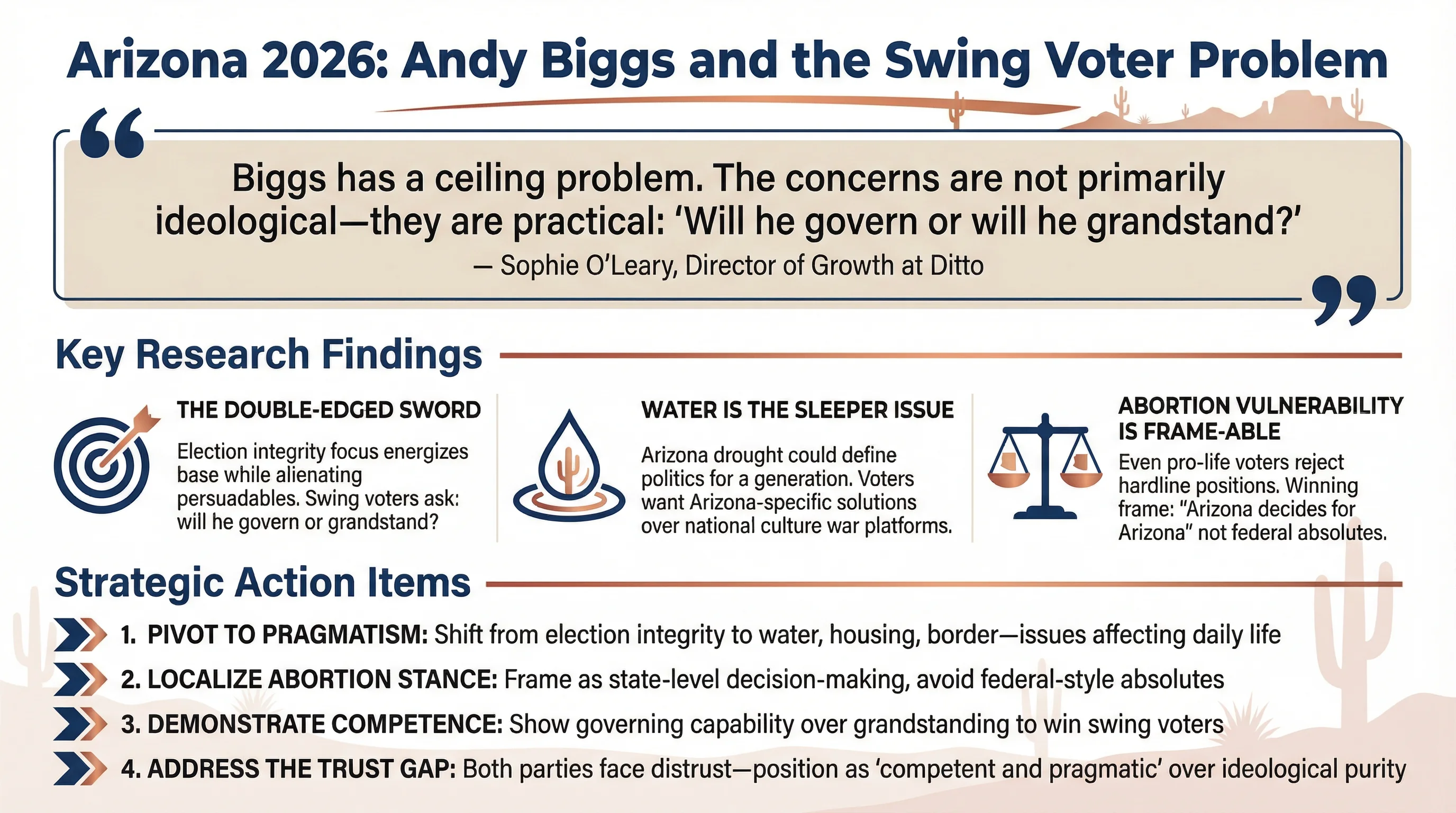
Arizona has become ground zero for American political realignment. After years of razor-thin margins and contested elections, the 2026 gubernatorial race will test whether the state's rightward shift is permanent or a reaction to specific circumstances. I ran a study with six Arizona voters to understand how they perceive Andy Biggs, the congressman positioning himself as the conservative standard-bearer, and what would actually move swing voters in either direction.
The findings suggest Biggs has a ceiling problem, and it is not where you might expect.
The Participants
Six participants from across Arizona: a retired Marine in Mesa, a real estate agent in Scottsdale, a teacher in Tucson, a construction foreman in Phoenix, a nurse in Flagstaff, and a small business owner in Yuma. Ages ranged from 29 to 64, split evenly between registered Republicans, Democrats, and independents. What united them? Deep concern about Arizona's direction and skepticism about candidates from both parties.
The Andy Biggs Question
I asked participants directly: what is your perception of Andy Biggs, and would you consider voting for him for governor?
The responses revealed a stark divide between base enthusiasm and swing voter concerns.
Frank from Mesa, a retired Marine who voted Trump twice, was enthusiastic: "Biggs is a fighter. He does not back down from the left, does not apologize, does not play their games. That is exactly what Arizona needs in a governor."
But Linda from Scottsdale, a Republican-leaning independent, had reservations: "I agree with him on a lot of policy. But the election stuff bothers me. I do not want a governor who is going to spend four years relitigating 2020 instead of fixing our water problem."
Michael from Tucson, a Democrat, was blunt: "He is an extremist. Full stop. The abortion position alone disqualifies him for most people I know. Arizona is not Alabama."
Key insight: Biggs has a motivated base but faces significant headwinds with swing voters. The concerns are not primarily ideological, they are practical: 'Will he govern or will he grandstand?' The election integrity focus is a double-edged sword, energizing the base while alienating persuadables.
The Abortion Factor
When I asked specifically about abortion policy, the responses were more nuanced than national polling might suggest.
Patricia from Flagstaff captured the swing voter sentiment: "I am not pro-abortion. But I also do not want politicians telling women they cannot get healthcare. The Arizona law that went back to 1864 was insane. Biggs supported that. That is a problem."
Even conservative voters expressed caution. Frank from Mesa: "I am pro-life. But you have to read the room. Most Arizonans do not want a total ban. A candidate who pushes that is handing the election to the Democrats."
Rosa from Yuma agreed: "This is a border state issue for me. Abortion is important, but water, jobs, and the border are what affect my daily life. If Biggs makes abortion the main issue, he loses people like me."
Key insight: Abortion is a genuine vulnerability for Biggs, but not insurmountable if he pivots to state-level pragmatism. The hardline position registers as 'out of touch' even with voters who are personally pro-life. The winning frame is 'Arizona decides for Arizona,' not federal-level absolutes.
What Actually Moves Arizona Swing Voters
I asked participants what issues would most influence their gubernatorial vote. The consensus was illuminating:
Water and drought - 'This is existential. Phoenix could run out of water in our lifetimes. I want a governor who takes this seriously.' (Linda)
Border security - 'We live with this every day. Fentanyl is killing kids in my neighborhood. This is not theoretical for us.' (Carlos)
Cost of living - 'Housing prices have gone insane. Young people cannot afford to stay here. That affects everything.' (Patricia)
Election administration - 'I want elections I can trust. That means competent administration, not conspiracy theories.' (Linda)
Education - 'Our schools are struggling. Teachers are leaving. We need actual solutions, not culture war talking points.' (Michael)
Key insight: Water is the sleeper issue that could define Arizona politics for a generation. Candidates who can speak credibly about drought, Colorado River negotiations, and long-term planning have a significant advantage with swing voters who have tuned out national culture war debates.
The Trust Deficit
What struck me most was the pervasive distrust of all political actors.
Carlos from Phoenix: "I do not trust Democrats to secure the border. I do not trust Republicans to leave abortion alone. I do not trust anyone to actually fix the water situation. I just vote for whoever seems least likely to make things worse."
Patricia from Flagstaff: "Politicians promise everything and deliver nothing. I am looking for someone who will just be competent. That is a low bar, but most candidates cannot clear it."
Rosa from Yuma: "Both parties are captured by their extremes. Regular people like me are left trying to figure out which crazy is less dangerous."
Key insight: The candidate who can project competence and pragmatism, while still satisfying base voters, has a path to victory. Pure ideology plays to the primary crowd but alienates the general election swing voters who decide Arizona races.
What This Means for 2026
If you are advising the Biggs campaign or any Arizona gubernatorial candidate:
Lead with water. It is the issue that unites Arizona across party lines. A detailed, credible plan for drought management signals seriousness and competence.
Reframe election integrity. 'I want secure, efficient elections that everyone trusts' plays better than relitigating 2020. Focus on the future, not the past.
Soften on abortion without surrendering. 'Arizona should decide for Arizona' gives flexibility. Hardline federal positions lose swing voters without gaining base supporters who are already committed.
Project competence, not combat. Arizona swing voters are exhausted by fighters who cannot govern. 'I will fix problems, not just fight about them' is an underrated message.
The Bottom Line
Andy Biggs starts with a solid Republican base but faces real challenges with the swing voters who decide Arizona statewide races. His vulnerabilities are less about ideology than about perceived priorities. Voters want a governor who will address Arizona-specific challenges like water and housing, not one who will use the office as a platform for national culture war battles.
As Linda from Scottsdale put it: "I could vote Republican. I have before. But I need to believe they will actually govern, not just grandstand. Show me a plan for water and I will listen. Show me another rally about 2020 and I am out."
Want to test your own campaign messaging in Arizona? Ditto lets you run voter research studies like this in hours, not weeks. Book a demo at askditto.io.
What the Research Revealed
We asked Arizona voters to share their thoughts. Here is what they told us:
What is your perception of Andy Biggs, and would you consider voting for him?
Frank Delgado, 64, Retired Marine, Mesa, AZ:
Biggs is a fighter. He does not back down from the left, does not apologize, does not play their games. Arizona needs someone who will stand up to the federal government on the border and push back on the woke agenda. Yes, I would vote for him. Enthusiastically.
Linda Harper, 52, Real Estate Agent, Scottsdale, AZ:
Mixed feelings. I agree with him on taxes, regulation, keeping government small. But the election stuff bothers me. I do not want a governor spending four years relitigating 2020 instead of fixing our water problem. I need to see what his priorities actually are.
Michael Torres, 38, Teacher, Tucson, AZ:
He is an extremist. Full stop. The abortion position alone disqualifies him for most people I know. Arizona is not Alabama. We are a swing state for a reason. Biggs represents the most extreme wing of his party and that does not sell here.
How does the abortion issue factor into your vote?
Patricia Williams, 45, Nurse, Flagstaff, AZ:
I am not pro-abortion. But I also do not want politicians telling women they cannot get healthcare. The Arizona law that went back to 1864 was insane. Biggs supported that. If he is going to be a hardliner, he loses people like me who might otherwise consider him.
Frank Delgado, 64, Retired Marine, Mesa, AZ:
I am pro-life. But you have to read the room. Most Arizonans do not want a total ban. A candidate who pushes that is handing the election to the Democrats. Be smart about it. Protect life where you can, but do not die on a hill that costs you the whole race.
Rosa Martinez, 29, Small Business Owner, Yuma, AZ:
This is a border state issue for me. Abortion is important, but water, jobs, and the border are what affect my daily life. If Biggs makes abortion the main issue, he loses people like me who care more about whether we can afford to live here and whether our communities are safe.
What issues would most influence your vote for governor?
Linda Harper, 52, Real Estate Agent, Scottsdale, AZ:
Water. It is existential. Phoenix could run out of water in our lifetimes. I want a governor who takes this seriously, who has an actual plan, who will fight for Arizona's share of the Colorado River. Everything else is secondary if we do not solve the water crisis.
Carlos Mendez, 41, Construction Foreman, Phoenix, AZ:
Border security, hands down. We live with this every day. Fentanyl is killing kids in my neighborhood. Cartels basically run the smuggling routes. This is not theoretical for us. I want a governor who will partner with Texas and actually do something, not just complain.
Patricia Williams, 45, Nurse, Flagstaff, AZ:
Cost of living. Housing prices have gone insane. Young nurses cannot afford to live here. They are leaving for other states. I want someone who will address that practically. Also water. Also healthcare access. Lots of issues, but a governor who cannot talk about affordability is not getting my vote.