
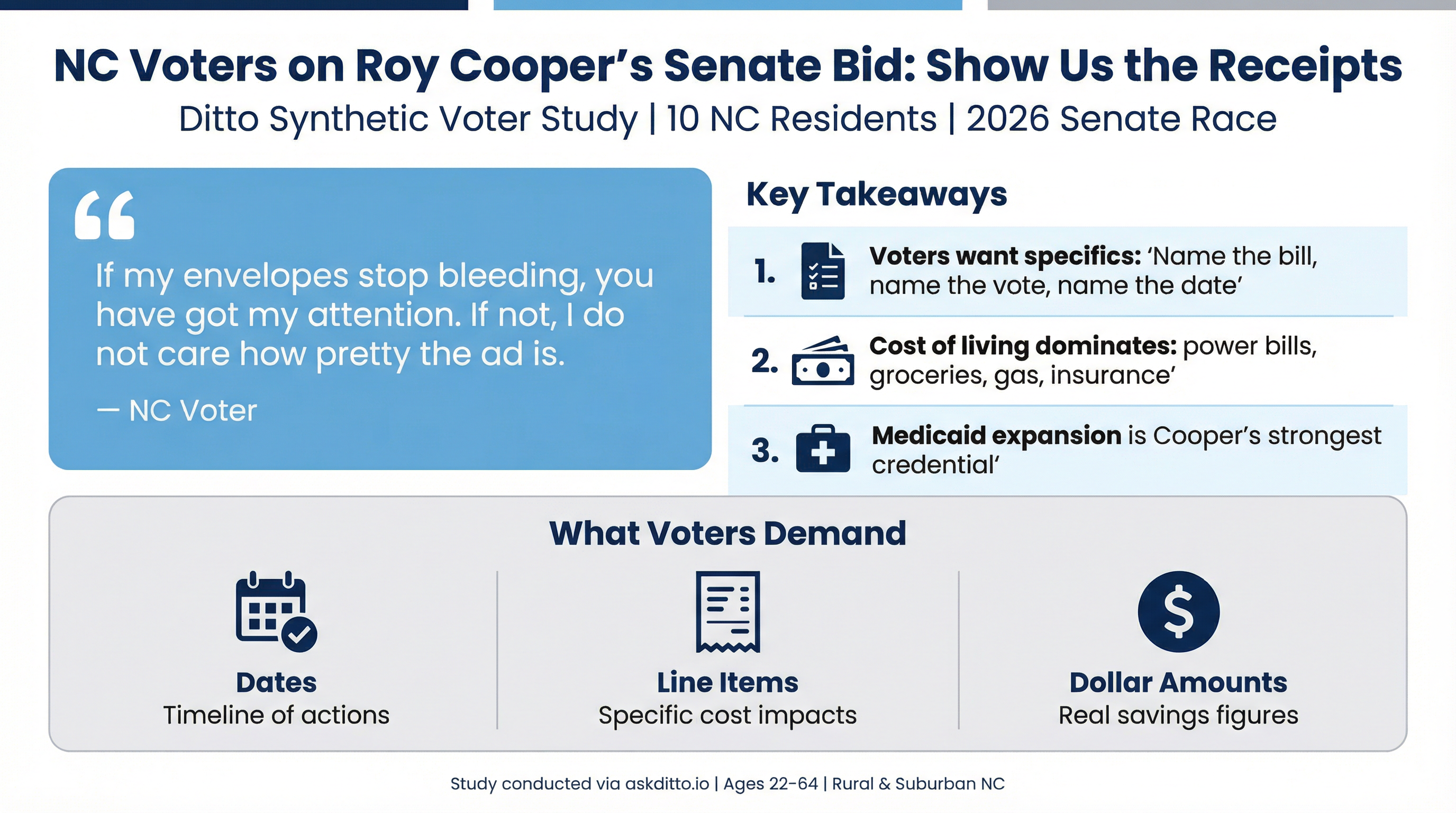
Ask ten North Carolina voters what they think about Roy Cooper running for Senate and you will not get a single hell yes. What you will get is something more interesting: a collective exhale, a cautious lean-in, and a very long list of receipts they want to see before they commit. We ran a live voter perception study with 10 NC voters to find out what Cooper's Senate bid actually sounds like at the kitchen table. The answer? Steady-but-prove-it.
Who We Spoke To
We recruited 10 North Carolina voters across the state: rural logistics workers, suburban retirees, nonprofit managers, agronomy directors, unemployed homeowners, young parents, and small-town educators. Ages ranged from 22 to 64. They live in Raleigh, Greensboro, High Point, Cary, and rural communities across the Piedmont and beyond. This is not a Research Triangle echo chamber. These are people who budget with cash envelopes, drive gravel roads, and have strong opinions about their power bills.
What We Asked
Seven questions designed to pressure-test Cooper's candidacy from every angle:
Gut reaction to Cooper running for Senate
Whether his 'lower costs for hardworking families' message lands or feels like standard talk
How his Medicaid expansion record affects their vote
The Cooper vs Whatley matchup: who do they trust more?
The single most important issue driving their vote
What they would ask Cooper to his face
Voting enthusiasm on a 1-to-10 scale and what moves the needle
The Gut Check: Cautiously Positive
The dominant reaction to Cooper's Senate run was cautiously positive. Voters described him as 'steady,' 'boring in a good way,' and 'not a circus.' One rural voter called him 'plain yogurt: not exciting, but it sits fine on a nervous stomach.' But caution was the operative word. Nearly every voter followed their positive lean with a 'but.'
He reads like a polite Raleigh Democrat who will vote the national line once he hits DC, and that regulatory drift is bad news for growers, small business, and folks who actually make things work outside the Triangle.
The swing voters are watching closely. They like stability over spectacle, but they have seen too many politicians 'climb to the next seat' without delivering locally first.
The Message Test: Lower Costs Lands, Billionaires Line Falls Flat
Cooper's core message about lowering costs for hardworking families hit the right nerve. Every single voter in this study feels squeezed on groceries, power bills, gas, and insurance. The problem? The message feels generic.
Parts land, parts feel like canned applause lines. I want specifics, not 'hardworking families' filler.
The 'billionaires vs working families' framing drew scepticism rather than solidarity. Multiple voters called it standard political talk. One rural voter put it bluntly: 'The billionaires line is fine, but everyone says it. Name the bill, name the vote, name the date.'
Healthcare: Cooper's Strongest Card
Medicaid expansion is Cooper's most tangible credential with these voters. Even conservative-leaning respondents acknowledged it as a real achievement. One suburban director of agronomy who leans right called it 'a mixed bag' but gave Cooper credit: 'It likely kept some rural ERs breathing.'
For uninsured and underinsured voters, healthcare is THE issue. A 54-year-old Greensboro woman who is currently uninsured said she needs to hear 'my monthly premium range at my age and income, in plain dollars' before she commits. Healthcare is Cooper's best card, but voters want him to play it with specifics, not slogans.
Cooper vs Whatley: Local Roots Beat Party Machine
The matchup question produced the clearest divide. Most voters trust Cooper more because he feels local. Whatley, as RNC Chair, reads as 'party machine' and 'DC-first.' One High Point voter described it as 'steady local grown up against party machine.'
I trust Whatley a bit more to vote how I lean on border, spending, judges. But he is a party chair, which makes me wary it will be all national talking points while our back roads and clinics get ignored.
The campaign takeaway: Cooper's localness is an asset, but he needs to lean into it hard. Voters who lean Republican are open to hearing him out IF he shows up outside the Triangle and talks about things they can feel on their monthly bills.
The One Issue That Matters: Cost of Living
When asked to name the single most important issue, the answer was overwhelming: cost of living. Not in the abstract. Voters named specific line items: power bills, grocery totals at Food Lion, car insurance, gas, and internet. Healthcare costs ran a close second, with rural and uninsured voters treating them as interchangeable with cost of living.
One rural logistics coordinator summed it up: 'If my envelopes stop bleeding, you have got my attention. If not, I do not care how pretty the ad is.' Culture-war messaging was explicitly rejected by multiple voters as a distraction from kitchen-table economics.
The Doorstep Question: Show Me the Numbers
If Cooper knocked on their door, these voters would ask for one thing: specifics. Not inspiration. Not values. Line items. Dates. Dollar amounts. A suburban director of agronomy wanted to know: 'What exact votes will you cast in your first year that cut my NC power bill and diesel price?' An uninsured Greensboro woman wanted: 'What will my monthly cost be to get decent coverage I can actually use, and what is the phone number with a live NC person I call when a bill goes sideways?'
The pattern is unmistakable: NC voters are done with vibes. They want a boring, precise one-pager with receipts.
Voting Enthusiasm: Steady But Not Fired Up
Enthusiasm scores ranged from 6 to 8 out of 10. These are habitual voters who will show up, but they are not excited about it. What moves the needle up: specific policy proposals, in-person events in their communities, easy early voting logistics, and less attack-ad noise. What keeps them home: bad weather plus logistical hassles, culture-war messaging with no substance, and the feeling that both candidates are party-first.
If they give me a boring, precise one-pager with rural receipts, bump me to a 9.
What This Means for the Cooper Campaign
Three strategic takeaways from this voter research:
Lead with specifics, not slogans. Every voter in this study is begging for numbers: monthly costs, bill names, vote dates. The 'hardworking families' framing is table stakes. The receipts are what close.
Play the local card relentlessly. Cooper's biggest advantage over Whatley is that he feels North Carolinian, not national. Show up east of I-95, in the Sandhills, at folding-chair town halls. Give voters a named local staffer with a phone number.
Make healthcare personal, not political. Medicaid expansion is a genuine credential. But voters want to hear what it means for THEIR premium, THEIR co-pay, THEIR pharmacy. Translate the policy into kitchen-table maths.
Want to run your own voter perception study? Explore the full interactive study here and see every response from all 10 NC voters. Ditto's synthetic research platform delivers insights like these in minutes, not months.