
I've been obsessing over what actually moves voters in competitive districts. Not the pundit takes. Not the Twitter discourse. The real stuff that makes someone think, "Yeah, okay, I'll show up for that person."
So I ran a study with six Arizona voters from AZ-03. Asked them about healthcare messaging, economic development, and whether they want ambitious progressives or practical problem-solvers. The results? Absolutely brutal for anyone still running on vibes.
The Participants
Six Arizonans from across the district: a 61-year-old bilingual customer success manager in Mesa, a 26-year-old Phoenix resident managing chronic illness on AHCCCS, a 56-year-old Tucson maintenance technician who's uninsured and works construction cleanup, a 57-year-old Buckeye controller, a 62-year-old retired office manager in Phoenix, and a 43-year-old tech project manager in Chandler. Different ages, different circumstances, but shockingly aligned on what they want.
Question 1: Ambitious Progressive or Practical Problem-Solver?
I asked whether they prefer candidates who run on ambitious progressive platforms or those who focus on being practical problem-solvers. The answer was unanimous and emphatic.
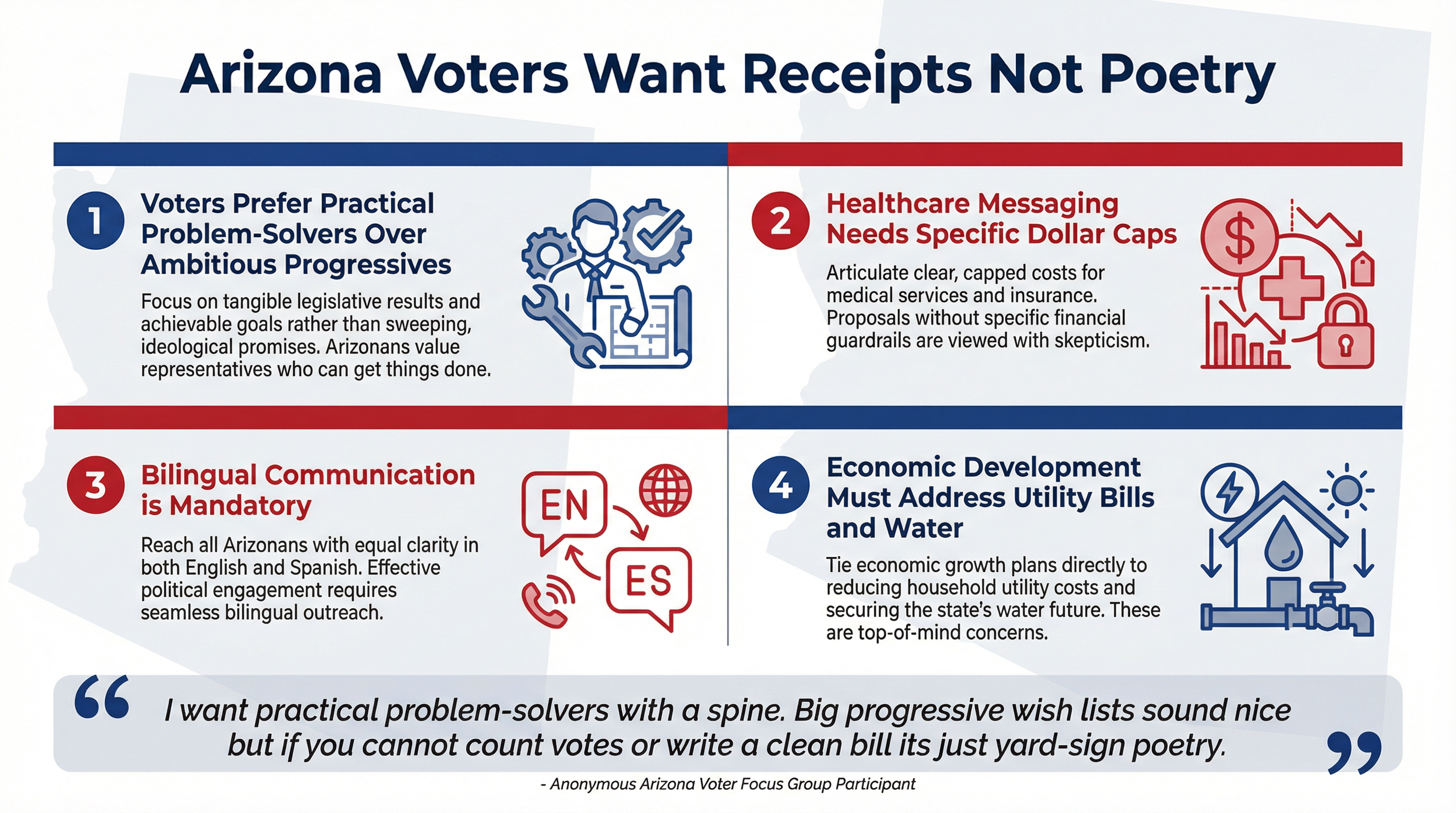
"I want practical problem-solvers with a spine. Big progressive wish lists sound nice, mija, but if you can't count votes or write a clean bill, it's just yard-sign poetry." - Dawnya, 61, Mesa
That phrase "yard-sign poetry" kept bouncing around my head. It captures something campaigns get wrong constantly. Voters aren't anti-ambition. They're anti-uncosted ambition.
"I want the boring problem-solver who shows their math and keeps their ego out of my wallet. Show the bill up front. What does it cost, who pays, when does it start." - Steven, 56, Tucson
What they actually want from candidates:
Top 3 priorities with exact timelines and pay-fors
Coalition math showing who they'll work with to pass legislation
Quarterly town halls with progress updates (in English AND Spanish)
A one-page PDF they can hand to family explaining the plan
Question 2: Economic Development and Clean Energy Jobs
Arizona is investing heavily in semiconductors and clean energy. So how should candidates talk about economic development to win votes?
The answer: start with my utility bill, not innovation buzzwords.
"My utility bill comes first. Spell out how big projects affect rates this summer and next. If there are subsidies, say who pays and when it sunsets. No hand-waving." - Janet, 62, Phoenix
Water came up constantly. These voters live in the desert. They know fabs are thirsty. And they want specifics.
"Water is non-negotiable. Spell out acre-feet per project, reuse plans, and who pays. No fuzzy metaphors, real gallons, real audits." - Deborah, 57, Buckeye
The 26-year-old on AHCCCS cut right to the chase:
"If you lure big employers, how are you stopping my rent from jumping $200? I want targets for affordable units near transit, protections against predatory hikes around job sites, and a simple renter tax credit I can actually claim." - Angie, 26, Phoenix
Question 3: Healthcare and Prescription Drug Costs
When candidates talk about fighting for affordable healthcare, what do these voters actually want to hear?
Spoiler: not slogans. Numbers.
"Cap insulin at 35 for everyone, not just seniors, and set a simple yearly out-of-pocket cap people can budget around. If you can't say the dollar amount, you're dodging." - Dawnya, 61, Mesa
The uninsured Tucson worker was even more direct:
"I don't want poetry. I want receipts. If you say 'affordable,' tell me: how much, for who, by when. No pharma PAC money. Post every meeting with drug lobbyists. I want receipts." - Steven, 56, Tucson
Key healthcare demands across all participants:
Specific monthly dollar caps on prescriptions (not "someday" promises)
PBM transparency with rebates passing through to patients
No pharma PAC money (full donor transparency)
Bilingual healthcare navigation support
Community clinic funding with real hours (evenings and weekends)
The Bilingual Expectation
One thing that kept coming up: candidates in AZ-03 need to communicate in Spanish. Not as a nice-to-have. As baseline expectation.
"Talk to me in Spanish, too. If you want my tia to buy in, give her the same details en espanol, not a watered-down flyer." - Yolanda, 43, Chandler
And from the Tucson maintenance worker: "Show up at 6 a.m. at a yard or a church hall, en espanol, with a one-page handout, not a podcast link."
What This Means for 2026 Campaigns
If I were advising a progressive candidate in AZ-03 right now, here's what I'd tell them:
Lead with receipts, not rhetoric. Every policy needs a timeline, a budget, and a coalition path.
Water is the killer issue. Have a specific answer ready.
Economic development only resonates when tied to utility bills and rent.
Healthcare messaging needs specific dollar caps, not fighting language.
Bilingual communication is mandatory, not optional.
Show up where people actually are: church halls, VFWs, early morning job sites.
The bottom line from these Arizona voters? As Dawnya put it: "Values first, receipts attached."
That's the formula. Everything else is just yard-sign poetry.
Cheers,
Sophie