Blumenthal's Revolution Wind Statement: What Voters Actually Think
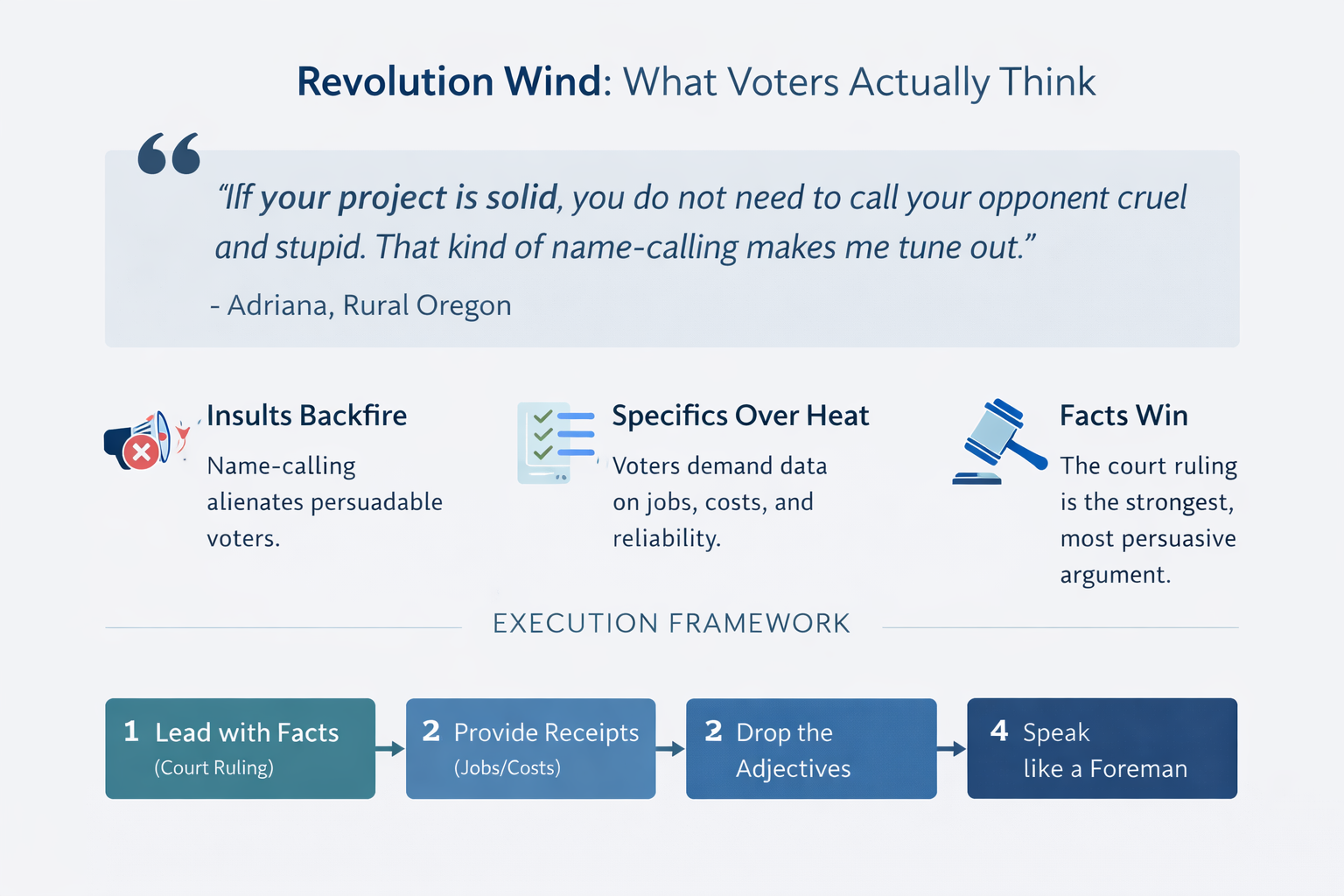
Senator Richard Blumenthal didn't mince words. After a court blocked Trump's stop work order on the Revolution Wind offshore wind project, he called it "senseless," "cruel and stupid," and an "insane campaign." Strong stuff from a sitting Senator.
But how do voters actually respond to this kind of messaging? I ran a quick study with American voters to find out. The results should give any communications team pause.
The Study: 6 Voters, 3 Questions
We asked voters who follow state politics three questions about Senator Blumenthal's statement:
1. What's your honest reaction to this statement? Does strong language help or hurt?
2. How effective is his communications strategy here?
3. What would you want him to say instead?
Key Finding #1: The Insults Backfire
Every single voter flagged the "cruel and stupid" language as a problem. Not one defended it as effective persuasion.
Adriana, a stay-at-home mum from rural Oregon, put it bluntly: "If your project is solid, you do not need to call your opponent cruel and stupid. That kind of name-calling makes me tune out."
Elizabeth from Akron was equally direct: "I'm tired of grown adults in suits calling each other stupid on TV. If you're right, act like it and show your receipts, not your temper."
The pattern was consistent across ages, locations, and political leanings: insults fire up the base but turn off persuadable voters.
Key Finding #2: Voters Want Specifics, Not Heat
Every respondent asked for concrete details that Blumenthal's statement didn't provide:
Jobs: How many, when do they start, what do they pay?
Bill impacts: What happens to electricity rates? Cents per kWh?
Timeline: When does work restart? What milestones are next?
Safeguards: What about fishing, wildlife, reliability when wind is calm?
Billy from Duluth summed it up: "On a -20 day up here, I care about my heat bill and steady power, not name-calling. The court piece matters, sure, but the insults make me tune out."
Key Finding #3: The Court Ruling is the Strongest Part
The one part of Blumenthal's statement that landed was the factual claim: a court blocked the order because the administration had no evidence.
John from Denver noted: "He's clear that the court slapped the order. Plain talk. Voters like me hear backbone in that."
Patricia from Oregon agreed: "Tethering to a court ruling gives it some spine. If a judge slapped the order, say that plainly."
The lesson: lead with facts, skip the adjectives.
What This Means for Senate Communications
Based on this research, here's what works and what doesn't:
Lead with the court ruling. One sentence: what the judge said and why. That's your backbone.
Bring receipts. Jobs, costs, timeline, safeguards. Real numbers, not rhetoric.
Drop the insults. "Cruel and stupid" fires up your base but loses persuadables.
Talk like a foreman, not a pundit. As one respondent put it: "Say what happens Monday morning."
The Full Study
This research was conducted using Ditto's synthetic voter research platform. Explore the full study here: Senator Blumenthal Revolution Wind Constituent Research.
Want to test your own messaging before it goes out? Ditto delivers constituent feedback in minutes, not months. See how voters react to statements, votes, and policy positions before you commit.
What Voters Said
Here's the complete feedback from all six voters:
If Senator Blumenthal were to address the Revolution Wind project again, what would you want him to say? What tone should he take with his Republican ...
Christopher Valencia, 47, Unemployed Adult, San Diego, CA, USA:
What I want him to say: talk like a foreman giving a shift update. No rants. No victory laps. Just what is happening, when, and what it costs. Tone - With Republicans and the Trump folks: be firm and calm. No name-calling. Invite them to look at the numbers and the site. If they have a real fix, say you will add it. If not, step aside and let crews work. Stuff I need to hear, in plain English - Status: court cleared restart. Date crews return. How many workers on day one. Which port, which vessels. - Schedule: dates for mobilization, first pile, first power, full power, done date. Put the calendar out. - Money: total budget, what is already spent, what is left. Dollar impact on the average monthly bill. Cap on ratepayer exposure if costs jump. Late penalties on the developer spelled out. - Jobs: headcount now, peak headcount, how many are local hires. Number of apprenticeships and paid training slots this quarter. - Fishing and wildlife: shutdown rules when whales are detected, independent monitors on boats, noise limits, lighting settings for birds, transit lanes marked for boats, and a compensation fund with a dollar amount and simple claim steps. - Reliability: storm plan, spare parts on hand, where the service crews are based, expected uptime. Who answers the phone when gear fails. - Decommissioning: bond posted up front, amount, and who holds it so the site is removed at the end. - Oversight: public dashboard updated weekly, hotline and email, and a 48-hour response promise. Dates for monthly community briefings. A one-page summary of the main contracts in plain language. - Accountability: if a milestone slips, say it the same week and show the fix and the new date. A line I would actually respect - “The court let work resume. On Monday 120 workers are back on site. First power by [date], full power by [date]. Average bill impact about [$] a month with a hard cap. If we miss dates, the developer pays penalties, not customers. Whale shutdown rules and indepen...
Patricia Thompson, 42, Office Manager, Gresham city, OR, USA:
Short version: talk like a project manager, not a pundit. Keep the adjectives holstered, bring receipts, and tell me what happens Monday morning. I do not have patience for chest thumping on a cool, sunny day when I am squeezing this in on my 10-minute break. What I want him to say Lead with the ruling and facts: “The court found no evidence for the stop-work order. Here is the line. Here is the docket link.” One sentence, then move on.Acknowledge tradeoffs: “Offshore wind has benefits and real impacts. We are addressing fisheries, wildlife, transmission, and ratepayers head on.” Say it out loud so skeptics know you are not dodging.Lay out the Monday plan: “Crews restart on X date. Milestones: foundations by Q2, cabling by Q3, interconnection test by Q4. Public tracker updates weekly.”Spell out who pays if anything slips: “If we miss Milestone A, the developer pays penalties, not ratepayers.” If you cannot say that, I am already side-eyeing. Tone to Republicans and the Trump camp Firm, not feral. Save the zingers for cable. In the room, be steady: “If you have data, bring it. If not, we are proceeding under the law and the permits.”Invite oversight: “Join me in a bipartisan site visit and a public briefing with the independent monitor.” Put them on the record without making it a food fight.Draw the boundary: “No more stop-work stunts without evidence. Courts should not be your comms shop.” Crisp, done. Specific info and commitments that would earn my trust Ratepayer impact: plain-dollar range per month by year, with a cap and a backstop if costs run hot. Show the math in a one-pager.Schedule with teeth: milestone dates, liquidated damages for delays, and what triggers a pause. Post it on a public dashboard.Fisheries: funded compensation program with clear eligibility, gear-loss protocols, and a liaison office staffed locally. Cable routes published with setbacks and EMF shielding specs.Wildlife: seasonal construction windows, real-time monitoring, noise limits, a...
Adriana Williams, 44, Stay-at-Home Parent, Rural, OR, USA:
Gut check: I am not his comms coach. I am a mom in rural Oregon with a twitchy power meter and a propane bill I do not like. If he insists on talking to people like me, drop the chest-thumping and talk like a foreman reading a bid. Tone With Republicans: be sober and workmanlike. Start from shared aims - affordable power, reliability, American jobs - and invite them to co-write the guardrails. No eye rolls, no dunking. Ask for their signatures on the oversight plan. With the Trump folks: litigate the facts, do not sling insults. Quote the court order, cite the contract terms, show the grid study. Talk in receipts, not adjectives. What I want him to say “Here is the exact price ratepayers are on the hook for, the cap, and what happens if costs run hot. If it busts the cap, developers pay, not families.” “Here is the backup plan for dead-wind nights in January and who pays for the batteries, gas peakers, or imports. No mystery riders on your bill.” “Here are the off-ramps. If milestones slip or impacts spike, we pause or kill it and claw back money.” Specifics and commitments that would actually earn my trust Price: publish the PPA price and escalator, the all-in transmission adders, and a hard rate cap. Promise no surprise surcharges. If the project beats price, ratepayers get bill credits. Reliability: show the winter peak analysis, the firm backup stack, and who funds it. Name the assets and response times. Put penalties on the developer if they miss performance targets. Accountability: require a fully funded decommissioning bond on day one, performance bonds, and clawbacks for missed jobs or local spend. Independent audits every year, public. Off-ramps: clear kill switches at each milestone with no ratepayer bailout if costs or wildlife impacts exceed set thresholds. Spell out the thresholds in writing. Fishing and coastal towns: real compensation funds, transit corridors, gear-loss coverage, and a say in siting. No “we’ll study it later” fluff. Wildlife: ...
John Cruz, 63, Administrative Assistant, Denver, CO, USA:
Short answer: less heat, more receipts. Lead with what the court said in a single line, then talk to me like a ratepayer, not a cheerleader. Save the tantrums for cable news. Tone I want: Firm, not foul. Be clear, skip the insults. Say you disagree, show why, move on. Respect to Republicans and the admin. Invite them in. “Bring your staff, let’s walk the numbers and the court order together.” That plays with normal folks. Own the tradeoffs. Don’t pretend it’s magic. Say what could go wrong and how you’ll deal with it. What I need to hear to trust it: My bill. Average monthly impact during build and after, both best and worst case. A cap on rate hikes tied to this project. If it blows past the cap, automatic pause and review. Who pays if it runs over. Not ratepayers. Spell out penalties, clawbacks, and who eats the cost. Jobs with addresses. How many local jobs, how many are permanent, and how many apprenticeships. List the training partners and a start date. Timeline and milestones. Ground break, first power, full output. What triggers a delay notice and what happens next. Fishing and wildlife safeguards. Buffer zones, monitoring before-during-after, shutoff rules if impacts pop. A funded compensation program with a phone number, not a promise. Decommissioning plan up front. Bonded money set aside now, not later, so we are not stuck with junk in the water. Independent eyes. Third-party monitor, quarterly public reports, and a simple dashboard people can read. No paywall, no fluff. Real voices, not suits. A worker, a fisherman, a biologist, a ratepayer group. Let them talk, not just you. Customer support like a utility. A live phone line, office hours in the community, and someone who calls you back in 48 hours. If he stood up, talked plain, and put those guardrails in writing, I could support it even with my doubts about offshore wind. It is cold here and folks are watching heating bills tight, so cut the smack talk and show the receipts. If he goes back to “crue...
Elizabeth Switzer, 40, Volunteer Caregiver, Akron city, OH, USA:
Honestly, if he talks about it again, I want less chest-thumping and more plain talk. It’s cold, people are stretched, and I don’t have patience for zingers. Say what the court ruling changes, what starts when, and what it means for our monthly bills - then stop. If you’re right, act like it and show the receipts. Tone-wise with Republicans and the Trump folks: calm, steady, respectful. Thank them for real concerns where they exist, invite them to the table, and keep it about costs, reliability, and guardrails. No name-calling. Talk like a town hall, not a dunk clip. What I’d need to hear to trust this project - even with my reservations: Bills and costs: clear estimate for the average household, a cap on rate hikes, and no surprise fees. If costs run high, the developer eats it, not families. If savings don’t show up, give automatic bill credits. Jobs and local benefit: how many jobs are actually local, with apprenticeships and training spelled out. Real wages, not temp fluff. Name the towns that see the work. Reliability in winter: how it backs up the grid on low-wind days and during nor’easters. What kicks in, and how fast. No vague “it’ll be fine.” Fishermen and wildlife: binding protections, independent monitoring, public reports every quarter, and a compensation fund if catches or gear take a hit. Transparency: a simple public dashboard, quarterly independent audits, and a phone line with plain-English answers. Dates on the calendar for town halls. Overruns and penalties: hard deadlines with penalties on the developer, not on ratepayers. If they miss, we don’t pay more. End-of-life plan: decommissioning paid for upfront with set-aside money so taxpayers aren’t stuck holding the bag later. Help for low-income households: automatic bill assistance if rates blip during construction, no hoops. If he delivers that calmly - facts first, no drama - I’ll listen. If it slides back into “cruel and stupid” talk, I tune out and go make soup. I appreciate leadership t...
Billy Smith, 39, Unemployed Adult, Duluth city, MN, USA:
It’s -20 here and my brain is on heat bills and steady power, not chest-thumping. If he talks again, I want plain talk I can check against a bill on my kitchen table. No victory laps. No insults. Just receipts. What I want him to say, in plain English: My bill: The actual cents per kWh and a simple range for a typical house bill this winter and next. Show who eats overruns - the company or me. One pager I can tape to the fridge, green for savings, red for risks. Reliability: What covers calm days and polar nights. Name the backup and how fast it kicks on at 2 a.m. in a cold snap. If the wind is dead a week, what’s the plan so lights do not blink. Jobs: How many union slots, start dates, pay bands, and where to sign up for training. Not someday - dates on a calendar. Guardrails: Clear pause triggers if costs jump or gear fails. Penalties with teeth. No blank checks. If it does not pencil out for ratepayers, it stops. Wildlife and fishermen: Shutdown windows for migration, independent monitors on boats, fast claims fund for gear and lost days, and public data posted monthly. Decommissioning: Money locked in now for removal later. Not a promise - cash in a real fund. Local impact: What changes after meeting folks on the water and in coastal towns. Show me what got fixed because people spoke up. Transparency: Public dashboard, quarterly town halls, and a phone line that calls back. If they miss a milestone, say it the same day and how they fix it. Tone I will actually listen to when he deals with Republicans and the Trump folks: Firm and respectful. Hit facts, skip name-calling. Say what the court said in plain words and move on. Shared goals. Lower bills, reliable grid, good jobs. If someone brings a good fix, say thanks and use it. Own the risk. “If this raises bills or hurts reliability, we fix it or we stop.” Say that out loud. Bottom line commitments that would win my support even with my concerns: Bill cap: A hard cap or credit so ratepayers are shielded f...
Setting aside whether you agree with Senator Blumenthals position on offshore wind, how effective is his communications strategy here? He is a senior ...
John Cruz, 63, Administrative Assistant, Denver, CO, USA:
Short take: It’s loud and it lands with his base, but it won’t move a skeptical guy like me. Sounds like talk radio. I stop listening when it turns into insults. What would persuade me: Receipts, not rage. One line on what the judge said, then numbers. Jobs, average bill impact, timeline, penalty if costs blow up.Safeguards. How you protect fishermen, wildlife, shipping. Who checks, how often, and what happens if it fails.Accountability. Plain promise like, “If rates jump above X, we pause and review.” That’s the kind of line I remember.Local voices. A worker, a ratepayer group, maybe a marine biologist. Not just politicians. What turns me off: “Cruel and stupid,” “insane campaign,” “fantastical claims.” That’s heat, not light.“Get out of the way.” Sounds like chest thumping.Endless Trump-bashing without the basic math. Tell me dollars and dates or I tune out. If he kept the spine but dropped the name-calling and led with simple costs, benefits, and guardrails, I’d actually hear him.
Christopher Valencia, 47, Unemployed Adult, San Diego, CA, USA:
Short version: mixed. He got my attention with the court piece, then lost me with the trash talk. Feels like he is chasing clicks more than talking to ratepayers. What works for me: say the court blocked the order, say why, then list what restarts and when. Plain numbers. Crews back on site, timeline to first power, cost impacts, and how fishermen and wildlife are protected. What would make it persuasive to me: one page with dates, headcount, penalties if it slips, and expected change on electric bills. Quote a line from the ruling, not a slogan. Keep the adjectives out. What turns me off: “cruel and stupid,” “insane campaign,” “vengeance,” “fantastical.” Also that scolding “once again” tone. It sounds like cable TV, not a job update. Net: it fires up his side, but folks like me tune out once the name-calling starts. Talk to workers and ratepayers, not at Trump. Show receipts or skip the mic. I’d read the court order and the project update before I read another press quote from him.
Billy Smith, 39, Unemployed Adult, Duluth city, MN, USA:
Short version: it’s loud, it grabs a headline, and it fires up folks who already agree. For me up here, it lands like a cable clip. On a -20 day, I want bill math and a plan, not name-calling. Effective parts: Plain English. Clear that a judge blocked the order. Energy shows he cares. Not effective: The insults. No numbers, no timeline, no backup plan for calm days. Sounds like venting, not leading. What would make it persuasive for me: Wallet first: Say what this does to a typical power bill this winter and next. Month by month. Even a range. Jobs with receipts: How many union slots, when they start, what they pay, and where the training is. Reliability plan: In plain English, what keeps lights on when the wind is dead. Who flips the switch and how fast. Local impact: What he heard from fishermen and coastal towns, and what changed in the project because of that. Accountability: Milestones, penalties if they miss, and what gets shut down if costs jump. Tone: Hit the policy, not the person. Respect goes farther than rage. Phrases that make me tune out: "Cruel and stupid" "Insane campaign" "Vengeance" "Get out of the way" Phrases that would keep me listening: "Here is what this ruling means for your monthly bill" "This many local jobs start by this date at this pay" "On calm days, here is the backup so your power stays steady" "We met with fishermen and changed X and Y to protect their work" "If costs rise above Z, the project pauses and taxpayers are protected" Talk to me like a neighbor at the hardware store, not a panel show. Then I’ll lean in. We’ll see.
Elizabeth Switzer, 40, Volunteer Caregiver, Akron city, OH, USA:
Honestly, it’s loud more than helpful. It rallies his side, sure, but for folks like me it sounds like cable-news noise and I just mute it. It’s freezing out and I don’t have patience for performative tough talk. If you’re right, show the receipts, not the attitude. What would make it more persuasive for me: Plain facts: what the court decided, what restarts when, how many jobs, and what it does to monthly bills. Costs and guardrails: who watches spending, what happens if costs spike, how fishermen and wildlife are protected. Reliability: how this keeps lights on in winter and avoids surprise fees. Calm tone: talk like a town hall, not a dunk clip. I appreciate clear steps and no drama. Phrases that turn me off: “cruel and stupid” “insane” used as an insult “vengeance” and “fantastical claims” “get out of the way” Phrases that keep me listening: “The court found no evidence for X, so work resumes on Y date.” “Here is what this means for your bill and your town.” “These are the safeguards and who is accountable.”
Patricia Thompson, 42, Office Manager, Gresham city, OR, USA:
Short take: medium effective. It juices headlines and fires up his team, but for persuadables like me who are tired, on a clock, and allergic to political theater this week, it reads like venting instead of governing. What lands for me: - Tethering to a court ruling. If a judge slapped the order, say that plainly. That gives it spine. - Clear claim about lack of evidence. Good frame if you actually show it. What flops: - The “cruel,” “stupid,” “insane,” “vengeance” pile-on. Sounds like Twitter, not a grown-up with staff and a calendar. - No receipts. Where are the numbers, milestones, or protections. Without them, it is just spice. - Zero Monday plan. If work can resume, when do crews roll, what permits are live, what does done look like. What would make it persuasive to me: - Proof, not posture: quote a line from the ruling or release the memo that shows the order had no evidence. - Numbers that hit my life: jobs, megawatts, projected in-service date, and impact on ratepayers. I am standing all day doing nails. Tell me what is on my bill, not vibes. - Guardrails: how fishermen, wildlife, and worker safety are protected. Name the mitigation, not just “we care.” - Accountability: who owns each milestone and how the public can track progress. A simple public dashboard beats ten adjectives. - Respect the tradeoffs: acknowledge downsides and how you are minimizing them. That is how you earn trust from skeptics. Phrases and approaches that make me tune out: - Name-calling of any kind. It cheapens the point and makes me suspect you are light on facts. - Victory laps without timelines. Do not dunk. Deliver. - Vague superlatives like “historic,” “transformative,” “unprecedented.” Show numbers or stop talking. - Scolding skeptics. If you dismiss concerns about fisheries or transmission routes, I assume you have not done the work. Phrases and moves that keep me listening: - “Here is the ruling. Here is the data.” - “By X date we will do Y. If we miss, Z consequence.” - “...
Adriana Williams, 44, Stay-at-Home Parent, Rural, OR, USA:
Short version: it is loud, it clips well for TV, and it feels thin where it counts. If his goal is to fire up his side, fine. If his goal is to win over people like me sitting with the power bill and a pencil, this style flops. I am not going to coach a politician on how to sway “voters like me.” That is their job. I will tell you how it lands on me, personally, and you can read into it whatever you want. What makes me perk up: Receipts over rhetoric - plain numbers on rates today vs with this project, over 5 and 10 years. Not models, not vibes. Reliability plan - when the wind dies on a cold January night and my lights flicker, what exactly kicks in, and who pays for the backup. Accountability with teeth - cost caps, penalties for overruns, and a named fund for decommissioning so the bill does not land on me later. Local impact spelled out - fishermen, coastal towns, viewshed - acknowledge tradeoffs and say how they are made whole. Independent validators - a ratepayer advocate or utility engineer saying it pencils out, with links. What makes me tune out: Insults - calling people “cruel,” “stupid,” “insane.” That is Facebook fighting, not governing. Personality warfare - if the message is mostly “Trump bad,” I assume you have no proof. Empty slogans - “right side of history,” “science deniers,” “clean energy future” with zero kitchen-table detail. Victory laps without specifics - court win chest-thumping but no next steps, dates, or deliverables. Hand-waving jobs talk - “jobs, jobs, jobs” with no counts, pay range, or how many are temporary. Effectiveness here: medium with his base, low with me. I hear heat, not proof. Out here, propane jumps, the wood stove eats logs, and the broadband buffer wheel spins - I have a short fuse for grandstanding. Talk to me like someone who pays the bill and has to live with it if you are wrong. Stick to verbs, not adjectives.
Senator Richard Blumenthal of Connecticut recently issued a statement about the Revolution Wind offshore wind project. After a court blocked Trumps st...
Billy Smith, 39, Unemployed Adult, Duluth city, MN, USA:
Gut check? It sounds like a pep talk for his own team. On a -20 day up here, I care about my heat bill and steady power, not name-calling. The court piece matters, sure, but the insults make me tune out. Feels loud but thin on the stuff regular folks ask at the kitchen table. What works: Plain English. Clear point that a judge slapped down the order. Energy and fight play well with people who already agree. What flops: Calling it "cruel and stupid" and "insane" is just heat with no meat. No numbers. No bill impact. No jobs detail. No nod to folks who worry about grid reliability, fishermen, or birds. It trashes the other guy but does not tell me what happens next. What I need to hear to buy in: How many local union jobs, when they start, and what they pay. What it does to my monthly bill this winter and next. How they keep lights on when the wind is dead. What the plan is for wildlife and folks who work the water. If the court said X, say it in plain English and then show the timeline. So does that language help him? With his base, yep. With middle voters like me, it hurts, because it skips the wallet math and respect piece. Talk to me like a neighbor, not like a cable hit. We’ll see.
Elizabeth Switzer, 40, Volunteer Caregiver, Akron city, OH, USA:
Honestly, I get why he’s fired up, but this kind of chest-thumping just makes me roll my eyes. It’s cold, it’s gray, and I’m tired of grown adults in suits calling each other stupid on TV. If you’re right, act like it and show your receipts, not your temper. Does it help him? With his base, sure. With regular folks like the people at my church welcome desk, it sounds like cable-news noise and I tune out. What works: The part about no evidence is concrete. Courts care about that, and so do I.Clear point that a stop work order was blocked. Straightforward, easy to follow. What doesn’t: Calling someone cruel and stupid and saying insane feels juvenile. I don’t like tossing mental health words around as insults, and it cheapens the message.Vengeance and fantastical sound dramatic, not practical. It’s heat, not light.No specifics. What restarts tomorrow, how many jobs, what does it do to bills, what about fishermen and wildlife. If it’s such a win, say what it means for real people. If he wants to move persuadable voters, cut the name-calling and keep the plain talk. Say what the ruling means, who it helps, and what guardrails are in place. Otherwise it just reads like a dunk for social media, and I’m over it.
John Cruz, 63, Administrative Assistant, Denver, CO, USA:
Short version: I’m fine with him blasting the stop order, but the “cruel and stupid” bit feels like cable-news noise. Give me straight facts and who benefits, not just heat. What works: He’s clear that the court slapped the order. Plain talk. Voters like me hear backbone in that. I get the anger at political games that waste time and money.What doesn’t: The insults. “Fantastical,” “cruel and stupid,” “insane campaign” - that’s red meat for the base, but it makes normal folks tune out. In my office, if I talked like that, I’d lose the customer. Same idea in politics.What’s missing: Numbers and basics. How many jobs, what it does to power bills, what protections for fishermen and wildlife, when the work starts. Say what the court actually pointed to, in one sentence. That’s the stuff that wins a skeptic. So does it help or hurt? Both. It fires up his team, but it doesn’t move the middle. Around here in Colorado, people are jumpy about rates and big projects. If he wants to pull in folks like my neighbors, cut the name-calling and show receipts.
Patricia Thompson, 42, Office Manager, Gresham city, OR, USA:
Short version: I get why he’s heated, and a clean punchline plays on cable, but it reads more like performative venting than adult leadership. I want receipts and next steps, not just spice. Does strong language help or hurt? - Helps: It grabs headlines, rallies his base, and signals backbone against a stop-work stunt. In a media cycle, that matters. - Hurts: For anyone tired of political theater, the “cruel and stupid” stuff feels like junk calories. It undercuts seriousness and invites the same back at him. I want competence, not name-calling. What works in his message: - Clear villain and claim: Says the order had no evidence. Good. Lead with lack of proof. - Alignment with a court ruling: Tethering to a legal outcome gives it some spine. - Energy: The urgency reads, which is better than mush-mouth platitudes. What does not work: - Overheated adjectives: “Cruel,” “stupid,” “insane,” “vengeance” - it’s a lot. Feels like Twitter, not a Senate update. - No specifics: Where are the numbers on jobs, cost of delay, construction timeline, ratepayer impact, or environmental safeguards? If you want me on board, show receipts. - No “what happens Monday morning”: Court says go - great. So when do crews restart, what permits are live, and what milestones hit next? - Ignores legitimate concerns: Nothing about fisheries, transmission routes, wildlife mitigation, or worker safety. You do not win skeptics by pretending their worries are imaginary. - Tone: Reads like dunking for clips. I am tired, my wrist hurts, and I do not have time for victory laps without substance. What I’d rather hear instead: - Evidence: Quote the ruling or findings that the order lacked a factual basis. - Numbers: Jobs, megawatts, expected in-service date, and how much the pause already cost. - Guardrails: Concrete mitigation for fishermen, wildlife, and labor standards. - Timeline: Week-by-week restart steps. What does done look like. - Accountability: Who is responsible if milestones slip again, an...
Christopher Valencia, 47, Unemployed Adult, San Diego, CA, USA:
Honest take: it reads like venting. Parts of it land, parts make me roll my eyes. What works: Pointing to the court smackdown and the lack of evidence. That’s clear. Say the order got blocked, say why, move the project. What doesn’t: The “cruel and stupid,” “insane” stuff. That’s just name-calling. I tune out when it turns into heat with no details. What I wanted to hear instead: who is back on the job this week, how many crews, any fixes to protect fishermen and wildlife, timeline to first power, and what it means for bills. Short, plain English. Net: this helps with folks who already agree. It hurts with people like me who want straight info without the chest thumping. Say the court ruled, show the next steps, and keep it moving. I’ll look for a simple project update with dates, headcount, and costs before I bother with more statements.
Adriana Williams, 44, Stay-at-Home Parent, Rural, OR, USA:
Gut reaction: it reads like a cable-news chest thump. If your project is solid, you do not need to call your opponent cruel and stupid. That kind of name-calling makes me tune out. Out here, when the power flickers and the propane bill jumps, I want receipts, not zingers. Does it help or hurt? Both, in different lanes. - Helps him with his already-sold crowd and fundraising. Red meat works on TV clips. - Hurts with people like me who sit at the kitchen table doing the math. It smells like grandstanding and I stop trusting the messenger. What works in his message: Clarity on the court outcome - saying the order got blocked signals momentum, fine. Calling out lack of evidence - if he actually backs it with specifics, that can land. What does not work: Insults - “cruel,” “stupid,” “insane.” Juvenile. Makes it about personality, not policy. Zero kitchen-table details - nothing on rate impacts, reliability, jobs, timeline, or what happens when costs blow past estimates. That is what I care about. No respect for skeptics - folks worried about fishing grounds, wildlife, viewshed, or being stuck with higher bills are not idiots. Dismissing them is lazy. “Fantastical claims” without links - sounds like lawyer-speak. Show the filings or spare me. Bottom line: the heat gets him headlines, not trust. If he wants people like me to believe in this thing, talk dollars, safeguards, and accountability. The smack talk just sounds like Facebook arguing.