
Here is something that has been bugging me about political communications: politicians keep using words that sound powerful in Washington but land flat with actual voters. Rep. Mike Levin recently accused the Trump Administration of 'weaponizing' the EPA against California. Strong language. But does it work?
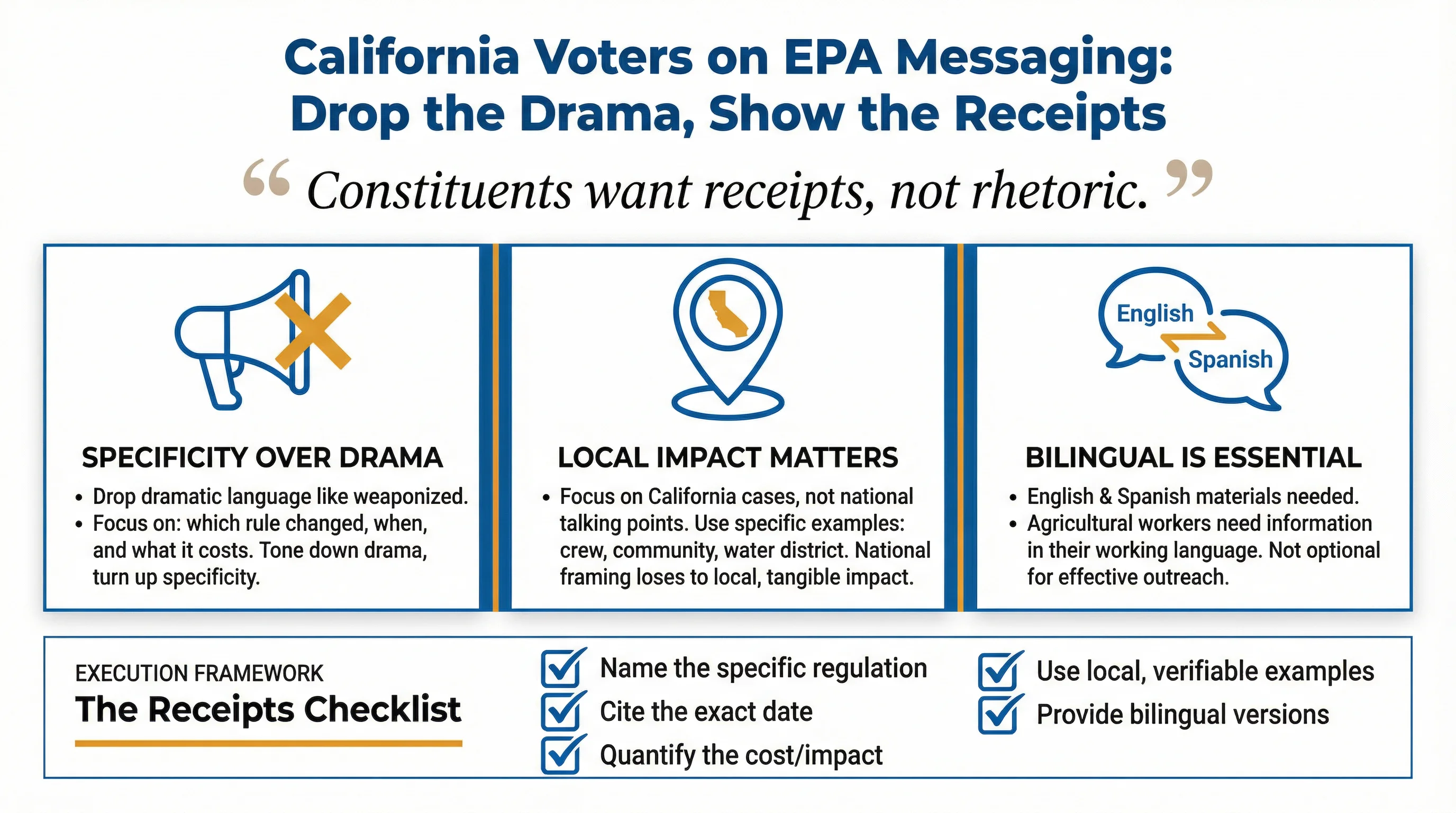
I ran a study with six California voters to find out. The feedback was blunt, practical, and surprisingly consistent. The short version: constituents want receipts, not rhetoric.
The Participants
The study included six California residents from Ditto's US research panel. They ranged from 25 to 67 years old, spanning urban and rural communities across the state. The group included a mix of income levels and political leanings, united by one thing: they all live with California's environmental realities, from wildfire smoke to water concerns to agricultural regulations.
This was not a poll about approval ratings. I wanted to understand how real Californians process political messaging about the EPA, and what would make that messaging more effective.
Finding 1: The Word 'Weaponized' Falls Flat
The most consistent feedback? Stop using dramatic language that sounds like cable news. Multiple participants pushed back on the word 'weaponized' specifically.
The sentiment was echoed across the group. Words like 'weaponized' register as performance, not policy. Californians dealing with actual environmental challenges want specifics: which rule changed, when, and what it costs them.
Key insight: Political language that plays well on cable news often alienates the very constituents it is meant to rally. Tone down the drama, turn up the specificity.
Finding 2: Constituents Want Receipts
Again and again, participants asked for concrete details. Not abstract accusations, but specific rules, specific dates, and specific dollar amounts.
One participant put it simply: name the regulation, show the timeline, explain the cost per acre or per gallon. Abstractions do not connect. Another said if you cannot bring receipts, better not to say it at all.
This is not about dumbing down the message. It is about grounding it in reality that constituents can verify and relate to. A farmer in the Central Valley does not care about bureaucratic turf wars in Washington. They care about permit timelines and compliance costs.
Key insight: Effective constituent communication requires local examples with verifiable details. Abstract framing fails to land.
Finding 3: Strong Appetite for Bilingual Communication
Several participants naturally switched between Spanish and English in their responses, and explicitly requested materials in both languages. This was not a question I asked directly. They volunteered it.
California is a linguistically diverse state, and EPA messaging that only exists in English misses a significant portion of the affected population. Agricultural workers, in particular, need information in their working language, not the language of press releases.
Key insight: Bilingual communication is not optional for effective California outreach. Constituents are asking for it explicitly.
Finding 4: Local Examples Matter More Than National Framing
Participants wanted to hear about California cases, not national talking points. They asked for local examples: what happened to a specific crew, a specific community, a specific water district.
The framing of EPA as a political weapon in a national battle does not resonate. What resonates is: here is what this EPA decision means for air quality in your county, or water access in your town, or permit costs for your business.
Key insight: National political framing loses to local, tangible impact. Start with the constituent's lived experience, then connect to the bigger picture.
What This Means for Congressional Communications
The research suggests a clear path for Rep. Levin's communications team, and really any congressional office dealing with complex regulatory issues.
First, drop the cable news vocabulary. Words like 'weaponized' signal that you are playing to a national audience, not speaking to your constituents. Second, lead with specific local examples that constituents can verify and relate to. Third, provide materials in both English and Spanish as a default, not an afterthought.
Most importantly: show your receipts. Name the rule, cite the date, quantify the cost. If the accusation is that the EPA is being misused, prove it with specifics. Constituents are not looking for red meat. They are looking for information they can use.
Methodology
This study used Ditto's synthetic research platform to gather feedback from six California-based personas. The research group was filtered to California residents only, with demographic diversity across age, income, and urban/rural location. Participants answered open-ended questions about their reactions to Rep. Levin's EPA messaging and their preferences for how environmental issues should be communicated.