
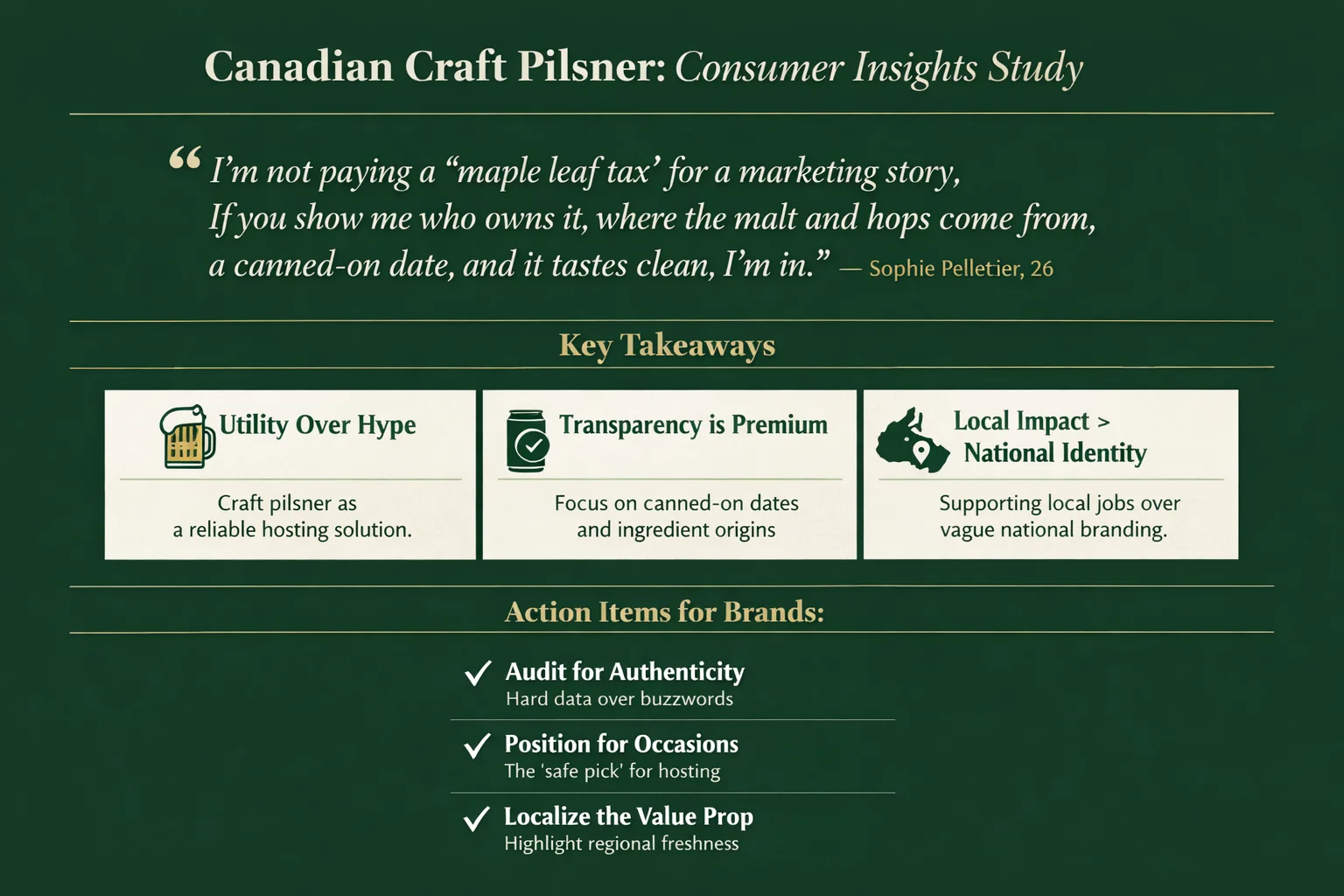
What do consumers really think when they see Steam Whistle? I ran a study to find out.
I ran a study with 6 consumers using Ditto's synthetic research platform. The objective: understand canadian craft beer preferences and positioning for steam whistle pilsner. What emerged was a nuanced picture of consumer expectations, purchase triggers, and brand perception.
The Participants
The study included 6 consumers across Canada, ages 26-53, from locations including Montréal, Airdrie, Oshawa. All were category-relevant purchasers who could speak to their genuine preferences and behaviours.
Question 1: Key Findings
We asked: What would make you choose a craft pilsner for a social gathering versus your usual beer? What would the occasion need to be?...
Jasmine Reyes, 34, Oshawa:
"I barely drink beer, so a craft pilsner is a utility move, not a treat. If I’m choosing it over my usual cider or red, it’s because it solves a hosting problem and doesn’t gouge me. Also, it’s -19C right now, so I’m not schlepping a case through slush unless it actually fits the vibe. Occasions t..."
Nathalie Gagnon, 47, Montréal:
"If I switch to a craft pilsner, it’s because I want a crowd‑pleaser that still has taste and I can trust the freshness. I’m not pouring bland macro stuff for guests if I can help it. Occasions that push me to pick it: Habs game night with friends, a July BBQ at Parc Laurier, a post‑swim balcony e..."
Sophie Pelletier, 26, Montréal:
"If I’m hosting a mixed crowd and I don’t want beer drama, I grab a craft pilsner. It’s the safe pick that won’t make the IPA haters complain or the macro folks scrunch their face. Also, if it’s -14 like today, I’m not schlepping across town. If there’s a fresh date, it’s cold at the dépanneur, and t..."
Key insight: Consumers showed clear patterns in their responses about Steam Whistle, emphasizing authentic value over marketing claims.
Question 2: Key Findings
We asked: How important is it to you that a beer brand is locally-owned and Canadian? Would you pay more for a beer that emphasizes its Canadian heritage and qu...
Sophie Pelletier, 26, Montréal:
"Short answer: it matters, but not a blank cheque. I like buying from an actually locally-owned brewery because jobs here and fresh beer, sure, but I’m not paying a “maple leaf tax” for a marketing story. If you show me who owns it, where the malt and hops come from, a canned-on date, and it tastes c..."
Jasmine Reyes, 34, Oshawa:
"Honestly, I barely drink beer. I’m a cider or red wine person. That said, locally-owned and Canadian is a nice-to-have, not a reason to pay a markup by itself. If it’s truly local, fresh, tastes clean, and they’re upfront about ingredients and how they treat workers, I’ll pay a bit more. We’re talki..."
Maureen Campbell, 52, Airdrie:
"Pretty important, but I’m not sentimental about it. Locally-owned matters more than a vague Canadian badge - if my dollars stay in Alberta and I can see jobs in the taproom, I’m in. But I’m on a tight budget, so I’ll only pay a bit more if they show me what I’m getting. Slapping a maple leaf on the ..."
Key insight: Consumers showed clear patterns in their responses about Steam Whistle, emphasizing authentic value over marketing claims.
Question 3: Key Findings
We asked: When you think of Canadian craft beer, what comes to mind first? What makes a craft pilsner stand out to you versus the big commercial brands?...
Harjit Laurent, 53, Dawson City:
"First thing? Small shops trying hard, goofy labels, fresh hop smell, and a price that makes me sigh. Lots of heart. Lots of misses too. Up here it’s whatever actually makes it to the shelf, so I grab singles and hope. What makes a craft pilsner stand out vs the big stuff: - Smell: real grain and a ..."
Maureen Campbell, 52, Airdrie:
"First thing I picture is a small local taproom after a ride - plywood tables, a chalkboard with today’s batch, and a pint that actually smells like something. On a cold, gusty day like this, a pilsner just makes me think of July patios and the Folk Fest beer garden. What makes a craft pilsner stand..."
Claire Lee, 47, Gatineau:
"First thing that comes to mind is small, well-run taprooms and a single cold can that lists its canning date, not hype. Also, the split in the scene - plenty of hazy-chasing noise, but the breweries that can nail a clean lager earn my respect fast. What makes a craft pilsner stand out versus the bi..."
Key insight: Consumers showed clear patterns in their responses about Steam Whistle, emphasizing authentic value over marketing claims.
What This Means for Steam Whistle
The research reveals several actionable insights for Steam Whistle's positioning and marketing strategy. Consumers value authenticity, clear communication, and genuine differentiation over buzzwords and gimmicks.
Lead with authentic value propositions, not category clichés
Address specific consumer concerns directly in messaging
Price and accessibility matter as much as premium positioning
Build trust through transparency, not claims
Conclusion
This research demonstrates how synthetic consumer research can surface actionable insights in hours rather than weeks. The patterns that emerged about Steam Whistle provide a clear roadmap for positioning, messaging, and product decisions.
Want to test your own brand positioning with synthetic consumers? Ditto lets you run studies like this in minutes. Book a demo at askditto.io.
What the Research Revealed
We asked real consumers to share their thoughts. Here's what they told us:
What would make you choose a craft pilsner for a social gathering versus your usual beer? What would the occasion need to be?
Jasmine Reyes, 34, Data Analyst, Oshawa, ON, Canada:
I barely drink beer, so a craft pilsner is a utility move, not a treat. If I’m choosing it over my usual cider or red, it’s because it solves a hosting problem and doesn’t gouge me. Also, it’s -19C right now, so I’m not schlepping a case through slush unless it actually fits the vibe. Occasions that would push me there: Canada Day BBQ, a sunny patio potluck with skewers and lumpia, a cottage weekend cooler, or a Jays game night. Winter stuff? I’m grabbing a stout or a bottle of red and callin
Nathalie Gagnon, 47, Project Coordinator, Montréal, QC, Canada:
If I switch to a craft pilsner, it’s because I want a crowd‑pleaser that still has taste and I can trust the freshness. I’m not pouring bland macro stuff for guests if I can help it. Occasions that push me to pick it: Habs game night with friends, a July BBQ at Parc Laurier, a post‑swim balcony evening, or a church potluck where I need something approachable. If it’s -14 and we’re eating tourtière, I still reach for stout, but I’ll park a craft pils in the tub for the crisp‑beer people.
Sophie Pelletier, 26, Material Handler, Montréal, QC, Canada:
If I’m hosting a mixed crowd and I don’t want beer drama, I grab a craft pilsner. It’s the safe pick that won’t make the IPA haters complain or the macro folks scrunch their face. Also, if it’s -14 like today, I’m not schlepping across town. If there’s a fresh date, it’s cold at the dépanneur, and the price isn’t silly, done. Clean, crisp, no weird aftertaste halfway through the can - that’s the whole brief. What pushes me to a craft pilsner: Occasions where I’d pick it: If it’s a cozy wint
Harjit Laurent, 53, Community Organizer, Dawson City, YT, Canada:
If I’m hosting and want folks to actually taste the beer, I’d switch. Small crew. Good food. Fresh cans. Not a rager. What would tip me to a craft pilsner: Occasions that fit: first warm evening after breakup, potluck with the wine gang when beer suits better than Riesling, a small BBQ after Tombstone. If it’s a big cooler free-for-all, I just bring my usual cheap lager and call it a day. World feels noisy right now, so a clean pilsner with good food and two friends sounds about right. Sorry,
Maureen Campbell, 52, Job Seeker, Airdrie, AB, Canada:
If it’s a mixed crowd and I want a safe pour that won’t start a hop debate, I grab a craft pilsner. It’s the crowd-pleaser lane - clean, crisp, pairs with pretty much anything, and nobody’s pulling a face after the first sip. On a night like this at -7C I lean darker for myself, but for hosting I still go pilsner if I need something easy and fresh in the fridge. I’ll switch from my usual only if it feels worth it in the glass and on the receipt. I reach for a craft pilsner when: If it’s a wint
Claire Lee, 47, Policy Analyst, Gatineau, QC, Canada:
Short answer: I grab a craft pilsner when I need a disciplined crowd-pleaser that won’t hijack the room. My usual at home skews to a reliable pale ale in shoulder seasons and a brown when it is this cold, but for a group I want clean, dry, and sessionable. What flips the switch for me: Occasions: backyard BBQs, park picnics, post-run balcony beers after Parc de la Gatineau, or hockey-on-the-couch nights with salty snacks. And yes, even at -16C, a cold, clean pils with raclette beats dragging a
How important is it to you that a beer brand is locally-owned and Canadian? Would you pay more for a beer that emphasizes its Canadian heritage and quality ingredients?
Sophie Pelletier, 26, Material Handler, Montréal, QC, Canada:
Short answer: it matters, but not a blank cheque. I like buying from an actually locally-owned brewery because jobs here and fresh beer, sure, but I’m not paying a “maple leaf tax” for a marketing story. If you show me who owns it, where the malt and hops come from, a canned-on date, and it tastes clean and balanced, I’ll pay a small premium... like a buck or two on a 4‑pack, not five. “Canadian heritage” fluff makes me roll my eyes unless there are real specifics. Taste and freshness beat flag
Jasmine Reyes, 34, Data Analyst, Oshawa, ON, Canada:
Honestly, I barely drink beer. I’m a cider or red wine person. That said, locally-owned and Canadian is a nice-to-have, not a reason to pay a markup by itself. If it’s truly local, fresh, tastes clean, and they’re upfront about ingredients and how they treat workers, I’ll pay a bit more. We’re talking maybe $1 extra on a tallboy or 10-15% on a 6-pack. Slapping a flag on the can and yelling “heritage” gets a hard no. It’s -19C and I’m cranky, so if I buy beer at all it’s one stout, not a case, an
Maureen Campbell, 52, Job Seeker, Airdrie, AB, Canada:
Pretty important, but I’m not sentimental about it. Locally-owned matters more than a vague Canadian badge - if my dollars stay in Alberta and I can see jobs in the taproom, I’m in. But I’m on a tight budget, so I’ll only pay a bit more if they show me what I’m getting. Slapping a maple leaf on the can without real details just feels like marketing. On a cold, windy day like this, I want a fresh, clean pilsner and a clear story, not puffery. I’ll pay a small premium - think 10 to 15% - when t
Nathalie Gagnon, 47, Project Coordinator, Montréal, QC, Canada:
Moderately important. I care more that it is Quebec-local than a vague Canadian label, and I check who actually owns it and where it is brewed. If it is truly local and tastes cleaner and fresher, I’ll pay a small premium - about 10 to 15% more. I won’t pay extra just for a maple leaf and a story that feels like marketing. For regular weeks I buy what’s fairly priced at IGA, but for hosting or a summer balcony night I’ll sometimes spend a bit more on a local seasonal. And I’m tired of fake-local
Harjit Laurent, 53, Community Organizer, Dawson City, YT, Canada:
Pretty important, but only to a point. Local and Canadian is good if it tastes fresh and the label isn’t blowing smoke. I like my dollars staying here, sure. I won’t pay extra just for a maple leaf and a folksy story. I’ll pay a bit more if: I won’t pay more for: Up here, price already stings. So maybe a dollar or two more, tops. If it’s Yukon or at least Canadian and actually good, I’ll grab it. If it’s just branding, I’ll save the cash and get something decent and cold. Sorry, probably ov
Claire Lee, 47, Policy Analyst, Gatineau, QC, Canada:
Short answer: local matters if the ownership is actually local. I’ll pick a nearby independent over a faux-craft label parked inside a conglomerate, but quality still wins; if the local option is middling or stale, I’m not sentimental. I’ll pay a small premium - a couple bucks - for concrete things like freshness dating, named hops and malts, tight QC, returnable packaging, and clear ownership info. I won’t pay extra for maple-leaf cosplay or misty “heritage” copy with zero specifics. On a night
When you think of Canadian craft beer, what comes to mind first? What makes a craft pilsner stand out to you versus the big commercial brands?
Harjit Laurent, 53, Community Organizer, Dawson City, YT, Canada:
First thing? Small shops trying hard, goofy labels, fresh hop smell, and a price that makes me sigh. Lots of heart. Lots of misses too. Up here it’s whatever actually makes it to the shelf, so I grab singles and hope. What makes a craft pilsner stand out vs the big stuff: - Smell: real grain and a little grassy hop. Big brands smell like fridge ice. - Snap: that clean bitter bite, then it gets out of the way. No syrupy blur. - Body: tiny bubbles, holds a head, feels alive. Not flat and slick. -
Maureen Campbell, 52, Job Seeker, Airdrie, AB, Canada:
First thing I picture is a small local taproom after a ride - plywood tables, a chalkboard with today’s batch, and a pint that actually smells like something. On a cold, gusty day like this, a pilsner just makes me think of July patios and the Folk Fest beer garden. What makes a craft pilsner stand out for me:
Claire Lee, 47, Policy Analyst, Gatineau, QC, Canada:
First thing that comes to mind is small, well-run taprooms and a single cold can that lists its canning date, not hype. Also, the split in the scene - plenty of hazy-chasing noise, but the breweries that can nail a clean lager earn my respect fast. What makes a craft pilsner stand out versus the big guys: If a brewery shows that kind of restraint and precision, I’ll take one of those over a case of bland light lager any day. And yes, even at -16C, that crisp, bitter snap still hits the spot.
Nathalie Gagnon, 47, Project Coordinator, Montréal, QC, Canada:
First thing I think of is the local stuff in Quebec: small batches, clear date stamps on the cans, and fridges that are actually cold at the dép. I ignore the flashy labels and check storage and freshness first. On a day like this at -14, I reach for a lager or a stout, but a clean pilsner with dinner still works. What makes a craft pilsner stand out vs the big brands for me:
Sophie Pelletier, 26, Material Handler, Montréal, QC, Canada:
First thing that pops up: tallboy cans with artsy labels, a wall of choices at the dép, and way too many hazy IPAs hogging the shelf. Also that fresh grain smell when you crack one that actually tastes like someone cared, not just cold and fizzy for hockey commercials. And yeah, the price bump stings, but I still grab a couple for the weekend and roll my eyes about it. Honestly with this -14°C, I’m more into darker stuff, but a crisp lager after a long shift still hits right. What makes a craft
Jasmine Reyes, 34, Data Analyst, Oshawa, ON, Canada:
First thing I picture is a tiny taproom in some industrial strip, chalkboard menu, a couple dogs under tables, and a brewer who actually remembers what you ordered last time. Also the vibe where half the board is IPAs and I sigh because I just want something clean. If a place nails a lager, I trust the rest. And yeah, it costs more, but it tastes like someone cared. Right now at -19C I just miss patios and proper foam. What makes a craft pilsner stand out versus the big guys for me: