
Rep. Brad Finstad recently made headlines with his statements on fraud investigations and ICE enforcement in Minnesota, including his claim that fraudsters 'played Minnesotans as chumps.' Strong language designed to generate attention. But I was curious: how does this messaging actually land with Minnesota voters?
I ran a study with six Minnesota residents to find out. The feedback was candid and constructive. The short version: constituents want specifics over soundbites, and they want fraud and immigration treated as separate issues.
The Participants
The study included six Minnesota residents from Ditto's US research panel, ranging from 29 to 64 years old. The group included residents from the Twin Cities metro area and rural Minnesota, with a mix of income levels and political leanings. What united them: they all pay attention to state issues and care about accountability in government.
Finding 1: Keep Fraud and Immigration Separate
The most consistent feedback? Stop mixing fraud and immigration in the same message. Constituents see these as distinct issues requiring different solutions, and conflating them muddies the argument.
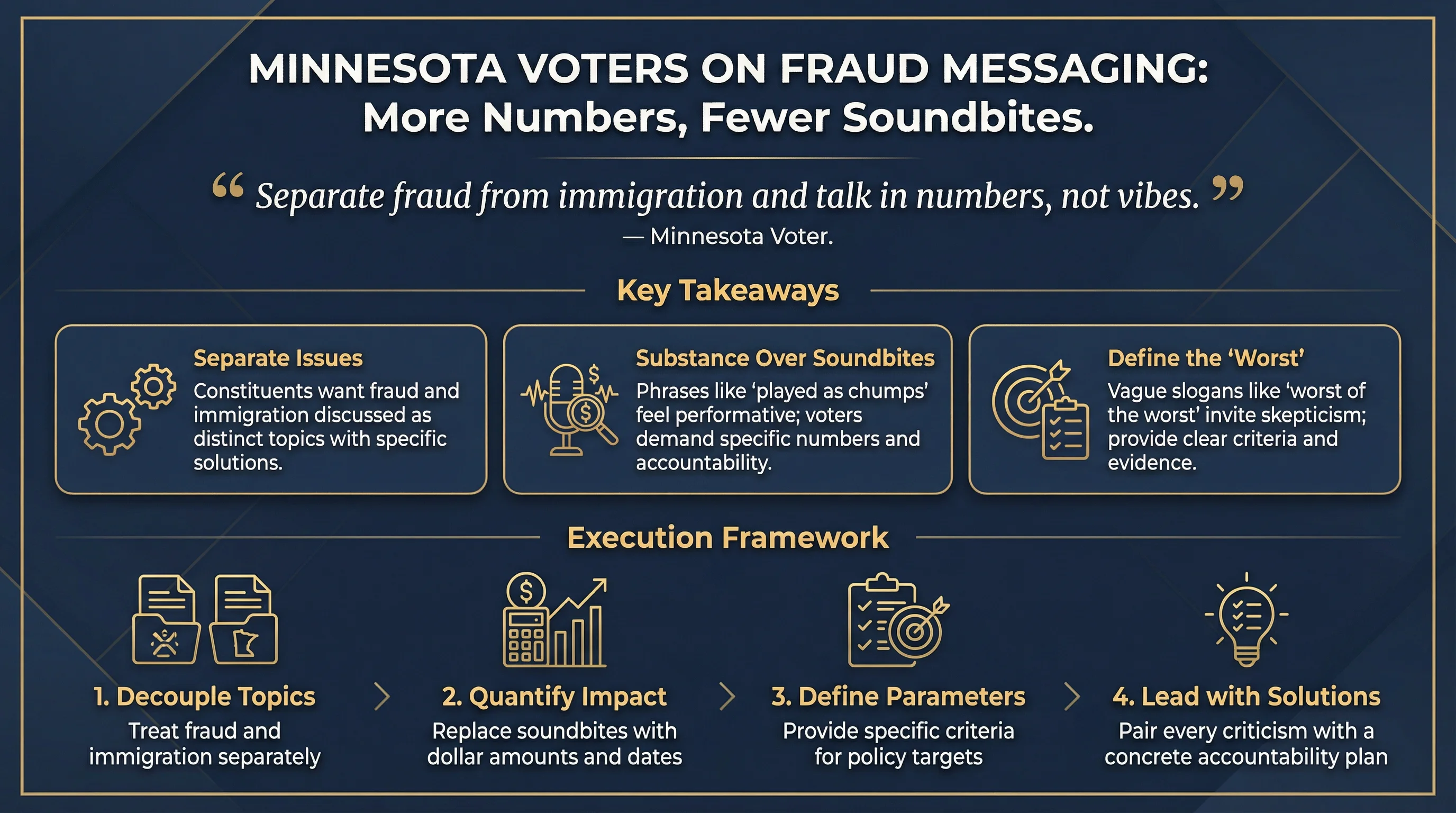
"Separate fraud from immigration and talk in numbers, not vibes." — Participant, Minnesota
Minnesotans pride themselves on fiscal responsibility and generosity simultaneously. They want to know that tax dollars are protected from fraud, and they also care about how immigrants are treated. Mixing these issues forces them into a false choice.
Key insight: Bundling multiple issues into single talking points may feel efficient but it actually alienates constituents who have nuanced views on each topic.
Finding 2: The 'Chumps' Line Lands as Performance
Multiple participants flagged the 'played Minnesotans as chumps' phrase as feeling performative rather than substantive. It generates heat but not light. What they want instead: specific numbers, specific amounts, specific accountability.
The appetite is not for watered-down language. Participants are genuinely angry about fraud. But they want that anger directed at solutions, not at applause lines. Show the dollar amounts. Name the agencies responsible. Outline the fixes.
Key insight: Emotion-laden soundbites may play well on cable news but constituents want substantive detail they can evaluate and act on.
Finding 3: 'Worst of the Worst' Needs Receipts
Rep. Finstad supports ICE enforcement, characterising targets as the 'worst of the worst.' Multiple participants pushed back, not necessarily on the policy, but on the lack of specificity. It sounds like a slogan without evidence.
The questions were practical: What is the exact definition? How many people fall into this category? What are the criteria? Constituents who might support targeted enforcement still want to know the parameters before they sign on.
Key insight: Even popular positions require evidence. Vague slogans invite skepticism. Specific criteria invite support.
Finding 4: Show the Plan, Not Just the Problem
Participants repeatedly asked: what comes next? It is not enough to point at fraud. They want to see the accountability framework: which agencies are responsible, what the timeline is for fixes, and who is tracking progress.
This reflects Minnesota's pragmatic political culture. Voters here expect competence. They are less interested in who to blame and more interested in how to fix it. Lead with solutions and the criticism becomes more credible.
Key insight: Problem identification without solution articulation reads as grandstanding. Minnesotans want to see the work, not just the anger.
What This Means for Congressional Communications
The research points to clear opportunities for Rep. Finstad's communications team. First, treat fraud and immigration as separate messaging tracks. Bundling them together may save time but it loses persuasion. Second, replace soundbites with specifics. The 'chumps' line generates attention but not credibility.
Third, define terms precisely. 'Worst of the worst' needs criteria that constituents can evaluate. Finally, always pair criticism with a concrete accountability plan. Show the dates, the dollars, and who owns each fix. Minnesotans respect the work more than the words.
Methodology
This study used Ditto's synthetic research platform to gather feedback from six Minnesota-based personas. The research group was filtered to Minnesota residents only, with demographic diversity across age, income, and urban/rural location. Participants answered open-ended questions about their reactions to Rep. Finstad's fraud and ICE enforcement messaging.