
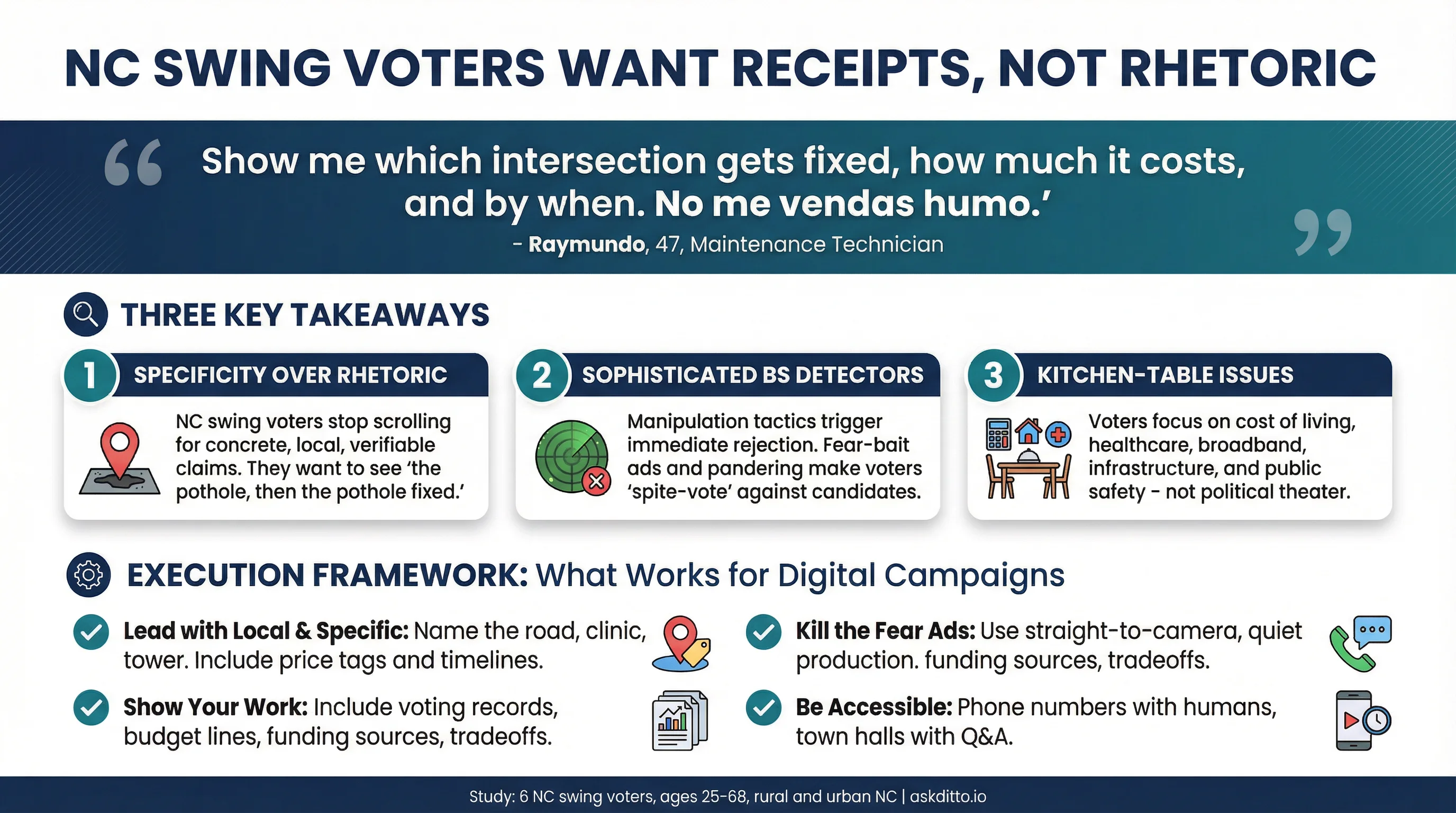
Six swing voters. Three questions. One consistent answer: stop treating us like idiots.
I ran a voter research study with North Carolina swing voters heading into 2026, and the responses were so consistent it almost felt coordinated. These voters span rural and urban NC, ages 25 to 68, different backgrounds, different priorities. But when it comes to political messaging? They all want the same thing: receipts, not rhetoric.
This matters for anyone running digital campaigns in a swing state. The consultants are getting it wrong, and the voters are telling us exactly how.
The Participants
I recruited 6 NC voters from Ditto's synthetic voter model. They include a medical billing specialist in rural NC, a retired IT project manager in Raleigh, a community volunteer, a maintenance technician, a retiree in Charlotte, and a young financial analyst in High Point. What unites them is their unaffiliated or swing status, and their deep fatigue with political noise.
What Actually Makes Them Stop Scrolling
When asked what political content catches their attention online, the responses converged on a single theme: specificity.
Show me which intersection gets fixed, how much it costs, and by when. No me vendas humo.
That's Raymundo, 47, a maintenance technician. He wants "receipts" - names, dates, numbers, and a timeline. The consensus across all six participants was clear:
Local faces and places they recognize, not DC studio shots
Plain language with the price tag attached
Quiet production - straight-to-camera, no scary music
How to show up: phone numbers, town hall times, not just donation links
Track record over promises: voting records and budget lines
Stephanie, 34, puts it bluntly: "If you cannot say what you will do, how you will pay, and when it starts, skip the ad and bring a one-pager."
Key insight: NC swing voters stop scrolling for concrete, local, verifiable claims. They want to see "the pothole, then the pothole fixed."
What Makes Them Reach for the Remote
The list of turnoffs was extensive and unanimous. These voters have developed sophisticated BS detectors and they are not shy about using them.
If your ad needs sirens and stock riot clips, you do not have a plan. Hard pass.
The universal dealbreakers include:
Fear-bait ads with grainy black-and-white footage and doom music
Fake urgency: "Triple match ends in 17 minutes" and pre-checked recurring donations
Pandering cosplay: new flannel, borrowed dog, fake twang, awkward biscuit photo-op
Cherry-picked votes from 900-page omnibus bills presented out of context
Push polls that are thinly disguised hit pieces
AI-polished fakery: plastic voiceover, uncanny B-roll
Using faith as a prop: staged prayer circles, Bible verses as bumper stickers
Celebrity endorsements (they trust the mail carrier over Hollywood)
Bethany, 55, captures the sentiment: "If it smells like panic fundraising or chopped attack clips, delete. If I cannot see the plan and the timeline, no voto, punto."
Key insight: Manipulation tactics that may have worked a decade ago now trigger immediate rejection. These voters will "spite-vote" against candidates who insult their intelligence.
What Actually Drives Their Vote
When asked about their top 2026 issues, NC swing voters focused overwhelmingly on kitchen-table concerns:
Cost of living: groceries, power bills, auto insurance, property taxes
Healthcare: premiums, prior auth nightmares, rural clinic access
Rural broadband: "Fiber in the ground, not press releases"
Roads and infrastructure with actual timelines
Public safety: but with accountability, not "circus acts"
Immigration: legal and humane, not chaos or cruelty
What struck me was how sophisticated their verification process is. Clayton, 64, described his "personal playbook": ignoring viral clips to pull full transcripts, triangulating with local paper and public radio, checking actual voting records, following the money, reading nonpartisan voter guides, watching full debates, and even emailing campaigns specific questions to test responsiveness.
Key insight: These voters are doing their homework. They are not passively consuming political messaging - they are actively fact-checking it.
What This Means for Digital Campaigns
The implications for anyone running digital outreach in NC (or any swing state) are clear:
Lead with local, specific, verifiable claims. Name the road, the clinic, the tower, the tax line.
Kill the fear ads. They trigger rejection, not persuasion.
Ditch the cosplay. Voters can "smell costume politics a mile off."
Show your funding. If donors hide, voters "assume the worst."
Respect their time. Short, captioned, no auto-play, mobile-friendly.
Include tradeoffs. Say what gets cut to pay for something. Treat voters like adults.
Have a real presence. Phone numbers answered by humans, town halls with unscripted Q&A.
As Jason, 45, put it: "If a candidate speaks like a foreman at the morning standup - what, when, who is accountable, how we will verify - I listen. If they speak like a commercial, I tune out."
The Bottom Line
NC swing voters are not persuaded by slick ads or emotional appeals. They want competence, specificity, and respect. They are tired, skeptical, and doing their own research. The campaigns that win them over will be the ones that stop treating political messaging like a marketing campaign and start treating it like a job interview.
Want to test your own campaign messaging with real voters? Ditto lets you run studies like this in hours, not weeks. Book a demo at askditto.io.