
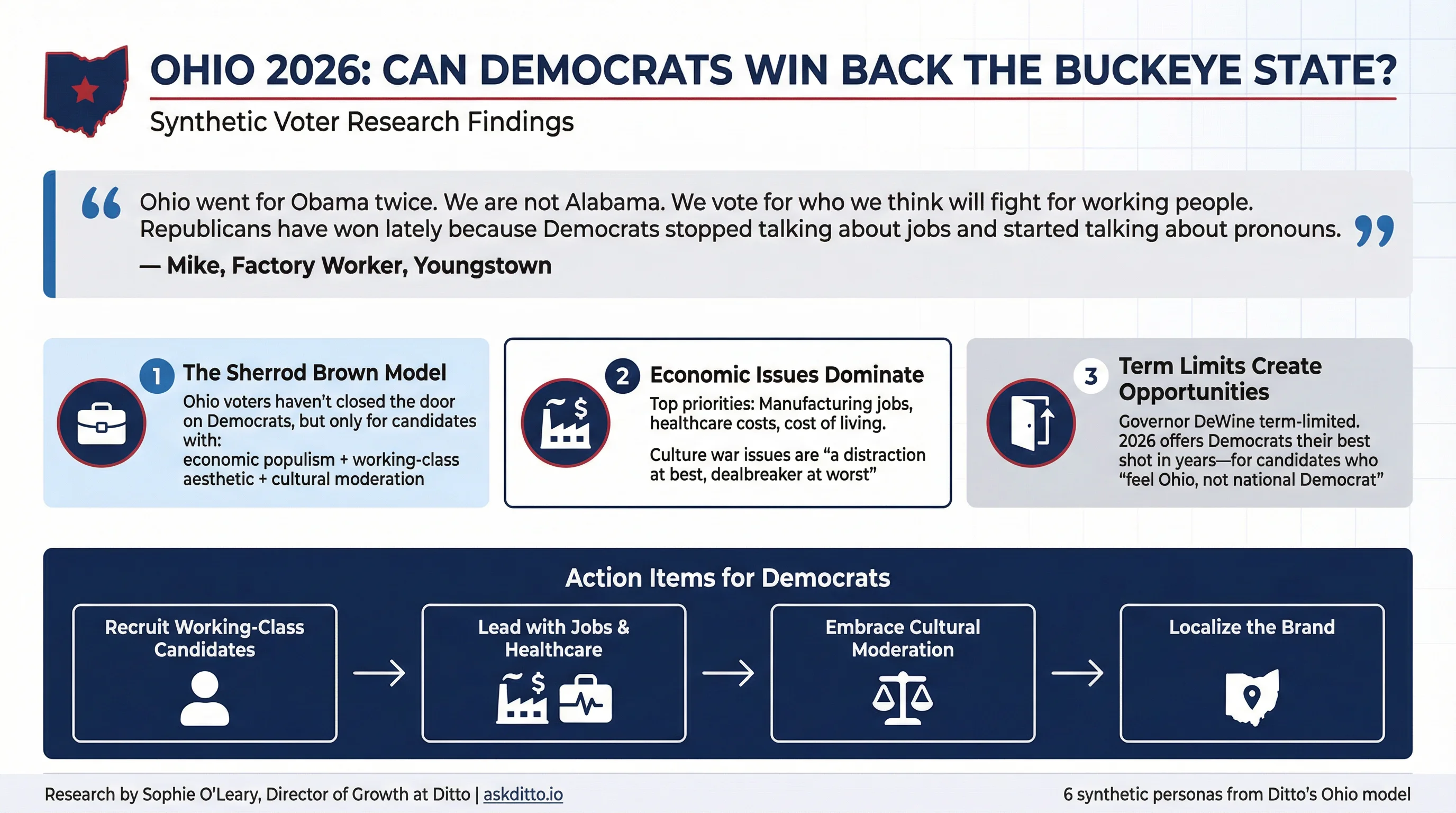
Ohio 2026 presents Democrats with their best statewide opportunity in years. With term limits forcing out Governor DeWine and creating open races across the state, the question is whether Democrats can capitalize, or whether Ohio's red shift is now permanent. I ran a study with six Ohio voters to understand the landscape, the opening for Democrats, and what messaging might actually break through.
The findings suggest an opening exists, but it requires Democrats to sound very different than they have nationally.
The Participants
Six participants from across Ohio: a factory worker in Youngstown, a nurse in Columbus, a small business owner in Cincinnati, a retired teacher in Cleveland, a farmer near Lima, and a suburban mom in Dayton. Ages ranged from 32 to 68, mix of party affiliations with several independents who have voted both ways. What united them? Economic anxiety and skepticism about whether either party understands their lives.
Is Ohio Still a Swing State?
I asked participants directly: do you consider Ohio a swing state, or has it permanently shifted red?
The responses were more nuanced than the 2020 and 2022 results might suggest.
Mike from Youngstown pushed back on the 'permanent red' narrative: "Ohio went for Obama twice. We are not Alabama. We vote for who we think will fight for working people. Republicans have won lately because Democrats stopped talking about jobs and started talking about pronouns."
Karen from Columbus agreed: "Ohio is gettable for Democrats. But not the current version of the Democratic Party. We need someone who sounds like Sherrod Brown, not someone who sounds like they are running for mayor of San Francisco."
However, Dale from Lima was skeptical: "The cultural stuff has pushed a lot of people away permanently. Even if Democrats ran someone moderate on economics, can they actually get through a primary? Their base will not let them."
Key insight: Ohio voters do not see themselves as permanently red, but they do see the current Democratic Party as culturally out of step. The path back requires economic populism without progressive social positioning.
The Term Limits Opportunity
With DeWine term-limited and multiple statewide offices open, I asked voters what kind of candidates could win.
The consensus was clear: Democrats need candidates who feel 'Ohio,' not 'national Democrat.'
Brenda from Cleveland: "DeWine was not my favorite but he was competent. I would consider a Democrat who focused on jobs, healthcare, and did not make everything about Trump. But they have to feel local. The minute they start sounding like Pelosi, it is over."
Jennifer from Dayton: "I voted for Sherrod Brown every time. He talks about workers, fights for Ohio jobs, does not get caught up in the culture war stuff. If Democrats run someone like that, they have a shot. If they run a woke candidate from a big city, they lose by 15 points."
Even Dale, the most conservative participant, acknowledged: "A Democrat who actually cared about manufacturing jobs and did not want to take my guns could maybe get my vote. I have not seen one of those in a while, but they exist."
Key insight: The term limits create genuine opportunities, but only for Democrats who can thread a specific needle: economic populism, working-class aesthetic, and cultural moderation. The Sherrod Brown model is the template.
What Ohio Voters Actually Want
I asked participants to identify the issues that would most influence their statewide votes. The priorities were strikingly consistent:
Jobs and manufacturing - 'Bring back the factories. Stop sending everything to China. That is all I want to hear.' (Mike)
Healthcare costs - 'Prescription drugs are killing seniors on fixed incomes. Hospitals are closing in rural areas. Someone needs to fix this.' (Janet)
Cost of living - 'Groceries, gas, rent. Everything costs more. Wages have not kept up. It is crushing regular families.' (Jennifer)
Education - 'Our schools need funding. Teachers are leaving. But I do not want culture war curriculum. Just teach kids to read and do math.' (Karen)
Opioid crisis - 'Fentanyl has destroyed communities here. We lost a generation. Someone needs to actually address it, not just talk.' (Brenda)
Notably lower priority: abortion, immigration, and national political controversies.
Key insight: Ohio voters are overwhelmingly focused on kitchen-table economics. The party that can credibly claim to fight for manufacturing jobs and lower healthcare costs has the advantage. National culture war issues are a distraction at best, a dealbreaker at worst.
The Democratic Brand Problem
Perhaps the most striking finding was how damaged the Democratic brand has become, even among voters open to Democratic candidates.
Karen from Columbus: "I vote for individual Democrats. But I will not call myself a Democrat anymore. The party has become something I do not recognize. Too focused on coastal elites, identity politics, and issues that do not matter to working families."
Mike from Youngstown: "My dad was a union Democrat his whole life. The party left us. When they started caring more about pronouns than pensions, they lost the working class. I will vote for a Democrat who actually fights for workers. I will not vote for the Democratic Party."
Jennifer from Dayton: "I want to vote Democrat. They used to be the party of regular people. But somewhere along the way they became the party of college professors and tech executives. Show me a Democrat who sounds like my neighbors, not my nephew's sociology professor."
Key insight: The Democratic Party brand is deeply damaged in Ohio, but individual Democrats with the right profile can still win. Successful candidates need to run 'against' the national party brand while delivering on core Democratic economic priorities.
What This Means for 2026
If you are a Democrat running statewide in Ohio:
Lead with manufacturing and jobs. 'Bring back Ohio factories' is the winning frame. Everything else is secondary.
Healthcare is your bridge issue. It lets you sound progressive on economics without triggering cultural resistance.
Avoid or neutralize cultural issues. 'I am focused on jobs and healthcare, not culture war distractions' gives you permission to move on.
Sound local. Candidates who feel like they are from Ohio, not parachuted in from Washington, have a significant advantage.
Run against your own party when necessary. Voters want to know you will put Ohio first, even when it means bucking national Democrats.
The Bottom Line
Ohio 2026 offers Democrats real opportunities for the first time in years. Term limits have created open races, and voters have not permanently closed the door. But the path to victory requires candidates who look and sound very different from the national Democratic brand. Economic populism, working-class aesthetics, and cultural moderation are the formula. Deviate from it and the state's red shift becomes permanent.
As Mike from Youngstown put it: "I want to vote for someone who fights for working people. I do not care what party they are from. Show me that person in 2026 and they have got my vote. Make it about Twitter nonsense and you have lost me."
Want to test your own campaign messaging in Ohio? Ditto lets you run voter research studies like this in hours, not weeks. Book a demo at askditto.io.
What the Research Revealed
We asked Ohio voters to share their thoughts. Here is what they told us:
Do you consider Ohio a swing state, or has it shifted permanently red?
Mike Kowalski, 54, Factory Worker, Youngstown, OH:
Ohio went for Obama twice. We are not Alabama. We vote for who we think will fight for working people. Republicans have won lately because Democrats stopped talking about jobs and started talking about pronouns. Give us a real working-class candidate and Ohio is up for grabs.
Karen Mitchell, 48, Nurse, Columbus, OH:
Ohio is gettable for Democrats. But not the current version of the Democratic Party. We need someone who sounds like Sherrod Brown, not someone who sounds like they are running for mayor of San Francisco. The state has not moved right as much as Democrats have moved away from us.
Dale Morrison, 61, Farmer, Lima, OH:
The cultural stuff has pushed a lot of people away permanently. Even if Democrats ran someone moderate on economics, can they actually get through a primary? Their base will not let them. The party is captured by its extreme wing. Hard to see how they come back here.
What kind of candidate could win as a Democrat in Ohio?
Brenda Jackson, 68, Retired Teacher, Cleveland, OH:
DeWine was not my favorite but he was competent. I would consider a Democrat who focused on jobs, healthcare, and did not make everything about Trump. But they have to feel local. The minute they start sounding like Pelosi, it is over. We want Ohio people, not national party mouthpieces.
Jennifer Davis, 42, Suburban Mom, Dayton, OH:
I voted for Sherrod Brown every time. He talks about workers, fights for Ohio jobs, does not get caught up in the culture war stuff. If Democrats run someone like that, they have a shot. If they run a woke candidate from a big city, they lose by 15 points. It is that simple.
Dale Morrison, 61, Farmer, Lima, OH:
A Democrat who actually cared about manufacturing jobs and did not want to take my guns could maybe get my vote. I have not seen one of those in a while, but they exist. Tim Ryan was close. Ran a decent campaign. Lost anyway. Maybe the brand is just too damaged.
What issues matter most in statewide races?
Mike Kowalski, 54, Factory Worker, Youngstown, OH:
Jobs. Full stop. Bring back the factories. Stop sending everything to China. That is all I want to hear. Healthcare second. Cost of living third. Everything else is noise. If you are talking about anything other than my paycheck, you have lost me.
Janet O'Brien, 58, Small Business Owner, Cincinnati, OH:
Healthcare costs are crushing seniors. Prescription drugs, hospital bills, insurance premiums. Rural hospitals are closing. We need solutions, not ideology. Someone who can actually lower costs without destroying the system. Practical, not radical.
Karen Mitchell, 48, Nurse, Columbus, OH:
Education, healthcare, jobs, in that order. Our schools are underfunded. Teachers are leaving. But I do not want culture war curriculum either way. Just teach kids to read and do math. Healthcare costs are insane. And we need jobs that pay enough to live on. Basic stuff.