
Poshmark has built its brand on being the "social" resale marketplace. Follow sellers. Comment on listings. Join live Posh Parties. Watch Posh Shows. It's commerce meets community, and it's a key differentiator from competitors like ThredUp or eBay.
But here's the question product teams should be asking: do shoppers actually WANT a social experience when buying secondhand clothes? Or are these features getting in the way?
We asked 6 US online shoppers. Their feedback was brutally honest.
The Research Setup
We assembled 6 US consumers aged 22-45 who shop online regularly. Not Poshmark power users, but people who might browse resale platforms when looking for deals. We asked them three questions about Poshmark's UX: trust signals, social features, and the new Smart List AI.
Finding #1: Social Features Make People LESS Likely to Use the App
This was the big one. We expected mixed reactions. We got consistent pushback.
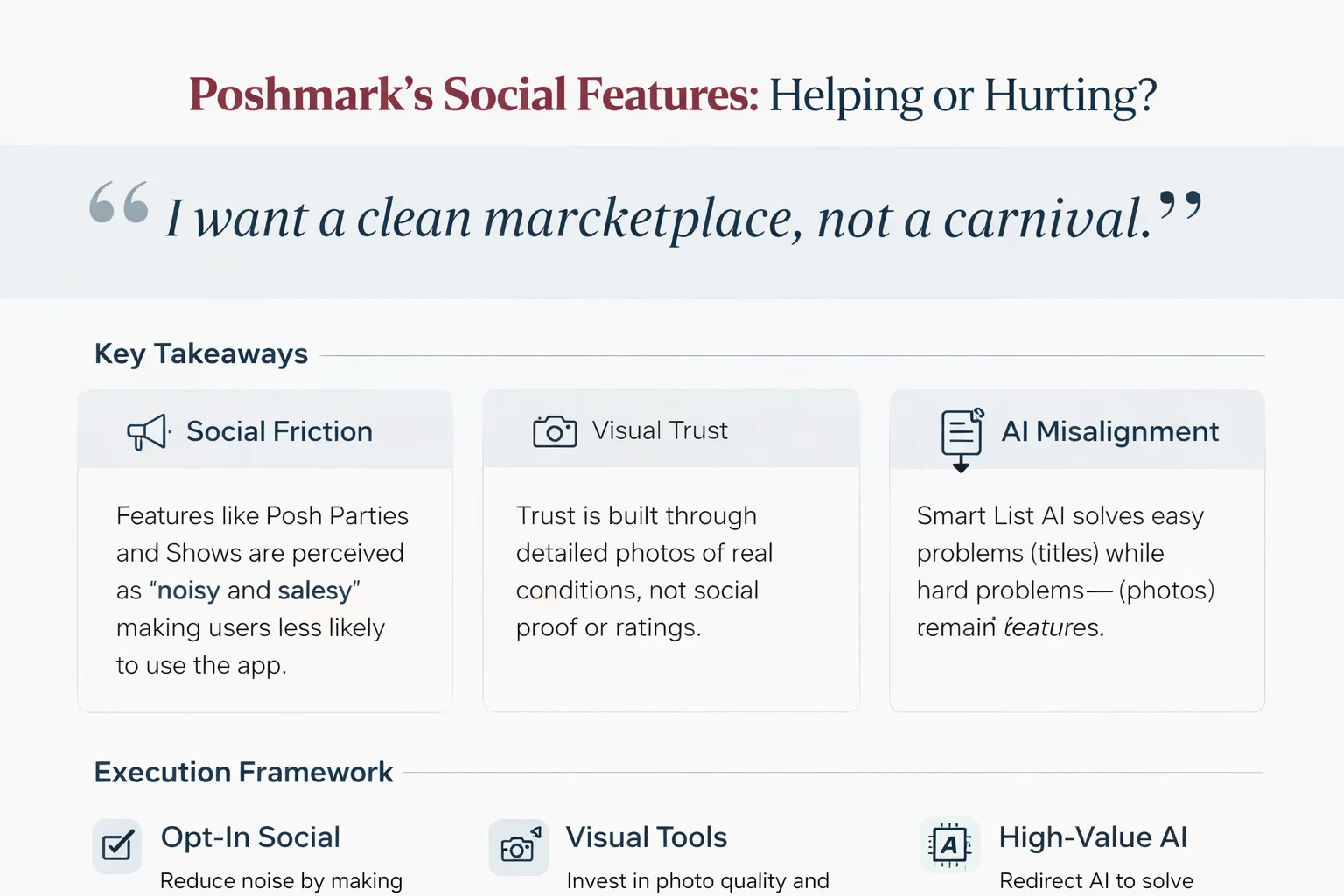
"I want a clean marketplace, not a carnival," one participant told us. "I'm not burning data to watch someone yell 'last call' into a ring light."
Another was equally direct: "Most of that social stuff feels noisy and salesy. Extra chatter just makes me close the app."
The pattern was clear: following sellers is useful. Comments can be helpful. But live shopping streams and themed parties? They feel like distractions rather than features.
Finding #2: Trust Comes From Photos, Not Features
When we asked what makes shoppers trust a secondhand listing, the answer was refreshingly simple: show me the real thing.
"I trust the pics, not the talk," one participant said. "If the photos feel like the seller actually handled the thing, I'm good. If it looks like a flyer, I bounce."
Another participant: "If I have to guess, I bounce. Show me close-ups. Show me the flaws. Stop trying to make it look prettier than it is."
The implication for product design: invest in better photo guidelines and quality signals rather than more social features.
Finding #3: Smart List AI Is Cool, But Trust Is Thin
Poshmark recently launched Smart List AI, which automatically generates listing titles and details from a photo. We asked how shoppers feel about this on both sides of the transaction.
For sellers: lukewarm. "I do not trust auto-copy," one participant said. "I still have to fix it, so it does not save me time."
Another was blunter: "Writing a title is the easy part. Photographing and measuring is the bottleneck. AI solved the wrong problem."
For buyers: scepticism. "If I know it's AI-written, I trust it LESS. I want to hear from the actual person who owned the item."
The Strategic Implications
For Poshmark's product and design teams, this research suggests a few uncomfortable truths:
1. Social features may be hurting more than helping — The differentiator that made Poshmark special is now feeling like friction. Consider making social features opt-in rather than default.
2. Trust is visual, not social — Shoppers trust clear photos showing real condition, not seller ratings or social proof. Invest in photo quality tools and flaw disclosure.
3. AI features need to solve real bottlenecks — Smart List AI is solving the easy problem (titles) while the hard problem (photos, measurements, authenticity) remains. AI that helps with the HARD parts would be more valuable.
Test Your Own Product Decisions
This study took about 15 minutes from question design to actionable insights. If you're building product features and want to know what users actually think — before you ship — Ditto can help you find out fast.
We integrate with Figma, Canva, and Framer so you can get feedback directly in your design tools.