
What do consumers really think when they see Rude Health? I ran a study to find out.
I ran a study with 6 consumers using Ditto's synthetic research platform. The objective: understanding how uk consumers perceive organic dairy-free alternatives and b corp brands. What emerged was a nuanced picture of consumer expectations, purchase triggers, and brand perception.
The Participants
The study included 6 consumers, ages 33-55, from locations including Aberdeen City, Swansea, Birmingham. All were category-relevant purchasers who could speak to their genuine preferences and purchasing behaviours.
Question 1: What Drives Purchase Decisions
We asked: What would make you pay more for a premium plant-based milk or granola? Is taste the main driver, or do ethical business practices and sustainability genuinely influence your choice?...
Natalia Kowalska, 45, Liverpool:
"Taste and performance first. I only pay extra if the cup is nicer and the pack is less hassle. Bad tea ruins my day, sorry. I’d pay more for milk if: I’d pay more for granola if: Ethics and sustainability? Nice to have, not my wallet’s boss. If price is close, I’ll choose UK oats, no palm oil, clear recycling, fair pay stuff. I will not pay ..."
Sophie Hartley, 33, Croydon (London Borough):
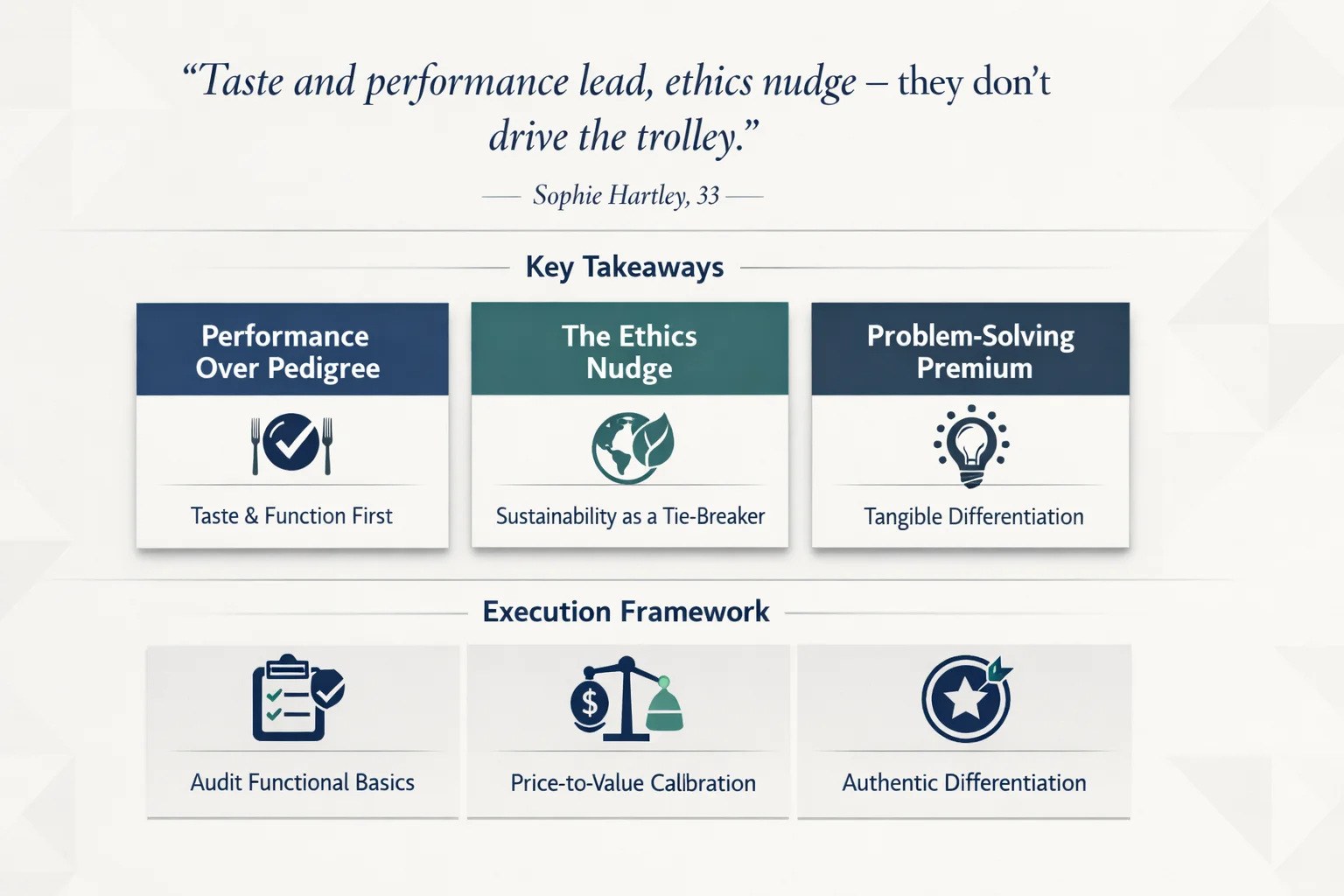
"Short answer: I’ll pay a bit more if it’s noticeably better to use every day. Taste and performance lead, ethics nudge - they don’t drive the trolley. So yes - taste and function first. Ethics tip it when prices are close. Nail both without rinsing my Monzo and I’m in...."
Hannah Collins, 39, Croydon (London Borough):
"To be honest, I only pay extra when it actually solves a problem. Taste is king, but not on its own - it has to make my mornings smoother and not rinse my Monzo. For milk, I’ll pay more if it: Price-wise, I’m probably overthinking but I’d go about 30-40p extra if it nails all that. More than that, forget it. For granola, I’ll pay up when it has:..."
Key insight: Consumers showed clear patterns in their responses about Rude Health, emphasizing authentic value and genuine differentiation over marketing claims.
Question 2: Brand Perception Deep Dive
We asked: How important is B Corp certification or organic labelling when choosing plant-based products? Does a brand promising kitchen cupboard ingredients sound appealing, or does it feel like marketing?...
Sophie Hartley, 33, Croydon (London Borough):
"Short answer: nice-to-have, not a dealbreaker. My order still stands: price, taste in tea, fortification, then the ethics badges. Happy to reward the halo when the basics are sorted, but I won’t pay a quid extra for a sticker and a sermon. Sorry, I’m rambling...."
Hannah Collins, 39, Croydon (London Borough):
"To be honest, badges don’t make my tea taste better. B Corp and organic are nice on the box, but I won’t pay extra just for a halo. If two cartons are the same price, sure, I’ll pick the one with the badge. If it’s 30p more, I’m not daft. I’m probably overthinking but my real deciders are still taste in tea, unsweetened, doesn’t split, and price..."
Natalia Kowalska, 45, Liverpool:
"Short answer: not very. B Corp and organic are nice, but I will not pay extra for a badge. If price is the same and it tastes good, fine. I care more about the tea test, no sugar, and a short label. Kitchen cupboard ingredients sounds good, but I still flip the carton. If I see gums and oils plus big claims on the front, that feels like marketing..."
Key insight: Consumers showed clear patterns in their responses about Rude Health, emphasizing authentic value and genuine differentiation over marketing claims.
Question 3: Key Consumer Insights
We asked: When you think about dairy-free milk alternatives, what comes to mind? How do you choose between brands like Rude Health, Oatly, Alpro, or supermarket own-brands?...
Natalia Kowalska, 45, Liverpool:
"Honestly? Dairy-free is fine for tea and porridge. I grab it when my stomach is off or the milk runs out. I hate paying for fancy labels. I want simple stuff that tastes OK and does not split. If it is pricey or sugary, I walk away. Sorted. How I choose: Brands, quick take: I swap based on offers and what we are drinking that week. If it pas..."
Hannah Collins, 39, Croydon (London Borough):
"To be honest, most dairy-free milks live or die in tea. If it splits or tastes like wet cardboard, I’m out. I just want something that doesn’t fight my chai and doesn’t rinse my Monzo. How I pick, in my head: Brands, my quick take: End of the day, I default to own-brand unsweetened oat for daily tea and porridge. I’ll do a barista oat when I f..."
Paul Bennett, 52, Birmingham:
"First thought is oat. We still keep cow’s milk in the fridge, but a carton of oat sits by it for porridge and Lisa’s coffees. Some of these are decent, some are just nutty water, and a few split in tea which does my head in. Oatly tastes good and foams nice, but it’s pricey, so I only grab it on a proper offer. Alpro is steady, often on promo, do..."
Key insight: Consumers showed clear patterns in their responses about Rude Health, emphasizing authentic value and genuine differentiation over marketing claims.
What This Means for Rude Health
The research reveals several actionable insights for Rude Health's positioning and marketing strategy. Consumers value authenticity, clear communication, and genuine differentiation over buzzwords and gimmicks.
Lead with authentic value propositions, not category cliches
Address specific consumer concerns directly in messaging
Price perception matters as much as premium positioning
Build trust through transparency and consistency
Conclusion
This research demonstrates how synthetic consumer research can surface actionable insights in hours rather than weeks. The patterns that emerged about Rude Health provide a clear roadmap for positioning, messaging, and product decisions.
Want to test your own brand positioning with synthetic consumers? Ditto lets you run studies like this in minutes. Book a demo at askditto.io.
What the Research Revealed
We asked real consumers to share their thoughts. Here is what they told us:
What would make you pay more for a premium plant-based milk or granola? Is taste the main driver, or do ethical business practices and sustainability genuinely influence your choice?
Natalia Kowalska, 45, Accountant, Liverpool, Merseyside, United Kingdom:
Taste and performance first. I only pay extra if the cup is nicer and the pack is less hassle. Bad tea ruins my day, sorry. I’d pay more for milk if: I’d pay more for granola if: Ethics and sustainability? Nice to have, not my wallet’s boss. If price is close, I’ll choose UK oats, no palm oil, clear recycling, fair pay stuff. I will not pay two quid extra for a badge and a speech. Make it taste better and make my bin day simple, then I’m in. Sorted.
Sophie Hartley, 33, Administrative Assistant, Croydon (London Borough), Greater London, United Kingdom:
Short answer: I’ll pay a bit more if it’s noticeably better to use every day. Taste and performance lead, ethics nudge - they don’t drive the trolley. So yes - taste and function first. Ethics tip it when prices are close. Nail both without rinsing my Monzo and I’m in.
Hannah Collins, 39, Administrative Assistant, Croydon (London Borough), Greater London, United Kingdom:
To be honest, I only pay extra when it actually solves a problem. Taste is king, but not on its own - it has to make my mornings smoother and not rinse my Monzo. For milk, I’ll pay more if it: Price-wise, I’m probably overthinking but I’d go about 30-40p extra if it nails all that. More than that, forget it. For granola, I’ll pay up when it has: Ethics and sustainability do matter to me, but they’re tie-breakers. If the premium one tastes better and the price gap is small, the ethical bit tips it. If it is £1.50 more just for badges, nah. Give me proof of less waste or fair pay and keep the price near the pack next to it - then I’m in. Otherwise, I’ll stick to the good own-brand and sleep fine.
Paul Bennett, 52, Administrative Assistant, Birmingham, West Midlands, United Kingdom:
Taste and how it behaves in a brew is the decider. I’ll pay a bit more if the oat stuff is proper creamy, unsweetened, and never splits in tea or coffee. If it foams nice for Lisa’s flat whites, that helps. For granola, I’ll pay extra if it’s got big crunch, loads of nuts and seeds, and not a sugar bomb. The whole fair company, eco bit matters to me, but it’s a tie-breaker - if the prices are close, fine, I’ll back the better lot. I’m not paying a posh tax for a smug label or a brown box with leaves on it. 20-30p more I can swallow if it’s clearly better in the cup or bowl, not 70p more because the packet winks at me. What actually gets me to pay up: So yeah - taste and performance lead. The fair-and-green stuff nudges me if the numbers line up. Otherwise, it’s just fancy marketing and I’ll pass.
Carys Evans, 55, Environmental Engineer, Swansea, Swansea, United Kingdom:
Short answer: taste and performance first. I’m not paying a logo tax. Money’s tight and I’m fed up of glossy cartons that split in tea. What gets me to pay more for plant milk: For granola, I’ll pay more if: Do ethics and sustainability matter? Yes, but as a tie-breaker. They influence me when they’re concrete: If it tastes great and works in my mug, I’ll pay a bit more. If it’s average but wrapped in ethics-speak, I won’t. Mind you, on a cold, wet morning like this, a plant milk that makes a solid cuppa without faff does earn its keep.
Marek Kowalski, 46, Community Volunteer, Aberdeen City, Aberdeen City, United Kingdom:
Taste and performance first. If I pay more, it has to beat own-brand in my mug or bowl. Badges and nice stories dinna fill me up. What would make me pay a wee bit extra: Ethics and green stuff - only if price is near the same: If they want a premium, they need to show me why in the cup and bowl. No splits, no sugar bombs, no shrink bags. If I see price creep or fancy badge tax, I’m oot and back to Aldi or Lidl without a blink. I hate waste and I hate paying for a story.
How important is B Corp certification or organic labelling when choosing plant-based products? Does a brand promising kitchen cupboard ingredients sound appealing, or does it feel like marketing?
Sophie Hartley, 33, Administrative Assistant, Croydon (London Borough), Greater London, United Kingdom:
Short answer: nice-to-have, not a dealbreaker. My order still stands: price, taste in tea, fortification, then the ethics badges. Happy to reward the halo when the basics are sorted, but I won’t pay a quid extra for a sticker and a sermon. Sorry, I’m rambling.
Hannah Collins, 39, Administrative Assistant, Croydon (London Borough), Greater London, United Kingdom:
To be honest, badges don’t make my tea taste better. B Corp and organic are nice on the box, but I won’t pay extra just for a halo. If two cartons are the same price, sure, I’ll pick the one with the badge. If it’s 30p more, I’m not daft. I’m probably overthinking but my real deciders are still taste in tea, unsweetened, doesn’t split, and price that doesn’t rinse my Monzo. The badges only break a tie.
Natalia Kowalska, 45, Accountant, Liverpool, Merseyside, United Kingdom:
Short answer: not very. B Corp and organic are nice, but I will not pay extra for a badge. If price is the same and it tastes good, fine. I care more about the tea test, no sugar, and a short label. Kitchen cupboard ingredients sounds good, but I still flip the carton. If I see gums and oils plus big claims on the front, that feels like marketing. One stabiliser is OK in barista if it stops splitting. Do not preach to me while charging silly money, thanks. My quick check: Organic almond once tasted like bath water anyway. So I buy what works and does not rinse the budget. Sorted.
Carys Evans, 55, Environmental Engineer, Swansea, Swansea, United Kingdom:
Gut feel: nice-to-have, not a deal-maker. With prices the way they are, I am not paying a label tax for something that still splits in tea. How I see it: What actually decides it for me: So, B Corp and organic are signals, but they sit below those basics. If two are identical on taste and price, I will pick the one with the stronger proof on ethics and packaging. If not, I am not paying extra for a logo.
Marek Kowalski, 46, Community Volunteer, Aberdeen City, Aberdeen City, United Kingdom:
Short answer? Badges dinna sway me. So aye, short list and low price first. The rest feels like posters in a shop window.
Paul Bennett, 52, Administrative Assistant, Birmingham, West Midlands, United Kingdom:
Short answer - price and taste first, badges second. B Corp and organic are nice, shows they’re trying to do right, but I’m not paying a posh tax for a sticker. If it’s the same money or within, say, 20p, I’ll pick the one with the badge. If it’s 50p to a quid more, nah. Organic on oat milk doesn’t taste any better to me, so it’s a nice-to-have, not a reason to buy. “Kitchen cupboard ingredients” sounds good, but half the time it’s marketing. I check the back - I want oats, water, calcium, maybe a pinch of salt, unsweetened, and it mustn’t split in tea. If “cupboard” means no fortification and a sad, thin brew, then it’s just a fancy label. A bit of oil is fine if it stops splitting. Bottom line: keep it simple, behave in a brew, fair price - badges are a tie-breaker, not the main event.
When you think about dairy-free milk alternatives, what comes to mind? How do you choose between brands like Rude Health, Oatly, Alpro, or supermarket own-brands?
Natalia Kowalska, 45, Accountant, Liverpool, Merseyside, United Kingdom:
Honestly? Dairy-free is fine for tea and porridge. I grab it when my stomach is off or the milk runs out. I hate paying for fancy labels. I want simple stuff that tastes OK and does not split. If it is pricey or sugary, I walk away. Sorted. How I choose: Brands, quick take: I swap based on offers and what we are drinking that week. If it passes the tea test and does not rinse my budget, it stays. Cheers.
Hannah Collins, 39, Administrative Assistant, Croydon (London Borough), Greater London, United Kingdom:
To be honest, most dairy-free milks live or die in tea. If it splits or tastes like wet cardboard, I’m out. I just want something that doesn’t fight my chai and doesn’t rinse my Monzo. How I pick, in my head: Brands, my quick take: End of the day, I default to own-brand unsweetened oat for daily tea and porridge. I’ll do a barista oat when I fancy foam. Everything else is nice in theory, but I’m not paying boutique prices for beige water, sorry.
Paul Bennett, 52, Administrative Assistant, Birmingham, West Midlands, United Kingdom:
First thought is oat. We still keep cow’s milk in the fridge, but a carton of oat sits by it for porridge and Lisa’s coffees. Some of these are decent, some are just nutty water, and a few split in tea which does my head in. Oatly tastes good and foams nice, but it’s pricey, so I only grab it on a proper offer. Alpro is steady, often on promo, does the job. Rude Health feels like paying extra for a smug label - bit thin for the money. Supermarket own-brand oat is usually the sweet spot - fine in porridge and cereal, hit and miss in a strong brew unless you get the barista one. How I pick, simple as: Bottom line: oat wins most days. Fancy brands are nice, but I’m not paying a posh tax for the same cup of tea.
Carys Evans, 55, Environmental Engineer, Swansea, Swansea, United Kingdom:
First thought? Most of them are fine in coffee and awful in tea, and too many cost silly money for what is basically water with bits. I get twitchy about paying £2-plus for something that splits in my mug. How I choose, in my very unscientific kitchen test: Brand-to-brand, honestly: Where I’ve landed: day to day I buy own-brand barista oat for coffee and porridge, and unsweetened soya for tea. If we’ve got guests or I’m feeling soft, I’ll spring for the posh oat. Almond and coconut live on the shelf for ages here - I just don’t reach for them. And yes, we still keep a small semi-skimmed in the fridge for Gareth, so I’m not pretending to be pure about it.
Sophie Hartley, 33, Administrative Assistant, Croydon (London Borough), Greater London, United Kingdom:
First thing that pops into my head is taste in tea, price, and whether it splits. If it curdles in a builder’s brew, I’m out. I’m not paying three quid for water and a whisper of oats, sorry. How I choose, in order: price per litre, unsweetened, fortified with calcium/B12 because I’m mostly veggie, and behaviour in tea - no flakes, no weird aftertaste. I keep a couple of UHT cartons in the cupboard because my fridge is tiny. Day to day it’s own-brand oat; for cooking I reach for soya; Oatly Barista is a treat when there’s guests or a yellow-sticker.
Marek Kowalski, 46, Community Volunteer, Aberdeen City, Aberdeen City, United Kingdom:
First thing? Hype and water. Half of them taste a bit sweet and thin, nice carton, big price. I drink coffee black, so I only use this stuff for porridge, tea, and the odd bake. If it splits in hot tea, I bin it and I don’t buy again. How I pick, in my own kitchen: My take on the big names: I tried making oat milk at home once. Sludge, mess, tasted okay but not worth the faff. So aye, I stick to cheap cartons, simple list, no sugar. If they start creeping the price up, I switch without blinking.