
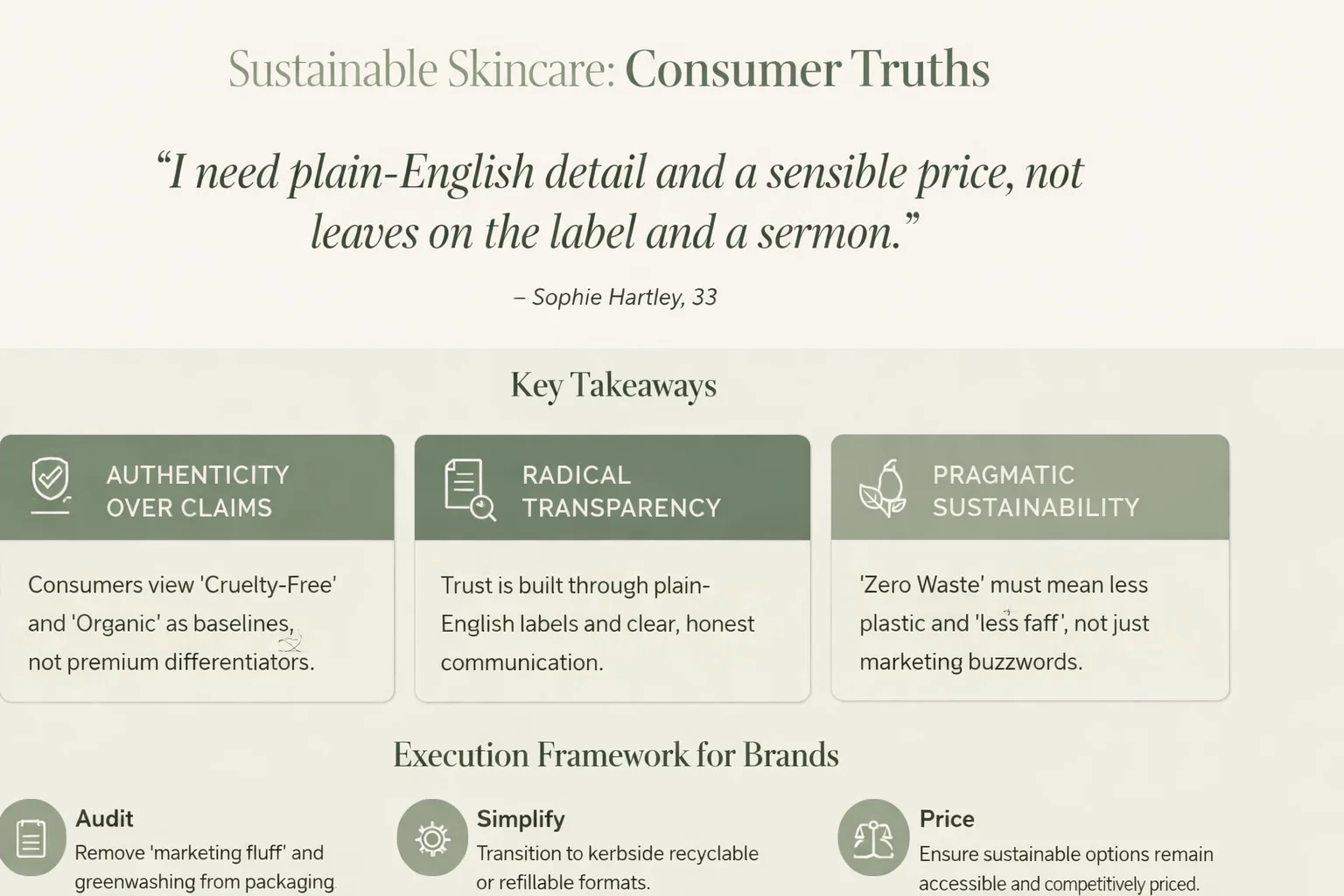
What do consumers really think when they see UpCircle? I ran a study to find out.
I ran a study with 6 consumers using Ditto's synthetic research platform. The objective: understand uk consumer attitudes toward upcycled/zero-waste beauty products. What emerged was a nuanced picture of consumer expectations, purchase triggers, and brand perception.
The Participants
The study included 6 consumers across Canada, ages 29-50, from locations including North Lanarkshire, Leeds, Liverpool. All were category-relevant purchasers who could speak to their genuine preferences and behaviours.
Question 1: Key Findings
We asked: When a skincare brand emphasizes being cruelty-free and organic, does that make you trust it more? What would make you switch from your current produc...
Sophie Hartley, 33, Croydon (London Borough):
"A little, but not automatically. Cruelty-free is baseline for me now - if you’re shouting about it while charging extra, I roll my eyes. Organic sounds nice, but it doesn’t make me trust you by itself. I need plain-English detail and a sensible price, not leaves on the label and a sermon. What woul..."
Anita Thomas, 44, Leeds:
"Cruelty-free is basic. I won’t clap a brand for that. Organic doesn’t make me trust it. Sometimes those smell strong and make me red. I trust simple labels, no big claims, and a fair price. I still check price per 100ml first. If it’s all marketing fluff, I switch off. What would make me switch: I..."
Mark Cartwright, 46, Leeds:
"Cruelty-free helps, aye - I don’t want animals hurt. “Organic” on the tub doesn’t make me trust it - could be fluff. I trust stuff that works, is priced fair, and talks straight, not fancy stamps. Tick those and I’d switch. If it’s just a green badge and double the price, I’m out, sorted...."
Key insight: Consumers showed clear patterns in their responses about UpCircle, emphasizing authentic value over marketing claims.
Question 2: Key Findings
We asked: What does 'zero waste' beauty mean to you? Are you skeptical of these claims, or do they genuinely influence your purchasing decisions?...
Paul McAllister, 50, Liverpool:
"“Zero waste” beauty, to me, is just “less faff and less plastic.” Make the bottle smaller or refillable, cut the pointless wrapping, job done. The “zero” bit is daft - nothing’s zero. I’m skeptical because it often smells like marketing, slaps a green label on, then charges a premium. Do I change w..."
Sophie Hartley, 33, Croydon (London Borough):
"‘Zero waste’ beauty, to me, means no faff and no excess - minimal or reusable packaging, no pointless outer boxes, clear refills that actually fit my life, and proper take-back schemes that aren’t just PR. Solid formats are fine if they don’t crumble or make the bathroom a mess, and I want plain-Eng..."
James Fletcher, 42, Birmingham:
"Zero waste beauty, to me, means as close to nothing-in-the-bin as real life allows. Simple pack, kerbside recyclable, proper refills that cut plastic and price, and no fiddly bits you can’t clean. What passes my sniff test: I am sceptical of the word “zero” because it rarely is. It can influence ..."
Key insight: Consumers showed clear patterns in their responses about UpCircle, emphasizing authentic value over marketing claims.
Question 3: Key Findings
We asked: How important is sustainability when you're buying skincare products? Would you pay more for products made from upcycled ingredients that would otherw...
Sophie Hartley, 33, Croydon (London Borough):
"Pretty important, but price comes first for me. On my budget, sustainability is more of a tie-breaker - if two things are similar and one has better packaging or fewer faffy extras, I’ll pick that. I care about simple, recyclable packaging and not paying for a fancy box I’ll just chuck. Cruelty-free..."
James Fletcher, 42, Birmingham:
"Short answer: it matters, but not more than it working and being fairly priced. I’m not paying boutique money for face cream, full stop. Upcycled stuff is a nice-to-have for me, not the reason I buy. I’d pay a bit more if it actually performs and doesn’t irritate my skin - say 10 to 15% or a couple..."
Paul McAllister, 50, Liverpool:
"Short answer: it matters, but it’s not the main thing. If a cleanser or moisturiser does the job and doesn’t sting or stink, I’m happy. If it’s got a big green label and lousy results, I’m out. Upcycled ingredients? Fine if they work and don’t feel gimmicky. I’m wary of greenwash. Show me what wast..."
Key insight: Consumers showed clear patterns in their responses about UpCircle, emphasizing authentic value over marketing claims.
What This Means for UpCircle
The research reveals several actionable insights for UpCircle's positioning and marketing strategy. Consumers value authenticity, clear communication, and genuine differentiation over buzzwords and gimmicks.
Lead with authentic value propositions, not category clichés
Address specific consumer concerns directly in messaging
Price and accessibility matter as much as premium positioning
Build trust through transparency, not claims
Conclusion
This research demonstrates how synthetic consumer research can surface actionable insights in hours rather than weeks. The patterns that emerged about UpCircle provide a clear roadmap for positioning, messaging, and product decisions.
Want to test your own brand positioning with synthetic consumers? Ditto lets you run studies like this in minutes. Book a demo at askditto.io.
What the Research Revealed
We asked real consumers to share their thoughts. Here's what they told us:
When a skincare brand emphasizes being cruelty-free and organic, does that make you trust it more? What would make you switch from your current products to a more sustainable option?
Sophie Hartley, 33, Administrative Assistant, Croydon (London Borough), Greater London, United Kingdom:
A little, but not automatically. Cruelty-free is baseline for me now - if you’re shouting about it while charging extra, I roll my eyes. Organic sounds nice, but it doesn’t make me trust you by itself. I need plain-English detail and a sensible price, not leaves on the label and a sermon. What would actually make me switch: Do that and, yeah, I’d switch. If it’s just organic-and-cruelty-free slapped on a pricier bottle... I’ll stick with what already works. Sorry, bit blunt.
Anita Thomas, 44, Housekeeper, Leeds, West Yorkshire, United Kingdom:
Cruelty-free is basic. I won’t clap a brand for that. Organic doesn’t make me trust it. Sometimes those smell strong and make me red. I trust simple labels, no big claims, and a fair price. I still check price per 100ml first. If it’s all marketing fluff, I switch off. What would make me switch: If it’s double the price, forget it. If I have to order from some fancy site, not interested.
Mark Cartwright, 46, Home Health Aide, Leeds, West Yorkshire, United Kingdom:
Cruelty-free helps, aye - I don’t want animals hurt. “Organic” on the tub doesn’t make me trust it - could be fluff. I trust stuff that works, is priced fair, and talks straight, not fancy stamps. Tick those and I’d switch. If it’s just a green badge and double the price, I’m out, sorted.
Paul McAllister, 50, Project Manager, Liverpool, Merseyside, United Kingdom:
Short answer: nice to hear, but not a trust badge on its own. Cruelty-free I sort of expect these days. If a brand shouts about it like it’s special, I roll my eyes. “Organic” makes me think higher price and sometimes strong smells. If it works and isn’t a faff, I’m in. If it’s just vibes, I’m out. What would actually make me switch: Red flags: So yeah - cruelty-free and organic can tip it if the basics are nailed. But performance, price, and no faff decide it for me. Sound?
James Fletcher, 42, Sales Manager, Birmingham, West Midlands, United Kingdom:
Cruelty-free and organic on the front doesn’t automatically make me trust it. I like the idea, but half the time it’s just a big green badge and a higher price. I assume most stuff isn’t tested on animals now, so shouting about it isn’t a trust booster on its own - show me it works and is fair money, then the ethics help close the deal. I’d switch if: Tick those and I’m in. If it’s just buzzwords and a mark-up, I’ll stick with what works. Sorted.
Conor Daly, 29, Job Seeker, North Lanarkshire, North Lanarkshire, United Kingdom:
Aye, it nudges me a bit, but I don’t trust it just for saying cruelty-free and organic - could be marketing. I’m swayed if it’s simple, no daft claims, and it actually feels right on my skin. Tried a posh organic one before, smelled like a garden and burst me out, so I’m wary. Does it work and how much is it still decides it. I’d switch if:
What does 'zero waste' beauty mean to you? Are you skeptical of these claims, or do they genuinely influence your purchasing decisions?
Paul McAllister, 50, Project Manager, Liverpool, Merseyside, United Kingdom:
“Zero waste” beauty, to me, is just “less faff and less plastic.” Make the bottle smaller or refillable, cut the pointless wrapping, job done. The “zero” bit is daft - nothing’s zero. I’m skeptical because it often smells like marketing, slaps a green label on, then charges a premium. Do I change what I buy? Sometimes, yeah. If it works the same, costs about the same, and I can bin or recycle it without a treasure map, I’ll pick the lower-waste one. Ellie nudges me too - she likes the idea of l
Sophie Hartley, 33, Administrative Assistant, Croydon (London Borough), Greater London, United Kingdom:
‘Zero waste’ beauty, to me, means no faff and no excess - minimal or reusable packaging, no pointless outer boxes, clear refills that actually fit my life, and proper take-back schemes that aren’t just PR. Solid formats are fine if they don’t crumble or make the bathroom a mess, and I want plain-English recycling info, not vague leaves and buzzwords. I’m pretty sceptical, to be fair. “Zero” feels like a stretch, and I’ve seen too many “compostable” bits that need an industrial facility no one
James Fletcher, 42, Sales Manager, Birmingham, West Midlands, United Kingdom:
Zero waste beauty, to me, means as close to nothing-in-the-bin as real life allows. Simple pack, kerbside recyclable, proper refills that cut plastic and price, and no fiddly bits you can’t clean. What passes my sniff test: I am sceptical of the word “zero” because it rarely is. It can influence me as a tie-breaker, and I’ll pay a couple of quid more if it actually works and slots into the budget, but I’m not paying boutique money for a green badge. Function first, fair price second, eco help
Anita Thomas, 44, Housekeeper, Leeds, West Yorkshire, United Kingdom:
Zero waste to me means less plastic and less rubbish in the bin. But nothing is zero, love. I’m wary when brands shout eco then whack on a fancier price. If it’s cheaper and it works, I’ll buy it. If it’s dear and a faff, I won’t. I’ve tried a shampoo bar. Made my hair weird and dull, so I binned it. Cardboard deodorant went soggy in my bag. Bar soap in paper is fine. Refill handwash is fine if it’s on offer. I reuse jars and cut tubes open to get the last bit. That’s my level. What actually s
Mark Cartwright, 46, Home Health Aide, Leeds, West Yorkshire, United Kingdom:
Short version: zero waste sounds nice, but the zero bit is daft. There’s always some waste. Feels like a marketing sticker half the time. What it means to me: less plastic, fewer fiddly pumps, stuff that actually lasts. Bars over bottles, refills if they’re cheap and easy. If it works and costs same as normal, I’m in. If it’s pricier for a brown box and a leaf logo, nah. I’m skeptical, aye. I’ve bought “eco” bits that turned to mush in the shower and went straight in the bin - that’s proper wa
Conor Daly, 29, Job Seeker, North Lanarkshire, North Lanarkshire, United Kingdom:
Zero waste beauty, for me, is less plastic and less faff - bars not bottles, tins you can reuse, easy refills you can grab in town. I’m skeptical, aye - a lot of it feels like posh green chat with a bigger price tag. I’ll bite if it’s simple and the numbers add up - lasts longer, same or cheaper, packaging I can recycle or reuse. I’m on cheap basics most weeks - bar soap, supermarket shampoo, roll-on - and I keep old tubs for screws. Tried a shampoo bar and it went grand then made my hair weird,
How important is sustainability when you're buying skincare products? Would you pay more for products made from upcycled ingredients that would otherwise be waste?
Sophie Hartley, 33, Administrative Assistant, Croydon (London Borough), Greater London, United Kingdom:
Pretty important, but price comes first for me. On my budget, sustainability is more of a tie-breaker - if two things are similar and one has better packaging or fewer faffy extras, I’ll pick that. I care about simple, recyclable packaging and not paying for a fancy box I’ll just chuck. Cruelty-free matters, but I’m wary of glossy green claims that feel like marketing fluff. Upcycled ingredients... I like the idea of turning waste into something useful, but I’m picky. If it’s fragrance-free, no
James Fletcher, 42, Sales Manager, Birmingham, West Midlands, United Kingdom:
Short answer: it matters, but not more than it working and being fairly priced. I’m not paying boutique money for face cream, full stop. Upcycled stuff is a nice-to-have for me, not the reason I buy. I’d pay a bit more if it actually performs and doesn’t irritate my skin - say 10 to 15% or a couple of quid - but not double. Too many brands slap a leaf on the label and whack a tenner on the price. Not biting. What I actually look for: If two products work the same, I’ll pick the more sustaina
Paul McAllister, 50, Project Manager, Liverpool, Merseyside, United Kingdom:
Short answer: it matters, but it’s not the main thing. If a cleanser or moisturiser does the job and doesn’t sting or stink, I’m happy. If it’s got a big green label and lousy results, I’m out. Upcycled ingredients? Fine if they work and don’t feel gimmicky. I’m wary of greenwash. Show me what waste you saved and how the packaging is sorted, not a fluffy slogan. I’d pay a bit more for that, but not double. What would actually sway me: Price-wise, I’d go maybe 10 to 15% more, or a couple of q
Mark Cartwright, 46, Home Health Aide, Leeds, West Yorkshire, United Kingdom:
Bit important, but not top of the list. If it works and the price is right, I’m in. I like less waste - big bottles, refills, simple packs you can recycle. Upcycled bits sound fine, but I’m not paying double for a green badge. I’d go a quid more if it actually stops my hands cracking and lasts longer, otherwise I’ll get the cheap one that does the job, sorted.
Conor Daly, 29, Job Seeker, North Lanarkshire, North Lanarkshire, United Kingdom:
Matters a bit, aye, but does it work and how much is it is what decides it for me. I stick to cheap own-brand moisturiser and SPF, simple stuff, and I like recyclable tubes and nae daft boxes. Upcycled sounds grand - I quite like less waste - but I’d only pay a wee bit more, like a quid or two, not double for the same job. If it’s all vibe and greenwash and it leaves my face greasy, naw, I’m out.
Anita Thomas, 44, Housekeeper, Leeds, West Yorkshire, United Kingdom:
It matters, but price comes first. I buy the basic face cream and SPF from Aldi or Asda. If it’s on offer, I get two. I like refill packs and less plastic in the bin, but I won’t chase it round town. Upcycled ingredients sounds nice, but it also sounds like marketing. If it works, no sting, no strong perfume, and the price is the same, I’ll swap. I wouldn’t pay loads more just for that. Maybe 50p more on a fiver, tops, if it lasts longer. If it’s double, forget it. My checklist is simple: At