
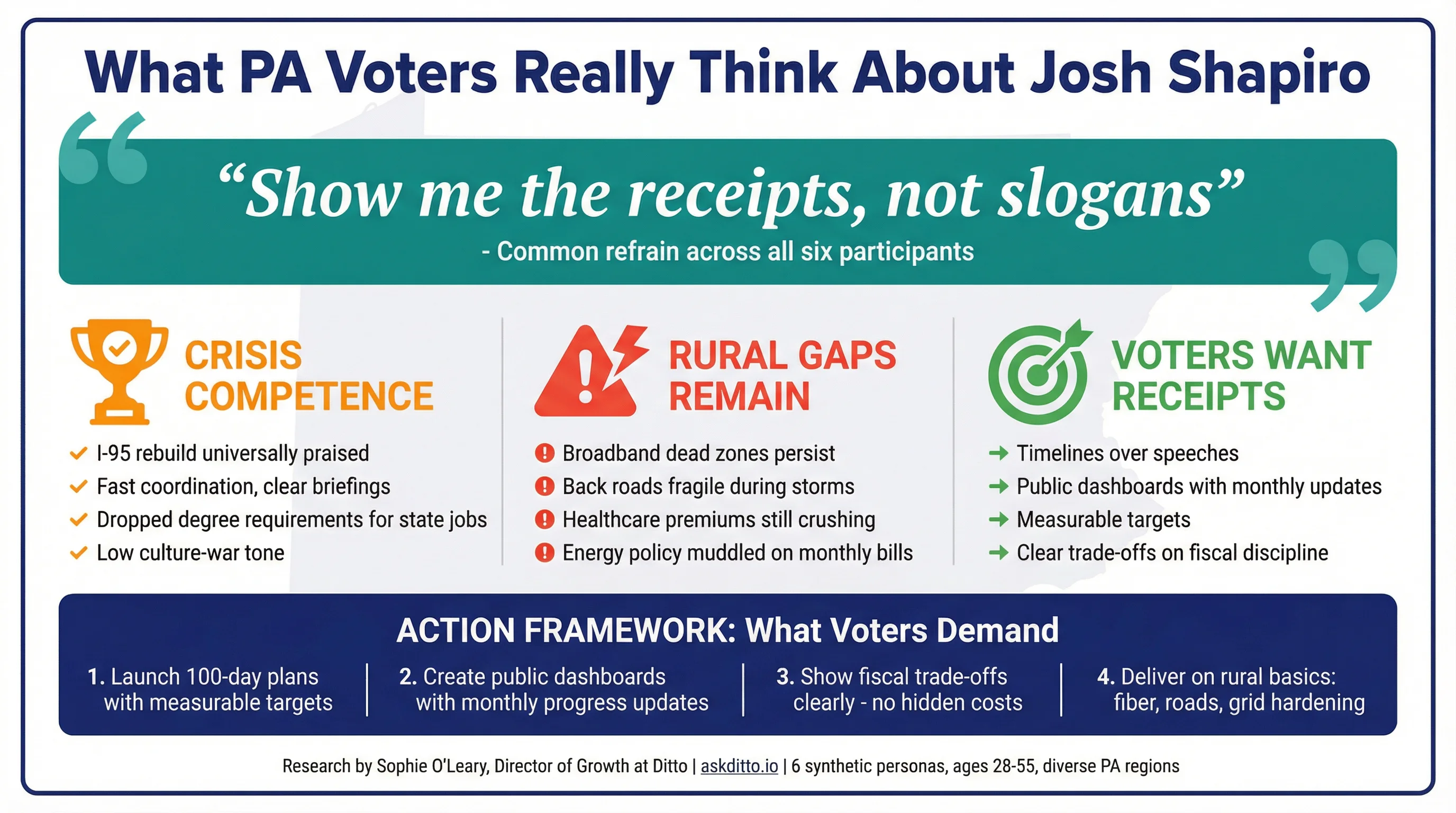
Governor Josh Shapiro is running for re-election in Pennsylvania, and I wanted to know what actual PA voters think about his first term. Not the pundit takes, not the polling averages. The real kitchen-table verdict from people managing mortgages, commutes, and healthcare bills in the Keystone State.
So I ran a study with six Pennsylvania voters from across the state. Their verdict? Competent on crisis management, but lacking on rural basics and cost of living.
The Participants
Six participants representing the geographic and economic diversity of Pennsylvania: a project manager in rural PA with two kids, a hospitality manager near Harrisburg, a product operations specialist in Allentown, a data architect in rural PA, a single mother and project coordinator in Philadelphia, and an unemployed former bartender in rural PA managing chronic pain. Ages ranged from 28 to 55, incomes from tight SNAP-dependent budgets to six figures.
What united them? They all wanted specifics, not slogans. And they all have finely tuned nonsense detectors when it comes to political promises.
The Issues That Will Decide 2026
When I asked participants what issues would most influence their vote, the answers were remarkably consistent across geographic and economic lines:
Public education and workforce prep - stable funding tied to clear results, CTE expansion, and no unfunded mandates
Rural infrastructure and emergency readiness - broadband that actually reaches back roads, plowed roads, hardened grids, and functioning EMS
Cost of living - energy bills, property taxes, healthcare costs, and utility fees that keep creeping up
Healthcare affordability and access - premiums, network adequacy, surprise billing, and rural hospital viability
Public safety with accountability - body cams, clear reporting, and truth when force is used
Jessica from Philadelphia summed it up: "Three things decide my vote. No slogans, no stunts. Public safety and basic order, school quality and choice, and cost of living that actually shows up in my bills."
Key insight: Pennsylvania voters want receipts, not speeches. They want timelines, dashboards, and accountability. "Show me the math" was the common refrain across all six participants.
Shapiros First Term: The Verdict
I asked participants to honestly assess what Shapiro has done well and where he has fallen short. The consensus formed quickly:
What He Has Done Well
Crisis response - the I-95 rebuild was universally praised. "Fast coordination, clear briefings, felt like someone was actually running point."
Cutting bureaucratic friction - dropping degree requirements for state jobs, streamlining permits, and fewer runarounds at PennDOT
Tone - "Low culture-war, higher on service-delivery talk. Less chirping, more doing."
Senior relief - the property tax and rent rebate expansion "actually helped people like my abuela in Bethlehem. She noticed."
Where He Has Fallen Short
School choice wobble - "He said he backed scholarships for kids in failing districts, then folded when his party balked. Pick a position and stand in it."
Budget brinkmanship - the standoff left districts and aftercare providers guessing. "Working parents ate the chaos."
Rural infrastructure - "Broadband grants are talked up, but dead zones remain and back roads still feel fragile when storms hit."
Healthcare costs - "Our premium still kicks us in the teeth. Networks are still a maze. I do not feel a lick of relief."
Energy policy - "Feels muddled. Big on acronyms, light on plain math about my monthly bill and local jobs."
Daniel from rural PA offered perhaps the sharpest assessment: "Stronger than most on competence and tone, not where I need him on rural nuts-and-bolts. Give me fiber on poles, trees trimmed before they are in the lines, a few microgrids lit at critical sites, and a privacy bill with teeth - then I will say he nailed the first term."
Key insight: Shapiro earns high marks for crisis management and operational competence, but loses points on school policy clarity, rural infrastructure follow-through, and healthcare costs. The verdict: B for the big-stage stuff, C-minus on the last-mile grind.
What Shapiro Needs to Do to Earn Their Votes
The final question asked participants what Shapiro would need to do or say to earn or strengthen their support. The answers converged on a clear playbook:
Publish a 100-day plan with measurable targets. "Cut permit times by 30 percent, hit 95 percent body-cam compliance, get 100 percent of major health systems posting compliant price files."
Create a public dashboard. "Updates monthly, bilingual, no login walls, with the raw data downloadable. Less ribbon cutting, more checklists."
Show fiscal discipline. "What gets re-prioritized or cut to pay for this? Which corporate giveaways are getting axed? If it needs new revenue, say it and show the math."
Hold in-person town halls. "In places like mine without a big entourage. Fire hall, VFW, diner back room. Take unscreened questions. Come back in 90 days and report what got done."
Name specific projects with timelines. "Three immediate pilots by April, then expand only if they hit uptime and cost targets. Kill what does not work. Say it out loud."
Zachary from rural PA put it simply: "If you put that in a 90-day checklist with a public dashboard and hit the first marks on time, I am in. Does that make sense?"
Key insight: These voters are not asking for the moon. They want specific, measurable commitments with clear accountability. The path to their votes runs through Excel spreadsheets, not press conferences.
What This Means for the 2026 Campaign
If you are advising the Shapiro campaign - or any gubernatorial campaign in a swing state - here is what this research reveals:
Crisis competence is table stakes, not a differentiator. Voters expect you to handle emergencies well. What earns loyalty is the boring stuff - permits, broadband, healthcare networks.
Rural voters feel forgotten. The last five miles of township roads, the dead zones in broadband coverage, the EMS response times - these are where trust is won or lost.
School policy inconsistency is a trust killer. "Pick a position and stand in it" was a common refrain. Wobbling between competing constituencies reads as weakness.
Healthcare costs are a sleeper issue. Multiple participants cited insurance premiums, surprise billing, and network adequacy as major concerns that are not being addressed.
Transparency is the new trust. Dashboards, timelines, named owners, quarterly updates. If you cannot show the metrics, voters assume you are hiding failure.
The Bottom Line
Pennsylvania voters are not opposed to Josh Shapiro. They are opposed to vague promises. The opportunity is real for a re-election campaign built on specific, measurable commitments with clear accountability mechanisms.
As Eric from rural PA put it: "Do it right once. Show me the receipts, not slogans. If they deliver on even half of that and keep talking to us like adults, they will have my vote."
Want to understand what your voters actually think? Ditto lets you run studies like this in hours, not weeks. Book a demo at askditto.io.