
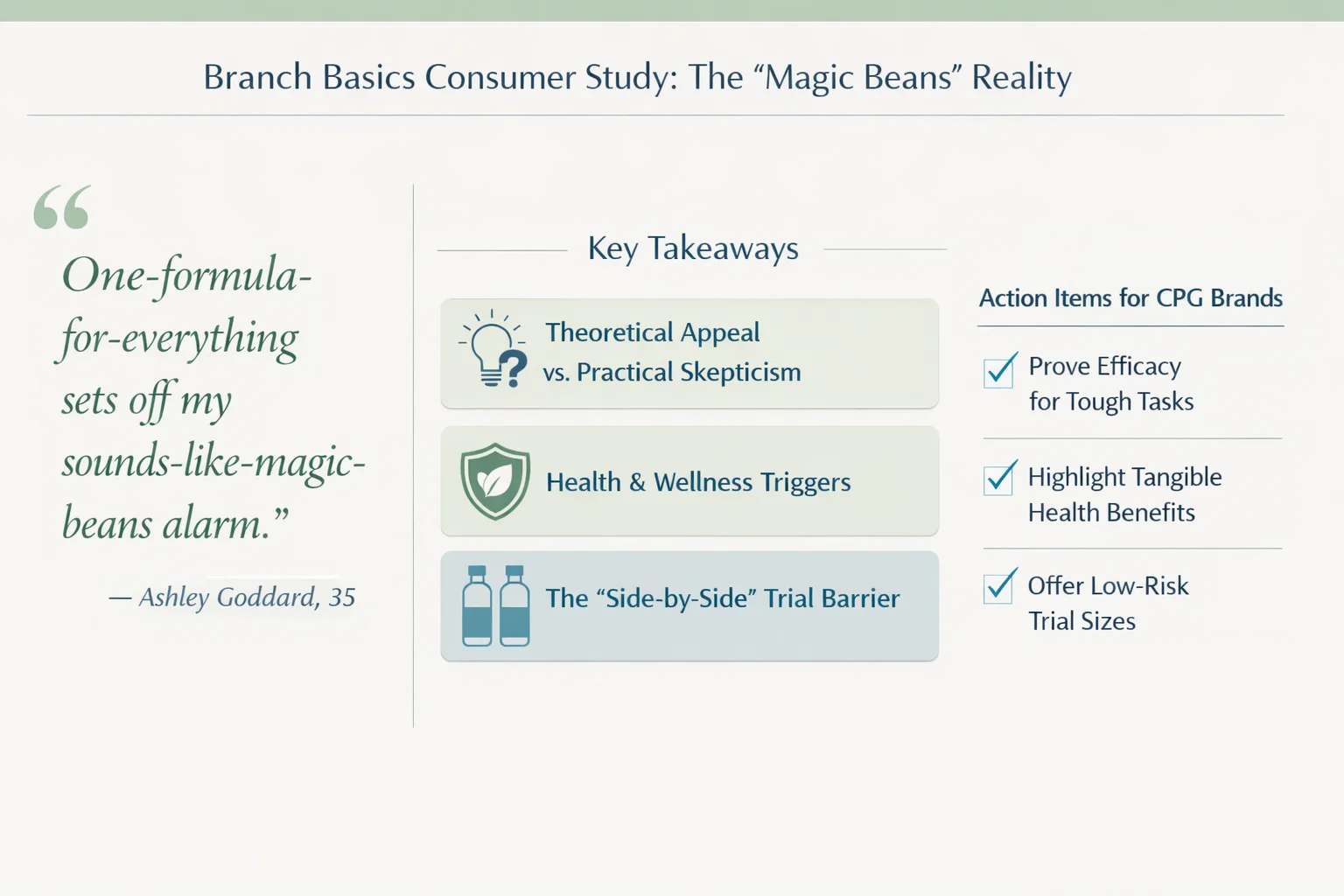
Six consumers. Three questions. One clear pattern emerged about Branch Basics.
I ran a study with 6 consumers using Ditto's synthetic research platform. The objective: understanding how us consumers perceive non-toxic plant-based cleaning products. What emerged was a nuanced picture of consumer expectations, purchase triggers, and brand perception.
The Participants
The study included 6 consumers, ages 28-48, from locations including Rural, Cincinnati city, Athens-Clarke County unified government (balance). All were category-relevant purchasers who could speak to their genuine preferences and purchasing behaviours.
Question 1: What Drives Purchase Decisions
We asked: If a cleaning brand promised to replace all your household cleaners with one concentrated non-toxic formula, would that appeal to you? What concerns would you have about whether it actually works?...
Ashley Goddard, 35, Athens-Clarke County unified government (balance):
"Short answer: it appeals in theory. Fewer bottles under the sink, one refillable concentrate, less plastic clutter fits my brain. But one-formula-for-everything sets off my sounds-like-magic-beans alarm. What I’d worry about: I might could try a small bottle for a month, side by side with what I use now. But I’m not tossing my back-pocket heavy-..."
Deidre Cook, 47, Rural:
"Short answer: sounds nice in theory, I’m skeptical in practice. One bottle to rule them all would save me shelf space and brain space, sure. Fewer bottles rolling around under the sink, fewer trips to Dollar General, maybe cheaper if it’s truly concentrated. That all appeals. But here’s what would make me side-eye it: Bottom line: I’d try a sma..."
Brittany Bedell, 29, Cincinnati city:
"Quick clarifier: when you say replace all, does that include toilet bowl cleaner and true disinfecting, and is there a fragrance-free option? Appeal-wise, yes, in theory. One concentrate would clear space under the sink, cut plastic, and simplify my brain on cleaning day. If it’s truly concentrated, refillable, and priced in the sane zone, I’d try..."
Key insight: Consumers showed clear patterns in their responses about Branch Basics, emphasizing authentic value and genuine differentiation over marketing claims.
Question 2: Brand Perception Deep Dive
We asked: Have you ever switched from a conventional cleaning product to a non-toxic or plant-based alternative? What prompted that switch, and did you notice any difference in cleaning performance?...
Brittany Bedell, 29, Cincinnati city:
"Yes. I ditched the bright-blue, fake-lemon everything after a migraine hit me mid-scrub and the dog started sneezing like a tiny foghorn. The switch was about headaches, a small apartment, and a beagle nose, plus I was tired of feeling lightheaded after cleaning the tub. Performance-wise: for daily stuff like counters, floors, and stainless, the ..."
Ashley Goddard, 35, Athens-Clarke County unified government (balance):
"Yep. A few, actually. It started after I brought Junie home and realized she licks everything, plus those heavy fake-lavender cleaners gave me a sinus throb that lasted all afternoon. I’ll pay a little extra for safer stuff, not twice as much, and I refuse to buy a leaf-covered label that’s just marketing. Net: the safer swaps handle 80-90 perce..."
Deidre Cook, 47, Rural:
"Yeah, I’ve switched a few times. Mostly because the heavy perfumes were giving me a headache and making my reflux flare, and Maddie got a little rash once from a “mountain breeze” laundry soap. I don’t need my house smelling like a fake flower shop to know it’s clean. What I changed and how it went: What prompted it: Bottom line: I’ll switch i..."
Key insight: Consumers showed clear patterns in their responses about Branch Basics, emphasizing authentic value and genuine differentiation over marketing claims.
Question 3: Key Consumer Insights
We asked: When you think about household cleaning products, how important is it that they are non-toxic or plant-based? Are you willing to pay more for safer alternatives, or do you prioritize cleaning power ab...
Ashley Goddard, 35, Athens-Clarke County unified government (balance):
"Non-toxic matters a lot in my house, mostly because of Junie and my fussy sinuses. If a cleaner smells like a perfume counter, I’m out. I’ll pay a little more, not twice as much - plant-based is great if it actually works and doesn’t gas me out of the bathroom. Day to day, I reach for simple, unscented stuff and concentrates I can dilute. For gna..."
Richard Nelson, 48, Rural:
"Short answer: I care a lot about non-toxic and septic-safe, but I still expect stuff to work. I’m not paying boutique prices for pretty labels and eucalyptus perfume that don’t cut grease. How I actually handle it: So yeah, I’ll lean safer when I can, but if something can’t break down mud, oil, or mildew, it’s dead to me. The sweet spot is simpl..."
Brittany Bedell, 29, Cincinnati city:
"Quick clarifier: are you asking about kitchen and bath specifically, or whole-house? For me, non-toxic and fragrance-free matter a lot. Small apartment, a nosy beagle, and I get migraines, so perfumey cleaners are a hard no. I’ll pay a little more for safer options if they actually work and are concentrated or refillable - think 10-20% more, not b..."
Key insight: Consumers showed clear patterns in their responses about Branch Basics, emphasizing authentic value and genuine differentiation over marketing claims.
What This Means for Branch Basics
The research reveals several actionable insights for Branch Basics's positioning and marketing strategy. Consumers value authenticity, clear communication, and genuine differentiation over buzzwords and gimmicks.
Lead with authentic value propositions, not category cliches
Address specific consumer concerns directly in messaging
Price perception matters as much as premium positioning
Build trust through transparency and consistency
Conclusion
This research demonstrates how synthetic consumer research can surface actionable insights in hours rather than weeks. The patterns that emerged about Branch Basics provide a clear roadmap for positioning, messaging, and product decisions.
Want to test your own brand positioning with synthetic consumers? Ditto lets you run studies like this in minutes. Book a demo at askditto.io.
What the Research Revealed
We asked real consumers to share their thoughts. Here is what they told us:
If a cleaning brand promised to replace all your household cleaners with one concentrated non-toxic formula, would that appeal to you? What concerns would you have about whether it actually works?
Ashley Goddard, 35, Community Organizer, Athens-Clarke County unified government (balance), GA, USA:
Short answer: it appeals in theory. Fewer bottles under the sink, one refillable concentrate, less plastic clutter fits my brain. But one-formula-for-everything sets off my sounds-like-magic-beans alarm. What I’d worry about: I might could try a small bottle for a month, side by side with what I use now. But I’m not tossing my back-pocket heavy-duty cleaner until this proves it can handle the greasy stove, the shower week, and the streak test. If it clears those without gassing me out, we can talk.
Deidre Cook, 47, Stay-at-Home Parent, Rural, TX, USA:
Short answer: sounds nice in theory, I’m skeptical in practice. One bottle to rule them all would save me shelf space and brain space, sure. Fewer bottles rolling around under the sink, fewer trips to Dollar General, maybe cheaper if it’s truly concentrated. That all appeals. But here’s what would make me side-eye it: Bottom line: I’d try a small bottle if the price is sane, but I’d keep my one heavy hitter for the bathroom until that concentrate proves itself on grease and scum. If it’s just nice-smelling water with a halo, hard pass.
Brittany Bedell, 29, Graduate Student, Cincinnati city, OH, USA:
Quick clarifier: when you say replace all, does that include toilet bowl cleaner and true disinfecting, and is there a fragrance-free option? Appeal-wise, yes, in theory. One concentrate would clear space under the sink, cut plastic, and simplify my brain on cleaning day. If it’s truly concentrated, refillable, and priced in the sane zone, I’d try a small bottle. My concerns, in order: My personal test set: greasy salmon splatter on the stove, our glass shower door, and the front-entry wood floor where the road salt lands. If it passes those three and stays fragrance-free, I’m in. If my bathroom ends up smelling like a spa and my mirror streaks, hard pass. Show me receipts first.
Claudio Orozco, 28, Unemployed Adult, Birmingham city, AL, USA:
Short answer: Kinda appealing for space and budget if it is truly low-fume and actually concentrated. But I do not buy miracle bottles. I would still keep one harsher spot-cleaner for mildew. Prove it on grease and glass first, then we talk. Long answer: Bottom line: it could appeal if it is unscented, truly concentrated, and passes grease, glass, and scum without leaving a film. But replace everything? No. I would still keep one tough cleaner for rare nasty jobs. Show me results at Aldi prices, then maybe I switch. Otherwise it is just another bottle with a leaf on it.
Richard Nelson, 48, Paralegal, Rural, CA, USA:
Short answer: Nice idea in theory, but I’m skeptical. One magic concentrate that does dishes, shower scale, windows, floors, and shop grease usually means it’s mediocre at most of them. I’d try it for light-duty, but I’d still keep my heavy hitter for the ugly jobs. What would make me hesitate: What would get me interested: Bottom line: I like fewer bottles. I don’t like fairy tales. If it quietly replaces my daily counter spray, floor soap, and dish liquid without leaving residue, great. But I’m still keeping a small bottle of the mean stuff for the once-a-month nasty jobs.
Desiree Gomez, 37, Stay-at-Home Parent, Glendale city, AZ, USA:
Short answer: kinda appealing, but I’m side-eyeing it hard. One bottle for everything sounds nice - less clutter, maybe saves money, ya mero. But I’ve been burned by “does-it-all” before. If it can’t blast stove grease, kill nasty germs when someone’s sick, and not streak my mirrors, then no gracias. My concerns: What would make me say ok, let’s try it: Bottom line: if it handles 90% of daily cleaning without fumes and without streaks, I’m listening. But for stomach bug or raw chicken days, I’m still keeping my tough backup, por si acaso. So tell me straight - how does it do on glass, toilet rings, greasy stove, and hard water? And what’s the actual cost per bottle, smell, and return policy, verdad?
Have you ever switched from a conventional cleaning product to a non-toxic or plant-based alternative? What prompted that switch, and did you notice any difference in cleaning performance?
Brittany Bedell, 29, Graduate Student, Cincinnati city, OH, USA:
Yes. I ditched the bright-blue, fake-lemon everything after a migraine hit me mid-scrub and the dog started sneezing like a tiny foghorn. The switch was about headaches, a small apartment, and a beagle nose, plus I was tired of feeling lightheaded after cleaning the tub. Performance-wise: for daily stuff like counters, floors, and stainless, the non-toxic, fragrance-free concentrates with hot water and microfiber clean just as well and leave no sticky film. Bathroom soap scum needs more soak time and a real scrub, but it still comes off. Oven messes are slower without the harsh foam, so I do a paste and let it sit. For true disinfecting, I keep a tiny bottle of diluted bleach for raw-chicken incidents and crack a window. Net: fewer headaches, the dog chills, trash bag is lighter from fewer bottles, and the only tradeoff is a bit more elbow grease. I’ll take that over my bathroom smelling like a citrus theme park.
Ashley Goddard, 35, Community Organizer, Athens-Clarke County unified government (balance), GA, USA:
Yep. A few, actually. It started after I brought Junie home and realized she licks everything, plus those heavy fake-lavender cleaners gave me a sinus throb that lasted all afternoon. I’ll pay a little extra for safer stuff, not twice as much, and I refuse to buy a leaf-covered label that’s just marketing. Net: the safer swaps handle 80-90 percent of my cleaning just fine. I keep one heavy-duty cleaner for the truly gross jobs, fan on, quick in-and-out. If it smells like a perfume counter, I’m out, and I’m not paying boutique prices for water in a pretty bottle.
Deidre Cook, 47, Stay-at-Home Parent, Rural, TX, USA:
Yeah, I’ve switched a few times. Mostly because the heavy perfumes were giving me a headache and making my reflux flare, and Maddie got a little rash once from a “mountain breeze” laundry soap. I don’t need my house smelling like a fake flower shop to know it’s clean. What I changed and how it went: What prompted it: Bottom line: I’ll switch if it actually cleans. For 80-90 percent of daily messes, the simpler, less-toxic stuff does fine. For bathrooms and baked-on grease, I still reach for the heavy hitter, quick in and out. Cleaning power still wins, but I’m not huffing chemical fog to prove a point.
Claudio Orozco, 28, Unemployed Adult, Birmingham city, AL, USA:
Short answer: Yes. I switched most daily stuff to low-fume, unscented options. It cleans fine for routine mess, but heavy grease and mildew still need the mean stuff, quick and ventilated. Long answer: Cost: cheaper overall. Concentrates stretch. I ignore the pretty leaf labels and the boutique tax. Net: I live 90% on low-fume now. For the ugly 10%, I use the strong stuff fast, ventilate, and stash the bottle in a bag under the sink so it does not stink up the room. So yeah, I switched because my head and my small space demanded it. Cleaning power is mostly fine, just slower on the tough grime. My lungs and wallet prefer it.
Desiree Gomez, 37, Stay-at-Home Parent, Glendale city, AZ, USA:
Sí, I’ve switched a few times. Mixed results, to be honest. What made me switch: What happened after: So yeah - daily stuff I switched and it’s been good. For heavy grease or disinfecting, I keep one tough product in the cabinet. Balance. Poco a poco. What are you thinking about switching - kitchen spray or bathroom?
Richard Nelson, 48, Paralegal, Rural, CA, USA:
Yeah, I’ve switched in a bunch of spots - mostly to unscented, non-toxic, septic-safe stuff - but I still keep a tiny bottle of the heavy hitter for the gnarly jobs. What pushed me: What actually changed, and how it cleans: Net: I switched wherever day-to-day cleaning doesn’t need brute force, and I didn’t lose performance in those lanes. When the job is truly filthy, I’m not going to pretend a gentle spray will cut it. The house smells like nothing, the septic sleeps easy, and I’m not buying cute bottles every month. That’s a win.
When you think about household cleaning products, how important is it that they are non-toxic or plant-based? Are you willing to pay more for safer alternatives, or do you prioritize cleaning power ab
Ashley Goddard, 35, Community Organizer, Athens-Clarke County unified government (balance), GA, USA:
Non-toxic matters a lot in my house, mostly because of Junie and my fussy sinuses. If a cleaner smells like a perfume counter, I’m out. I’ll pay a little more, not twice as much - plant-based is great if it actually works and doesn’t gas me out of the bathroom. Day to day, I reach for simple, unscented stuff and concentrates I can dilute. For gnarlier jobs - grout, mildew, mystery fridge goo - cleaning power wins and I’ll use the strong stuff sparingly with the fan blasting. I’m picky about labels I can pronounce and refill options, and I’ve got a low tolerance for greenwashing. So, balance: mostly safer basics, with a small back pocket of heavy-duty when the situation calls for it.
Richard Nelson, 48, Paralegal, Rural, CA, USA:
Short answer: I care a lot about non-toxic and septic-safe, but I still expect stuff to work. I’m not paying boutique prices for pretty labels and eucalyptus perfume that don’t cut grease. How I actually handle it: So yeah, I’ll lean safer when I can, but if something can’t break down mud, oil, or mildew, it’s dead to me. The sweet spot is simple, unscented, refillable - and it actually cleans.
Brittany Bedell, 29, Graduate Student, Cincinnati city, OH, USA:
Quick clarifier: are you asking about kitchen and bath specifically, or whole-house? For me, non-toxic and fragrance-free matter a lot. Small apartment, a nosy beagle, and I get migraines, so perfumey cleaners are a hard no. I’ll pay a little more for safer options if they actually work and are concentrated or refillable - think 10-20% more, not boutique pricing for eucalyptus-scented water. I cannot stand greenwashed labels that clean like lukewarm tea. Cleaning power still matters. If it’s raw-chicken goo or gnarly grout, I’ll use a targeted disinfectant like a small, diluted bleach moment or peroxide and open a window, but that’s occasional. Day to day it’s basics: vinegar-water, baking soda, unscented dish soap, microfiber - cuts winter salt and kitchen grease without the headache. So I prioritize safe and simple first, then bring out the strong stuff only when the job truly calls for it.
Deidre Cook, 47, Stay-at-Home Parent, Rural, TX, USA:
Short answer: cleaning power wins, but I don’t want my house smelling like a chemistry lab either. Here’s how I look at it: What I actually buy: So yeah, I care about safer options, but they’ve got to pull their weight. If it’s plant-based and actually cleans, I’m in. If it’s just marketing and a higher price, hard pass.
Claudio Orozco, 28, Unemployed Adult, Birmingham city, AL, USA:
Short answer: I care about non-toxic and low-fume, but I will not pay a big premium for a fancy leaf on the label. Price and real cleaning power still run the show. Long answer, since I live in a tiny studio and migraines hate strong smells: So yeah: I pick low-fume, simple ingredients when the price is close. But if something gentle cannot cut the grime, I grab the tougher cleaner, use it fast, ventilate, and move on. I am not paying a boutique tax to make the bottle feel holy.
Desiree Gomez, 37, Stay-at-Home Parent, Glendale city, AZ, USA:
Short answer: safety matters, but it still has to clean like it means it. I have three kids touching every surface, so I avoid heavy fumes and weird dyes if I can. Plant-based by itself doesn’t impress me. If it leaves grease behind or I have to scrub twice, no gracias. I’ll pay a little more for safer stuff, but not double. Like 10-20% more, tops - and only if it lasts longer or actually works. How I do it, real life: What I’ll pay more for: What I won’t: So yeah - balance. Keep my kids safe, keep my counters not sticky, keep my budget breathing. Poco a poco. What products are you looking at exactly - kitchen, bathroom, laundry?