Here's something that's been nagging at me. Rob Sand, Iowa's State Auditor, is making a run for Governor in 2026 against Kim Reynolds. And the question everyone seems to be asking is: can a watchdog actually run the state, or just bark at it?
I was fierce curious about this one. Auditors have this reputation for finding problems, flagging waste, pointing fingers. But governing? That's a different beast entirely. You need to build coalitions, manage crises, say yes to things, not just red-pen everything that crosses your desk.
So I ran a study with 6 Midwest voters to understand how they perceive Sand's auditor background, whether his bipartisan positioning lands as genuine or spin, and what a challenger actually needs to say to unseat an incumbent. The results? Jaysus, these voters are not messing about.
The Participants
I recruited 6 synthetic personas representing a cross-section of Midwest voters: ages 32 to 55, spanning North Carolina, Kansas, Florida, Pennsylvania, and rural California. We had a nonprofit program manager, a compliance analyst, a senior lineman, a project manager, an industrial engineer, and a sales manager. Some lean conservative, some moderate, all share one thing: absolutely zero patience for political theatre.
What unites them? A practical, show-me-the-receipts mentality. These are voters who care about roads, schools, healthcare access, and budgets that add up. They're not asking for poetry. They're asking for plumbers.
The Auditor Question: Cautious Thumbs Up
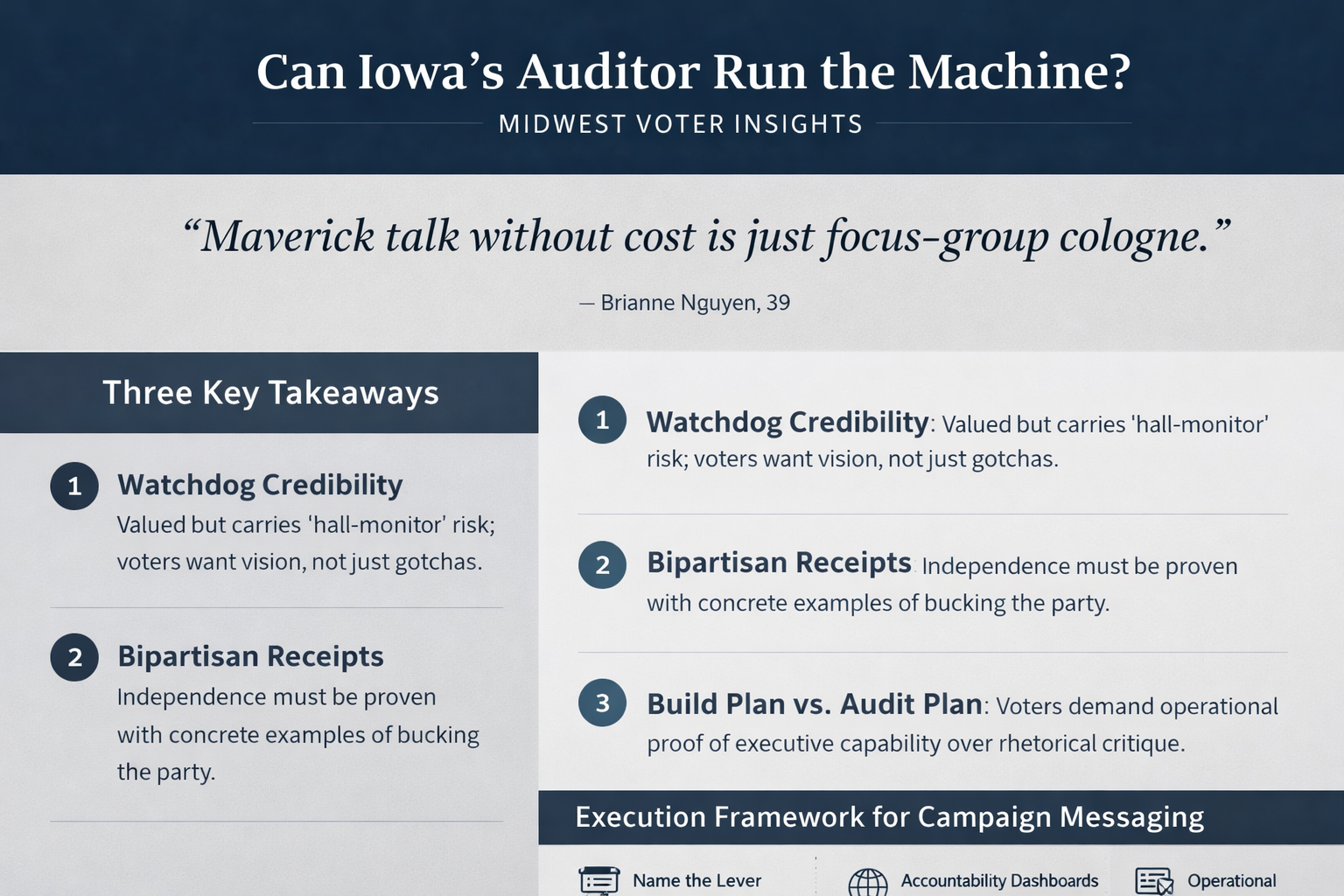
When I asked voters about their gut reaction to an auditor running for governor, the consensus was what I'd call a cautious thumbs up with an asterisk. The watchdog background carries genuine credibility, but it comes with a significant worry: can this person actually lead, or are they stuck in hall-monitor mode?
Christina, 55, from North Carolina put it perfectly: "I like an auditor in the arena, with a big asterisk. The watchdog, follow-the-money skill set helps if they can translate spreadsheets into kitchen-table English. It hurts if they slip into hall-monitor mode, all gotcha and no vision."
Brianne, 39, an industrial engineer from rural California, framed it in operational terms: "An auditor is basically a QC inspector. A governor is the plant manager. I want proof they can move product, set priorities, hit milestones, and still keep the books clean."
Key insight: The auditor background is a net positive for credibility and fiscal discipline. But it becomes a liability if the campaign is all receipts and no vision. Voters want someone who can run the machine, not just audit it.
Bipartisan Positioning: Show Me the Scars
Sand has been described as someone who stands up for what's right even when it goes against his own party. Does that resonate with voters? The answer is a qualified yes, but only if he can prove it cost him something.
One participant, Brianne, delivered what might be the quote of this entire study: "Maverick talk without cost is just focus-group cologne." Jaysus. That's going on a t-shirt.
John, 55, a compliance analyst from Kansas, was equally blunt: "Show me two or three concrete instances where he crossed his party, took heat, and stuck the landing with a clean outcome for taxpayers. If it's just press-release 'both sides' rhetoric, it reads as spin and brand-building."
Jessica, 39, from Philadelphia laid out what credibility looks like:
Concrete examples of when he actually bucked his party and what it cost him
Consistency across multiple issues, not cherry-picked one-offs
Spine plus priorities, not mushy both-sides-ism
Key insight: Bipartisan positioning appeals in theory, but voters are deeply sceptical of political theatre. Sand needs to name dates, decisions, and who was mad at him afterward. Abstract claims of independence land as spin.
What It Takes to Fire an Incumbent
This is where the research got genuinely surprising. When I asked what a challenger would need to say to make them consider voting against an incumbent, every single participant gave variations of the same answer: show me the build plan.
Rural healthcare and "standing up to special interests" are table stakes, not differentiators. Every candidate says that. What voters actually want is operational detail that feels real:
Name the special interests and the lever. Don't say 'stand up to powerful interests' and then waffle. Utilities? Hospital monopolies? Spell it out.
Publish KPIs and accept accountability. Quarterly dashboards on health access, infrastructure delivery, and cost of living. If you miss targets, explain why.
Fund it without gimmicks. Line-item the revenue and the tradeoffs. No magic beans or lottery fairy tales.
Name your operators. Who's your no-drama COO running health and infrastructure day to day?
Stephanie, 49, from rural California, summed it up: "If Sand wants my vote against an incumbent, he has to show he can run the machine, not just bark at it... Torque only matters under load. Show me you can keep the clinic lights on and the plows rolling when it hits the fan."
Key insight: Voters have heard 'rural healthcare' and 'fighting special interests' a thousand times. To break through, Sand needs operational specifics: names, dates, dollar amounts, and who gets squeezed. Vague promises trigger immediate tuneout.
What This Means for Rob Sand's Campaign
Based on this research, here's what the Sand campaign should be thinking about:
1. Lead with the build plan, not just the audit trail. The watchdog credibility is baked in. What voters are missing is evidence that Sand can actually govern. Lean into operational detail: who runs what, what metrics matter, what gets measured quarterly.
2. Make bipartisanship concrete. If Sand has crossed his own party and taken real heat for it, that story needs to be front and centre with names, dates, and consequences. Abstract claims of independence will be dismissed as spin.
3. Name the interests you're fighting. Hospital monopolies? Utility rate hikes? Specific lobbying carve-outs? Voters want to know exactly whose influence will diminish and how. "Special interests" as a vague enemy no longer cuts it.
4. Publish a public dashboard commitment. Multiple participants asked for quarterly KPIs they can track. This is a genuine differentiator if Sand commits to it early and often.
5. Don't rely on rural healthcare alone. It's table stakes. Pair it with specifics: which facilities, what timeline, what funding mechanism, what happens if it fails.
The Bottom Line
Rob Sand's auditor background is an asset, but it's not a slam dunk. Midwest voters are sophisticated enough to appreciate watchdog credibility while also demanding proof of executive capability. The pathway to victory runs through operational specifics, not rhetorical positioning.
As Christopher, 32, from Tampa put it: "Talk torque, not polish. If I can't see the bolts you plan to turn, with what wrench, and when, I'm not switching."
The question isn't whether Sand can find problems. He's proven that. The question is whether he can fix them at scale, under pressure, with receipts. That's what separates an auditor from a governor.
Want to test your own campaign messaging with synthetic voters? Ditto lets you run studies like this in hours, not weeks. Book a demo at askditto.io.
What the Research Revealed
We asked real consumers to share their thoughts. Here's what they told us:
What's your gut reaction to an auditor running for governor?
Christina Updyke, 55, Nonprofit Program Manager, High Point city, NC, USA:
Gut reaction? I like an auditor in the arena, with a big asterisk. The watchdog, follow-the-money skill set helps if they can translate spreadsheets into kitchen-table English and show where waste gets trimmed without nicking bone. It hurts if they slip into hall-monitor mode, all gotcha and no vision, because a governor has to build coalitions and say yes to something bigger than line items.
Brianne Nguyen, 39, Industrial Engineer, Rural, CA, USA:
Gut reaction? Cautious thumbs-up with an asterisk. From where I sit, running a line where QC and throughput wrestle every day, an auditor for governor can be either the best kind of adult in the room or a bean-counter who freezes progress. It depends if they know how to build, not just say no. An auditor is basically a QC inspector. A governor is the plant manager. I want proof they can move product, set priorities, hit milestones, and still keep the books clean.
John Quero, 55, Compliance Analyst, Topeka, KS, USA:
Gut reaction? Cautious yes. An auditor knows where the bodies are buried in a budget, and I respect anyone who can follow a dollar from appropriation to invoice without getting lost. But that mindset can slide into nitpicking and stall-outs. Governing needs a builder's spine, not just a referee's whistle.
Does bipartisan, principled positioning appeal to you, or does it sound like political spin?
Brianne Nguyen, 39, Industrial Engineer, Rural, CA, USA:
Short answer: it depends. My default is skeptical. I like spine, not branding. If someone crosses their own party for real, I want receipts. In my world, if you catch a defect, you own it and fix it. Same for politics. Maverick talk without cost is just focus-group cologne.
Christopher Garcia, 32, Senior Lineman, Tampa, FL, USA:
Gut check: it appeals if it's real, and it's spin if it's vibes. I've got time for someone who takes heat from their own side to call balls and strikes fairly. I've got zero patience for both-sides mush that dodges hard choices. In my world you don't both-sides a downed line, you fix it and own the call.
Jessica Gutierrez, 39, Project Manager, Philadelphia, PA, USA:
Short answer: it appeals if it is real. Otherwise it reads like spin. I respect adults who can call out their own side and defend fair play. That signals judgment over tribalism. But I need receipts, not vibes.
What would a challenger need to say to make you consider voting against an incumbent?
Stephanie Cezar, 49, Sales Manager, Rural, CA, USA:
Short version: talk is cheap. If Sand wants my vote against an incumbent, he has to show he can run the machine, not just bark at it. What a challenger needs to say: name the stakes, list the top 5 at-risk rural hospitals, the dollar gap for each, and a 24-month stabilization plan with metrics. Pick a fight that costs you. Which powerful interest are you crossing and how? Operational guarantees with telehealth parity by date X, ambulance coverage within Y minutes.
Brianne Nguyen, 39, Industrial Engineer, Rural, CA, USA:
Top issues for me in a governor's race are simple to say, hard to do. If you can't show me a build plan with targets and deadlines, I tune out. Name the special interests and the lever. Don't say 'stand up to powerful interests' and then waffle. Publish KPIs and accept accountability. Fund it without gimmicks. Bottom line: I'll consider dumping an incumbent if a challenger brings a concrete, costed plan that improves rural care, reliability, and job quality with transparent metrics. Spare me the slogans. Show me the throughput, the bottlenecks, the constraints, and the schedule.
Christina Updyke, 55, Nonprofit Program Manager, High Point city, NC, USA:
I'm not in Iowa, but my list travels. In a governor's race, I care most about things that keep families steady: keeping clinics open in rural counties, mental health care that isn't a six-month wait, schools that can recruit good people, childcare that doesn't eat a paycheck. What would make me consider firing an incumbent? Name names. Show your math. Concrete fixes I can repeat. If Sand can do that with examples, costs, and a little human warmth, I'm persuadable. If it's just 'standing up to special interests' without specifics, I'll stick with the devil I know.
About This Study
This research was conducted using Ditto's synthetic market research platform. Six synthetic personas participated, representing Midwest voters aged 32-55 with diverse occupations and political leanings. Participants answered three open-ended questions about candidate perception, bipartisan positioning, and challenger messaging requirements.
View the full research study: Rob Sand Iowa Governor Race - Midwest Voter Perception