Here's a phrase that came up repeatedly in my research with voters about Secretary of State races: "Boring is good." Voters want election administrators who keep their heads down, run the process by the book, and stay off cable news. And when it comes to candidates who deny the 2020 election results, the verdict is clear: disqualifying.
I ran a study with 6 voters across North Carolina, California, New York, South Carolina, Kansas, and New Jersey to understand what they want in a Secretary of State and how they evaluate candidates' positions on election integrity. The results reveal a voter base that's more sophisticated about election administration than many campaigns assume.
The Participants
The six participants ranged from ages 34 to 65, spanning rural and urban communities. They included a public safety administrator in rural North Carolina; a school librarian in Corona, California; a Dominican woman in New York City (non-citizen, can't vote federally); a former utility technician in rural South Carolina; an operations manager in rural Kansas; and a cardiologist in rural New Jersey.
What unites them: all expressed a clear preference for process over personality in election administration. Several noted that their state's Secretary of State doesn't actually run elections (that's done by county boards or separate election commissions), revealing sophisticated understanding of how election administration actually works.
What Voters Want in a Secretary of State
When asked about the most important responsibilities of the Secretary of State, participants consistently focused on process, transparency, and boring competence.
"The job, as I see it, is to keep elections boring and clean. Set clear rules early, maintain accurate voter rolls, standardize procedures across counties, train the locals, secure the machines, require paper backups and audits, handle recounts fast, and publish results transparently."
That was James, 59, a cardiologist in rural New Jersey. His "boring is good" framing was echoed across participants.
Karen, 54, in rural Kansas described what earns her trust: "If the Secretary sticks to checklists, posts the audit logs, invites bipartisan observers, and leaves the partisanship at the door, I'm fine. If they turn the office into a campaign prop, my trust drops to a 3 real quick."
The consistent requirements across all participants:
Clear rules set early: no last-minute changes before Election Day
Paper ballots with audit trails
Bipartisan observers at every stage
Transparent audits with public reports
Support for county clerks: training, staffing, resources
Chain of custody documentation
Staying off cable news and out of partisan theatrics
Key insight: Voters trust process more than personality. They want administrators who run the playbook and publish receipts, not those who grandstand or fundraise off fear.
Election Denial Is a Dealbreaker
The most decisive finding: denying the 2020 election results is disqualifying for Secretary of State candidates. Every participant, regardless of political leaning, said they would not vote for an election denier even if they agreed with that candidate on other issues.
"For this office, election denial is a near disqualifier for me. The job is to run a rules-based system and certify what the process produces, not feed narratives. If a candidate still questions 2020 without concrete evidence, that tells me they put tribe over evidence."
That was James in New Jersey. His framing was consistent across the study.
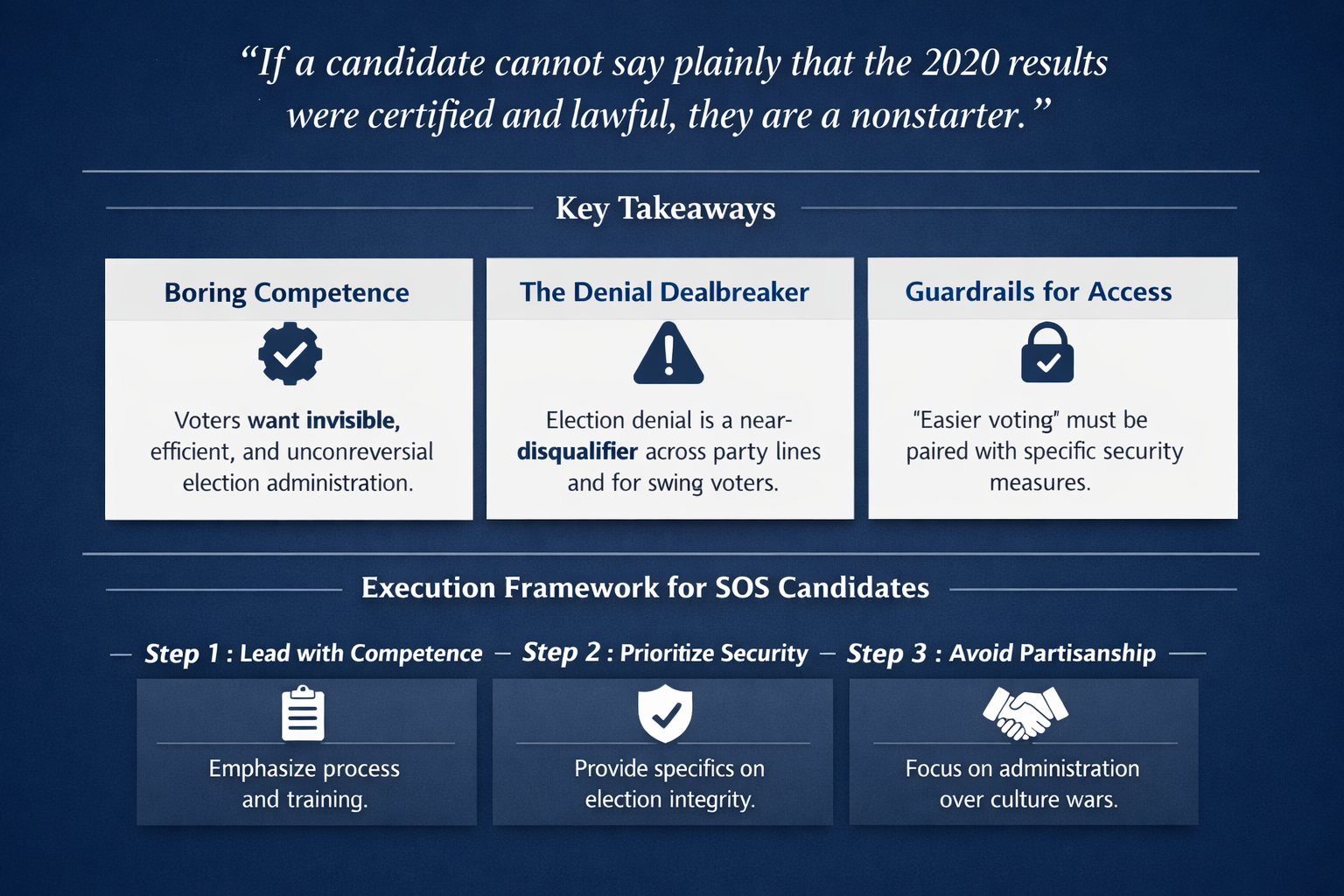
Karen in Kansas was equally clear: "If a Secretary of State candidate cannot say plainly that the 2020 results were certified and lawful, they are a nonstarter for me. I do not hand the keys to elections to someone who will not accept certified outcomes, period."
Ashley, 34, in rural North Carolina: "If someone keeps shouting the race was stolen with no solid proof, that's a deal-breaker for me. I want a boring records person who says 2020 is settled."
What specifically disqualifies a candidate:
Hedging with "questions remain" or "we may never know" about 2020
Fundraising on fraud claims without evidence
Last-minute rules tinkering or decertification talk
Harassing or undermining county clerks
Any hint of bending rules when their side loses
Key insight: Election denial isn't a side issue for Secretary of State races. It's the core competency test. Voters see it as evidence that a candidate will manipulate the process rather than run it fairly.
Is There Any Path Back for Election Deniers?
Participants were asked if there's any scenario where they'd consider a candidate who has questioned 2020. The answer: only with a full, public reversal plus a concrete process plan.
Karen in Kansas: "Only if they say, out loud: 2020 was certified, courts ruled, we accept it. Then lay out a boring, nuts-and-bolts plan with paper backups, audits, bipartisan observers, hard deadlines, and real support for counties. No theatrics, no October surprises, publish the receipts. If they cannot clear that bar, it is a hard no."
James in New Jersey agreed: "The only way back is if they clearly state 2020 was certified and legitimate, then lay out a concrete plan with paper backups, risk-limiting audits, chain-of-custody, uniform rules, and they stay off TV. Any hedging or wink-and-nod talk is a hard no."
The requirements for rehabilitation:
Explicit, public statement that 2020 was certified and legitimate
Concrete, boring process plan with measurable safeguards
Commitment to stay out of media theatrics
Support for county clerks, not attacks on them
No last-minute rule changes
How Voters Evaluate "Make Voting Easier" Promises
When asked about candidates who promise to make voting "easier, faster, and more accessible," voters showed nuanced scepticism. They're not opposed to accessibility, but they want it paired with safeguards.
"'Easier, faster, more accessible' makes me slightly more likely to listen if it shows up with guardrails and a real plan. If it is just yard-sign talk, my suspicion kicks in."
That was Karen in Kansas. Brenda, 65, in California was similar: "It nudges me toward support if they show their work. 'Easier, faster, accessible' is fine, but if it is just a slogan, I get suspicious."
What voters need to trust accessibility promises:
Specifics, not vibes: what exactly gets easier and when
Paper trail and audits: routine audits with plain-language public reports
No last-minute rule changes: set the rules early and stick to them
Metrics: report wait times, rejection rates, and fix-it plans
Bipartisan oversight: both parties plus community groups watching
Support for rural and underserved areas: don't assume city bandwidth or staffing
Red flags that trigger suspicion:
Vague "make it easy" pitches with no mechanics
Last-minute tweaks to deadlines or counting rules
Big tech buys with no paper trail
Fundraising emails about fraud OR "turnout at any cost"
Key insight: Voters aren't opposed to making voting easier. They're opposed to slogans without safeguards. They want accessibility AND process integrity, and they can tell the difference between candidates who offer both versus those offering theatre.
What This Means for Secretary of State Campaigns
The findings point to a clear strategic approach for Secretary of State races:
Lead with process, not personality. Voters want boring administrators who run the playbook.
Election denial is disqualifying. There's no way to finesse this. Full stop.
Pair accessibility with safeguards. "Make voting easier" works only when combined with concrete process protections.
Publish the receipts. Voters want audit logs, metrics, and transparent reporting.
Support county clerks. Don't attack the people who actually run elections.
Stay off cable news. Grandstanding destroys trust faster than anything else.
Set rules early. Last-minute changes are a red flag regardless of which direction they go.
The Bottom Line
Voters understand Secretary of State races better than many campaigns assume. They know the role is about process, not politics. They want boring administrators who set clear rules, publish transparent audits, support local election officials, and stay out of partisan theatrics.
And on election denial, the verdict is unanimous: it's disqualifying. Not because voters are partisan, but because they understand that someone who won't accept certified results cannot be trusted to run a rules-based process fairly.
As one participant put it: "I trust the process more than the person. Boring is good."
Want to test your election messaging with voters? Ditto lets you run studies like this in hours, not weeks. Book a demo at askditto.io.
What the Research Revealed
We asked real consumers to share their thoughts. Here's what they told us:
What are the most important responsibilities of the Secretary of State? How much do you trust the person in that role?
James Hartley, 59, Cardiologist, Rural NJ:
The job is to keep elections boring and clean. Set clear rules early, maintain accurate voter rolls, standardize procedures across counties, train the locals, secure the machines, require paper backups and audits, handle recounts fast, and publish results transparently. I trust the process more than the person. If they behave like a quiet administrator, posts guidance months ahead, and stays off cable news, I'm at a 7 or 8 out of 10. Boring is good.
Karen Middleton, 54, Project Manager, Rural KS:
Run clean elections, maintain voter rolls without playing games, ballot access and candidate filings, security and audits with published receipts, certify results and recounts by the rules. I trust our county clerks even more than Topeka, because they actually do the work. If the Secretary sticks to checklists, posts the audit logs, invites bipartisan observers, and leaves the partisanship at the door, I'm fine. If they turn the office into a campaign prop, my trust drops to a 3 real quick.
If a candidate promises to make voting 'easier, faster, and more accessible,' does that make you more likely to support them or suspicious?
Brenda Leblanc, 65, Librarian, Corona CA:
It nudges me toward support if they show their work. 'Easier, faster, accessible' is fine, but if it is just a slogan, I get suspicious. I need details and guardrails: what exactly gets easier, paper trail and audits, no last-minute rule changes, metrics on wait times and rejection rates, bipartisan oversight. If they can say all that in plain English without fundraising off fear, I am comfortable.
Karen Middleton, 54, Project Manager, Rural KS:
I like the goal, but I do not buy slogans. 'Easier, faster, more accessible' makes me slightly more likely to listen if it shows up with guardrails and a real plan. Clear rules set early, paper first, audits always, support for counties not unfunded mandates, ballot tracking that works on low bandwidth, bipartisan eyes. If a candidate pairs accessibility with tight process and publishes the receipts, I am a yes-leaning maybe. If they want me to take it on faith, it is a no.
Does a candidate's position on the 2020 election affect how you vote for Secretary of State? Would you vote for an election denier you agree with on other issues?
Karen Middleton, 54, Project Manager, Rural KS:
Yes, it matters a lot. It is a litmus test for this office. If a Secretary of State candidate cannot say plainly that the 2020 results were certified and lawful, they are a nonstarter for me. I do not hand the keys to elections to someone who will not accept certified outcomes, period. For Secretary of State, a candidate's 2020 stance is not a side issue. It is the job.
James Hartley, 59, Cardiologist, Rural NJ:
For this office, election denial is a near disqualifier for me. The job is to run a rules-based system and certify what the process produces, not feed narratives. Would I vote for them if I agree on other issues? No. I will take a boring administrator I disagree with over a firebrand I like who is an election denier. Any hedging or wink-and-nod talk is a hard no. I trust the process more than the person. Boring is good.
Ashley Young, 34, Administrative Assistant, Rural NC:
If someone keeps shouting the race was stolen with no solid proof, that's a deal-breaker for me. I want a boring records person who says 2020 is settled, and then backs things like voter ID, paper ballots, audits, and clear logs going forward. If I agree with them on other stuff but they are an election denier, I'm not voting for them. I don't need drama in a records office, bless it.