There's a consulting class debate that never ends: should Democratic candidates in competitive suburban districts move left to energise the base, or stay moderate to win swing voters? I've sat through this argument at least a dozen times in various strategy meetings, and honestly, it always feels like the wrong question.
I ran a study with 6 suburban voters across Pennsylvania, Arizona, Oklahoma, Massachusetts, California, and South Carolina to find out what they actually want. These are people in competitive districts: the kind that swing elections, the kind campaigns obsess over. And their answers reveal something campaigns often miss: suburban voters don't think in ideological terms. They think in deliverables.
The unanimous answer to the move-left-versus-stay-moderate debate? Stay moderate, but with a very specific definition of what "moderate" means.
The Participants
The six participants ranged from ages 31 to 50, spread across competitive suburban districts. They included a facilities manager at a charter school in Rock Hill, South Carolina; a remote enterprise account manager in rural Pennsylvania; a healthcare operations manager in Oklahoma City; a hospital logistics coordinator in East Boston; a bilingual auto sales specialist in Visalia, California; and a data analyst in Scottsdale, Arizona.
What unites them: all live in or near swing districts. Several are non-citizens who can't vote federally but are deeply engaged in local politics and influence their households. All expressed frustration with political theatrics and a hunger for competent, measurable governance.
The Consensus: Stay Moderate, Show Receipts
When asked whether a moderate Democrat should move left to energise the base or stay centrist to win swing voters, all six said stay moderate. But their definition of "moderate" was more sophisticated than the consultant debate suggests.
"Gut check: in the PHX-Scottsdale burbs, lurching left to juice the base backfires. Stay moderate with receipts, plant a firm flag on democratic norms and basic rights, and do the boring ops that make life cheaper and calmer. Energise the base by delivering, not by chasing slogans."
That was Travis, 31, in Scottsdale. His framing captures what all six articulated: moderation isn't about splitting the difference on every issue. It's about prioritising competence over ideology, delivery over posturing, and receipts over vibes.
Jerome, 50, in East Boston described it as "centre-left with a spine": "Not a lurch left, not mushy middle. Speak plainly, protect core rights, and deliver tangible fixes that people can touch."
Key insight: Suburban voters don't reject progressive outcomes. They reject progressive posturing. They want left-of-centre results delivered through moderate tone and measurable accountability.
What Suburban Voters Actually Care About in 2026
When asked to rank what matters most, every participant put cost of living at or near the top. After that, the priorities clustered consistently:
Cost of living: groceries, insurance, property taxes, utilities, childcare
Schools: teacher retention, basic functionality, zero culture-war drama
Public safety: car theft, fentanyl, retail theft, with accountability and treatment
Healthcare: premiums, networks, mental health access, reproductive rights
Housing: starter homes, middle housing, faster permits
Infrastructure: roads, broadband, stormwater, reliable power
Raven, 31, in Pennsylvania was explicit: "Suburban voters want normal, affordable, safe. Not vibes. Deliverables."
Justin, 35, in Oklahoma City broke it down like an operations problem: "If the monthly nut keeps creeping, nothing else matters... I will cross the aisle for a boring adult with receipts who treats governance like an operations job."
Key insight: The issues suburban voters care about aren't ideological. They're operational. They want someone who can lower their monthly burn rate and keep schools functional, not someone who can win arguments on cable news.
What Would Make Them Cross Party Lines
One of the most revealing questions was whether they'd vote for a candidate who disagrees with them on some issues if that candidate is competent and honest. All six said yes, with specific conditions.
The recurring requirements for earning a cross-party vote:
Published metrics and dashboards, not just promises
Quarterly reporting on constituent service and outcomes
Budget honesty with clear pay-fors
Willingness to buck their own party when it matters
Reproductive rights protection without hedging
Election integrity and acceptance of results
No culture-war theatre or cable-news auditions
"I'll cross for a boring workhorse with measurable wins who lowers my monthly burn and keeps Maya's school boring-in-the-best-way. If it's just vibes and tribal jerseys, hard pass."
That was Raven again. The phrase "boring workhorse" came up repeatedly. These voters aren't looking for inspiration. They're looking for results.
Key insight: Suburban voters are ideologically flexible but operationally demanding. They'll tolerate disagreement on some issues for a candidate who delivers measurable results and demonstrates independence from party leadership.
How Voters View House-to-Senate Transitions
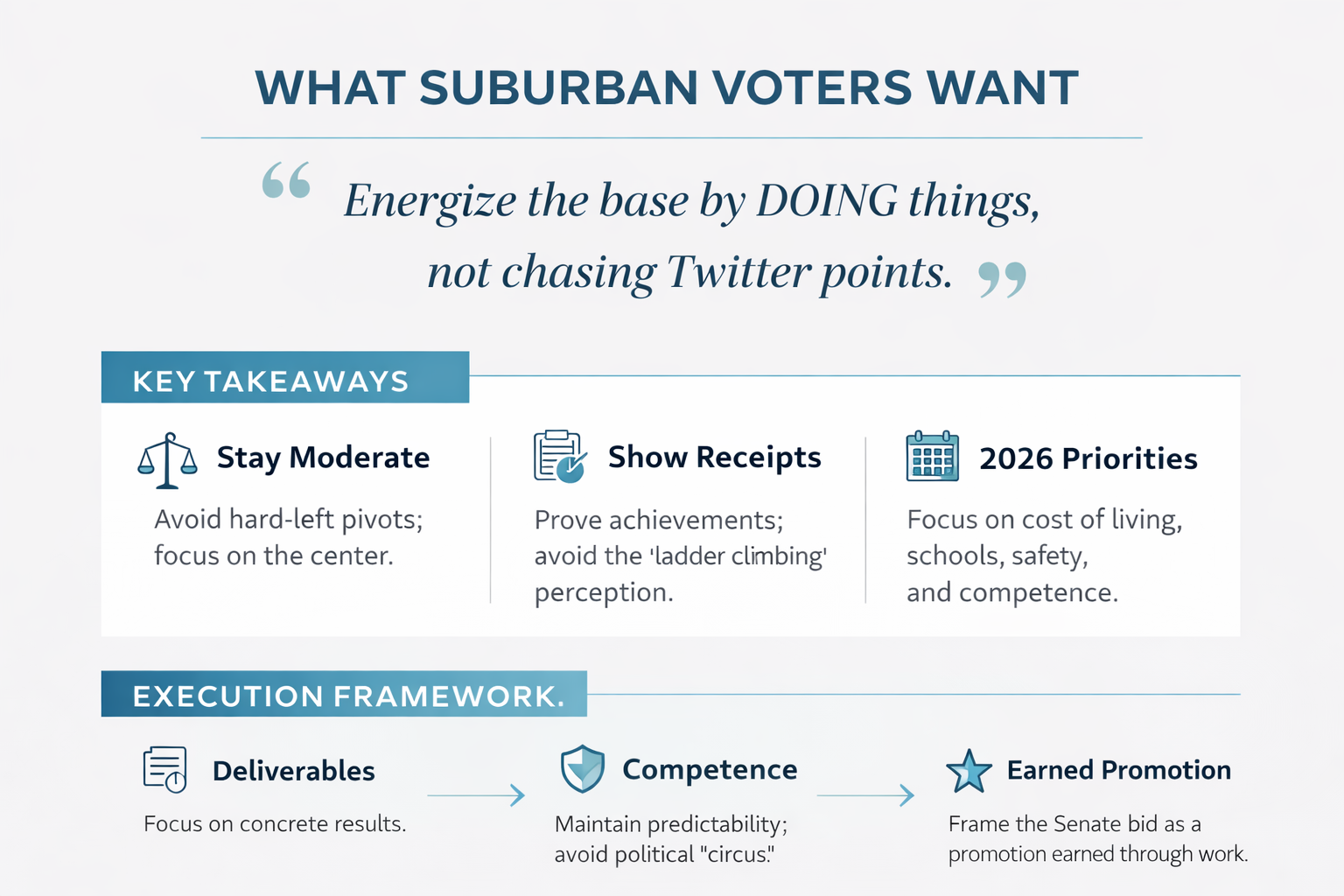
The study also tested reactions to House members running for Senate. The gut reaction across all six participants: eye roll. They see it as ladder-climbing unless there are receipts.
"Feels like ladder climbing unless they can prove they finished the job they started. Maybe I'm jaded, pero la neta, I want receipts, not a promo tour."
Jaime, 47, in Visalia captured the sentiment. Justin in Oklahoma was more detailed: "Most of the time it reads as, 'I topped out in the House, I want a bigger microphone.' I don't hate ambition, but I want receipts, not a rebrand."
What would change their mind about a House-to-Senate transition:
Serious committee work that moved legislation, not just cable hits
Tough votes with clear explanations, including bucking their party
Coalition-building that actually landed bills
Strong constituent service record with measurable results
Several said they'd often prefer someone with executive experience: a governor, mayor, attorney general, or even a union leader who's managed budgets and crises. The Senate requires different skills than the House, and voters recognise that.
Key insight: House experience is neutral to slightly negative in voters' minds. It helps only if there's a demonstrable record of legislative accomplishment and coalition-building. Voters prefer executive experience or serious policy expertise over a long House tenure.
What This Means for Democratic Campaigns
The findings point to a clear strategic approach for competitive suburban districts:
Lead with deliverables, not ideology. Talk about monthly bills, not political philosophy.
Publish metrics. Voters want KPIs, dashboards, quarterly reports. Treat governance like an operations job.
Protect core rights clearly. Reproductive rights and election integrity are non-negotiable. Don't hedge.
Avoid culture-war theatre. School board drama, book bans, and performative fights actively repel these voters.
Show independence. Name specific issues where you'd buck your own party. Voters reward spine over loyalty.
Feature local specificity. District-level impacts, county-level numbers, local messengers.
Lower the volume. "Boring competence" and "calm tone" came up repeatedly. Theatrics signal untrustworthiness.
The deeper insight: these voters aren't centrists in the ideological sense. They're pragmatists who want left-of-centre outcomes delivered through competent, accountable governance. "Stay moderate" means stay focused on results, not stay in the ideological middle.
The Bottom Line
Suburban voters aren't asking candidates to abandon progressive values. They're asking candidates to deliver those values through competent execution rather than ideological posturing. They want lower bills, functional schools, safe neighbourhoods, and accessible healthcare. They want candidates who show their work, publish their results, and admit when they miss targets.
As one participant put it: "Trade me 20 percent ideological purity for 90 percent fewer headaches and a plowed road by 7 a.m., and I'm in."
That's the suburban voter mandate: stay moderate in tone, deliver progressive outcomes, and show receipts.
Want to test your campaign messaging with suburban swing voters? Ditto lets you run studies like this in hours, not weeks. Book a demo at askditto.io.
What the Research Revealed
We asked real consumers to share their thoughts. Here's what they told us:
When a House Representative announces they're running for Senate, what is your gut reaction?
Michael Salcido, 40, Facilities Manager, Rock Hill SC:
Gut reaction? Eye roll. Feels like ladder climbing unless they've put in real work for their district. House experience only helps if it's the right kind - committee grind over cable hits, actual funding wins, tough votes, and staff that answers phones.
Justin Slabinski, 35, Data Analyst, Oklahoma City OK:
Gut reaction? Skeptical. Feels like a ladder move. Most of the time it reads as, 'I topped out in the House, I want a bigger microphone.' I don't hate ambition, but I want receipts, not a rebrand.
Jerome Shen, 50, Logistics Coordinator, Boston MA:
Gut reaction? Eye roll. Feels like career ladder stuff - upgrade the office, new stationery, same speeches. If a Representative has been doing real committee work, building coalitions, and actually landing bills - not just doing cable hits and fundraising laps - fine.
What issues do you think suburban voters care about most in 2026?
Raven Sanchez, 31, Sales Manager, Harrisburg PA:
Short answer: cost of living, schools that run without drama, and safety you actually feel in the parking lot and on the highway. It's face-numbing cold and I have zero patience for culture-war cosplay - suburban voters are pricing out groceries and aftercare and just want competent basics delivered on time.
Travis Vaquero, 31, Analytics Engineer, Scottsdale AZ:
Short answer: suburban voters want normal, affordable, safe. Not vibes. Deliverables. My read for 2026: cost of living, housing supply, schools without circus, public safety, healthcare costs, infrastructure that works, privacy and fraud protection.
Jaime Tejada, 47, Sales Manager, Visalia CA:
Gut check: it's the monthly nut. Groceries, mortgage or rent, insurance, car payment, daycare. After that, keep schools steady, keep neighborhoods calm, and keep healthcare from blind-siding the budget.
Should a moderate Democrat move left to energise the base, or stay moderate?
Michael Salcido, 40, Facilities Manager, Rock Hill SC:
Short answer: in my area, stay moderate, deliver left-of-center results. Keep it boring and competent. Energize the base by doing things, not chasing Twitter points. It's freezing here and every pothole and power flicker is louder than any slogan.
Jerome Shen, 50, Logistics Coordinator, Boston MA:
Gut reaction to that consultant fight? Eye roll. In my corner of Massachusetts, what works is center-left with a spine. Not a lurch left, not mushy middle. Speak plainly, protect core rights, and deliver tangible fixes that people can touch.
Justin Slabinski, 35, Data Analyst, Oklahoma City OK:
Short answer: stay moderate and run on competence. In my neck of the woods, hard-left pivots play great on Twitter and crater in the suburbs. If you want base energy, earn it with visible wins on cost of living, schools, and safety - not ideological chest thumping.