In 2024, North Carolina voters elected a Democratic governor while simultaneously voting for Donald Trump for president. This wasn't a fluke or an accident. It was deliberate ticket-splitting by voters who saw the two offices as fundamentally different jobs requiring different kinds of candidates.
I ran a study with 6 voters across Minnesota, Colorado, California, Oregon, and Ohio to understand why voters split tickets and what it means for Democratic strategy in 2026. The answers reveal a clear framework for how swing-state Democrats can win even when the national brand is underwater.
The Participants
The six participants ranged from ages 39 to 63, spanning urban, suburban, and rural communities. They included a disabled former line cook in Duluth, Minnesota; an administrative assistant in Denver; an unemployed permanent resident in San Diego; a nail salon manager in Gresham, Oregon; a divorced caregiver on disability in Akron, Ohio; and a stay-at-home mother of three in rural Oregon.
What unites them: all live in competitive or traditionally Republican-leaning areas. Several are non-citizens who can't vote federally but are deeply engaged in state and local politics. All expressed frustration with national political theatrics and a hunger for competent, measurable governance at the state level.
Why Voters Split Their Tickets
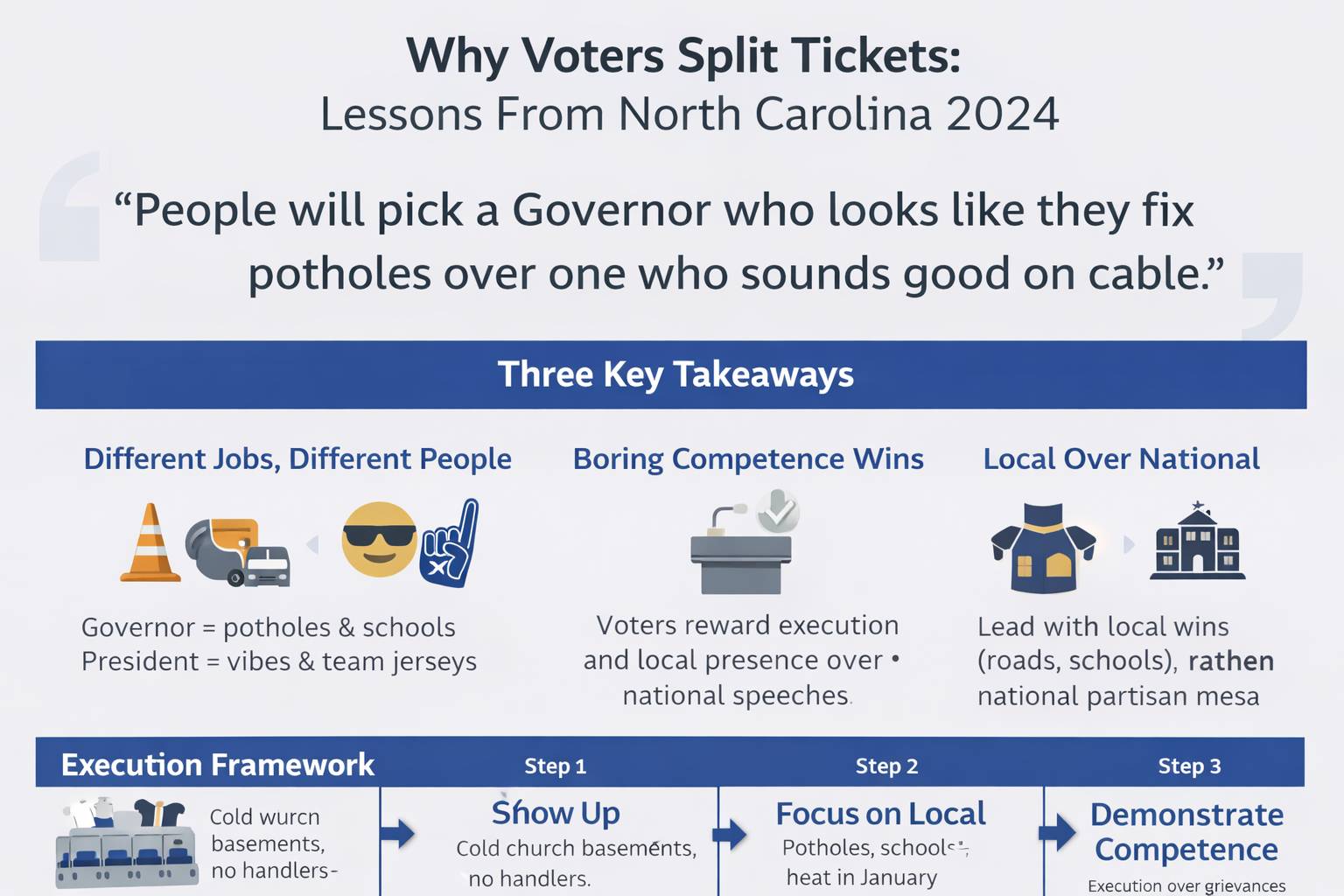
When asked to explain North Carolina's split result, all six participants offered the same core insight: voters see the governor's race and the presidential race as completely different jobs.
"People split tickets when one race feels like customer service and the other feels like a TV food fight. Governor is potholes, schools, storms, insurance, permits. President is vibes and team jerseys."
That was John, 63, in Denver. The framing was consistent across all participants: the president is about national mood, team identity, and culture-war signalling. The governor is about whether the roads get plowed, the schools function, and the power stays on.
Patricia, 42, in Oregon put it memorably: "People can love a red jersey for president and still hire a blue manager for the state house. Different jobs, different stakes. When the power goes out or roads ice up, you want a boring operator, not a brand."
The reasons voters split tickets, as articulated across the study:
Different jobs, different risks: President sets national mood; governor fixes roads, schools, and utilities
Candidate quality matters more at state level: calm problem-solver beats loud culture warrior
Check-and-balance instinct: some voters like a governor who can counterbalance the president
Pocketbook focus: kitchen-table issues dominate state races in a way they don't for president
Local respect: candidates who show up without donor caravans earn trust
Key insight: Voters don't think of ticket-splitting as disloyal or inconsistent. They think of it as hiring the right person for each job. The presidential race is tribal; the governor's race is operational.
What Democrats Must Do Differently in Swing States
The second major question explored what a Democratic candidate needs to do differently from the national party brand to win a swing state. The answers formed a remarkably consistent playbook.
De-nationalise the Pitch
Every participant said the same thing: drop the DC talking points and lead with local basics.
"Cut the D.C. script. Talk local basics in plain English: roads, power grid, insurance rates, school buses, lunch debt."
Billy, 39, in Duluth was blunt about what works. John in Denver expanded: "Run local, not national. Talk permits, DMV wait times, paving schedules, utility bills. Show the map, show the phone number, show your hours."
Cost of Living First
Across all six participants, cost of living was the top priority. Not abstractions about "the economy" but specific, measurable costs: groceries, utilities, insurance, fees, childcare.
Adriana, 44, in rural Oregon: "If a policy raises my heat bill, say it out loud and vote no. If my monthly nut creeps up, I notice."
The ask is for specificity: "Crack down on junk fees, towing traps, surprise add-ons on power and internet. Hit car and home insurance hard so people are not priced out."
Public Safety with a Spine and a Plan
Every participant wanted public safety addressed, but with a specific framing: back cops AND demand accountability; enforcement AND treatment. The "both-and" framing appeared repeatedly.
Elizabeth, 40, in Akron: "Safety and care together. Back cops and expand mental health beds. Both, not either-or."
Patricia in Oregon wanted metrics: "Treatment capacity up, repeat violent offenders targeted, cops trained and accountable. Both-and, not Twitter bait."
Show Up Everywhere
A consistent demand: candidates must be physically present in small towns, rural areas, and overlooked communities, without donor caravans or media circuses.
"VFW halls, Black churches, farm auctions, PTA nights. No fancy stage. Take questions without handlers."
Billy in Duluth added: "Outstate respect. Duluth, Range, Brainerd too. Not just St. Paul photo ops."
Adriana in rural Oregon was explicit: "Show up in small counties without donors, listen to mill workers and ranchers, and take hard questions. One unvarnished town hall beats five polished speeches."
Weekly Dashboards, Not Press Conferences
Multiple participants asked for regular, measurable accountability: weekly updates on what got done, what slipped, and what's next.
John in Denver: "Weekly plain-language updates: what got fixed, what slipped, what's next. Skip the culture-war fluff."
Patricia in Oregon: "A simple weekly dashboard with goals, not glossy PDFs. Tell me what got done, what slipped, and why."
The Complete Swing-State Playbook
Synthesising the responses across all six participants, here's the playbook for a Democrat to win a swing state:
Lead with bills, not buzzwords. Talk gas, power, groceries, fees. Promise no new fees year one, show where you'll cut waste.
Public safety with a spine. Support officers, insist on body cams, clear rules, and real consequences for repeat offenders. No hedging.
Parents and basics in schools. Reading, math, shop, apprenticeships. Transparency without the smug. Less pep rally, more results.
Respect rural life. Show up early and often, not just October. Do not sneer at wood stoves, older pickups, or hunting season.
Jobs you can touch. Trades, ag, small manufacturing. Real pipelines to real paychecks, not consultant decks.
Permits that move. Set clocks on agencies. If the state blows the deadline, the fee drops. Make agencies feel the same pain voters do.
Energy sanity. Reliability first. Weather the winter without blackouts, then talk goals. No guilt trips for keeping the lights on.
Distance from national theatrics. Skip the activist lingo, skip the celebrity surrogates. Stand next to a shop foreman, not a hashtag.
Cultural moderation. Do not treat faith, guns used responsibly, or traditional norms like a punchline. Respect goes a long way.
The Bottom Line
North Carolina voters split their tickets because they understood something campaigns often miss: different offices require different qualifications. The president is a national tribal leader. The governor is a state operations manager.
Democrats can win swing states even when the national brand is underwater, but only by running as competent local operators rather than national culture warriors. The playbook is clear: de-nationalise the pitch, lead with cost of living, show up everywhere, demand accountability with weekly dashboards, and treat voters like stakeholders, not audiences.
As one participant put it: "Voters hired a governor to manage their state, not perform ideology. If a Democrat looks like a competent, boring fixer who keeps costs steady and streets orderly, they can win even while the state goes red for president."
Want to test your campaign messaging with swing-state voters? Ditto lets you run studies like this in hours, not weeks. Book a demo at askditto.io.
What the Research Revealed
We asked real consumers to share their thoughts. Here's what they told us:
When a new Governor takes office, what are the first things you watch?
Billy Smith, 39, Unemployed Adult, Duluth MN:
Right now it is brutal cold, so if I-35 and the side streets get cleared by sunrise and the buses keep rolling, that tells me they mean business. If it is just a slick logo and a podium tour, I roll my eyes. Snow and roads: Plows out fast. Heat and groceries: Energy help simple and quick. No sweetheart deals: No stadium shin-digs while bridges crumble.
Patricia Thompson, 42, Office Manager, Gresham OR:
I watch for boring competence, not speeches. Hires: Who runs Housing, OHA, ODOT, BOLI. If they pick steady operators instead of donors-in-suits, good sign. First budget: Do dollars move to addiction treatment, housing production, and CTE at community colleges, or is it all fluff and task forces. Licensing speed: If the cosmetology and instructor license backlog gets cleared, I notice.
Elizabeth Switzer, 40, Volunteer Caregiver, Akron OH:
I watch the boring, daily stuff I can feel in my life. Plows, salt, potholes. Benefits and Medicaid hoops: fewer forms, fewer prior auth fights, phones answered. No surprise fees: Quit sneaking in little charges on registrations, utilities, or rent apps. If my bus shows up on time, I notice.
What qualities are you looking for in a Senator?
John Cruz, 63, Administrative Assistant, Denver CO:
I want a Senator who treats the job like fixing a stubborn sink, not chasing microphones. Plain talk and everywhere presence - show up in Denver, Pueblo, the plains, take raw questions. Constituent service first - staff that answers phones and fixes SSA, VA, IRS messes. No sweetheart deals - tie incentives to wages and results, claw it back if they don't deliver.
Adriana Williams, 44, Stay-at-Home Parent, Rural OR:
I want a workhorse, not a cable-news peacock. Kitchen-table focus: fights anything that hikes gas, propane, groceries, or power. Rural presence, not photo ops: show up in counties like mine without donors or a camera crew. Law and order with a spine: back good officers and agents, demand body cams and clear rules.
Why did voters split tickets in North Carolina, electing a Democratic governor while voting Trump for president?
Patricia Thompson, 42, Office Manager, Gresham OR:
Short take: People can love a red jersey for president and still hire a blue manager for the state house. Different jobs, different stakes. When the power goes out or roads ice up, you want a boring operator, not a brand. Governor = services, not sermons. Voters judge schools, roads, hospitals, storm response. If the Dem looked like a competent fixer and the GOP felt more culture-war, that is an easy split.
Adriana Williams, 44, Stay-at-Home Parent, Rural OR:
People used the top of the ticket to send a national message and the governor spot to hire a competent shop foreman. Different jobs, different votes. If a Democrat looks like a normal, steady manager who respects cops, parents, and paychecks, swing voters will split. If they sound like Twitter, they lose the driveway.
John Cruz, 63, Administrative Assistant, Denver CO:
People split tickets when one race feels like customer service and the other feels like a TV food fight. Governor is potholes, schools, storms, insurance, permits. President is vibes and team jerseys. If the Democrat for governor looks steady and local while Trump is doing his own channel, folks punch both and sleep fine.